Stream a simulated run, inspect the notifications it would send on Slack and email, and see exactly where it sits in the 7-stage PM OS flow. No password required.
The short version
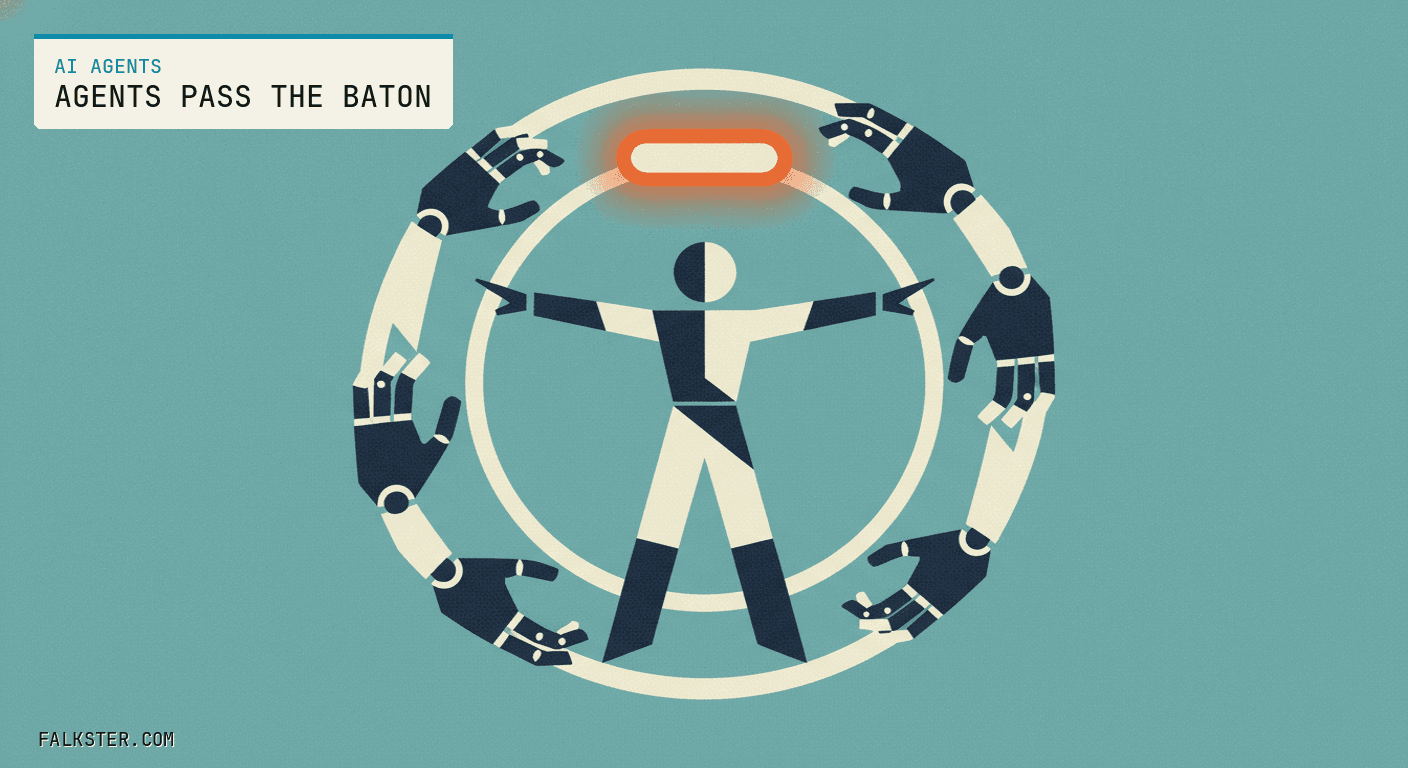
The entire market is selling single AI agents to product managers: an agent that writes the PRD, an agent that summarizes research, an agent that drafts the update. That is the easy, demo-friendly part, and it is not where the value is. The value is in the layer nobody is building, where agents hand work to other agents with no human relaying context in between. A listening agent detects an outcome, routes a structured brief to a build agent, a research agent, and a comms agent, and the PM sits above it as the dispatcher who sets policy and owns the quality gates, not the relay who carries messages between tools. The companies that win will not have the most agents. They will have agents that talk to each other. Here is the architecture, and why your org chart is the thing that has to change.
Look at what is being sold to PMs right now. An agent for PRDs. An agent for competitive intel. An agent for release notes. Every one is a single tool that waits for you to prompt it, does its one job, and hands the result back to you.
Notice who carries the result to the next step. You do. You are the integration layer. You copy the research agent's output into the PRD agent, copy that into the comms agent, and ferry context between tools all day. We automated the tasks and left the human doing the worst job in the building: relay.
The relay is the role we are not killing
This is the part the agent gold rush keeps missing. The bottleneck in a modern product org was never writing the doc. It was the coordination between the people who write the docs, run the research, build the thing, and tell the story. That coordination is what a PM spends most of the day on, and it is exactly what single agents leave untouched.
I argued in PM as a Team of AI Agents that the job dissolves into a fleet. Here is the structural claim underneath that: a fleet of agents that cannot talk to each other is not a fleet. It is a toolbox, and you are still the one walking between the tools.
We automated the tasks and left the human doing the worst job in the building. The PM became the relay between agents that should be talking to each other directly.
What dispatch actually looks like
Agent-to-agent dispatch is three layers, and only the middle one is interesting.
The sensing layer is the listening agents that watch customer signals, usage, support, prompt logs, and extract a concrete outcome: this segment is failing at this job, with this evidence.
The routing layer is the part the market refuses to build, because it is invisible and specific to how your team works. It takes the structured outcome and decides what happens next. Does this trigger a build agent to prototype? A research agent to validate? A comms agent to draft the change? Often all three, in parallel, with the output of one feeding the next. No human in the middle.
The execution layer is the specialist agents doing the actual work, the ones everyone is already selling.
The tools are the easy part. The routing is the product. Owning five power tools does not make you a factory. The assembly line, the thing that moves work between stations without a person carrying it, is the whole point, and it is the layer almost nobody is designing in product orgs.
The PM becomes the dispatcher
So what is left for the human? Not less. Different, and harder.
You set the routing policy. Which signals are worth waking an agent for, and what the agent is allowed to do on its own. You own the quality gates, the specific points where work stops and a human approves before it moves. And you handle exceptions, the cases your policy did not anticipate, which is where your judgment actually earns its keep.
That is the shift from relay to dispatcher. A relay carries every message and adds nothing. A dispatcher never carries a message and designs how every message flows. One of those jobs survives AI. The other one was the job we just automated.
The part teams get exactly backwards
Here is the controversial bit. The skill is not adding humans to the loop. It is removing them from the right places and keeping them in the few that matter.
Most teams do the opposite. Out of caution, they put a human approval in every single handoff between agents, then, buried in all that ceremony, they rubber-stamp the one decision that was actually irreversible. They have humans in all the cheap loops and no real attention left for the expensive one.
Good dispatch design is the inverse. Zero humans in the relay between agents, because that is pure overhead with a salary attached. A human at every step that is irreversible or customer-facing, with a clear written rule for what passes the gate. Few gates, but the right ones. This is the same discipline I argue for in knowing when not to use AI: the value is in placing the human precisely, not everywhere or nowhere.
Most teams put a human in every handoff and then rubber-stamp the one decision that mattered. Few gates, the right ones, is the entire skill.
Why I think this is the next moat
Single agents are about to be a commodity. Everyone will have them, they will all be roughly as good, and they will be priced like a SaaS seat. There is no durable advantage in owning the same agent your competitor downloaded.
The advantage is in the routing layer, because it encodes how your specific team turns a signal into a shipped change, and that is not downloadable. It is the closest thing to institutional knowledge a product org can build into software. At Falkster.AI this is the thing I am actually building, the dispatch between agents, because the agents themselves are table stakes and the wiring between them is the company.
If you manage a product team, the question for this quarter is not which agents to buy. It is simpler and more uncomfortable: where in your workflow is a human still carrying a message that one agent could hand to another directly? Find one relay. Remove the human from it. Put that attention on a gate that actually matters. That is the first inch of the org chart nobody is designing yet.
Sources: Anthropic, on multi-agent systems · Andrew Ng, on agentic workflows · Latent Space, on agent orchestration patterns
Also on Medium
Full archive →AI Agents and the Future of Work: A Pixar-Inspired Journey
What product managers can learn about AI agents from how Pixar runs a film team.
Many AI Agents Are Actually Workflows or Automations in Disguise
How to tell agents from workflows from cron jobs, and why it matters for what you ship.
Frequently asked
What is agent-to-agent dispatch in product management?+
Agent-to-agent dispatch is an architecture where AI agents hand work to other agents without a human relaying it in between. A listening agent detects a customer outcome, passes a structured brief to a routing layer, and that layer dispatches the work to the right specialist agent, a build agent, a research agent, or a comms agent. The product manager sets the policy for how work routes and reviews the output, but does not sit in the middle copy-pasting between tools. It turns a stack of single-purpose agents into an operating system.
How is this different from using ChatGPT or a single AI copilot?+
A single copilot waits for you to prompt it, does one task, and hands the result back to you to carry to the next step. You are the integration layer, ferrying context between tools by hand. Agent-to-agent dispatch removes you from that relay. The agents pass structured context to each other directly and you only intervene at decision points and quality gates. The difference is the same as the difference between owning five power tools and owning a factory line: the tools are the easy part, the routing between them is the product.
What does the PM actually do in an agent-to-agent system?+
Three things. Set the routing policy, meaning which signals trigger which agents and what counts as good enough to proceed. Own the quality gates, the specific points where a human must approve before work moves forward. And handle exceptions, the cases the policy did not anticipate. The PM stops being the relay that carries messages between functions and becomes the dispatcher who designs how messages flow and where they stop. It is a shift from doing the work to designing the system that does the work.
Is agent-to-agent dispatch safe to run without humans in the loop?+
Not fully autonomously, and that is the point of designing it deliberately. The skill is placing the humans precisely. You want zero humans in the relay between agents, because that is pure overhead, and you want a human at every irreversible or customer-facing step. Most teams have it backwards: they put a human in every handoff out of caution and then rubber-stamp the one decision that actually mattered. Good dispatch design means few gates, but the right ones, each with a clear rule for what passes.
Why is nobody building this yet?+
Because the market is selling agents, not orchestration. A single agent demos well and sells easily. The routing layer is invisible, hard to show in a screenshot, and specific to how a given team works, so vendors avoid it. But the routing layer is where the value is. The companies that win will not be the ones with the most agents. They will be the ones whose agents talk to each other without a person in the middle, and that architecture is still mostly undesigned in product orgs.

Comments (0)
Sign in with LinkedIn to leave a comment.
Sign in with LinkedIn