Stream a simulated run, inspect the notifications it would send on Slack and email, and see exactly where it sits in the 7-stage PM OS flow. No password required.
The short version
The Market Intelligence agent runs bi-weekly Wednesdays at 9 AM and aggregates six sources (competitor websites and blogs, Crunchbase, Salesforce win/loss data, Gong sales call transcripts, customer switching signals, analyst reports) into one strategic report. The output is seven sections: competitive landscape changes, feature parity matrix, win/loss patterns, switching signals with ARR at risk, positioning comparison, watchlist, and two-to-three strategic recommendations. The difference from the daily competitive intel agent: this one zooms out to find patterns, not events. Run it for the first time on your top three competitors and see what shifts.
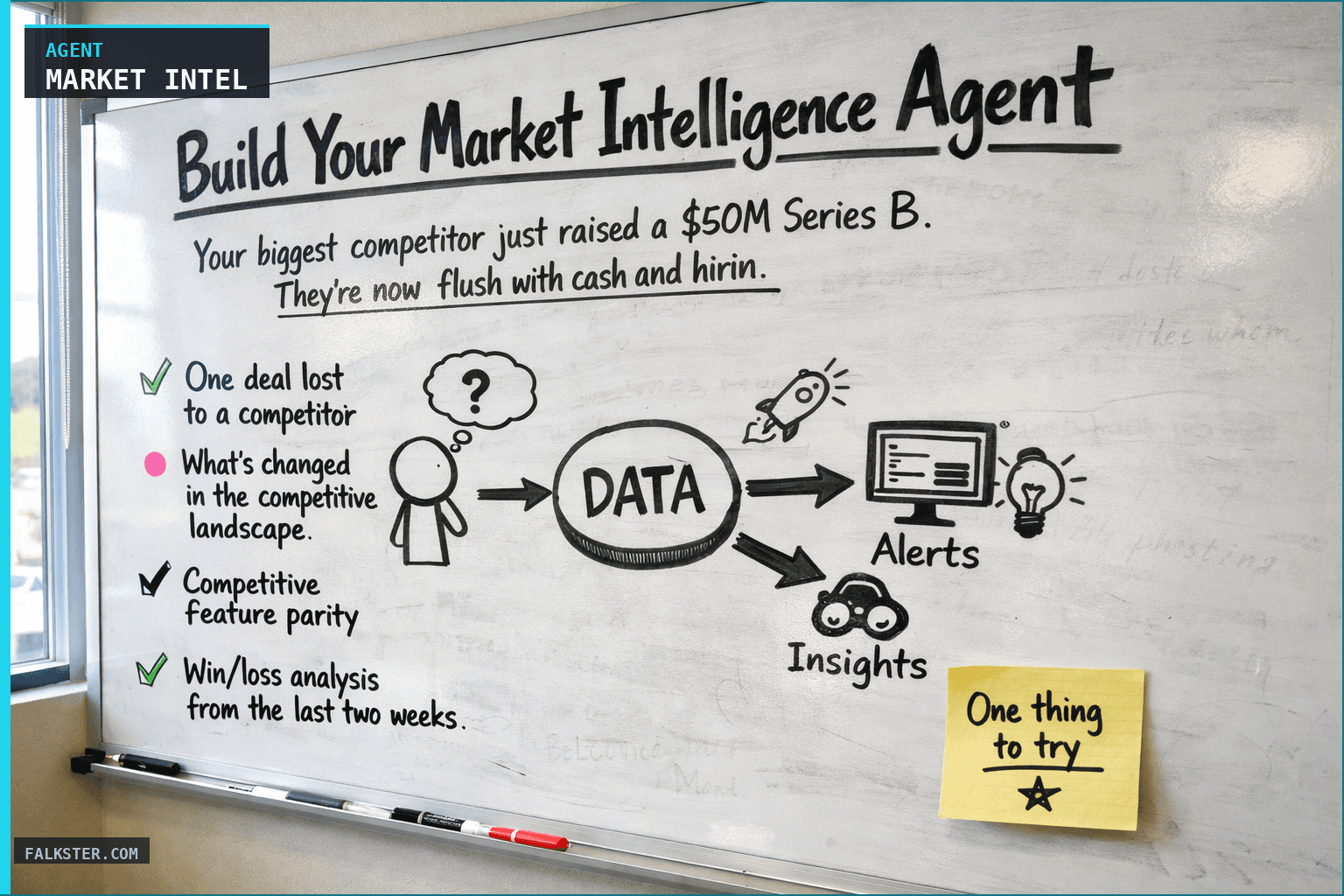
Your biggest competitor just raised a $50M Series B. They're now flush with cash and hiring aggressively. You find out through a news article. Not from your market intelligence. From a journalist.
Your sales team lost three deals in the last two weeks to the same competitor. You don't know why. The CRM note just says "Lost to Competitor X." Nobody on product has context about what Competitor X is doing differently or what you should do about it.
One of your largest customers mentions in a support call that they're "talking to someone else" about their needs. Nobody flags this. It's just a casual comment. By the time you notice the churn signal, they're already in contract with your competitor.
This is how companies get blindsided. Intelligence is fragmented. Win/loss data lives in the CRM but nobody reads it. Competitive announcements are scattered across blogs, LinkedIn, and news sites. Customer switching signals are buried in support transcripts.
The Market Intelligence Agent fixes this by running bi-weekly and aggregating all the signals. Competitive moves, M&A activity, win/loss data, customer switching signals - everything gets surfaced in one report with strategic recommendations.
This is how you stay ahead instead of chasing.
Daily Alerts vs. Bi-Weekly Strategy
Daily alerts tell you something happened. "Competitor X announced a new feature." "We lost a deal to Competitor Y."
But alerts don't tell you what it means. Is this a one-off announcement or part of a strategic shift? Did we lose one deal or is there a pattern? Is this customer switching signal a warning sign or a false alarm?
You need bi-weekly analysis. You need to see the pattern. You need to understand what's changing in your market and why.
A bi-weekly competitive intelligence report gives you that. It's not just "Competitor X launched Y." It's "Competitor X launched Y as part of a broader shift toward Z positioning. Here's how that affects us. Here's what we should do about it."
Here's the difference context makes:
One deal lost to a competitor. That's a sales situation. Handle the customer.
Three deals lost to the same competitor for the same reason. That's a product problem. You need to fix that gap or accept losing that segment.
Three deals lost to the same competitor AND you're hearing the same concern in five other sales calls. That's a market positioning problem. Competitors are winning with a narrative. You need a counter-narrative or a feature that makes their claim irrelevant.
Win/loss data only becomes strategic intelligence when you aggregate it and see patterns.
How the Agent Works: Competitive Intelligence at Scale
The Market Intelligence Agent connects to six sources: competitor monitoring (websites, blogs, changelogs), industry news (Crunchbase, analyst reports), CRM win/loss data, sales call notes (Gong transcripts or Slack summaries), customer switching signals, and investor/analyst reports.
It runs every other Wednesday and produces one report covering:
- What changed in the competitive landscape: new entrants, exits, pivots, M&A, and what each move signals for you.
- Feature parity, in a matrix, so you can see at a glance where you lead and where you lag.
- Win/loss from the last two weeks: why you won, why you lost, which competitor beats you most, and whether there's a pattern.
- Switching signals: who's evaluating alternatives, what they're weighing, how much ARR is at risk.
- Positioning: how they're positioned, how you're positioned, where the gap sits.
- A watch list: which competitors to track closely and what to prepare for.
- Two or three strategic recommendations drawn from all of the above.
The report reads like a story. Here's what's moving in your market, here's what you're winning on, here's what you're losing on, here's what's at risk, here's what to do about it.
Data sources and setup
Prerequisites: Complete the Claude setup guide first. This agent needs the following MCP connections active:
- Salesforce - win/loss data, deal notes, ARR impact
- Gong - sales call transcripts with competitor mentions
- External research tools - industry publications, analyst reports, company websites
Schedule: Runs bi-weekly on Wednesday at 9:00 AM via cron. Output posts to Slack.
Quick test: Open Claude and ask: "Scan for market shifts, analyst reports, and technology trends relevant to our product category in the last 2 weeks."
For the full agent fleet and scheduling details, see Your AI Agent Fleet.
The Prompt (Customize This)
Here's the basic prompt structure:
You are a competitive intelligence analyst. Your job is to analyze your competitive landscape every two weeks.

DATA INPUTS:
- Competitor activity from websites, blogs, LinkedIn, changelogs
- Industry news (Crunchbase, analyst reports, TechCrunch)
- Win/loss data from last 2 weeks
- Sales call notes with competitive mentions
- Customer switching signals

COMPETITORS TO MONITOR: [List your 5-8 primary competitors]

INSTRUCTIONS:
1. Summarize all competitor announcements in the last 2 weeks: new features, positioning changes, hires, partnerships
2. Market landscape shifts: new entrants, exits, M&A, funding news. What does each signal?
3. Create feature parity matrix: rate us vs competitors on key capabilities
4. Analyze won deals: what made us win? What features? What positioning? Any patterns?
5. Analyze lost deals: what made us lose? Which competitor beats us most? What reason? Any patterns?
6. Identify switching signals: which customers are evaluating alternatives? Why? How much ARR at risk?
7. Compare positioning: how are they positioned vs how we're positioned? Where's the gap?
8. Recommend 2-3 strategic actions based on competitive data

TONE: Strategic, data-driven, focused on patterns and market shifts.
OUTPUT: Markdown for Slack.
What This Changes
Bi-weekly market intelligence shifts your strategic conversations.
You stop getting surprised. The announcement is in the report before it's in the press, so you have time to shape a response instead of scrambling for one. Win/loss data starts driving product decisions too. Instead of gut-feel roadmapping you're saying "we're losing three deals a week to Competitor X on feature Y, do we build it or accept losing that segment?"
Switching signals get handled while there's still a customer to save. When you know an account is evaluating alternatives, CS reaches out: "we saw you're looking at X, here's what we do that they don't." You get a shot at keeping them.
Positioning stops being reactive. You know what competitors are claiming, you know whether the claim is even true, and you can either counter it with a feature that makes it irrelevant or plant a flag on positioning nobody else owns. Roadmap priorities come from the same place. The patterns in wins and losses tell you what's table-stakes and where the white space is. Sales walks into the next deal already briefed on why you lose to Competitor X and what the counter is. And retention climbs, because catching an at-risk customer you already know about is a lot cheaper than replacing one you lost.
That's the gap between reacting to your market and shaping it.
The Broader Toolkit
The Market Intelligence Agent is the strategic complement to your operational toolkit:
- Weekly Executive Report (Monday 7am): Leadership brief on execution
- Weekly Ops Digest (Monday 8am): Operational trends
- Product Health Dashboard (Tuesday 9am): Feature adoption and retention
- Release Checker (Thursday 10am): Pre-release verification
- Market Intelligence Agent (Bi-weekly Wednesday 9am): Competitive strategy
Together they give you a standing view of execution, operations, product health, release quality, and competitive positioning.
Start with market intelligence. It's the one that reorders your strategy conversations fastest.
Sources: Crunchbase, Gong, Salesforce, Slack.
Download the artifact
Ready to use. Copy into your project or share with your team.
Also on Medium
Full archive →AI Agents and the Future of Work: A Pixar-Inspired Journey
What product managers can learn about AI agents from how Pixar runs a film team.
Many AI Agents Are Actually Workflows or Automations in Disguise
How to tell agents from workflows from cron jobs, and why it matters for what you ship.
Frequently asked
What is the difference between the Market Intelligence Agent and the Competitive Intel Agent?+
The Competitive Intel Agent runs weekly and surfaces events: what competitors launched, what customers mentioned this week. The Market Intelligence Agent runs bi-weekly and surfaces patterns: why you're winning or losing, what's shifting in the market, which customers are at risk of switching. One is operational, one is strategic.
What six sources does the Market Intelligence Agent aggregate?+
Competitor websites and blogs, Crunchbase and analyst reports, Salesforce win/loss data, Gong sales call transcripts, customer switching signals from support, and investor or analyst reports. It runs every other Wednesday and synthesizes all six into one strategic report.
How does the agent help prevent customer churn?+
By surfacing switching signals before they become churns. When a customer mentions a competitor in a support call, it gets flagged alongside ARR at risk. CS can reach out proactively while the customer is still evaluating, not after they've signed a contract with your competitor.
What are the seven sections of the bi-weekly market intelligence report?+
Competitive landscape changes, feature parity matrix, win/loss analysis, customer switching signals with ARR at risk, positioning comparison, strategic watch list, and two to three strategic recommendations. The whole report reads in under fifteen minutes.
How do I run a quick test before setting up the full agent?+
Open Claude and ask: 'Scan for market shifts, analyst reports, and technology trends relevant to our product category in the last two weeks.' That one prompt gives you a preview of the kind of output the agent produces every other Wednesday.

Comments (0)
Sign in with LinkedIn to leave a comment.
Sign in with LinkedIn