The short version
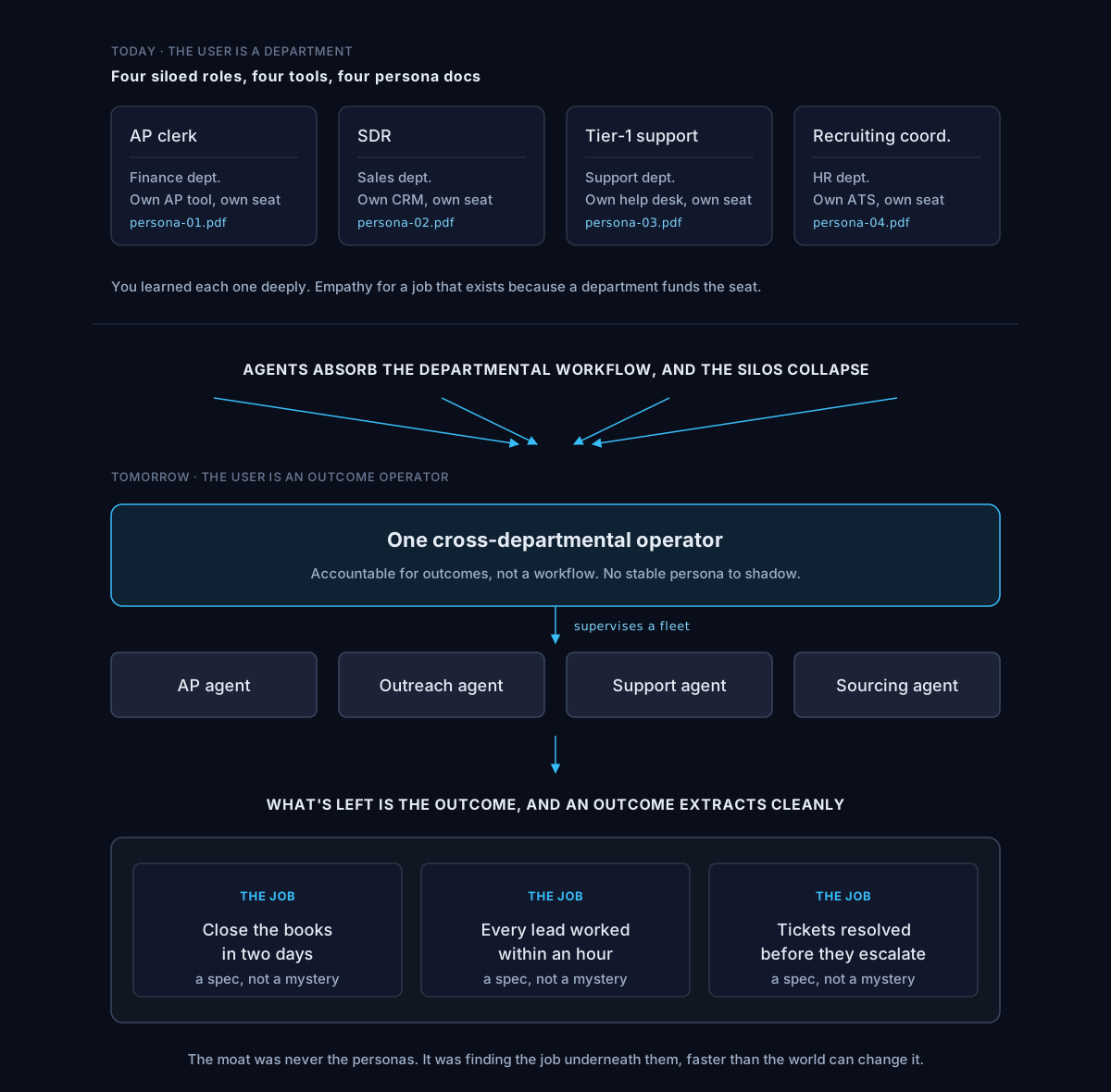
The most confident defense of the human PM goes like this: let AI write the PRD and run the standup, it will never do the one thing that matters, it can't understand the user. I used to give that speech. I've stopped, because it rests on a hidden assumption that no longer holds. The user we spent careers learning to understand is not a person, it is a departmental role: the AP clerk, the SDR, the tier-one support agent, the recruiting coordinator. We built personas around those roles because software was sold per seat into departments, so the user was the seat. Agents are now dissolving the departments. The workflow that defined the job gets absorbed, and the person left standing is a cross-departmental operator supervising outcomes across three functions that used to be three users. So the moat isn't wrong about empathy. It is aiming empathy at a user who is on the way out. Understanding the future user is less about deeper feeling for a fixed role, and more about reading outcomes that don't map to any persona doc you own. Here is why the user is disappearing, and what replaces the discovery job built on top of them.
Every time the "AI will replace PMs" debate flares up, the same rebuttal wins the room. Someone senior says: fine, hand AI the documents and the meetings. It will never do the part that counts. It can't sit across from a person, watch their face, follow the tangent, and feel the problem they can't put into words. I've given that speech. I believed it. I still think the skill is real.
I've stopped believing it's a moat, and the reason has nothing to do with whether AI gets better at empathy. The reason is that the user I was defending is disappearing.
The user you picture is a department, not a person
Pull up any persona doc your team has ever written. "Priya, the accounts-payable clerk. Processes 200 invoices a week. Frustrated by manual matching." "Marcus, the SDR. Lives in the CRM. Hates logging activity." These read like people. They are org-chart artifacts.
The reason we know Priya's day so well is that someone sold a seat of AP software into a finance department, and the seat came with a job description. The reason we know Marcus is that someone sold sales-engagement seats into a sales team. The empathy we're proud of, the thing we insist AI can't replicate, is mostly deep domain knowledge about a job that exists because a department exists and a budget line funds the seat.
That was a safe thing to build a career on for thirty years, because the departments held still. Finance was finance. Support was support. The roles inside them changed slowly enough that a persona written in 2019 was still roughly true in 2024. We mistook the stability of the org chart for the stability of the user.
The departments are what's dissolving
Here is what breaks the assumption. The unit of software is moving from the seat to the outcome, and when it does, the seat stops defining a person.
Watch how the work actually reorganizes. A listening agent sits on the finance team's calls and support tickets and extracts the outcome the business is accountable for: close the books in two days, with no manual matching, with a clean audit trail. A prototyping agent builds the workflow that produces that outcome. The invoice matching that was Priya's entire job is now something an agent does in the background. Priya doesn't vanish. She becomes the person who supervises the outcome, reviews the exceptions the agent flags, and owns the result across what used to be three separate desks: AP, procurement, and treasury. Three personas collapse into one operator.
I've written before about how product management escaped the product team and now shows up in finance, legal, HR, and sales ops. This is the other side of that same shift. If the product operator is spreading across every function, the user is being compressed in exactly the same motion. The org chart that gave us tidy, department-shaped users is the thing agents are rearranging. You cannot keep the personas and lose the departments they were drawn from.
Pricing tells you it's already happening. Per-seat billing assumed a person per seat doing a role. Per-outcome pricing assumes a result, and is indifferent to how many human roles used to stand between the input and that result. When the business stops paying for seats and starts paying for outcomes, the seat-shaped user loses the thing that made it real.
The future user doesn't fit your persona doc
So who are you actually going to be doing discovery on in two years?
Not Priya the AP clerk. Someone more like an operator who owns "the money going out is correct and on time," full stop, and who does that by supervising a fleet of agents that touch what used to be four teams. They don't have a workflow you can shadow for a day and map. They have a set of outcomes they're accountable for and a set of agents doing the tasks, and both shift month to month as the agents take on more. There is no stable day-in-the-life to write down, because the day keeps getting rewritten.
This is why the old discovery muscle strains. We were trained to understand a role deeply and assume it would hold. The future user is defined by an outcome, not a role, and the outcome is durable while the role around it churns. The thing you're trying to understand isn't "what does the AP clerk need." It's "what has to be true for the money to go out correctly," which is a question about a job, not a person. Related: I've argued the same thing happens to discovery when your customer is itself an agent.
What this does to the "AI can't understand the user" defense
It's defending the wrong noun.
The defensible skill was never "understand this specific user." It was "figure out, fast, what a moving target actually needs, and decide what to do about it." When the target was stable, that skill looked like deep empathy for a fixed role, because the role sat still long enough to reward the empathy. Now the target moves, and the same skill looks like continuous re-discovery against outcomes that don't hold their shape.
And here's the part that should make every PM uncomfortable, myself included. Outcomes are more legible to a machine than workflows ever were. The stuff that made a user feel irreducibly human, the tacit steps, the muscle memory, the "you had to be there" of the actual job, was the departmental scaffolding. Strip it away and you're left with an outcome, and an outcome extracts cleanly. "Close the books in two days" is not a mystery an AI can't approach. It's a spec.
I'm not arguing discovery is worthless or empathy is fake. Someone still has to decide which outcome is worth pursuing, notice the one the customer will never say out loud, and choose what not to build. That is judgment, and judgment survives this. This is the same reason I think PMs won't be automated, they'll be amplified. What doesn't survive is treating a shelf of persona docs as a moat. The moat was never the personas. It was the ability to find the job underneath them, which is exactly what jobs-to-be-done told us decades ago and we half-ignored because departments made personas easy.
What to do this week
Pick one. Not three. One.
- Take your most-used persona and find the department hiding inside it. If the persona stops making sense the moment that department merges into an operator role, you're holding a dated map, not a durable user. Rewrite it as an outcome and see how much survives.
- Run one discovery session against an outcome instead of a role. Interview for "what has to be true for the books to close in two days," not "walk me through the AP clerk's day." Notice how differently the conversation goes, and how much less of it is workflow trivia an agent could learn from the logs.
- Find one cross-departmental operator inside your own company and shadow them. Finance, support, RevOps, whoever is already supervising agents across what used to be multiple desks. That person is a preview of your future user. Your current personas won't describe them.
The senior line in the room is half right. AI can't do the deep human part of the job. But the deep human part was never "understand the user." It was "find the job the user is actually trying to get done, faster than the world can change it." The user is disappearing. The job is not. Aim there.
Sources and further reading:
- Clayton Christensen on jobs-to-be-done, the argument that the user was always the job, not the persona
- Aaron Levie on the agent operator role spreading across every function
- Marty Cagan on the empowered product team and where discovery goes next
- Ben Thompson (Stratechery) on how AI-native companies reshape the org chart
Frequently asked
What is the strongest argument that AI won't replace product managers?+
That AI can automate the documents, the standups, and the reporting, but it can't sit with a customer and understand what they actually need. The claim is that customer empathy, sensing the problem a person can't articulate, is the irreducibly human part of the job. The skill is real. The problem is that it points at a user who is a departmental role, and agents are dissolving the departments those roles live in.
Why does the 'user' product managers picture stop existing?+
Because that user is an org-chart artifact. Software was sold per seat into departments, so the user became the seat: the AP clerk, the SDR, the tier-one support agent, the recruiting coordinator. We learned each one's day because a department bought a tool. As agents absorb the departmental workflow and pricing moves from per-seat to per-outcome, those siloed roles collapse into a single cross-departmental operator supervising outcomes. The persona you learned to empathize with is being deprecated by the same shift automating your PRDs.
Who is the future user a product manager has to understand?+
A cross-departmental, outcome-oriented, agent-augmented operator. They don't have a fixed workflow you can shadow. They own a set of outcomes and a fleet of agents that do the work that used to define three separate jobs. Their responsibilities shift month to month as agents take on more, so there is no stable persona doc to build. You understand them by reading the outcome they are accountable for, not the role they occupy.
Does this mean customer empathy no longer matters?+
No. Someone still has to decide which outcome matters, notice the one the customer won't say out loud, and choose what not to build. That is judgment, and it survives. What doesn't survive is mistaking a persona library for a moat. The defensible skill was never 'understand this fixed user,' it was 'figure out fast what a moving target actually needs.' When the target was stable that looked like deep empathy for a role. Now the target moves, and the job looks like continuous re-discovery.
How is this related to jobs-to-be-done?+
It is jobs-to-be-done taken to its conclusion. Clayton Christensen argued the user was never the persona, it was the job they were trying to get done. Personas were a convenient stand-in while software was organized by department. Agents strip away the departmental scaffolding and leave the bare outcome, which is exactly the 'job' Christensen told us to design for. The uncomfortable part is that an outcome is more legible to a machine than a workflow ever was.

Comments (0)
Sign in with LinkedIn to leave a comment.
Sign in with LinkedIn