The short version
Prototype-first is my thesis. When building collapses to nearly free, the working prototype beats the written argument, and I have made that case across this whole site. This post is the asterisk I owe it. Cheap prototyping has a failure mode almost nobody who advocates for it, including me, names clearly: when building is free, the demo quietly replaces the argument, and good ideas die because a rough first prototype made them look like bad ideas. The graveyard fills with strong concepts killed by weak demos, because no one stated what a fair test would even be before opening the editor. The fix is not prototyping less. It is stating a falsifiable claim before you build, so the prototype tests a hypothesis instead of becoming an unearned verdict. Here is how good ideas die, and how to stop killing yours.
I argue for prototype-first development everywhere. PRD as output, not input. The working prototype as the argument. Build to learn instead of speccing to death. I believe it, I run my company on it, and it is right for where software is going.
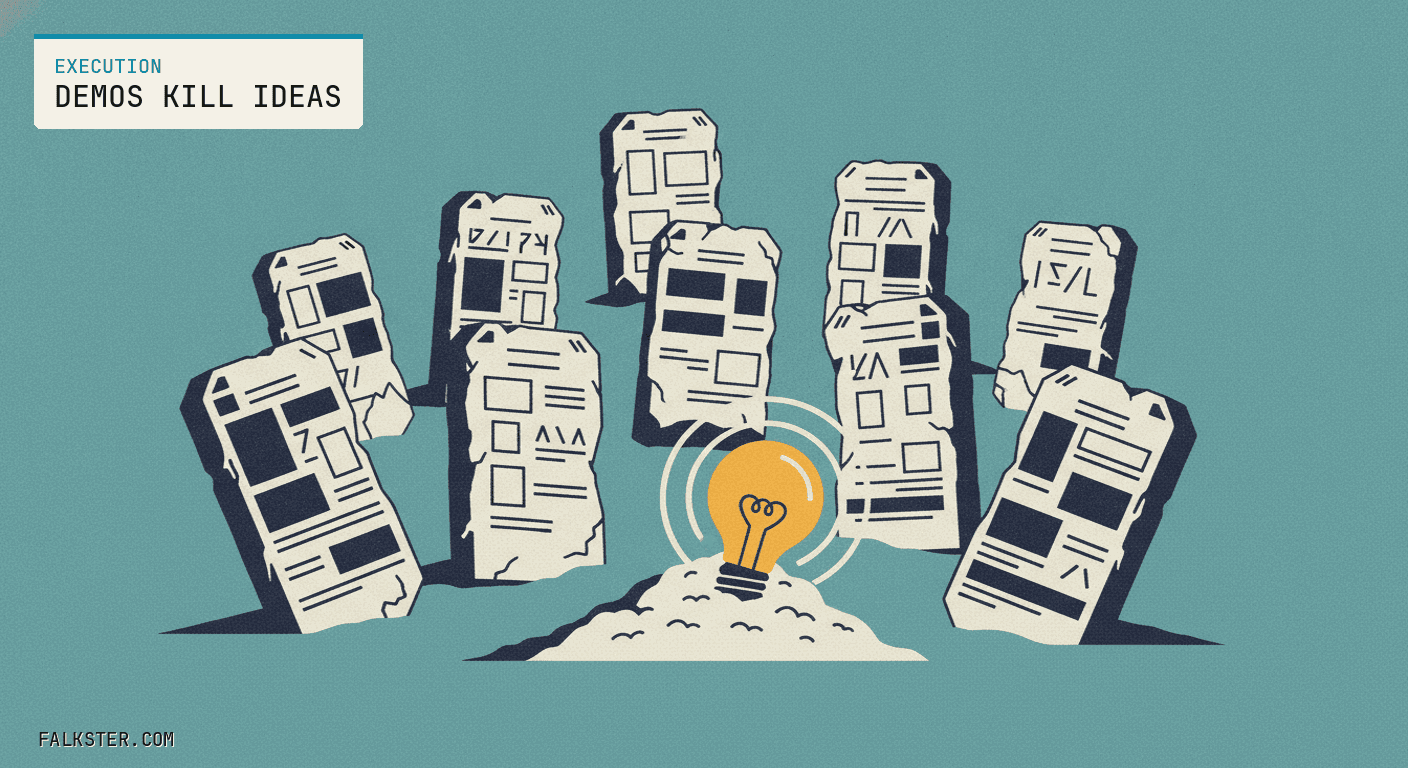
It also has a body count, and I do not see the people selling prototype-first, me included, talking about it honestly. So let me walk you through the graveyard.
How a good idea dies in the graveyard
Here is the death, step by step, because it is always the same.
Someone has a strong idea. Building is cheap now, so instead of arguing for it, they build a quick prototype over an afternoon. The prototype is rough, because it was an afternoon. It gets shown in a review. The room reacts to what is in front of them, which is a rough thing, and the reaction is lukewarm. The idea gets shelved. Everyone feels rigorous because hey, we prototyped it and the prototype was not compelling.
But nobody tested the idea. They tested a rushed first rendering of the idea, in a room that could not separate the two. A weak prototype of a strong idea reads as a weak idea. That is the whole tragedy. The cheapness that let them build it fast is exactly what let them kill it fast, for a reason that has nothing to do with whether the idea was good.
A rough prototype of a strong idea reads as a weak idea. The graveyard is full of concepts that were never tested, only rendered badly and buried.
Why cheap building makes this worse, not better
The counterintuitive part is that expensive prototypes used to protect against this, and cheap ones removed the protection.
When a prototype cost three weeks of engineering, the cost itself forced a conversation before anyone built. What are we trying to learn. What do we actually believe. Is this even worth the three weeks. That friction was annoying, and it was also doing real work: it made the team articulate a hypothesis before committing. You could not afford to build without a reason.
Now you can. Building is an afternoon, so the friction is gone, and the forced hypothesis went with it. Teams generate five prototypes in a week and learn nothing from any of them, because no one ever said what each one was supposed to prove. This is the line I keep coming back to, and I mean it as a criticism of my own thesis: cheap building makes undisciplined teams more prolific, not more correct. The assumption you never stated cannot be tested by a demo, no matter how many demos you crank out.
Cheap building makes undisciplined teams more prolific, not more correct. The friction we removed was also doing the thinking.
The substitution nobody admits to
Underneath all of this is a swap that happens silently. Teams believe they are building to learn. They are actually building to decide.
Building to learn means the prototype is a question. It is an instrument pointed at a specific hypothesis about a customer, and its job is to return a signal. Building to decide means the prototype has quietly become the decision itself: if it looks good in the demo, the idea is approved, and if it looks rough, the idea is rejected. The production values become the verdict.
The graveyard fills up entirely from this confusion. Teams think the demo is testing the idea when the demo is just rendering it, and they let the rendering decide. A polished prototype of a mediocre idea sails through. A rough prototype of an excellent idea gets buried. Both are the same error: letting how the thing looks stand in for whether the thing is true. This is the same trap I warn about with shipping vibe-coded features, pointed inward at your own roadmap instead of at your customers.
The fix is one sentence, before the editor
You do not fix this by prototyping less. You fix it by reinstalling the friction the cost used to provide, deliberately, as a habit.
Before you build anything, write one sentence. I believe this specific user will do this specific thing for this specific reason, and I will be wrong if they do not. That is it. A falsifiable claim, stated out loud, before the editor opens. Now the prototype has a job that is not just to look good. Its job is to make that sentence true or false. When you show it, you are not asking "do you like this," you are asking "did the user do the thing I claimed." The demo stops being a verdict on the idea and goes back to being a test of a hypothesis, which is what it was always supposed to be.
And in the review room, hold the two things apart on purpose. Judge the idea against the claim, and judge the prototype as a rough first instrument. A great idea behind a clumsy build is not a dead idea. It is an idea whose first instrument was clumsy. Say that sentence in the room, every time, because the room will not separate them on its own. This is the discipline underneath the whole outcome-to-prototype loop: the loop only works if a claim sits at the front of it.
I still believe building beats arguing. But a prototype that replaces the argument instead of testing it is not building to learn, it is theater with better production values, and it kills more good ideas than slow discovery ever did. State the claim first. It is one sentence, and it is the difference between a prototype that tests your idea and a graveyard you fill without noticing.
Before your next prototype this week, write the sentence. One claim, falsifiable, out loud, before you open the editor. If you cannot write it, that is not a signal to build faster. It is a signal you do not yet know what you are testing.
Sources: Teresa Torres, on assumption testing · Marty Cagan / SVPG, on building to learn versus building to earn · Tom Chi, on rapid prototyping discipline
Also on Medium
Full archive →Is Mob Programming the Right Approach for Your Team?
When mob and pair programming work, when they don't, and how to read the trade-offs.
Why Users Don't Know What They Want Until You Show Them
Visionary product development, when prototypes beat interviews, and how to know the difference.
Frequently asked
What is the prototype graveyard?+
The prototype graveyard is the pile of good ideas that get killed because a cheap, fast prototype made them look bad before anyone defined what a fair test would be. When building is nearly free, teams skip the step of stating what they believe and what would prove it wrong, and instead let a rough demo render the verdict. A weak first prototype of a strong idea reads as a weak idea, and the idea dies in review for the wrong reason. It is the underdiscussed failure mode of prototype-first development.
Is this an argument against prototype-first development?+
No. Prototype-first is the right default when the cost of building has collapsed. The argument is that the speed creates a specific trap its advocates, including me, do not name often enough: when a prototype is cheap, it tempts teams to substitute the demo for the thinking. The fix is not to prototype less, it is to state a falsifiable claim before you open the editor, so the prototype tests a hypothesis instead of silently becoming the verdict on the idea.
Why does cheap prototyping make this worse than expensive prototyping?+
When prototypes were expensive, the cost forced a conversation first: what are we trying to learn, what do we believe, is this worth building. That friction was annoying and it also did real work, it made teams articulate a hypothesis. When prototypes are nearly free, the friction disappears and so does the forced hypothesis. Teams generate five demos in a week and learn nothing, because no one defined what each demo was supposed to prove. Cheap building makes undisciplined teams more prolific, not more correct.
How do you prototype without falling into the graveyard trap?+
State the claim before you build. Write one sentence: I believe this specific user will do this specific thing for this specific reason, and I will be wrong if they do not. Then build the prototype to test exactly that, and judge it against that claim, not against a vague reaction to the demo. Separate the quality of the idea from the quality of the first build, because a rough prototype of a great idea and a polished prototype of a bad one look deceptively similar in a review room.
What is the difference between building to learn and building to decide?+
Building to learn means the prototype is a question, an instrument for testing a stated hypothesis about a customer. Building to decide means the prototype has quietly become the decision itself, where looking good in the demo equals approval and looking rough equals rejection. The graveyard fills up when teams think they are building to learn but are actually building to decide, letting production values stand in for evidence. The discipline is keeping the prototype a question until the claim it tests is answered.

Comments (0)
Sign in with LinkedIn to leave a comment.
Sign in with LinkedIn