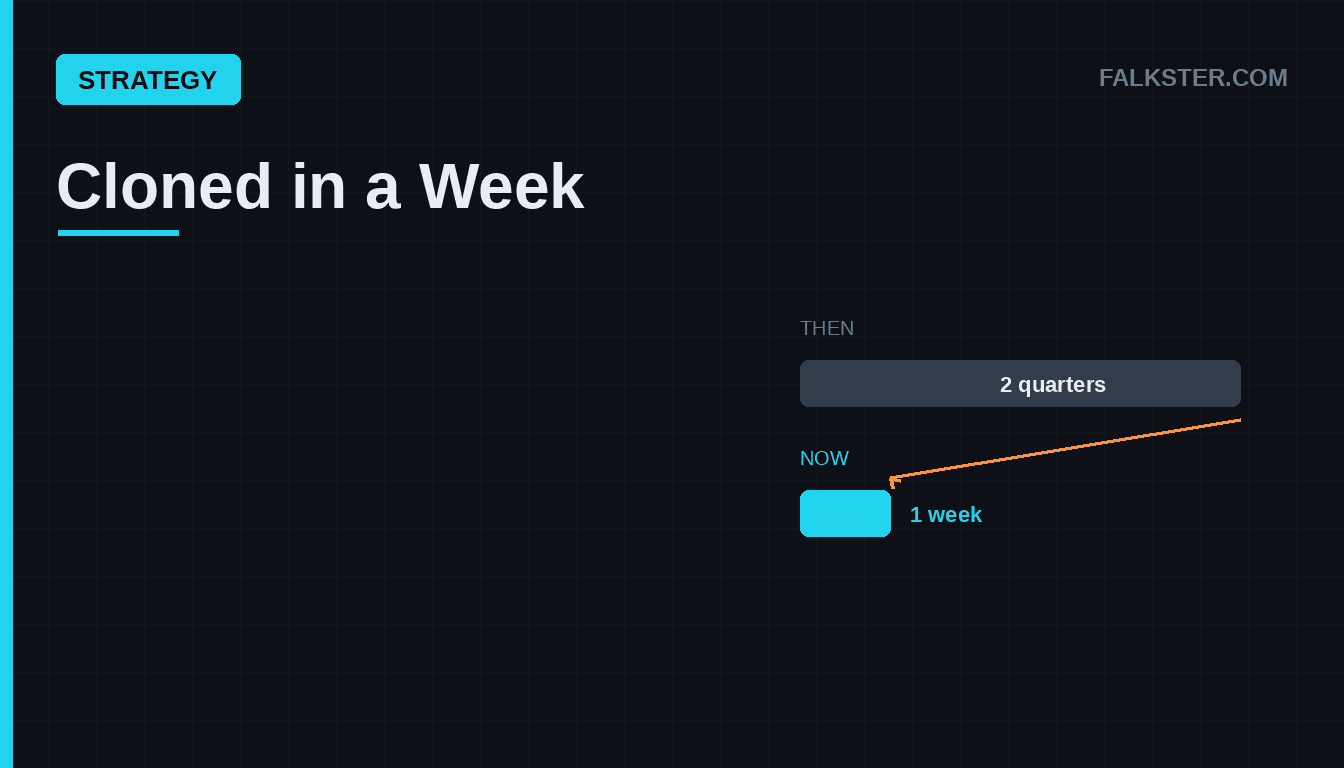
Here is a test you can run on your own product strategy this afternoon. Take your three most-promoted features, the ones on the homepage, the ones the sales team leads with. For each, ask one question: how long would it take a well-funded competitor, using the current agent stack, to reproduce this?
If the honest answer is "a week or two," then that feature is not protecting you. It is a head start, and head starts expire.
For most products, most of the list comes back in weeks. That should change how you think about the entire roadmap.
The short version
Feature parity used to take competitors quarters, and that lag was the implicit moat under most product strategies: ship a feature, enjoy a head start, use the runway to ship the next one. The agent stack collapsed that lag to days. It can read your site, docs, public API, and demos and reproduce the experience in a week. So the feature is no longer the moat. Durable defensibility now lives in four places a week of copying cannot reach: distribution, proprietary data, switching cost, and trust. The CEO move is to stop treating features as defensibility, build them fast as the price of entry, and pour real investment into the four moats that remain.
For how this reshapes what product orgs are accountable for, see the CPO Mandate 2026. For the operating model underneath, see the Product Operating Model.
The assumption nobody wrote down
Almost every software strategy of the last two decades rested on a quiet assumption: building takes long enough that a good feature buys you time. You shipped something hard, got a few quarters of lead, and spent that lead shipping the next hard thing. The lead was the strategy. We called it a roadmap, but the engine underneath was always the build-time gap between you and whoever was copying you.
That gap is what AI closed. Not the idea of competition, the timing of it. When a competitor can ingest your public surface area and reconstruct the experience in days, the runway you were counting on never arrives. You ship, and parity shows up before your next release does.
I have watched this on both sides. I have had teams reproduce a competitor's flagship capability in a sprint that would have been a six-month project in 2021. And I have had our own differentiators matched within weeks of a launch. The speed is not coming back down. If anything it keeps accelerating.
What this does not mean
It does not mean features are worthless. They are still the price of entry. A product missing a capability the category expects loses, full stop. You still have to build, and build well, and build fast.
What changes is the role the feature plays in your strategy. It moves from "the thing that protects us" to "the thing we have to have to be in the conversation." That is a demotion, and it should feel like one, because it forces the real question: once the feature is matched, why do customers still choose us?
The four moats that survive a week of copying
When I strip a defensibility argument down to what cannot be reproduced quickly, four things are left.
Distribution. The audience, channels, and attention you already own. A competitor can copy your feature in a week. They cannot copy your install base, your email list, your partner network, or the fact that customers already open your product every morning. Distribution compounds and resists cloning.
Proprietary data. Data that exists only because customers use you, and that a competitor cannot scrape off your website. The usage history, the labeled outcomes, the model that gets better the more it runs inside your specific customer base. If your product gets sharper with use in a way a copy cannot replicate on day one, that is a moat.
Switching cost. The workflows, integrations, configurations, and history that make leaving expensive. This is the least glamorous moat and often the strongest. A cloned feature does not move a customer who has six months of data, four integrations, and a team trained on your product.
Trust. The thing customers reach for when two products look identical on a feature grid. Brand, reputation, the sense that you will be around and you will not break their workflow. Trust is slow to build and cannot be generated, which is exactly why it holds.
Notice that the feature itself is on none of these lists. That is the whole point.
How to act on it
Two moves, one defensive and one offensive.
Defensive: run the clone test on your roadmap. For every major bet, ask how long parity would take and what protects you after parity arrives. If the answer to the second question is "nothing," you have found a feature you should build cheaply and fast, not lavishly and slowly. Stop spending flagship effort on things that will be matched in a fortnight.
Offensive: route your strongest investment into the four moats. That looks like building distribution before you need it, designing the product so usage creates compounding proprietary data, deepening integrations and workflow lock-in (the good kind, where leaving costs the customer real value), and protecting trust as a first-class metric. These are slower and less demo-friendly than features, which is precisely why competitors underinvest in them and why they last.
The plain version
The feature is no longer the moat. It is the entry fee. Any competitor worth worrying about can now reproduce your best capability in about a week, so the strategy question is not "what do we build next" but "what about us survives being copied."
Run the clone test on your top three features this week. The ones that come back as "a week or two" are telling you where you have a head start and no moat. That is not bad news. It is a map of where to stop overspending and where to start.
If you are reworking a product strategy that was built on build-time advantage that no longer exists, that is the most common rebuild I see right now. Reach out on LinkedIn.
Further reading
Also on Medium
Full archive →Frequently asked
Why can competitors clone features so much faster now?+
The agent stack can ingest a competitor's marketing site, documentation, public API, and demo videos and reproduce the experience in days rather than quarters. Generation is cheap and fast, so the build time that used to protect a feature has collapsed. The feature is no longer scarce; the decision to copy it is the only gate left.
If features can be cloned, what actually defends a product now?+
Four things that a week of copying cannot reproduce: distribution (the audience and channels you already own), proprietary data (data that compounds from usage and cannot be scraped), switching cost (workflows, integrations, and history that make leaving expensive), and trust (the brand customers reach for when two products look identical). The feature itself is not on the list.
Does this mean we should stop building features?+
No. It means you should stop treating features as the moat and start treating them as the cost of entry. Build them fast and ship them well, because parity is table stakes, but invest the real energy in distribution, data, switching cost, and trust, which is where durable advantage now lives.
How do I audit my own defensibility?+
List your top three differentiators and ask, for each, how long it would take a well-funded competitor with the current agent stack to reproduce it. Anything that comes back in 'a week or two' is not a moat, it is a head start. What is left after you cross those off is your actual defensible position. If nothing is left, that is the finding.
What about patents or being first to market?+
First-to-market matters only if you convert the lead into distribution, data, or switching cost before parity arrives, which now happens in weeks. Patents rarely move fast enough to matter in software competition at this speed. Treat both as supporting factors, not as the core of a defensibility strategy.

Comments (0)
Sign in with LinkedIn to leave a comment.
Sign in with LinkedIn