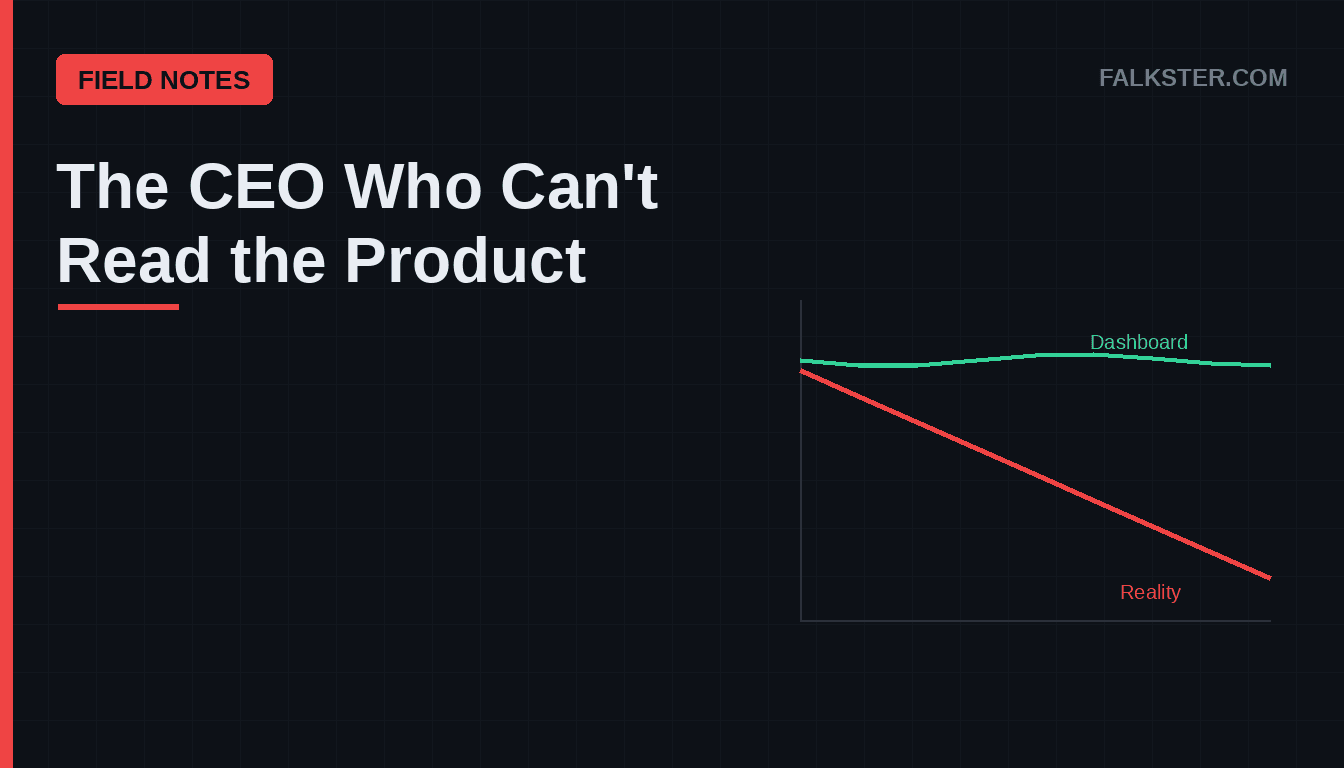
There is a specific kind of executive blindness spreading right now, and the people who have it are the least likely to notice, because the symptom is that everything looks fine. The dashboard is green. The numbers are good. And the product is quietly getting worse in ways the numbers will not show for a while.
These are CEOs who can no longer read their own product. They are still reading something. It just is not the product anymore.
The short version
Dashboards were a faithful proxy for the product when humans built it at human speed: usage, retention, and revenue moved slowly and legibly, so reading the numbers was a reasonable way to know the state of the thing. Agents broke that link. When the product is partly produced and operated by agents, the gap between what the metrics say and what customers experience can open fast, because an agent can be confidently wrong in ways that pass aggregate checks for weeks. The dashboard stays green while the experience degrades. The fix is not more dashboards but three habits: watch the agents work and not just their outputs, read evals and not just KPIs, and use your own product weekly on a real task. CEOs who stay close to the experience keep their judgment; those managing by dashboard alone are about to be surprised by their own product.
For why this judgment matters most, see Taste Is the Last Moat. For the eval discipline that catches the drift, see the eval-first product org.
When the dashboard was trustworthy
For most of software history, a dashboard was a reasonable proxy for reality. The reason is that humans built the product at human speed. Changes shipped slowly, their effects propagated slowly, and the aggregate metrics (usage, retention, revenue) moved in legible step with the underlying experience. If the product got worse, the numbers got worse, on a timescale where reading the numbers gave you real, if slightly delayed, knowledge of the state of the thing.
So a generation of executives learned, correctly, to manage by dashboard. It worked. The instruments pointed at the territory.
What agents changed
Agents decoupled the instruments from the territory. When a meaningful part of your product is produced or operated by agents, two things become true that were not true before.
First, the experience can change faster than the aggregate metrics can register. An agent can start handling a workflow slightly worse (subtly wrong answers, a degraded edge case, a tone that erodes trust) and the topline will not move for weeks, because topline metrics are lagging and aggregate by nature. The damage accumulates below the resolution of the dashboard.
Second, agents fail in a particular way: confidently and consistently. A human doing a task badly tends to leave obvious signs and to vary. An agent doing a task badly does it the same wrong way every time, smoothly, in a manner that often passes every aggregate check you have. It is exactly the failure mode dashboards are worst at catching, because nothing looks anomalous in the numbers.
Put those together and you get a product that is degrading in ways that are real to customers and invisible to the dashboard. The CEO reading the dashboard feels in control. The control is an illusion with a delay built into it, and the delay is precisely long enough to be expensive.
The three things to read instead
The instinct, when a dashboard fails you, is to build more dashboards. Resist it. More aggregate metrics do not fix a problem caused by the limits of aggregate metrics. Read these instead.
Agent behavior, not just agent output. Periodically watch how an agent actually performs a task, end to end, on real inputs. Not the aggregate of its outputs, the behavior. Drift shows up in behavior first. This is the same reason sitting in a raw customer call beats reading the summary: the texture that reveals the problem is exactly what aggregation removes. You do not need to do this constantly. You need to sample it often enough to keep your mental model honest.
Evals, not just KPIs. An eval score with a trend line is built to catch the thing revenue hides: quality decay over time. KPIs tell you what already happened to the business. Evals tell you whether the systems producing those results are getting better or worse right now. If you only read one new instrument, read this one.
Your own product, weekly, on a real task. This is the one no dashboard can replace. A metric cannot tell you the product feels wrong, that a flow that used to be smooth now has a hitch, that an answer that used to be sharp is now vaguely off. Only using it can tell you that. The CEOs who keep their judgment are the ones who never stopped touching the actual thing.
The plain version
Dashboards earned your trust in an era when they faithfully tracked a human-built product. Agents broke that link, and now the dashboard can stay green while the product gets worse, for weeks, before the numbers admit it. Managing by dashboard alone is managing by a proxy that has quietly stopped pointing at the real thing.
This week, do one thing no dashboard can do for you: sit down and use your own product on a real task, start to finish, the way a customer would. If it feels worse than you assumed from the numbers, that gap is the thing you have not been able to read. Close it before it closes on you.
If you are a CEO or CPO trying to rebuild a true read on a product that agents now help operate, that re-instrumentation is one of the more important pieces of work in front of leadership teams right now. Find me on LinkedIn.
Further reading
Also on Medium
Full archive →The AI Revolution: Faster, Deeper, and More Disruptive
Why the current AI shift compounds faster than the Industrial Revolution did.
AI Agents and the Future of Work: A Pixar-Inspired Journey
What product managers can learn about AI agents from how Pixar runs a film team.
Frequently asked
Why can dashboards mislead a CEO in an agent-native product?+
Because dashboards were a faithful proxy only when humans built the product at human speed, so the numbers moved slowly and legibly with the actual experience. When agents produce and operate the product, the gap between aggregate metrics and real customer experience can open quickly. An agent can be confidently wrong in ways that pass aggregate checks for weeks, so the dashboard stays green while the product degrades.
What should a CEO read instead of just KPIs?+
Three things in addition to KPIs: agent behavior (watch how the agents work, not only their outputs, because drift shows up in behavior first), eval scores with trend lines (which catch quality decay that revenue masks), and the product itself used weekly on a real task. KPIs lag; these are closer to the live state of the experience.
Why doesn't quality drift show up in revenue right away?+
Because topline metrics are lagging and aggregate. A degrading experience erodes trust and retention gradually, and the damage often surfaces in revenue weeks or months after it began. By the time the dashboard moves, the cause is old. Evals and direct observation catch the decay while it is still cheap to fix.
Isn't watching agents work a poor use of CEO time?+
Spot-checking, not constant monitoring. Periodically observing how an agent actually performs a task reveals failure modes that aggregate outputs hide, the same way sitting in a customer call reveals what a summary launders out. It is a small, high-leverage sample that keeps the CEO's mental model calibrated to reality rather than to a lagging proxy.
What is the single most useful habit here?+
Use your own product weekly on a real task. A dashboard cannot tell you the product feels wrong; only direct experience can. This one habit catches a class of problems that no metric surfaces in time and keeps the CEO's judgment anchored to the actual experience rather than to a number that may have drifted away from it.

Comments (0)
Sign in with LinkedIn to leave a comment.
Sign in with LinkedIn