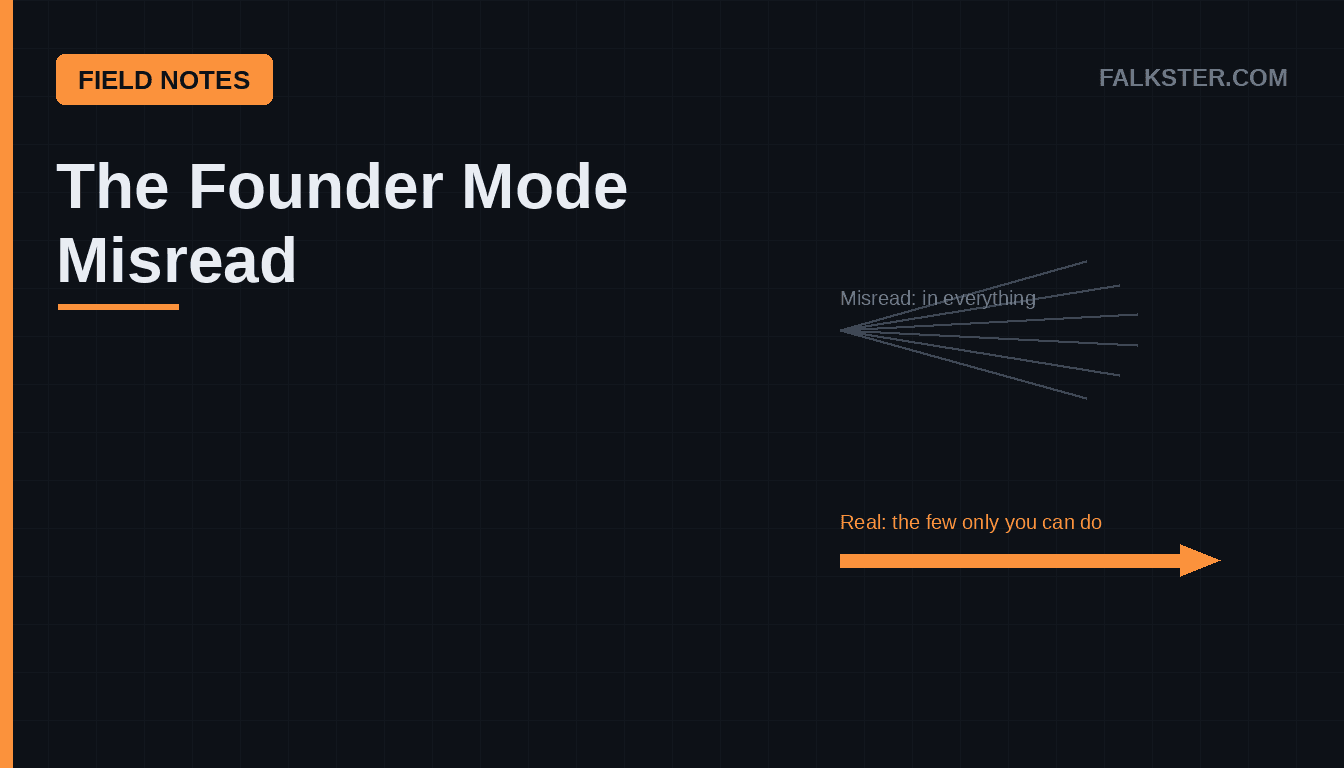
Founder mode arrived as a useful correction and got flattened into a bad excuse. I want to separate the two, because the flattened version is actively hurting companies right now, and the AI-native version of the original idea is sharper and more demanding than most founders realize.
The short version
Founder mode started as a correction to over-delegation: founders who professionalized so hard they lost touch with their own product. The real idea was to stay close to the things only a founder can do. It got misread as permission to micromanage and be in every decision, which is just a bottleneck with a good story. The AI-native version cuts the other way from how most founders apply it. When execution was expensive and human, "stay involved" meant staying in execution. Now execution is cheap and automatable, so it is the least valuable place for founder attention and the first thing to hand off. What remains founder-only is narrow: problem selection, defining what good looks like, the few expensive-to-reverse decisions, and taste. Founder mode means being irreplaceable in those and getting out of everything else faster than ever.
For why judgment is the scarce input, see Taste Is the Last Moat. For triaging which decisions deserve founder attention, see The Cost of Being Wrong Is the Only Number That Matters Now.
The original point was good
The correction founder mode named was real. For years, the standard advice to a scaling founder was to professionalize: bring in experienced executives, build process, and delegate aggressively so you could work on the company instead of in it. Mostly sound advice. But some founders followed it so completely that they delegated the things that were actually theirs, the product judgment and the standard of quality, and the company drifted into a competent, soulless version of itself. Founder mode said, correctly, that there are things a founder should not delegate, and that staying close to those things is not a failure to scale.
That is true and worth holding onto. The problem is what happened to the idea next.
The misread
Founder mode got compressed into a license. It became a justification for being in every decision, for overriding the team on instinct, for treating the org chart as advisory because you are the founder and you can override anyone. That is not staying close to what only you can do. That is inserting yourself into everything, which produces a single point of failure with a flattering name.
I have watched capable companies slow to the founder's personal throughput because the founder read "stay involved" as "approve everything." The team stops making decisions because the founder will override them anyway. Talented operators leave because there is no real authority to hold. The founder, exhausted, concludes that nobody else can be trusted, which makes them centralize further. It is a doom loop dressed up as commitment.
Why AI flips the application
Here is the part most founders have not updated. The original founder mode was articulated in a world where execution was the expensive, human-intensive bottleneck. In that world, "stay involved" naturally meant stay involved in execution, in the building and shipping, because that was where the company's effort and risk concentrated.
That world is gone. Execution is now cheap and increasingly automated. Which means staying involved in execution is no longer staying close to what matters, it is parking your scarcest resource (founder attention) on the part of the business that needs it least. The instinct to be in the weeds of how things get built was defensible when the weeds were expensive. Now the weeds are cheap, and your attention there is almost pure waste.
So the AI-native reading inverts the common application. Delegate and automate execution faster than you ever have, because it is cheap and getting cheaper. And concentrate ferociously on the narrow band that is actually yours.
What is actually yours
Strip founder mode down to what cannot be delegated or automated, and it is a short list.
Problem selection. Which problems are worth solving at all. This is upstream of everything and it is where being wrong is most expensive, because no amount of cheap execution saves you from building the wrong thing well.
What good looks like. The standard. The bar a thing has to clear before it ships. Your team calibrates against your sense of quality whether you state it or not, so state it, defend it, and keep it sharp by staying close to the actual product.
The few expensive-to-reverse decisions. Pricing, positioning, the bets that customers and the architecture will build on top of. These are rare and they deserve real founder attention precisely because they are hard to undo.
Taste. The judgment that decides which of the many cheap options is the right one. When generation is free, selection is the scarce skill, and the founder's taste is often the org's best instrument for it.
That is the list. It is narrow on purpose. Founder attention compounds when it is concentrated on these and dilutes into noise when it is sprayed across execution the team and the agents could handle.
The plain version
Founder mode was never "be in everything." It was "be irreplaceable in the few things only you can do." The misread turned it into micromanagement. The AI-native version makes the original point sharper: execution is now the cheap part, so spending founder attention there is the worst trade you can make. Hand it off fast. Hold tightly to problem selection, the standard, the irreversible calls, and taste.
Look at your last week. Count how many of your decisions were execution calls your team or your agents could have made, versus how many were on that short list of things only you can do. If the ratio is wrong, that is founder mode telling you something, and it is the opposite of what you have been hearing.
If you are a founder trying to find the line between staying close and becoming the bottleneck, that line moved when execution got cheap, and finding it again is most of the job. Reach out on LinkedIn.
Further reading
Also on Medium
Full archive →Frequently asked
What is the common misread of founder mode?+
That it is permission to micromanage, override teams on instinct, and insert yourself into every decision because you are the founder. The original idea was a correction to over-delegation that left founders out of touch with their own product. It was about staying close to the things only the founder can do, not about being in everything. The flattened version is just a bottleneck with a good origin story.
How does AI change what founder mode should mean?+
When execution was expensive and human-intensive, 'stay involved' meant staying involved in execution. Now execution is cheap and increasingly automated, so it is the least valuable place to spend founder attention and the first thing to hand to agents and trusted operators. What remains genuinely founder-only is narrow: problem selection, defining what good looks like, the few expensive-to-reverse decisions, and the taste that sets the bar.
Where should a founder actually spend their attention now?+
On the small set of things that are irreplaceably theirs: which problems are worth solving, what 'good' means for the product, the decisions that are costly to reverse, and the standard of taste the org calibrates against. Everything else, especially execution, should be delegated or automated faster than ever. Founder attention compounds when concentrated and dilutes when spread.
Isn't staying close to the product the same as micromanaging?+
No. Staying close means using the product, sitting in customer conversations, and putting your judgment in front of the few high-stakes bets. Micromanaging means overriding execution decisions your team is better positioned to make. The first sharpens your judgment where it matters; the second slows the org and dulls your team. Founder mode done right does the former and explicitly avoids the latter.
Does this mean founders should delegate less or more?+
More, on execution, and faster than before, because execution is cheap and automatable. And less, on the narrow set of problem-selection, standard-setting, and irreversible decisions that are genuinely theirs. The mix shifts: hand off the expensive-looking work that is now cheap, and hold tightly to the small set of judgments that no one else can make.

Comments (0)
Sign in with LinkedIn to leave a comment.
Sign in with LinkedIn