For most of my career, the organizing question was speed. How fast can we ship. Every process, every staffing decision, every argument about scope traced back to it, because building was the slow and expensive part of making a product. Reduce time-to-ship and you won.
I do not ask that question much anymore. Building got fast and cheap, which means speed stopped being the thing in short supply. A different number moved into the center, and most operating models have not adjusted: the cost of being wrong.
The short version
When building was slow, speed was the binding constraint and a wrong decision cost you the quarters it took to ship it. Now that building is fast and cheap, you can ship in a week, which means you can also be wrong in a week, at scale, in front of customers, especially when an autonomous agent executes the wrong call thousands of times before anyone notices. The constraint moved from "how fast can we go" to "how expensive is it when we are wrong, and how fast can we undo it." The CPO move is to stop triaging decisions by size and start triaging by reversibility: ship cheap-to-reverse decisions immediately and learn, and reserve real scrutiny for the expensive-to-reverse ones. Speed is now free. Judgment about reversibility is the scarce skill.
For the review cadence that surfaces this, see Five Questions That Make a Product Review Worth Your Time. For the outcome system underneath, see the Impact Loop. The training loop for this kind of judgment is judgment reps, logged in the decision log template.
What speed used to hide
When shipping took two quarters, the slowness was doing quiet work you never had to think about. It was a buffer. A bad idea had to survive planning, scoping, building, and review before it ever reached a customer, and that gauntlet killed a lot of mistakes by attrition. The cost of being wrong was high in calendar terms but capped in blast radius, because wrongness traveled slowly.
Compressing the build collapsed that buffer. The gauntlet that used to filter mistakes is mostly gone. A decision can go from idea to in front of every customer in days. That is a gift when you are right and a liability when you are not, and the liability is the part nobody priced in when they celebrated the speed.
The autonomous multiplier
There is a sharper version of this for anything an agent does on its own. A human making a wrong call makes it once and usually catches it. An agent making a wrong call makes it confidently, consistently, and at volume. It will do the wrong thing ten thousand times before a person notices, because it does not get bored or suspicious. The cost of being wrong does not just travel faster, it scales.
This is why "move fast" as a blanket instruction is now dangerous in a way it was not five years ago. Fast and reversible is great. Fast and irreversible, executed autonomously at scale, is how you turn a small misjudgment into a large, public, expensive one over a weekend.
Triage by reversibility, not size
The old way to triage decisions was by size. Big decisions got executive scrutiny and a meeting. Small decisions got delegated and waved through. That heuristic is now actively misleading, because a "small" decision (a default setting, a prompt, a threshold an agent uses) can be catastrophically expensive to reverse if customers build on it or an agent runs it at scale.
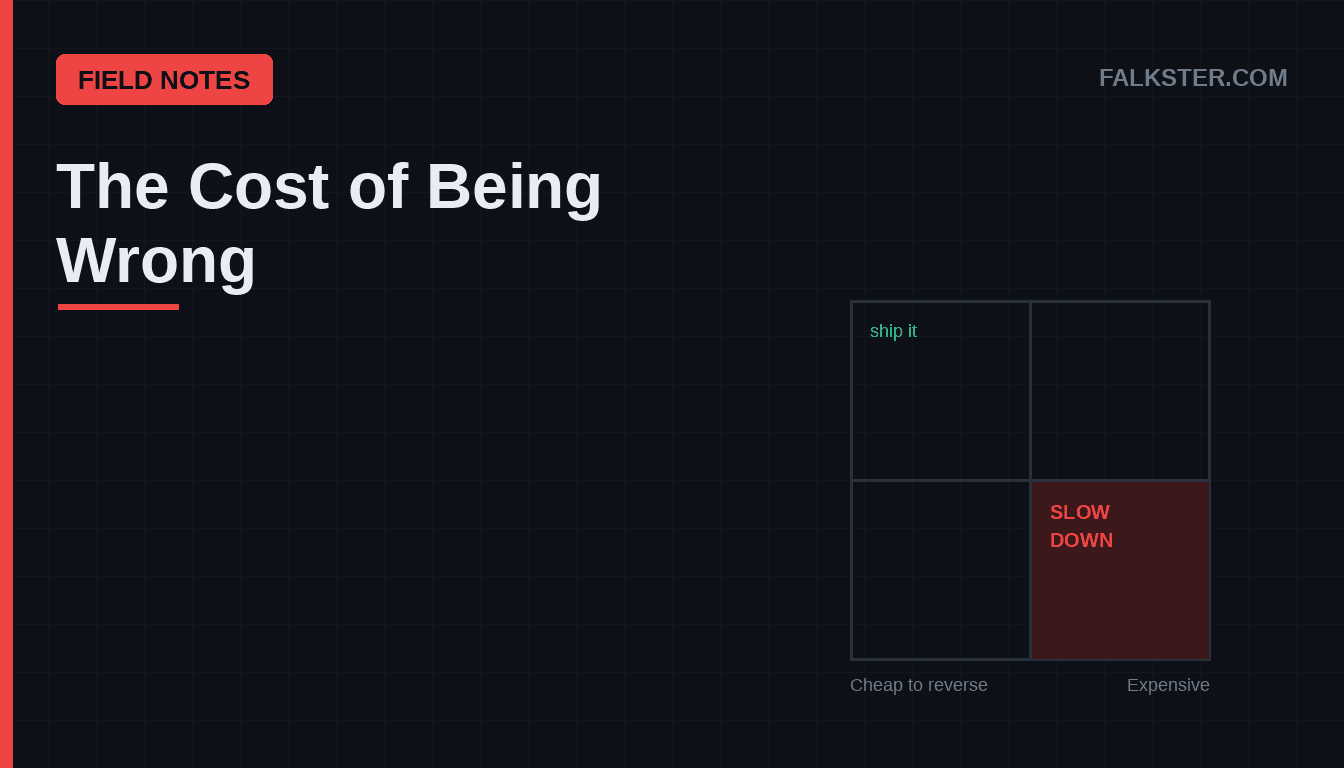
The better axis is reversibility. Two buckets.
Cheap to reverse. You can undo it on Tuesday with no lasting damage. Most UI choices, most copy, most experiments behind a flag, most internal workflows. For these, the right move is to ship now and learn. Do not spend a meeting deliberating a decision you can reverse in an afternoon. The deliberation costs more than the mistake would. Speed here is pure upside.
Expensive to reverse. Pricing and packaging, data model and schema decisions, anything customers integrate against or build workflows on top of, public commitments, and anything an autonomous agent does at scale before a human reviews it. These create dependencies or happen too fast and too often to cleanly undo. For these, slow down on purpose. Spend the scrutiny you used to spread across everything. Build the guardrails, the sampling, the human review sized to the blast radius.
The point is not to slow down generally. It is the opposite. You speed up on the large reversible majority precisely so you can afford to be deliberate on the small irreversible minority. Done right, this looks like an org that ships constantly and yet treats a handful of decisions with unusual care. That combination confuses people who think speed and caution are opposites. They are not. They are allocations.
How to install this
Make reversibility an explicit field in how you decide. When a decision comes to you, the first question is not "how big is this" but "how hard is this to undo, and what is the blast radius if we are wrong." Sort into the two buckets out loud. The sorting itself does most of the work, because it stops smart people from over-deliberating safe calls and under-scrutinizing dangerous ones.
For the agent layer specifically, tie autonomy to reversibility. The more irreversible the action, the more human review and sampling sits on top of it. An agent drafting internal notes needs almost no oversight. An agent changing a customer-facing price or touching a data model needs a human in the loop, full stop. Match the guardrail to the cost of being wrong, not to how impressive the automation looks.
The plain version
Speed used to be the constraint, so we organized everything around going faster. Speed is cheap now. The constraint is the cost of being wrong, amplified by agents that can be wrong at scale before anyone notices. Stop triaging decisions by how big they are and start triaging by how hard they are to undo.
Next time a decision lands on your desk, ask one question first: if we are wrong, can we reverse this on Tuesday? If yes, ship it and stop debating. If no, that is where your judgment is supposed to go. Spend it there.
If you are rebuilding your decision process around reversibility, or sizing guardrails for autonomous agents, that is one of the more useful conversations I am having with product leaders right now. Find me on LinkedIn.
Further reading
Also on Medium
Full archive →Frequently asked
Why does 'the cost of being wrong' matter more than speed now?+
Because building stopped being the constraint. When shipping took two quarters, speed was the bottleneck and a wrong call cost you two quarters. Now you can ship in a week, so you can also be wrong in a week, at scale, in front of customers. The binding constraint moved from how fast you can go to how expensive it is when you are wrong and how quickly you can undo it.
How should a CPO triage decisions if not by size?+
By reversibility. Cheap-to-reverse decisions should be shipped now and learned from, with no meeting wasted on something you can undo on Tuesday. Expensive-to-reverse decisions (pricing, data models, anything customers build on, anything an agent does autonomously at scale) deserve the scrutiny you used to spend on everything. Size is a poor proxy; reversibility is the real axis.
What kinds of decisions are expensive to reverse?+
Pricing and packaging changes, data model and schema decisions, anything customers integrate against or build workflows on top of, public commitments, and especially anything an autonomous agent does at scale before a human reviews it. These create downstream dependencies or happen too many times too fast to cleanly undo, so they warrant deliberate slowness.
Doesn't slowing down on some decisions just bring back bureaucracy?+
No, because you are slowing down on far fewer decisions. The point of triaging by reversibility is to stop spending scrutiny on reversible calls so you can concentrate it on the few that are genuinely costly to undo. Most decisions get faster; a small set gets slower on purpose. That is the opposite of blanket bureaucracy.
How does autonomous AI change the cost of being wrong?+
An agent can execute a wrong decision thousands of times before a human notices, which turns a small error into a large, fast, customer-facing one. That raises the cost of being wrong for anything an agent does autonomously and is why those decisions belong in the expensive-to-reverse bucket, with guardrails, sampling, and human review sized to the blast radius.

Comments (0)
Sign in with LinkedIn to leave a comment.
Sign in with LinkedIn