The first-90-days plan I used as a new product leader five years ago is mostly obsolete, and I say that having used it successfully more than once. It was a good plan for its era. The era changed. Here is how I would run the first ninety days if I stepped into a CPO role today, with the specific shifts that AI forces. One thing does not change across any of them: every CPO job is secretly a turnaround. Nobody hires a new product leader when product is going well.
The short version
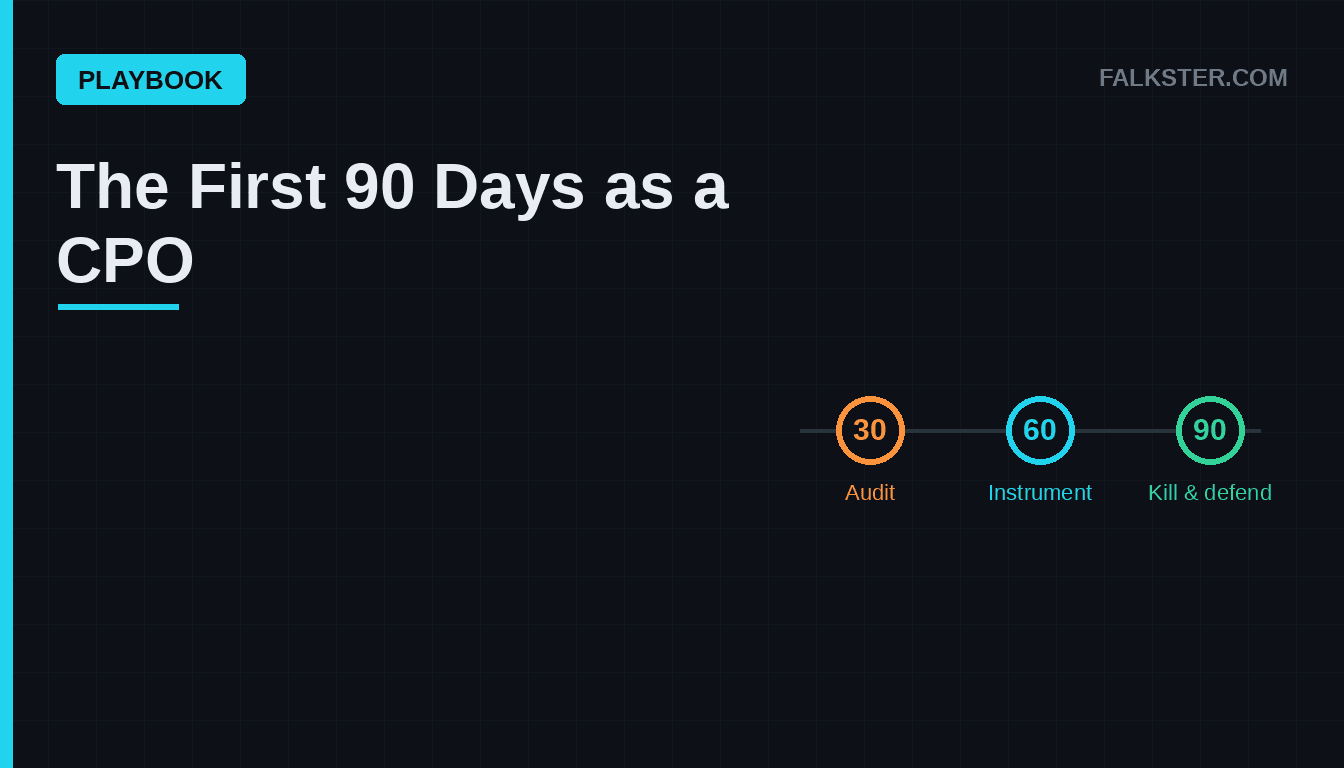
The classic CPO first-90-days plan centered on people and roadmap because execution was the constraint. Execution is no longer the constraint; judgment, cost, and quality are. So the plan changes. Days 1 to 30: audit reality, not the deck (use the product on real tasks, sit in raw customer calls, map what agents build versus people, find out if anyone reads evals). Days 30 to 60: instrument what matters (cost per outcome by workflow, eval scores with trend lines, an operating cadence that forces decisions). Days 60 to 90: kill the ceremonies that survive on inertia and defend the few things that are actually yours (problem selection, the quality bar, the expensive-to-reverse calls), and decide what to do about the segment a lean competitor would attack. The throughline: stop optimizing execution, which is cheap, and start owning judgment, cost, and quality, which is the job.
For the board-facing scoreboard you will inherit, see the CPO Mandate 2026. For the operating model underneath, see the Product Operating Model. This post is the argument; the week-by-week operational version, with templates, is the CPO 30/60/90.
Why the old plan expired
The classic plan ran on a clear logic. Execution was the expensive, risky part of building product, so a new leader spent the first quarter making the execution machine run better: learn the people, learn the roadmap, build trust, find quick wins, then start steering the machine you now understand. That logic was sound when the machine's throughput was the binding constraint.
It is not the binding constraint anymore. Throughput is cheap and getting cheaper. The constraints that decide whether the product wins moved to judgment (what to build), cost (what it takes to run), and quality (whether it stays good). A first-90-days plan that spends its energy understanding and optimizing execution is optimizing the part that is no longer scarce. Redirect the same ninety days at the parts that are.
Days 1 to 30: audit reality, not the deck
You will be handed a roadmap, an org chart, and a stack of decks. Read them, then set them aside, because they describe the company as it presents itself, not as it is. Spend the first month closing the gap between the two.
Use the product yourself, on real tasks, the way a customer would. Not a demo. You will learn more about the true state of the product in five real sessions than in fifty slides.
Sit in raw customer calls, unedited. The synthesis is downstream of someone's judgment about what mattered. You want your own read on the texture before you adopt theirs.
Map what is actually produced by agents versus people. Most orgs have a fuzzy picture of this, and the fuzziness hides both risk and opportunity. You cannot reason about cost or quality until you know what is generating the work.
Find out whether anyone reads evals. Ask the single most clarifying question available to a new CPO: what is the eval score on our most important AI feature, and which way is it trending? The answer, or the silence, tells you more about the org's maturity than any roadmap review. If the answer is "we are working on that," you have found your first real priority.
Days 30 to 60: instrument what matters
You cannot lead what you cannot see, and most product orgs are running on instruments that lag reality. The second month is about fixing the instruments.
Make cost per outcome visible by workflow. Pull the compute and agent spend out of the aggregate cloud bill and attribute it to the workflows that incur it. You will almost certainly find at least one workflow that is quietly underwater. That finding pays for the whole exercise.
Put eval scores with trend lines on every production AI feature. This is the instrument that catches quality drift before revenue does, and revenue will not warn you in time. If evals do not exist, standing them up is the highest-leverage thing your org can do this quarter.
Replace the status meeting with one that forces decisions. Move reporting into something people read beforehand, and reserve live time for the hard calls. The fastest way to change what an org optimizes is to change what its leadership meeting is about.
Days 60 to 90: kill and defend
Now you have a true picture and working instruments. The third month is about exercising judgment with them.
Kill the ceremonies that survive only by inertia. Every product org carries rituals and artifacts that persist because nobody decided to stop them, not because they earn their cost. Apply one test: does this change a decision? If not, retire it, and reinvest the time.
Defend the narrow set that is truly yours. Problem selection, the quality bar, and the few expensive-to-reverse decisions. These are the things a CPO cannot delegate and should not automate, and they are where your attention compounds. Protect them from the gravitational pull of execution detail that will try to fill your calendar.
Decide about the lean competitor. Run the exercise: if eight people started today with no legacy, which segment would they attack? Pick it, and decide deliberately whether you defend it or cede it. Leaving it undecided is the same as ceding it without noticing.
The plain version
The first ninety days used to be about understanding and improving execution. Execution is cheap now, so spend the ninety days on what is scarce: a true read on reality, working instruments for cost and quality, and the judgment to kill what does not earn its place and defend what only you can own.
If you are stepping into the role, write down the answer to one question before your second week ends: what is the eval score on our most important AI feature, and which way is it trending? Whether you can answer it, and how the org reacts to being asked, is the most honest baseline you will get.
If you are about to step into a CPO role, or you are a CEO hiring one, I am happy to compare notes on what the first ninety days should actually contain now. Reach out on LinkedIn.
Further reading
Also on Medium
Full archive →Frequently asked
How is an AI-native CPO's first 90 days different from the classic playbook?+
The classic plan centered on people and roadmap because execution was the constraint: meet everyone, learn the roadmap, find quick wins. That still partly applies, but execution is no longer the bottleneck, so the plan shifts toward auditing reality (what is built by agents versus people, whether anyone reads evals), instrumenting cost and quality, and owning judgment rather than optimizing throughput.
What should a new CPO audit in the first 30 days?+
Reality, not the deck. Use the product on real tasks, sit in raw customer calls, map what is actually produced by agents versus people, and find out whether the org reads evals. The single most revealing question is 'what is the eval score on our most important AI feature, and which way is it trending.' Most orgs cannot answer it, and that gap is more useful to know than any roadmap review.
What should be instrumented in days 30 to 60?+
Cost per outcome made visible by workflow, eval scores with trend lines on every production AI feature, and an operating cadence that forces decisions instead of narrating status. The principle is that you cannot lead what you cannot see, and most product orgs run on lagging, aggregate metrics that hide both quality drift and margin problems.
What should a CPO kill versus defend in days 60 to 90?+
Kill ceremonies and artifacts that survive only by inertia and force no decision. Defend the narrow set that is genuinely the CPO's: problem selection, the quality bar, and the expensive-to-reverse decisions. Also pick the one segment a lean competitor would attack and decide deliberately whether to defend or cede it. The aim is to concentrate attention where judgment compounds.
What is the single throughline of the AI-native CPO role?+
Stop optimizing execution, which is now cheap and increasingly automated, and start owning judgment, cost, and quality, which is what actually determines whether the product wins. Velocity is table stakes; the job is deciding what to build, knowing what it costs, and ensuring it stays good. Everything in the 90-day plan serves that shift.

Comments (0)
Sign in with LinkedIn to leave a comment.
Sign in with LinkedIn