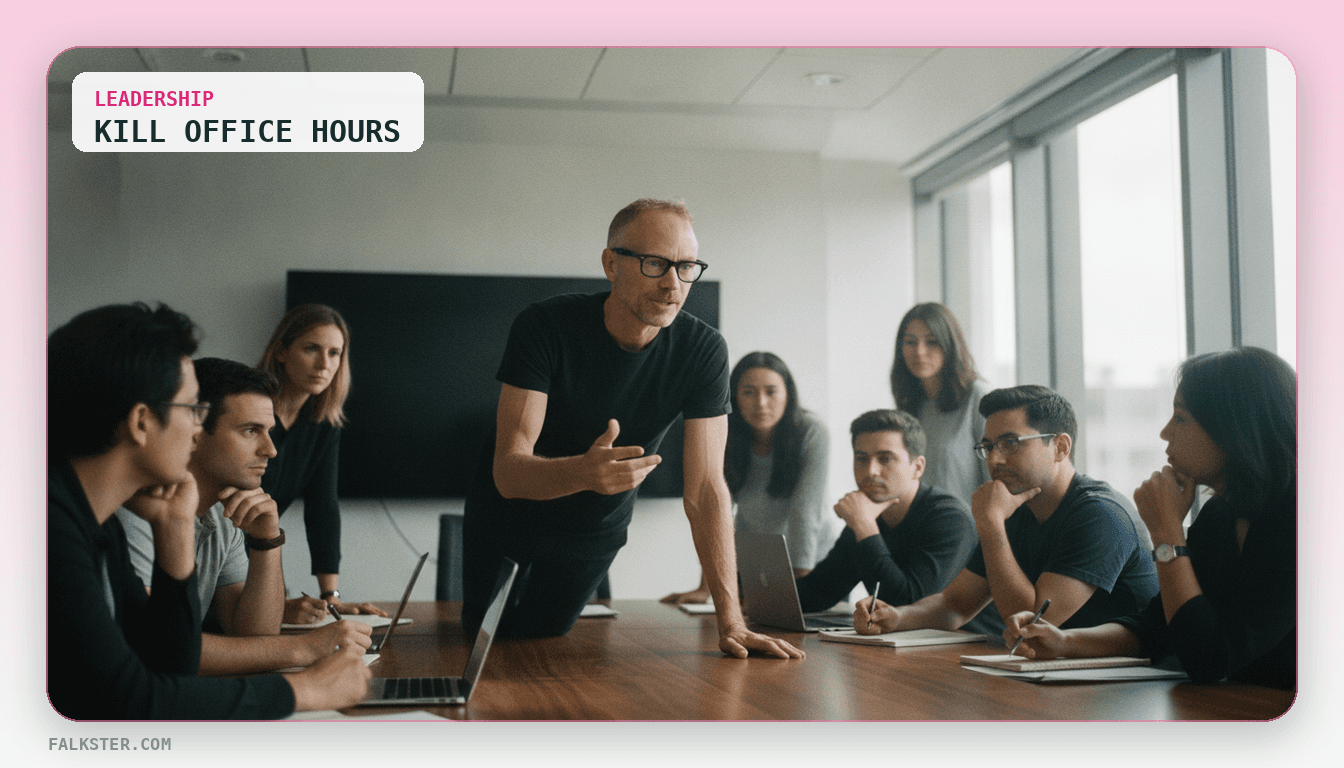
Every Friday at 2pm, in 70% of the product orgs I talk to, there is an AI office hour on the calendar. Someone from a central AI team demos a tool, shares a prompt, or runs a Q&A. The audience nods. The team returns to a workflow that is structurally identical to the one they had at the start of the meeting.
This is the 2026 version of the agile transformation. Same shape, same failure mode. A centralized team running a ceremony that signals motion without producing it.
Kill it.
The short version
AI office hours, AI Slack channels, AI prompt libraries, and AI lunch-and-learns are coping mechanisms for an org that does not know how to operationalize AI inside actual work. They produce no shipped output. They exist to make leadership feel like the org is moving. Three replacements work: paired shipping sessions, eval reviews, and kill list reviews. All three are integrated into existing workflow, not added on top of it. The test of any AI ritual is whether it changes what shipped this week. If the answer is no, kill the ritual.
For the structural argument, see the blog post Agile Is a Coping Mechanism and the handbook chapter Kill the Roadmap. For the artifact that does work (the eval), see The Five-Row Eval Template.
What an AI office hour actually looks like
Friday, 2pm. Forty-five minutes on the calendar. Three people from the central AI team. Twenty to fifty attendees from product, design, engineering, and ops.
The session has a standard shape:
- Ten minutes of demo (someone shows a new tool, agent, or prompt)
- Twenty minutes of prepared content (a deep dive on a use case, usually one the team already tried)
- Fifteen minutes of Q&A (mostly logistics, sometimes a substantive question that gets a "we'll follow up" answer)
The audience leaves the meeting with a screenshot, a Slack link, and a vague feeling that they should "try it out." Nobody schedules the time to try it out. The next office hour happens. The cycle repeats.
I have audited this format in seven product orgs in the last year. In all seven, the same pattern. High attendance. High sentiment. Zero measurable change in shipping velocity, eval discipline, or agent integration into core workflows.
The audience is not at fault. The format is at fault.
Why it fails
Three reasons.
1. Broadcast does not change behavior
The default assumption is that people change what they do when they learn about a new tool. They do not. They change what they do when the tool is in their workflow and the old workflow no longer works.
An office hour is broadcast. It tells you about the tool. It does not put the tool in your workflow.
The PMs who actually use Claude Code daily did not learn about it in an office hour. They learned about it because someone they trust sat next to them for 30 minutes and shipped a real thing with them.
2. Prompt libraries are an anti-pattern
Most office hours come with a Notion page or a Slack channel of "useful prompts." This looks productive and is not.
A prompt that solved someone else's problem is not a prompt that will solve yours. The actual craft is writing prompts against your own data, your own workflow, your own evals. A library bypasses the craft.
The strongest AI-augmented PMs I work with have a personal prompt collection that lives in their own repo or notes. The collection is short, opinionated, and constantly rewritten. None of them have ever used a shared prompt library after the first week.
3. The metric is attendance, not output
The office hour exists because someone in leadership wanted to track AI adoption. The easiest thing to track is attendance. The hardest thing to track is whether the attendees shipped something new because of what they learned.
The metric that gets tracked becomes the metric the program optimizes. Attendance is up. Output is flat. The program is declared a success.
This is the same dynamic that killed agile transformations. The framework tracked ceremonies (stand-ups, retros, sprint reviews) instead of shipped value. Ceremonies went up. Value did not.
What to do instead
Three replacements, ranked by how much they will actually move the org.
1. Paired shipping sessions
Ninety minutes. Two people. One concrete feature, prototype, or workflow shipped with agents in the loop.
Format: one person who has already shipped something similar (the "driver") sits with one person who hasn't (the "rider"). They build a real artifact for the rider's team. The driver does not give a tutorial. They share the screen and ship.
Cadence: rotate the rider weekly. The driver pool grows organically as last week's rider becomes next week's driver.
Eval: at the end of each session, the artifact has to be in the rider's team's actual workflow within 48 hours. If it is not, the session was a tutorial and should not count.
This format is the single highest-ROI replacement. It looks like an office hour from the outside (a meeting on the calendar) and is structurally different. The output is shipped work, not a screenshot.
2. Eval reviews
Thirty minutes. Once a week. The team reviews the eval scorecards for every AI-driven feature in their surface area.
Format: each feature owner brings their eval scorecard. The group asks three questions per feature. What moved? What broke? What did we kill?
Eval: by the end of the meeting, every feature has at least one explicit decision (ship, hold, kill, or invest more) and the decision is logged in the outcome ledger.
This is the replacement for the "AI quality" portion of office hours. It is operational, not ceremonial. The audience is the people who own the work, not a general audience.
3. Kill list reviews
Twenty minutes. Every other week. The team reviews what got killed because the agent surfaced it.
Format: the agent stack (discovery agents, evaluation agents, telemetry agents) generates a weekly kill candidate list. Things the data says are not paying off. The team reviews the list and decides what to formally retire.
Eval: by the end of the meeting, at least one thing is in the retirement queue. If nothing got killed for three consecutive reviews, the agent stack is not surfacing real signal and the stack needs work.
This is the operational replacement for the "AI strategy" portion of office hours. It produces shipped (or unshipped) work.
The transition script
If you currently run AI office hours and want to kill them without political fallout:
Week one: keep the calendar invite, change the format. Instead of a central demo, run a paired shipping session in the same slot. Two people, one feature. Record the artifact at the end and post it.
Week two: same slot, different pair. Add a 10-minute eval review at the start of the session.
Week three: same slot, different pair. Add a 10-minute kill list review at the end.
Week four: the meeting now has three components (paired shipping, eval review, kill list review) and produces three artifacts per session. The "office hour" branding can stay or go. The work has changed underneath it.
In every org I have seen do this, the meeting either becomes the most useful 90 minutes on the calendar or quietly stops happening. Both outcomes are wins.
Why this matters
AI office hours are not just a wasted hour. They are an active misdirection. They tell leadership the org is making progress while the actual operating model stays exactly where it was.
The cost is opportunity cost. Every hour spent in an office hour is an hour not spent shipping. Every Slack channel of prompt sharing is a Slack channel that is not a paired shipping log.
The good news is that the fix is small. The same calendar slot, with the same people, doing different work. The bad news is that doing different work is harder than running a ceremony, which is the whole reason the ceremony exists.
Kill the office hour. Pair-ship instead.
The paired shipping session format, the eval review agenda, and the kill list template are on the toolkit. For the broader kill list this post belongs to, see Kill the OKR and Kill the PRD.
Sources: Marty Cagan on ceremony vs outcome, Reforge on AI adoption, Simon Willison on prompt craft, Andy Grove on what a useful meeting looks like (HBR).
Further reading
Frequently asked
What are AI office hours?+
A recurring meeting (usually weekly, often Friday) where someone from a central AI team demos a tool, shares a prompt, or runs a Q&A. Adjacent rituals include the AI Slack channel, the AI prompt library, the AI lunch-and-learn, and the AI tools rollout email. All of them share the same shape: a centralized broadcast, low integration into actual work, no eval discipline.
Why are they the 2026 version of the agile transformation?+
Same shape, same failure mode. A centralized team runs a ceremony that signals motion without producing it. The audience attends out of obligation, picks up nothing usable, returns to a workflow that has not changed. The metric that matters (shipping velocity with AI in the loop) does not move. Leadership concludes the org 'is on the journey' and adds more ceremonies.
What's wrong with sharing prompts?+
Nothing, when the sharing is embedded in real work. Everything, when the sharing is the work. A prompt that solved someone else's problem is not a prompt that will solve yours. Prompt libraries are particularly bad because they look productive and produce nothing. The PMs who actually ship AI-augmented work have prompts that live in their own workflow, not in a shared library.
What should replace AI office hours?+
Paired shipping sessions (90 minutes, two people, one feature shipped with agents in the loop), eval reviews (the team reviews the eval scorecards for AI features weekly), and kill list reviews (the team reviews what got killed because the agent surfaced it). All three are integrated into existing workflow, not added as new ceremony.
Doesn't change management require some kind of broadcast?+
It requires demonstration, not broadcast. A demo that gets the audience to ship something within 48 hours is change management. A demo that ends with 'try it out and let us know what you think' is theater. The test of a useful AI demo is whether the audience shipped within the week, not whether they attended.
What about regulated industries where adoption needs to be controlled?+
Office hours are still the wrong tool. Controlled adoption needs gated access (the agent is wired into the workflow with permissions), monitored outputs (every agent action is logged and reviewable), and incident drills (what happens when the agent gets it wrong). All three are operational, not ceremonial. The office hour is the avoidance of doing the real work.
How do I kill AI office hours without political fallout?+
Don't kill them. Repurpose them. Convert the weekly hour into a rotating paired-shipping slot where two people from different teams ship something concrete with agents. Same time, same calendar invite, different output. The ceremony stays. The work changes.

Comments (0)
Sign in with LinkedIn to leave a comment.
Sign in with LinkedIn