Originally published on Medium.
The short version
The product manager role has evolved through four eras: the 1930s P&G Brand Man, the 1960s HP product owner, the 1980s Microsoft Program Manager, and the 2000s Big Tech PM. The next era is the AI Product Engineer: one person owning the full lifecycle (strategy, design, development, customer insights), amplified by AI to do the work of three. PMs are best positioned to step into this role because they already have customer empathy, strategic thinking, and holistic focus. The challenges are real (overload, blind spots, ethical risk). The benefits are speed, clarity, cost efficiency, and customer focus. Five years out, this is the norm for small fast-moving products.
A powerful, polarizing job
Product managers get called the "mini-CEO" of their product. The title carries admiration and resentment in equal measure.
Engineers chafe at being told what to build. Designers feel second-guessed. And the PM turns into a bottleneck, every decision routing through one person. Some of the smartest people in the room resent taking direction from someone they read as less technical.
That tension is real. It exists because the traditional PM role has been powerful.
A short history of the role
P&G invented it in the 1930s: the Brand Man, one person owning a brand from marketing through to the store shelf, end to end.
In the 1960s Hewlett-Packard adapted the idea for product development. David Packard believed the best people should own complete products.
The 1980s pushed it further. Microsoft's program managers weren't only coordinating, they were designing the product, working with engineers and business teams to shape the vision.
Then in the 2000s, Google, Amazon, and Meta professionalized it into a coveted career path built on strategic thinking, customer empathy, and a bias for execution.
Where the traditional model breaks
The traditional model breaks on handoffs and misalignment.
Priorities clash. Engineering optimizes for system design and technical excellence. Product optimizes for customer value and business impact. Design optimizes for the experience. Those don't always line up, and the PM plays arbitrator, which is its own source of friction.
Then the handoffs pile up. Product proposes, engineering estimates, design suggests alternatives, product negotiates. Three months of email threads later you've shipped 80% of what anyone wanted.
And nobody really owns it. Engineers executing someone else's vision is not the same as owning their own. Ownership is what creates accountability, pride, and speed, and the handoff model quietly starves all three.
Which is why people ask whether a PM is a "mini-CEO" or just a coordinator who slows things down. The honest answer depends on how the PM operates.
How AI makes end-to-end ownership possible
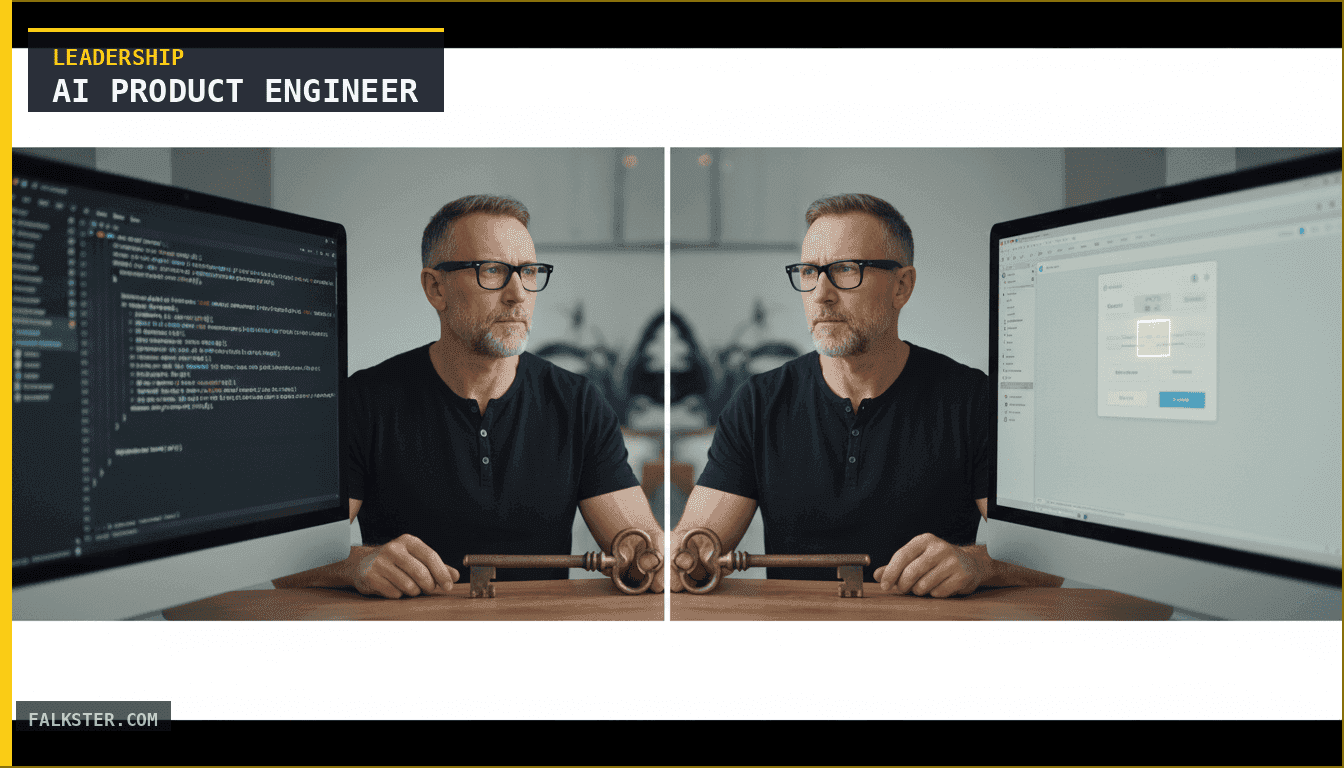
Here's what changed. One person can now do the work of three.
On strategy, AI helps you research market trends, read competitor moves, and synthesize customer feedback. You go from "I vaguely think we should build X" to "here's the data behind X, here's the customer feedback, here's the trend."
On design, Figma and AI design tools take you from idea to interactive prototype in hours instead of weeks, so you can test an assumption with users before engineering builds a thing. The full workflow is in Instant Prototyping.
On build, AI coding assistants don't just write code. They architect systems, implement features, and write tests. A strong engineer with AI ships what used to take a team.
And on customer insight, quarterly surveys give way to real-time feedback loops. You see how people actually use the product, what frustrates them, what they come back for.
One person can own all of it. Not because they're superhuman. Because AI amplified what they can already do.
What the best teams actually look like
The best teams I've seen have product leaders with engineering backgrounds who know how to work with designers. Or designers with product sense who understand engineering constraints. Or engineers with PM instincts. They're not just one thing. They're hybrid thinkers, and they own the whole product.
That's the shape the AI Product Engineer takes to its logical end.
The upside
Speed, first. No waiting for design review, no month-long argument about architecture. One person is making decisions with full context, so the thing moves.
Then clarity. Everyone knows who owns the product and what they're optimizing for. No ambiguity, no quiet tug-of-war between PM goals and engineering goals.
The economics are better too. You're paying for one person instead of three, so the unit economics work and the burn rate is lower. And the person building the product sits close to customers. They aren't removed by two layers of abstraction, so they feel the pain when something doesn't work.
The downside is just as real
Overload is the obvious one. Strategy, design, and engineering is a lot of surface area for one head, and burnout comes fast if you're not careful.
The subtler cost is blind spots. One person misses things a second person would catch. Diversity of thinking is powerful, and you give some of it up with a solo operator.
Then there's the ethical risk. Product decisions made without enough challenge can be harmful. AI gives you speed, and without the right guardrails speed is dangerous.
Why PMs are best positioned for this
Of the three disciplines, PM, design, engineering, PMs are the ones best set up to add the other two.
Start with the customer lens. PMs are trained to understand customers deeply, and that doesn't disappear when you also design or code. It gets stronger. Same with strategic thinking: business model, market dynamics, competitive positioning. That's useful in code, useful in design, and it shapes the whole product. And PMs are trained to look at the whole system, not just the code or just the interface but how everything fits together. That holistic view is the foundation for good design and good architecture. For the agent fleet that amplifies it, see Your AI Agent Fleet.
The future
The AI Product Engineer is emerging right now. In five years it's the norm for small, fast-moving products. The PM Operating System is the framework that makes it practical at any stage.
Large organizations will still need specialists. But the power, and the opportunity, sits with people who can own the full product lifecycle, move fast, and decide with full context.
Pick one part of the stack you don't own yet, design or code, and spend this week closing the gap with AI.
Also on Medium
Full archive →Frequently asked
What is the AI Product Engineer role?+
An AI Product Engineer is someone who owns the full product lifecycle: strategy and roadmapping, design and prototyping, development and deployment, and customer insights, all amplified by AI tools. It is not a formal job title but a description of the emerging archetype of one person doing what used to require three specialists. PMs are best positioned to grow into this role because they already have the customer empathy and strategic thinking at the center of it.
What are the four eras of product management?+
The 1930s P&G Brand Man (one person, end-to-end brand accountability), the 1960s HP product owner (product development ownership inspired by David Packard), the 1980s Microsoft Program Manager (design and engineering coordination), and the 2000s Big Tech PM at companies like Google and Amazon (strategy, customer empathy, execution focus). The fifth era is the AI Product Engineer.
What are the main challenges of the AI Product Engineer model?+
Three real ones: overload (doing strategy, design, and engineering can lead to burnout), limited perspectives (one person misses blind spots that a diverse team would catch), and ethical risks (AI enables speed, but product decisions made without enough challenge can be harmful). The model works best for internal tools, early-stage products, and rapid experiments.
Why is lack of ownership a problem in the traditional PM model?+
Engineers executing someone else's vision feel less accountability and less pride than they would owning their own vision. When a PM proposes, engineering estimates, and design suggests alternatives, you get three months of email threads and 80% of what anyone wanted. Ownership creates speed and cohesion that handoff-based models cannot.
Will the AI Product Engineer replace full cross-functional teams?+
Not at scale. Large organizations still need specialist engineers, designers, and product leaders. But the threshold for when you need a full team has moved. Things that used to require a team of three for four weeks now require one person for four days. That changes how you staff early products, internal tools, and experimental features.

Comments (0)
Sign in with LinkedIn to leave a comment.
Sign in with LinkedIn