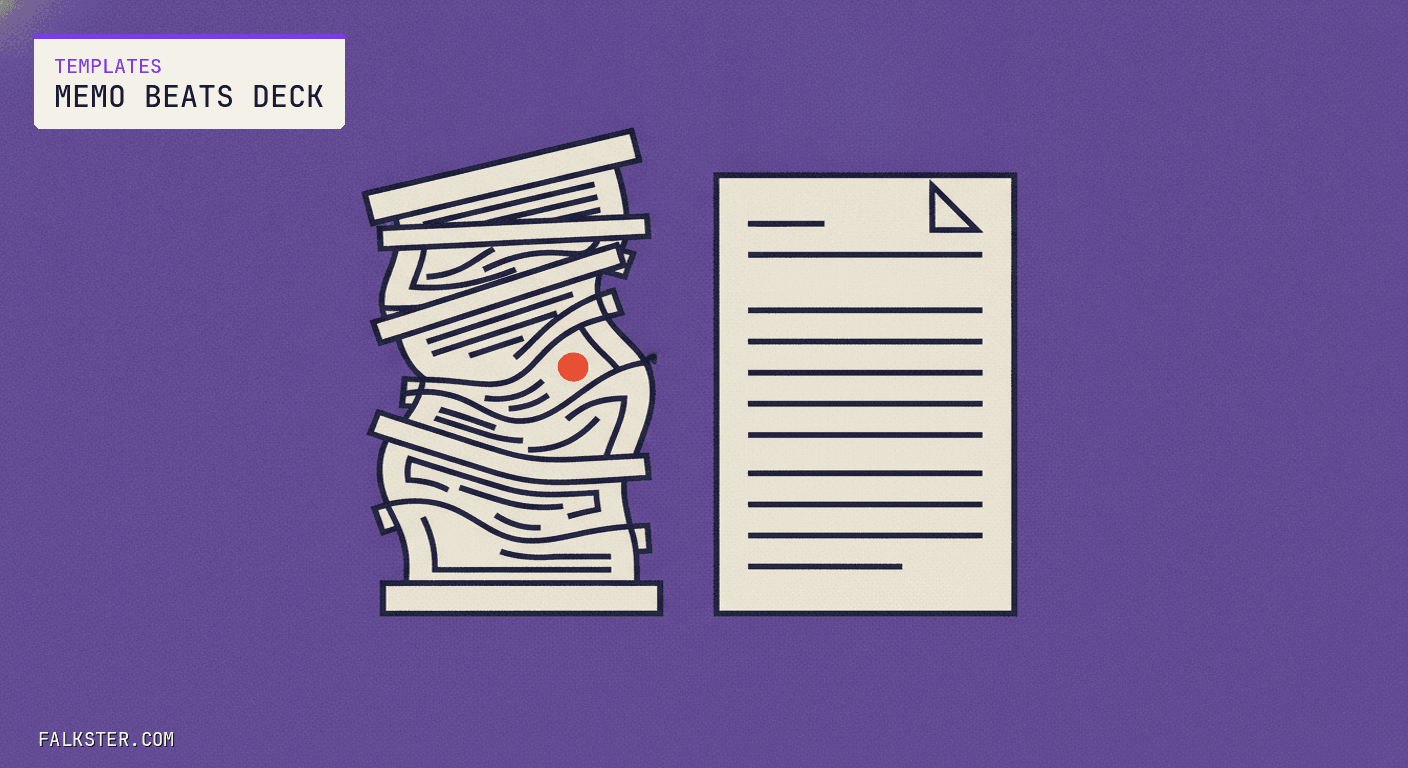
I have sat through a hundred strategy reviews where a forty-slide deck got nods in the room and produced no behavior change afterward. The deck did its job, which was to be agreed with. It did not do the strategy's job, which is to survive contact with a skeptical reader and then travel through the org intact.
Decks hide weak arguments. The transition slide, the speaker's energy, the bullet that gestures at evidence without showing it, all of it lets a soft claim ride along with the hard ones. A six-page strategy memo, read in silence, gives the soft claim nowhere to sit. Every assertion is adjacent to its evidence or visibly naked.
This is not my invention. The structure is Barbara Minto's Pyramid Principle, built at McKinsey in the 1970s, and the read-in-silence ritual is Amazon's. What I have added, after writing these memos at Salesforce and as a CPO four times over, is the product-specific template: where the anti-bets go, what the evidence slots are, and the QA test that catches a broken memo before the room does.
The short version
The template is a six-page maximum SCQA memo. The answer comes first, in one sentence at the top, per Minto. Then situation, complication, and question establish the shared ground and the choice. The answer section breaks into three grouped arguments, each a full sentence, each with three evidence slots: data, verbatim customer quotes, competitive. Then anti-bets, a premortem-sourced risks section with "what would change my mind" lines, and an ask that names a decision and a date. Final QA is the retelling test. This memo is the engine behind the day-90 readout in the CPO First-90 Kit and the long-form version of the discipline in Investor and Board Narrative.
What's in the kit
Strategy Memo Template (Markdown)
The full skeleton with bracket guidance and a length budget on every section. The parts that do the most work:
The one-sentence answer at the top. The entire memo compressed. If it takes you a day to write, that was the day the memo needed. A reader who stops after this sentence should still know what you propose and roughly why. This is Minto's governing thought, and everything below exists to support it.
Three arguments, grouped Minto-style. Mutually exclusive, collectively sufficient. Each written as a full sentence, not a topic header. "The mid-market workflow is underserved and our data proves we already win it when we show up" is an argument. "Market opportunity" is a filing label. Each argument gets three evidence slots:
Data: the one or two numbers that carry this argument, with source and date. One strong number beats five weak ones. Customer evidence: two or three verbatim quotes, dated. Verbatim, not paraphrased. Paraphrase is where wishful thinking enters memos. Competitive: what competitors structurally cannot do, with a source. "They have not done it yet" is not an argument, it is a countdown.
Anti-bets. Three to five things you are explicitly not doing, with one-line reasons. The highest alignment-per-word section in the document. The standing version of this practice is The Anti-Backlog; the memo section is its strategy-grade snapshot.
Risks via premortem. Run the premortem before writing the section: assume failure twelve months out, have the team write why, cluster the answers. The memo reports the top two or three failure modes, each with its early signal and the line that separates a strategy from a position: what would change my mind.
The ask. A decision, a decider, a date. If the ask is "alignment," the memo is an FYI and should say so. Most strategy memos die here, five pages of argument and no checkable request at the end.
Length budgets and the cut order. Six pages, hard. Over budget, cut in order: appendix candidates out of the body, situation detail, evidence kept for sentiment. Never the anti-bets, never the what-would-change-my-mind lines. Those are the credibility.
The retelling test. The final QA step, in the file. Give the memo to someone uninvolved, one read, take it away, ask for the argument back. If the retelling survives, ship it. If it collapses, fix the structure, not the prose. Your strategy will spend its life being retold in rooms you are not in, and the retelling test is the only rehearsal you get to watch.
When to use it: any decision big enough that you want it to stick for more than a quarter. New direction, a major kill, a pricing posture, an annual plan. For the weekly-cadence sibling, the scoreboard-and-asks format, that is a different instrument and a different post.
Strategy Memo (Word)
The same skeleton as a .docx for orgs that live in Word and comments-in-margins review. Identical sections and budgets. Write in whichever format your most skeptical reader will actually mark up, because the marking up is the review.
How to use it this week
Take the strategy you are currently carrying in deck form, or in your head, and write only the top of the template: the one-sentence answer, the complication, and the anti-bets. Thirty minutes.
If the one-sentence answer comes out clean and the anti-bets list names things people actually want, you have a strategy, and the remaining five pages are transcription. If the sentence will not compress, or the anti-bets section is empty, you have found out something important for the price of thirty minutes: there is no strategy yet, only intentions. Better to learn that from a template than from a board.
Then schedule the read-through. Silent reading, twenty minutes, questions after. The format from the CPO First-90 Kit's readout agenda works for any strategy memo, not just day-90 ones.
Sources: Barbara Minto, The Pyramid Principle for SCQA and the grouping rules, Amazon's narrative memo culture via Bezos's shareholder letters for the silent read, Gary Klein on the premortem for the risks section, Richard Rumelt, Good Strategy Bad Strategy for the choice-versus-wishlist test the anti-bets enforce.
Downloadable bundle · 2 files
Pick your level. Grab the JD.
Copy into your ATS, fork for your org, or send to a recruiter as-is.
Frequently asked
Why a memo instead of a strategy deck?+
A deck lets a weak argument hide behind a transition. A memo, read in silence, has nowhere to hide. Every claim sits next to its evidence, every gap is visible, and the reader sets the pace instead of the presenter. If the strategy survives six pages of connected prose, it is probably a strategy. If it only survives as bullets, it was probably a wishlist.
What is SCQA?+
Barbara Minto's opening structure from The Pyramid Principle. Situation: what the reader already agrees is true. Complication: what changed or is now wrong. Question: the choice the complication forces. Answer: your governing thought, stated first, with the supporting arguments grouped beneath it. The whole memo is the answer plus the pyramid that holds it up.
How long should a product strategy memo be?+
Six pages maximum, with budgets per section: half a page each for situation and complication, three sentences for the question, about a page per argument, a third of a page each for anti-bets, risks, and the ask. When you run over, cut situation detail and sentimental evidence first. Never cut the anti-bets.
What are anti-bets and why do they matter?+
Three to five things you are explicitly not doing, each with a one-line reason. They prove the strategy is a choice rather than a budget request, and they convert a hundred future hallway debates into one paragraph. A strategy memo without anti-bets is a wishlist with a header.
How do the three argument sections work?+
Minto's grouping rule: the arguments must be mutually exclusive and collectively sufficient. Each is written as a full sentence, not a topic, and carries three evidence slots: data, verbatim customer quotes, and competitive. If your third argument is padding, write two. The skeptical reader attacks the weakest point and generalizes.
What is the retelling test?+
The final QA step. Give the memo to someone uninvolved, let them read it once, take it away, and ask them to retell the argument from memory. If the retelling survives, the structure is sound. If it collapses into 'it was about a lot of things,' the pyramid is broken. Strategy travels by being retold in rooms you are not in.

Comments (0)
Sign in with LinkedIn to leave a comment.
Sign in with LinkedIn