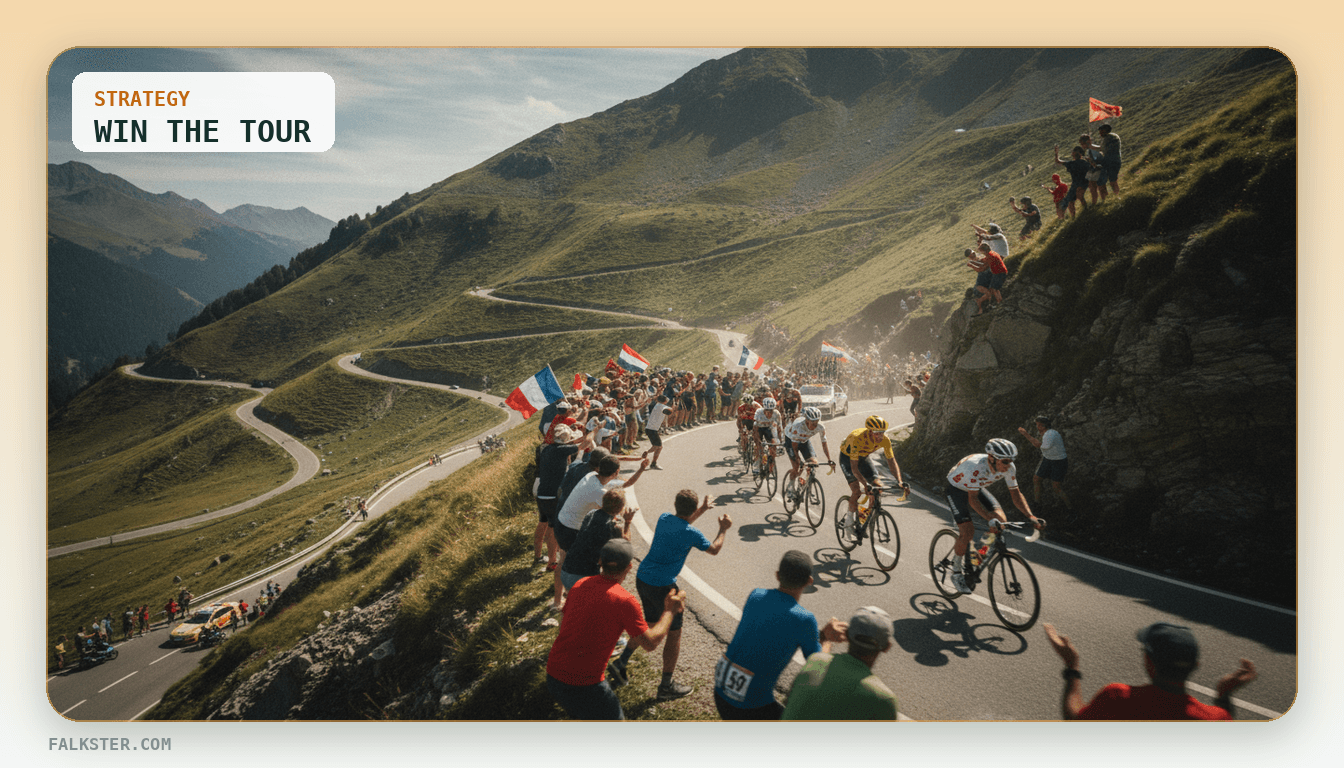
The rider who wins the most stages in the Tour de France almost never wins the Tour. Hold that thought, because it is the whole model.
The short version
You do not win the Tour de France by winning stages. It is a 21-stage race decided on cumulative time, and the rider with the most stage wins almost never wears the yellow jersey at the end. AI product management works the same way. The win is cumulative outcome across many cheap bets, not the flashiest launch, and chasing stage wins, the visible daily victory, is how teams lose the general classification that actually counts. Three things carry over: the leader wins on an invisible team of domestiques, which in an AI-native org is your agent fleet plus product ops doing the pulling; you choose your terrain instead of contesting every stage, which is tournament design; and the yellow jersey goes to whoever spent judgment best over three weeks, not whoever was strongest on any single day.
I have spent a lot of words arguing that product judgment is cumulative, that it lives in many small cheap bets rather than one heroic launch. The Tour de France is the cleanest picture of that argument I know, so here it is as a model.
You don't win by winning stages
The Tour is 21 stages over three weeks, and it is won on cumulative time. Add up every rider's time across every stage, and the lowest total wears yellow in Paris. This produces a fact that surprises people who do not watch: the rider with the most stage wins almost never wins the overall. Stage hunters and general-classification contenders are playing two different games on the same road.
Product teams confuse these games constantly. A launch is a stage win. It is visible, it photographs well, and it feels like the point. But the yellow jersey is cumulative outcome, and the cost of being wrong on any single stage is small precisely because the race is long. What matters is the total, accumulated across many days, most of which no highlight reel will remember. This is the same reason I care more about judgment reps than any individual decision: the race rewards the accumulation, not the peak.
The failure mode has a name in both sports. The stage hunter chases visible daily wins while the general classification quietly slips away. In product that is the team with a great launch cadence and no idea whether the cumulative outcome is moving. A highlight reel is not a yellow jersey.
The leader wins on a team you never see
Here is what casual viewers miss entirely. The rider in yellow is almost never the strongest engine in the race. The leader wins because a team of domestiques pulls at the front, shelters him from the wind, fetches his bottles, and sacrifices their own race so he spends the least energy and the most judgment. By the final climb, the leader has saved everything the domestiques spent.
That is the AI-native product org. The PM is the general-classification contender, and the fleet of agents is the team of domestiques, pulling through research synthesis, first drafts, monitoring, and the grunt work that used to consume the day. Product ops is the team car and the road captain, keeping everyone on the same route and catching the crash before it happens. The PM's job is not to be the strongest engine. It is to spend judgment about when to attack, which is the whole argument behind the Product Builder: the scarce input was never the pedaling.
You choose your terrain
A climber does not contest the bunch sprints. A sprinter does not chase over the high mountains. Every serious contender picks which stages to fight and, more importantly, which to sit in the pack and conserve for. Contesting everything is how you arrive at the decisive climb with nothing left in the legs.
This is tournament design in a different jersey. You do not prototype all fifty ideas any more than you sprint for every intermediate. You decide, before the evidence exists, which bets fit your terrain and deserve the energy, and you let the rest go by. The judgment is in the selection, and the discipline is in what you refuse to contest. The impact loop is how you keep score across the stages you chose.
The yellow jersey is worn by whoever spent judgment best over three weeks, not whoever was strongest on any single day, and never without a team they did not have to see. Pick your race the same way.
Frequently asked
What does the Tour de France teach about product management?+
The Tour is a 21-stage race won on cumulative time, not by winning any single day. The rider with the most stage wins almost never wins the overall. Product judgment works the same way: the yellow jersey goes to whoever accumulated the best outcome across many small bets, not whoever shipped the flashiest launch. Optimizing for stage wins, the visible daily victory, is how teams lose the general classification, the thing that actually counts.
Who is the domestique in an AI product team?+
The agents and the product ops function. In cycling, the general-classification leader wins because domestiques pull, shelter, and sacrifice so the leader spends the least energy and the most judgment. In an AI-native product org, a fleet of agents does the pulling, research synthesis, drafting, monitoring, and product ops keeps everyone on the same road. The PM's job is not to be the strongest engine, it is to spend judgment about when to attack.
How does choosing your terrain apply to product bets?+
A climber does not contest the bunch sprints, and a sprinter does not chase the mountain stages. You pick which stages to fight. In product terms that is tournament design: deciding which bets deserve a prototype before any evidence exists, and refusing to spend energy on the ones that do not fit your terrain. Contesting every stage is how you arrive at the mountains with nothing left.
What is the stage-hunter failure mode for a PM?+
Chasing visible daily wins, launches, demos, shipped features, while the cumulative outcome quietly slips away. A stage win feels like progress and photographs well. But if nobody is riding for the general classification, you finish the three weeks with a highlight reel and no yellow jersey. It is the same trap as mistaking motion for judgment.
What is the one-line version of the Tour de France model?+
The yellow jersey is worn by whoever spent judgment best over three weeks, not whoever was strongest on any single day, and never without a team you do not see. Pick your race the same way: cumulative outcome, chosen terrain, and a fleet doing the pulling.

Comments (0)
Sign in with LinkedIn to leave a comment.
Sign in with LinkedIn