Stream a simulated run, inspect the notifications it would send on Slack and email, and see exactly where it sits in the 7-stage PM OS flow. No password required.
The short version
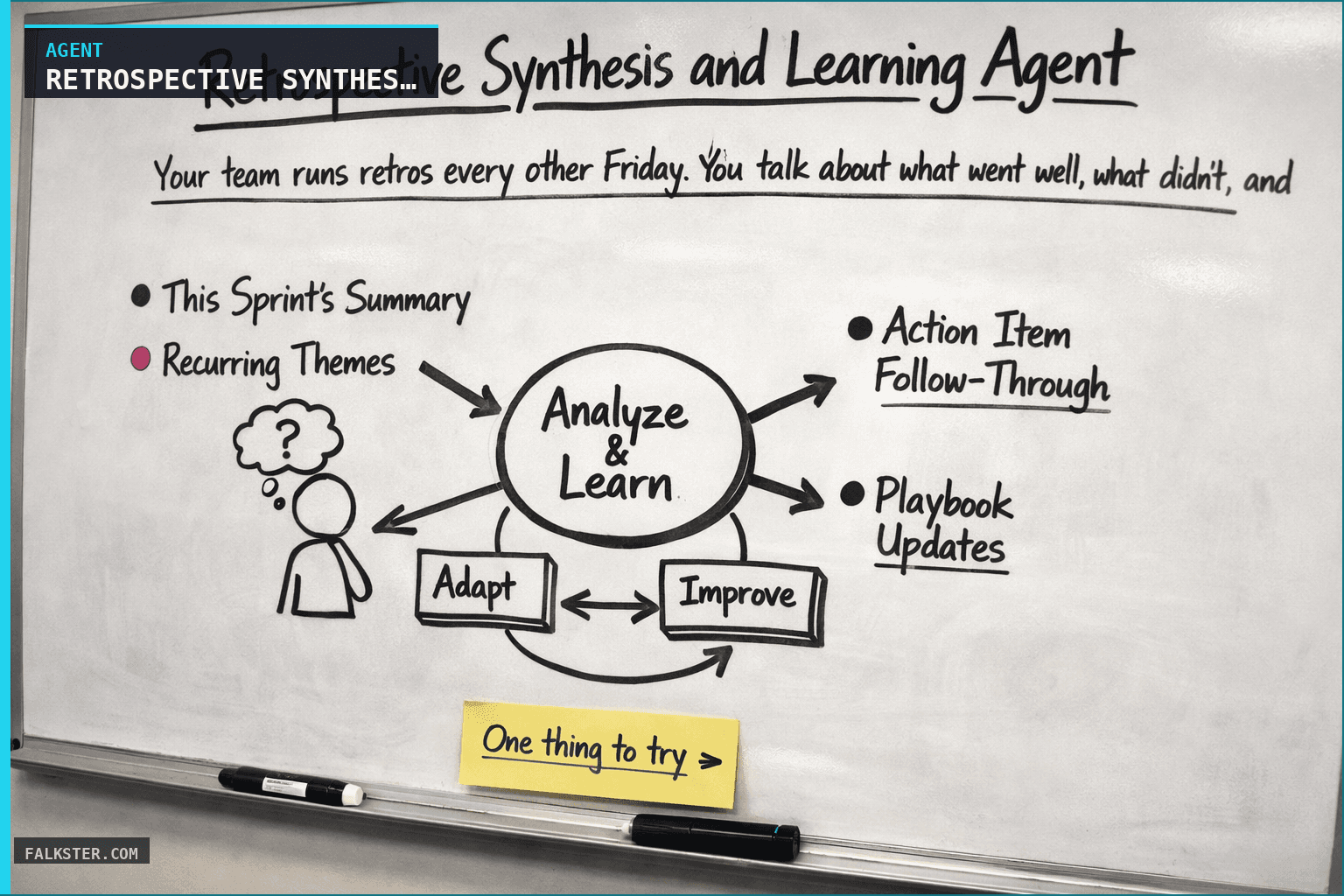
The Retrospective Synthesis agent runs every Friday at 5 PM after your retro and turns retro notes into actual learning. It compares today's retro against the last 8 retros, detects recurring themes (the "slow deploys" complaint mentioned 5 times that nobody fixed), tracks action item follow-through, and proposes specific playbook updates. The point is to stop re-discovering the same problems every quarter. Three sprints from now, you'll have a living team playbook that's been updated 6 times with patterns you actually learned. Connect your retro notes repo and run it on this week's session.
Your team runs retros every other Friday. You talk about what went well, what didn't, and what to improve next sprint. You leave with action items. Then... nothing happens. For a faster, data-first retro format, see Run a 15-Minute Sprint Retro That Actually Improves Things.
The problem is documentation. Retro notes sit in a doc nobody reads. Months later, you're re-discovering the same problems. "We should do more async standups" (you said that 3 sprints ago). "We need better code review discipline" (same issue, second time).
The Retrospective Synthesis agent captures retro learnings and surfaces them. Every Friday evening, it reads the retro notes from that day and: identifies recurring themes across sprints, updates your team playbook, and flags high-priority issues. You actually learn from retros instead of just going through the motions.
How It Works
The agent processes retro notes and applies learning logic:
Retro parsing: Reads raw retro notes (what went well, what didn't, action items) and structures them. Extracts: specific problems mentioned, proposed solutions, owners, and severity.
Pattern detection: Compares this retro against 8+ previous retros. Is this a recurring problem? First time? Did we say we'd fix this last sprint and fail to follow through?
Playbook updates: If a solution is recommended (and agreed), the agent extracts: the principle/process change, and updates your team playbook. "We agreed to async standups. That goes in the playbook."
Incident/pattern flagging: If the same issue appears 3+ times, it gets flagged. "We've complained about slow deploys 5 times. We keep saying we'll fix it and we don't. Let's actually prioritize it."
The output: a retro summary (what changed, what to track), updated playbook, and flagged high-priority patterns.
Data Sources and Setup
Prerequisites: You'll need:
- Retro notes repository: Retros stored in Notion, Google Docs, or a shared drive
- Sprint metrics: Velocity, bugs, incidents, deployment frequency - to correlate with retro themes
- Team playbook: Current processes and principles (so the agent can update it)
- Historical retros: At least 8-10 past retros to identify patterns
- Action items tracking: Which action items from past retros were completed? Abandoned?
Schedule: Weekly Friday at 5 PM (after retros). Processes that day's retro.
The Claude Prompt
You are synthesizing sprint retros and extracting learnings.

Here's today's retro notes:
[RETRO NOTES:
- What went well
- What didn't go well
- Action items and owners
- Any process changes discussed]

Here's our sprint metrics for context:
[METRICS: velocity, bugs found, incidents, deployment frequency, pull request cycle time]

Here are the past 8 retro summaries (from previous sprints):
[PAST RETROS:
- Sprint date
- Top complaints/themes
- Top wins/themes
- Action items and whether they were completed]

Here's our current team playbook:
[PLAYBOOK: current processes, principles, and guidelines]

Here's what we said we'd improve and whether we did:
[ACTION ITEMS: past items, completion status]

Please analyze and report:

1. **This Sprint's Summary**
   - Top 3 wins this sprint
   - Top 3 problems this sprint
   - Proposed action items
   - Metrics context: was velocity up/down? bugs up/down? Any correlation with retro themes?

2. **Recurring Themes** (PRIORITY)
   - Which problems have appeared in 2+ retros?
   - Which in 3+ retros?
   - Are we repeating ourselves instead of fixing?
   - Examples: "slow deploys" (mentioned 5 times, never addressed), "communication gaps" (mentioned 3 times, partially addressed)

3. **Action Item Follow-Through**
   - What action items from past retros did we actually complete?
   - What did we commit to but not follow through on?
   - Why? (deprioritized? too hard? unclear owner?)

4. **Playbook Updates**
   - Should we add any processes to the playbook?
   - Should we change any existing processes?
   - What principle should we encode from this sprint's learnings?

5. **Team Health Indicators**
   - Is team morale improving or declining?
   - Are we shipping faster or slower?
   - Are we more coordinated or less?

6. **High-Priority Issues**
   - Which problems from this retro need immediate action?
   - Which can wait?
   - Which are systemic vs. one-time issues?

7. **Recommendations**
   - What's the ONE thing we should commit to fixing next sprint?
   - What process change would have the biggest impact?
   - What do we need to stop doing?

Format as a retro summary and playbook update. Be specific enough that the team can act on it.
What you get
Retro insights stop evaporating. You track recurring problems instead of re-discovering them every three months, and you see which improvements you committed to but never followed through on. The playbook evolves off actual experience, not theory. And the agent keeps pointing at the thing you keep ignoring: "deployments are slow" complained about 5 times and never fixed is a signal, not another line item. Each retro builds on the last instead of sitting in its own doc. It's the Amplify stage of the AI Agent Fleet.
What comes out of that: velocity ticks up because you're finally fixing the recurring bottlenecks, morale ticks up because action items get done, and you stop re-litigating the same problems every quarter.
For the full agent fleet and scheduling details, see Your AI Agent Fleet.
Also on Medium
Full archive →AI Agents and the Future of Work: A Pixar-Inspired Journey
What product managers can learn about AI agents from how Pixar runs a film team.
Many AI Agents Are Actually Workflows or Automations in Disguise
How to tell agents from workflows from cron jobs, and why it matters for what you ship.
Frequently asked
What does the Retrospective Synthesis agent do?+
It runs every Friday at 5 PM after your retro and reads that day's retro notes. It compares them against the last 8 retros, detects recurring themes, tracks action item follow-through, and proposes specific playbook updates. The output is a retro summary, an updated team playbook, and a list of high-priority recurring patterns that need real prioritization.
What is pattern detection in retro synthesis and why does it matter?+
The agent looks across 8 or more previous retros to find problems that keep appearing. If 'slow deploys' has been mentioned 5 times across 5 sprints without resolution, that is a pattern worth prioritizing, not another action item to forget. The agent flags these explicitly so the team stops re-discovering the same problems and starts actually solving them.
How does the agent track action item follow-through?+
It compares action items from past retros against completion status in your tracking system. It tells you which items were completed, which were abandoned, and which were committed to but never followed through on. This makes the invisible visible: 'we said we'd fix this three times and never did' is a signal that the fix is either under-resourced or unclear.
What data does this agent need to run?+
Retro notes stored in Notion or Google Docs, sprint metrics (velocity, bugs, deployment frequency), your team's current playbook, at least 8-10 historical retros, and action items tracking. The schedule is Friday at 5 PM, running after the retro itself is complete.
How is this different from manually reviewing retro notes?+
Manual review requires opening 8+ documents and building a pattern map in your head. The agent does this in minutes and surfaces the patterns you might not notice because they span long time periods. Three sprints from now you have a living playbook updated 6 times with patterns your team actually learned.

Comments (0)
Sign in with LinkedIn to leave a comment.
Sign in with LinkedIn