Stream a simulated run, inspect the notifications it would send on Slack and email, and see exactly where it sits in the 7-stage PM OS flow. No password required.
The short version
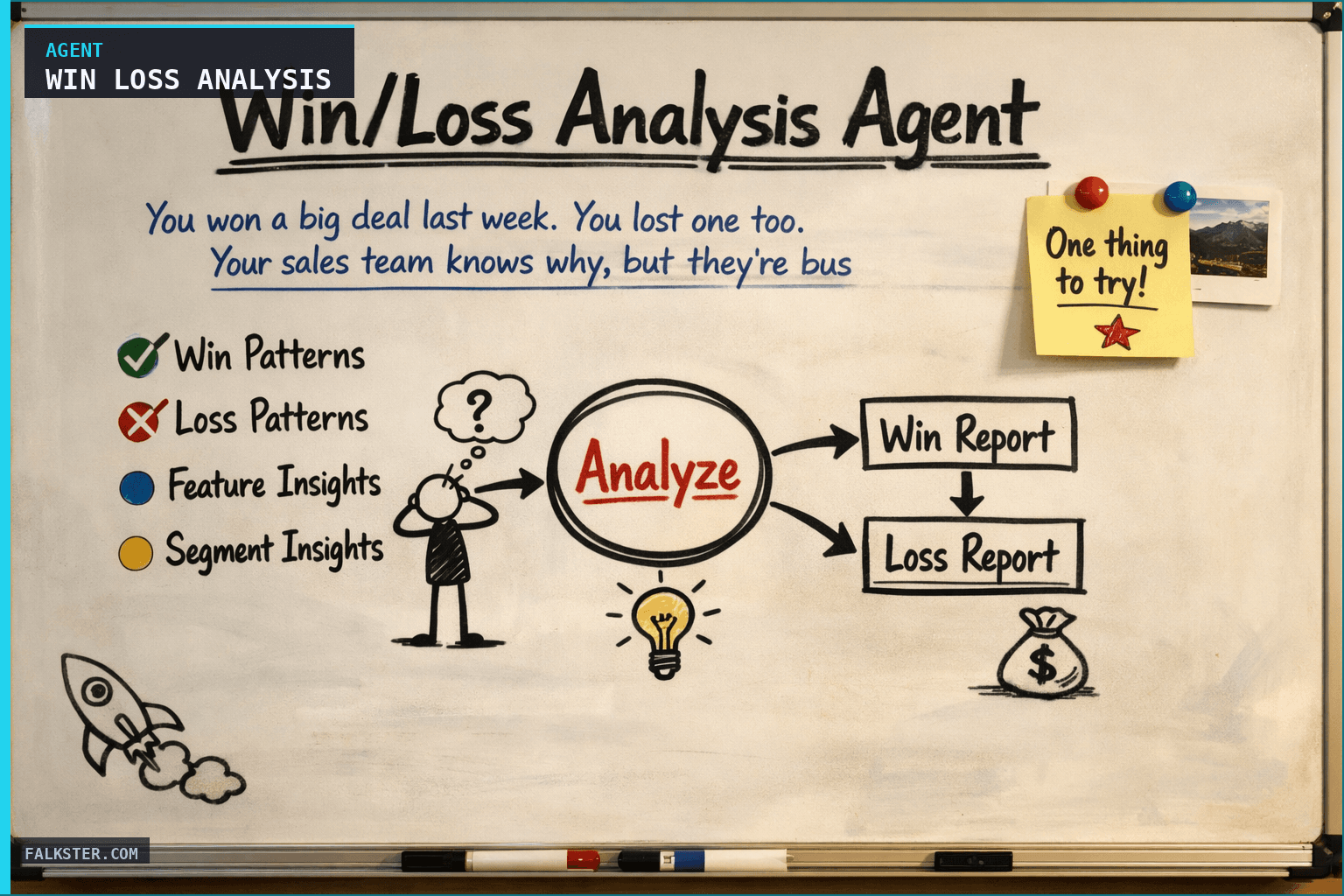
The Win/Loss Analysis agent runs bi-weekly Tuesday at 10 AM and reads every won and lost deal from the last two weeks. It pulls from Salesforce (deal size, close reason, sales notes), call transcripts, and win/loss interviews, then extracts seven categories of insight: win patterns, loss patterns, feature insights, segment insights, competitive positioning, pricing insights, and three recommendations. The point is to stop building features nobody asked for and start building the ones that move deals. The output of one run: "We win enterprise on API reliability and lose mid-market on price. Two product fixes would convert 30% of mid-market losses."
You won a big deal last week. You lost one too. Your sales team knows why, but they're busy with the next deal. The insights get lost. For the continuous discovery loop that puts these insights to work, see Continuous Discovery.
Meanwhile, product doesn't know: are you losing deals because of a product gap? A pricing problem? Bad UX? Or just competitive pressure? You're building features nobody asked for while missing the ones that would actually close deals.
The Win/Loss Analysis agent extracts insights from your deal outcomes. Bi-weekly, it reads: recent wins (Salesforce), recent losses (with call notes or post-mortems), and customer interviews. It synthesizes: what products/features are you winning on? What gaps are costing you deals? What are competitors doing that you're not?
How It Works
The agent pulls three sources and looks for patterns.
Wins first. Recent closed-won deals from Salesforce, with deal size, segment, cycle length, and sales notes for each. The agent hunts for what they share. "Every enterprise win mentions API reliability" tells you API reliability is a differentiator.
Then losses. Recent closed-lost deals, the recorded reason if there is one, sales notes, and call notes if you have them. "We lost to competitor X because they had feature Y." "Customer went with the cheaper option."
Last, interviews. If you run win/loss interviews, feed in the transcripts. The "why did you choose us" and "why didn't you choose them" conversations are where the real story lives.
Out of that comes a set of product insights you can act on.
Data Sources and Setup
Prerequisites: You'll need:
- Salesforce: Win/loss records, deal size, customer segment, close reason, sales notes
- Call recordings / transcripts: Sales calls with lost prospects (if available)
- Win/loss interview data: Structured interviews with customers and churned customers
- Competitive context: Rough knowledge of what competitors offer
- CRM contact history: To understand decision-making (who was involved? how long did it take?)
Schedule: Bi-weekly Tuesday at 10 AM. Analyzes 2 weeks of deal outcomes.
The Claude Prompt
You are analyzing won and lost deals to extract product insights.

Here are the deals we won in the past 2 weeks:
[WON DEALS:
- Deal size and customer segment
- Sales cycle length
- Key decision-maker roles
- Reason selected us (from Salesforce or sales notes)
- Key features that came up in conversations
- Objections we overcame]

Here are the deals we lost in the past 2 weeks:
[LOST DEALS:
- Deal size and customer segment
- Sales cycle length
- Reason we lost (if recorded)
- Competitor who won (if known)
- Key objections we couldn't overcome
- Notes from sales team]

Here's win/loss interview data (if available):
[INTERVIEWS:
- Customer quotes on why they chose us
- Reasons they almost didn't
- Competitor comparisons
- Feature gaps they mentioned
- Anything surprising they said]

Here's our competitive context:
[COMPETITORS: rough comparison of features, pricing, positioning]

Please analyze and report:

1. **Win Patterns**
   - What's common across our wins? (segment? deal size? time to close?)
   - Which features are we winning on most?
   - Which customer segments are easiest to close?
   - What objections do we overcome successfully?

2. **Loss Patterns** (PRIORITY)
   - What's common across our losses?
   - Are we losing to a specific competitor? If so, why?
   - What's the #1 reason we lose deals?
   - Are we losing to price? To features? To something else?
   - Which segments are hardest to close?

3. **Feature Insights**
   - Which features do winning customers care most about?
   - Which feature gaps are costing us deals?
   - Are there features we're building that don't move deals?
   - Which features should we emphasize in sales?

4. **Segment Insights**
   - Do winning segments have different needs than losing segments?
   - Are we positioned best in some segments and weak in others?
   - Should we focus on segments where we win more?

5. **Competitive Positioning**
   - Which competitors are we losing to most?
   - What are they doing that we're not?
   - What's our advantage vs. them?
   - Where are we vulnerable?

6. **Pricing Insights**
   - Are we losing deals to price?
   - Does price sensitivity vary by segment?
   - Are we winning on price? Against whom?

7. **Recommendations**
   - Top 3 product improvements that would help us win more deals?
   - Which segments should we invest in most?
   - What should we fix urgently? What can wait?

Format as a clear analysis with patterns and actionable insights. I should be able to use this for roadmap planning.
What You Get
Deal outcomes stop being invisible to product. You know which features would actually close deals, and whether you're losing them for the same reason customers churn, backed by data instead of a hunch. You get a clear read on what you win on and where you're exposed. You can see that some segments close at 60% and others at 20%, and start asking why. And you find out whether you're losing to price or to product, which is the thing that changes your whole strategy.
Downstream, you stop building for the loudest customer and start building what moves deals. Sales gets real data to sharpen positioning ("we win when we lead with API reliability"). And you catch competitive threats while they're still small ("competitor X is taking enterprise deals with feature Y"). Feed all of it into the Impact Loop to check whether your product fixes actually move win rates.
For the full agent fleet and scheduling details, see Your AI Agent Fleet.
Also on Medium
Full archive →AI Agents and the Future of Work: A Pixar-Inspired Journey
What product managers can learn about AI agents from how Pixar runs a film team.
Many AI Agents Are Actually Workflows or Automations in Disguise
How to tell agents from workflows from cron jobs, and why it matters for what you ship.
Frequently asked
What does the Win/Loss Analysis agent do?+
It runs bi-weekly on Tuesday at 10 AM and reads every won and lost deal from the last two weeks. It pulls from Salesforce (deal size, close reason, sales notes), call transcripts, and win/loss interviews, then extracts seven categories of insight: win patterns, loss patterns, feature insights, segment insights, competitive positioning, pricing insights, and three product recommendations. The point is to stop building features nobody asked for and start building the ones that move deals.
Why is win/loss analysis a product problem, not just a sales problem?+
Product decisions drive win and loss patterns. If you're losing mid-market deals on price, that might be a packaging problem, not a pricing one. If you're winning enterprise on API reliability, that tells you where to invest. Sales knows the stories but not the pattern. This agent reads the patterns across every deal and translates them into product action.
What data sources does the Win/Loss agent need?+
Salesforce for win/loss records with deal size, customer segment, close reason, and sales notes. Call recordings or transcripts from lost prospect conversations. Win/loss interview data from structured customer interviews. Competitive context on what competitors offer. The schedule is bi-weekly Tuesday at 10 AM covering the prior two weeks of deal outcomes.
What is the most valuable output of the win/loss analysis?+
The loss pattern analysis, which is labeled PRIORITY in the prompt. Understanding what's common across losses, which competitor is winning and why, and whether you're losing to price or product is the single highest-leverage input to roadmap decisions. One run might show: 'We lose mid-market on price, but two product fixes would convert 30% of those losses.'
How is automated win/loss different from quarterly win/loss reviews?+
Quarterly reviews are retrospective and rely on sales team memory. By the time the review happens, the context is stale and the reps are on to the next deal. Bi-weekly automation catches patterns while the data is fresh and delivers them to product in time to act before the next sprint planning cycle.

Comments (0)
Sign in with LinkedIn to leave a comment.
Sign in with LinkedIn