Stream a simulated run, inspect the notifications it would send on Slack and email, and see exactly where it sits in the 7-stage PM OS flow. No password required.
The short version
The OKR Tracker agent gives you daily progress scoring and weekly confidence predictions for every key result. Daily at 4 PM, it pulls the latest metrics from Amplitude, Mixpanel, and Salesforce, scores each OKR against the trajectory needed, and flags anything off-track. Friday at 3 PM, it runs the confidence model: "you're at 65% of target with 4 weeks left, current velocity puts you at 82%, here's what would need to change to hit 100%." The point is to stop being surprised at the end of the quarter and catch slippage at week 5 when you can still course-correct. Set up the metrics feeds, then ask which Q2 OKR has the lowest confidence score today.
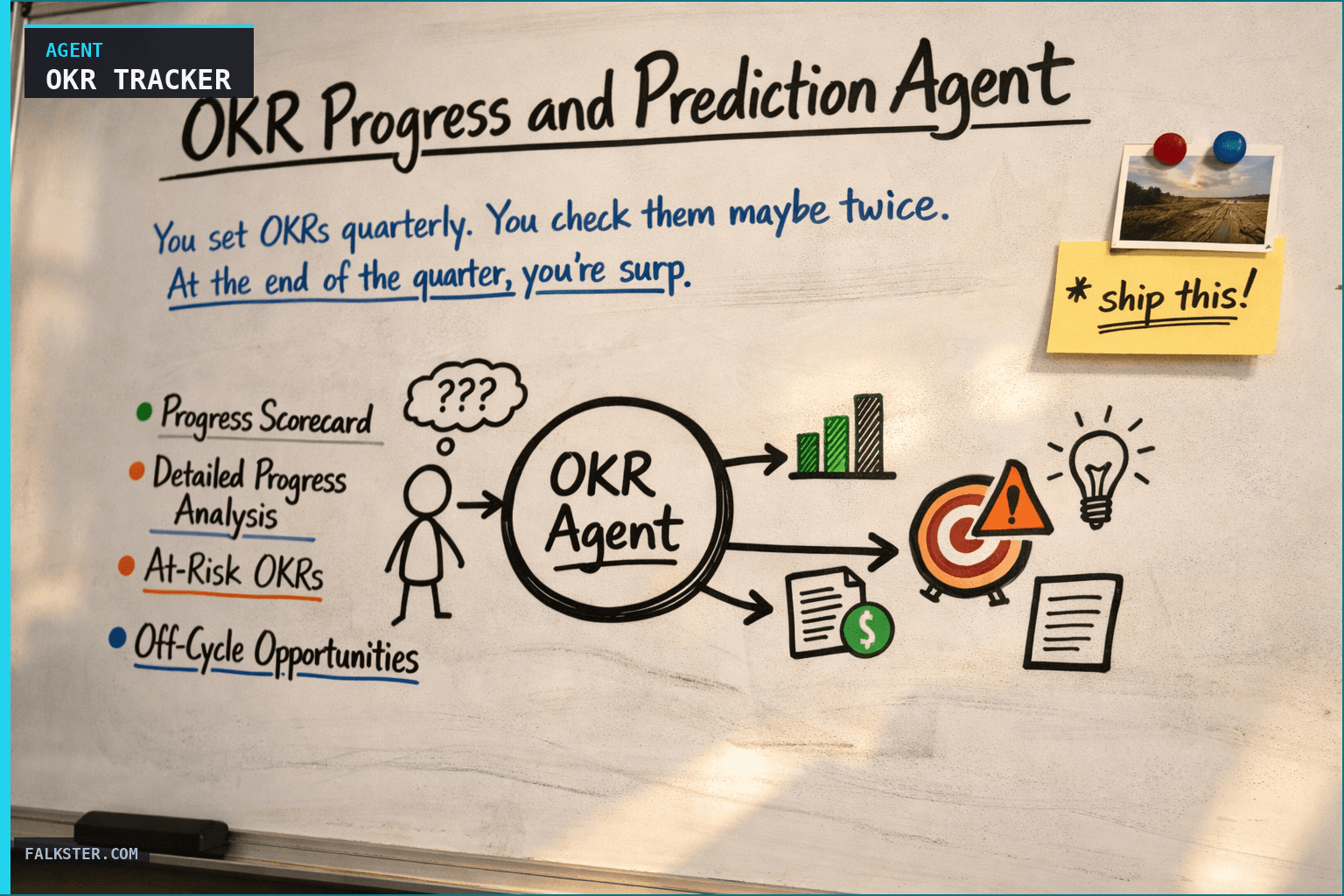
You set OKRs quarterly. You check them maybe twice. At the end of the quarter, you're surprised by the results.
The problem is visibility. If you're tracking manually (spreadsheets, quarterly reviews), you're always behind. You find out about slippage weeks after it happened. By then it's too late to course-correct.
The OKR Tracker agent maintains real-time visibility. Daily at 4 PM, it pulls the latest metrics for each OKR, scores progress, and flags anything off-track. Weekly it predicts: given current velocity, will you hit this OKR? If not, what do you need to do to get back on track?
How It Works
The agent connects to your metrics sources and runs continuous scoring:
Daily snapshot: Pulls the latest values for each OKR's key results. If you're tracking "reduce churn by 2%," it pulls yesterday's churn number. If you're tracking "increase enterprise ARR by $2M," it pulls recent close data from Salesforce.
Progress scoring: Compares current progress against the trajectory needed. At week 5 of a 13-week quarter, you should be roughly 38% of the way to your goal. If you're at 25%, you're off-track.
Weekly prediction: Using current velocity, the agent models: will you hit this OKR? How confident are you? What would need to change? "You're at 65% of target with 4 weeks left. If you maintain this velocity, you'll hit 82% of goal. To hit 100%, you need to accelerate 25%."
Red flags: Anything trending in the wrong direction, or confidence dropping below 50%, gets highlighted.
Data Sources and Setup
Prerequisites: Complete the Claude setup guide first. You'll need:
- Metrics platform: Amplitude, Mixpanel, or custom dashboard that tracks your OKR metrics daily
- CRM: For revenue-based OKRs (ARR, pipeline, win rate)
- Analytics: For product-based OKRs (activation, retention, feature adoption)
- Your OKR document: Goals, key results, target numbers, and what "success" means
- Experiment tracking: To understand which initiatives are driving which metrics
Schedule: Daily at 4 PM (score tracking). Weekly Friday at 3 PM (confidence prediction).
The Claude Prompt
You are tracking our OKR progress and predicting achievement likelihood.

Here are our Q2 OKRs:
[OKR LIST: goals, key results, target numbers, definitions]

Here's the current metrics snapshot (as of today):
[METRICS: current values for each OKR, historical trend for past 4 weeks]

Here's the quarter timeline:
[TIMELINE: today's date, weeks elapsed, weeks remaining]

For weekly predictions, here are our recent initiatives:
[INITIATIVES: experiments, launches, changes that might affect metrics]

Please analyze and report:

1. **Progress Scorecard** (for daily reports)
   For each OKR:
   - Key result name
   - Target number
   - Current progress
   - % of goal achieved
   - On track / at risk / off track?
   - Trend (improving / stable / declining)?

2. **Detailed Progress Analysis** (for weekly reports)
   For each OKR:
   - Progress to date
   - Velocity (rate of progress per week)
   - Trajectory: if current velocity continues, what % will you achieve?
   - Confidence: % chance you hit 100% of goal
   - What would need to change to hit goal?

3. **At-Risk OKRs** (PRIORITY)
   - Which OKRs are below 50% confidence?
   - For each at-risk OKR:
     - Why is it slipping? (metric stalling, wrong initiative, external blocker?)
     - What's the gap between needed velocity and current velocity?
     - What could course-correct? (new initiative? reprioritization? better execution?)

4. **Off-Cycle Opportunities**
   - Are any OKRs likely to overachieve (>120%)?
   - Are there quick wins that could push at-risk OKRs over the line?
   - Should you reallocate effort from overachieving OKRs to at-risk ones?

5. **Initiative Impact**
   - Which initiatives are moving which OKRs?
   - Are your biggest efforts producing the biggest results?
   - Any disconnects (expected big impact but little metric movement)?

6. **Next Week Recommendations**
   - What should the team focus on?
   - For at-risk OKRs, what's the highest-leverage action?

Format clearly: I should be able to see at-a-glance which OKRs are on track and which need attention.
What you get out of it
The quarterly surprise goes away. You know where every OKR stands each day instead of at the readout, and at-risk ones get flagged weeks early, while you can still do something about them. The scoring isn't just "on track," it's "82% likely to hit goal at current velocity," and it names what's going to slip before it slips. You also see which initiatives are actually moving the metric and which ones just felt busy.
So you catch a declining metric the week it turns, not at the end-of-quarter review. You course-correct in month two instead of missing the target in month three. And you point effort at what the numbers say matters, not at what you guessed mattered back in the planning offsite.
For the full agent fleet and scheduling details, see Your AI Agent Fleet.
Also on Medium
Full archive →AI Agents and the Future of Work: A Pixar-Inspired Journey
What product managers can learn about AI agents from how Pixar runs a film team.
Many AI Agents Are Actually Workflows or Automations in Disguise
How to tell agents from workflows from cron jobs, and why it matters for what you ship.
Frequently asked
How does an OKR tracking agent prevent end-of-quarter surprises?+
It pulls metrics daily and scores each key result against the trajectory needed. At week 5 of a 13-week quarter, you should be roughly 38% of the way to your goal. If you are at 25%, the agent flags it immediately. You find out about slippage at week 5 when you can still course-correct, not at week 13 when the quarter is over.
What is confidence scoring and how does the OKR agent calculate it?+
Confidence scoring is the predicted probability that you hit 100% of the OKR goal given current velocity. If you are at 65% of target with 4 weeks left and maintaining current pace, the agent models that you will hit 82% of goal, giving you roughly 60% confidence of hitting 100%. It also tells you what would need to change to close the gap: accelerate 25%, or reallocate effort from an overachieving OKR.
What data sources does the OKR tracker agent connect to?+
A metrics platform (Amplitude, Mixpanel, or a custom dashboard) that tracks your OKR metrics daily, a CRM for revenue-based OKRs like ARR and pipeline, analytics for product-based OKRs like activation and retention, your OKR document with goals, targets, and success definitions, and experiment tracking to understand which initiatives are driving which metrics.
How does the agent handle OKRs that are overachieving?+
It flags OKRs likely to exceed 120% of target as overachieving and asks whether effort should be reallocated to at-risk OKRs. The weekly prediction section includes a dedicated off-cycle opportunities review: which quick wins could push a lagging OKR over the line, and which overachievers have freed up capacity that could be redirected.
What does a weekly OKR prediction report look like?+
For each OKR: current progress, velocity (progress per week), trajectory (what percent you will hit if velocity holds), confidence score (probability of hitting 100%), and a specific recommended action for at-risk OKRs. The at-risk section lists every OKR below 50% confidence with a root-cause hypothesis (metric stalling, wrong initiative, external blocker) and a highest-leverage corrective action.

Comments (0)
Sign in with LinkedIn to leave a comment.
Sign in with LinkedIn