Stream a simulated run, inspect the notifications it would send on Slack and email, and see exactly where it sits in the 7-stage PM OS flow. No password required.
The short version
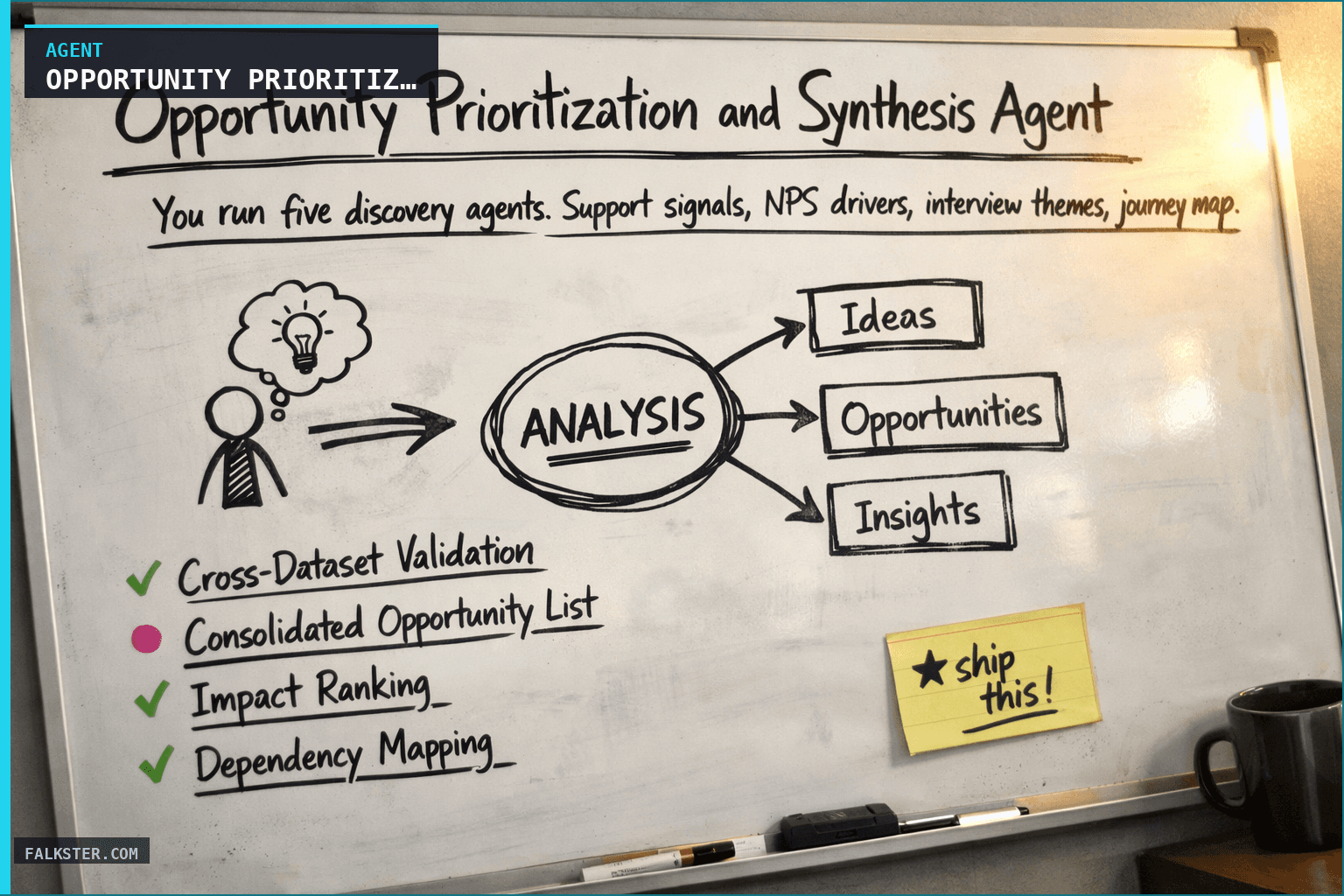
The Opportunity Prioritization agent reads the outputs of all five DISCOVER agents (Support Signal Processing, NPS/CSAT Analysis, Interview Synthesis, Journey Mapping, Customer Segmentation) and produces one prioritized opportunity stack every Friday at 11 AM. Three layers of synthesis: cross-dataset validation (opportunities appearing in 2+ reports get high confidence), impact estimation (segment size × WTP × churn reduction), and dependency mapping (fixing A unlocks B). The output is OST-ready: problem statement, evidence, affected segments, estimated impact, rough effort. Going from five scattered reports to one actionable list cuts roadmap planning to a fraction of the time.
You run five discovery agents. Support signals, NPS drivers, interview themes, journey maps, segment updates. Every week you get five reports from your continuous discovery process. Now what?
The problem: synthesis takes hours. You sit with all five reports and try to find the connections. Does the interview theme match the journey friction? Is the NPS driver the same as the support pain point? How do these opportunities rank against each other? Which are dependencies?
The Opportunity Prioritization agent does this synthesis automatically. Every Friday, it reads all five DISCOVER agent outputs and produces a single prioritized list of opportunities. Each opportunity has: impact estimate, segment applicability, implementation dependencies, and a 1-paragraph problem statement.
You go from five scattered reports to one actionable OST. For how to use that opportunity list in practice, see Your First OST.
How It Works
The agent ingests all DISCOVER outputs and applies three layers of synthesis:
Cross-dataset validation: If three different reports point to the same issue (support signals, interview themes, journey friction), it's a high-confidence opportunity. If only one report mentions it, it's lower confidence. The agent surfaces the strongest signals first.
Impact estimation: Using segment size, willingness-to-pay, and engagement data, the agent estimates: how many customers would this affect? How much would it reduce churn? Would it enable new revenue? Rough estimates, but better than guessing.
Dependency mapping: Does fixing opportunity A unlock opportunity B? Does solving the "slow onboarding" issue depend on first fixing "confusing data mapping"? The agent maps these so you can prioritize implementation sequentially.
Data Sources and Setup
Prerequisites: All five DISCOVER agents should be running:
- Support Signal Processing
- NPS/CSAT Analysis
- Interview Synthesis
- Journey Mapping
- Customer Segmentation
Schedule: Weekly Friday at 11 AM. Reads outputs from the previous week's DISCOVER runs.
The Claude Prompt
You are synthesizing discovery data into a prioritized opportunity list.

Here are this week's DISCOVER agent outputs:

**Support Signals Report**:
[SUPPORT REPORT]

**NPS/CSAT Analysis**:
[NPS REPORT]

**Interview Synthesis**:
[INTERVIEW REPORT]

**Journey Mapping**:
[JOURNEY REPORT]

**Customer Segmentation**:
[SEGMENTATION REPORT]

Here's our customer base and financial context:
[SEGMENT SIZES, ARR, GROWTH METRICS]

Please synthesize and report:

1. **Cross-Dataset Validation**
   - Which opportunities appear in 2+ reports? (HIGH confidence)
   - Which opportunities appear in only 1 report? (LOWER confidence)
   - Are there contradictions between reports? How do you explain them?

2. **Consolidated Opportunity List**
   For each opportunity, show:
   - **Problem statement**: 1-2 sentence problem (what's broken? who does it affect?)
   - **Evidence**: Which reports validate this? What specific data points?
   - **Affected segments**: Which customer groups feel this pain most?
   - **Estimated impact**: How many customers affected? Revenue impact if you fixed it?
   - **Rough effort**: Is this a small, medium, or large effort?

3. **Impact Ranking**
   - Prioritize by: (impact × segment size × willingness to fix) / effort
   - Show top 10 opportunities in priority order
   - Explain the ranking rationale for the top 3

4. **Dependency Mapping** (IMPORTANT)
   - Does opportunity A depend on opportunity B?
   - Are there clusters of related opportunities?
   - In what order should you tackle them?

5. **Segment-Specific Opportunities**
   - Are different segments asking for different things?
   - Should you build a segment-specific feature set?

6. **Surprising Findings**
   - What's the most unexpected insight from this week's reports?
   - What patterns do you see that the individual reports missed?

Format as an OST-ready list. Make it concrete enough that an engineer could estimate effort, but focused enough that it's usable for prioritization.
What you get out of it
Five reports you'd otherwise reconcile by hand become one prioritized OST. Each opportunity carries a confidence read, so you know which ones are backed by multiple signals and which rest on a single data point. The impact line is concrete, not "customers want X" but "40 customers want X and it would cut churn by 3%." And the sequence is mapped: fix Y first, it unblocks three others.
The practical effect is that Monday planning turns into a decision meeting instead of a data-gathering session. You catch the consensus opportunities early, the ones showing up in three reports at once are usually real pain. And you stop building things nobody asked for.
For the full agent fleet and scheduling details, see Your AI Agent Fleet.
Also on Medium
Full archive →AI Agents and the Future of Work: A Pixar-Inspired Journey
What product managers can learn about AI agents from how Pixar runs a film team.
Many AI Agents Are Actually Workflows or Automations in Disguise
How to tell agents from workflows from cron jobs, and why it matters for what you ship.
Frequently asked
What does the Opportunity Prioritization agent do?+
It reads the outputs of all five DISCOVER agents (Support Signal Processing, NPS/CSAT Analysis, Interview Synthesis, Journey Mapping, Customer Segmentation) and synthesizes them into one prioritized opportunity list every Friday at 11 AM. Instead of manually reconciling five reports, you get a single OST-ready stack.
What three layers of synthesis does it apply?+
Cross-dataset validation (opportunities appearing in 2 or more reports get high confidence, single-report mentions get lower confidence). Impact estimation (segment size times willingness-to-pay times churn reduction). Dependency mapping (does fixing opportunity A unlock opportunity B, and in what sequence should you tackle them).
What does each opportunity in the output include?+
A 1-2 sentence problem statement, the evidence backing it (which reports, which data points), the affected customer segments, an estimated revenue or retention impact, and a rough effort size. The format is OST-ready: specific enough for an engineer to estimate and focused enough to use in roadmap planning.
What are the prerequisites for this agent?+
All five DISCOVER agents should already be running: Support Signal Processing, NPS/CSAT Analysis, Interview Synthesis, Journey Mapping, and Customer Segmentation. The Prioritization agent reads their weekly outputs, so if any are missing, the synthesis will have gaps. See Your AI Agent Fleet for the full setup order.
How does this change roadmap planning?+
Instead of spending hours manually looking for patterns across five separate reports, you have a single prioritized list by Friday afternoon. You go into Monday planning with opportunities already validated by multiple signals, impact estimates attached, and implementation sequence mapped. Roadmap planning becomes a decision meeting instead of a data-gathering session.

Comments (0)
Sign in with LinkedIn to leave a comment.
Sign in with LinkedIn