Stream a simulated run, inspect the notifications it would send on Slack and email, and see exactly where it sits in the 7-stage PM OS flow. No password required.
The short version
The Sprint Planning agent runs every Monday at 9 AM and converts your prioritized opportunities into a proposed sprint plan in 30 minutes instead of 4 hours. It reads opportunities, tech debt backlog, team capacity, and historical velocity from Jira or Linear, then breaks each opportunity into user stories with story points, fits stories into the sprint respecting capacity and dependencies, and explains every trade-off. The output is ready to load into Jira, with a confidence score on the plan and a list of which stories are most likely to slip. Half a day reclaimed, every sprint.
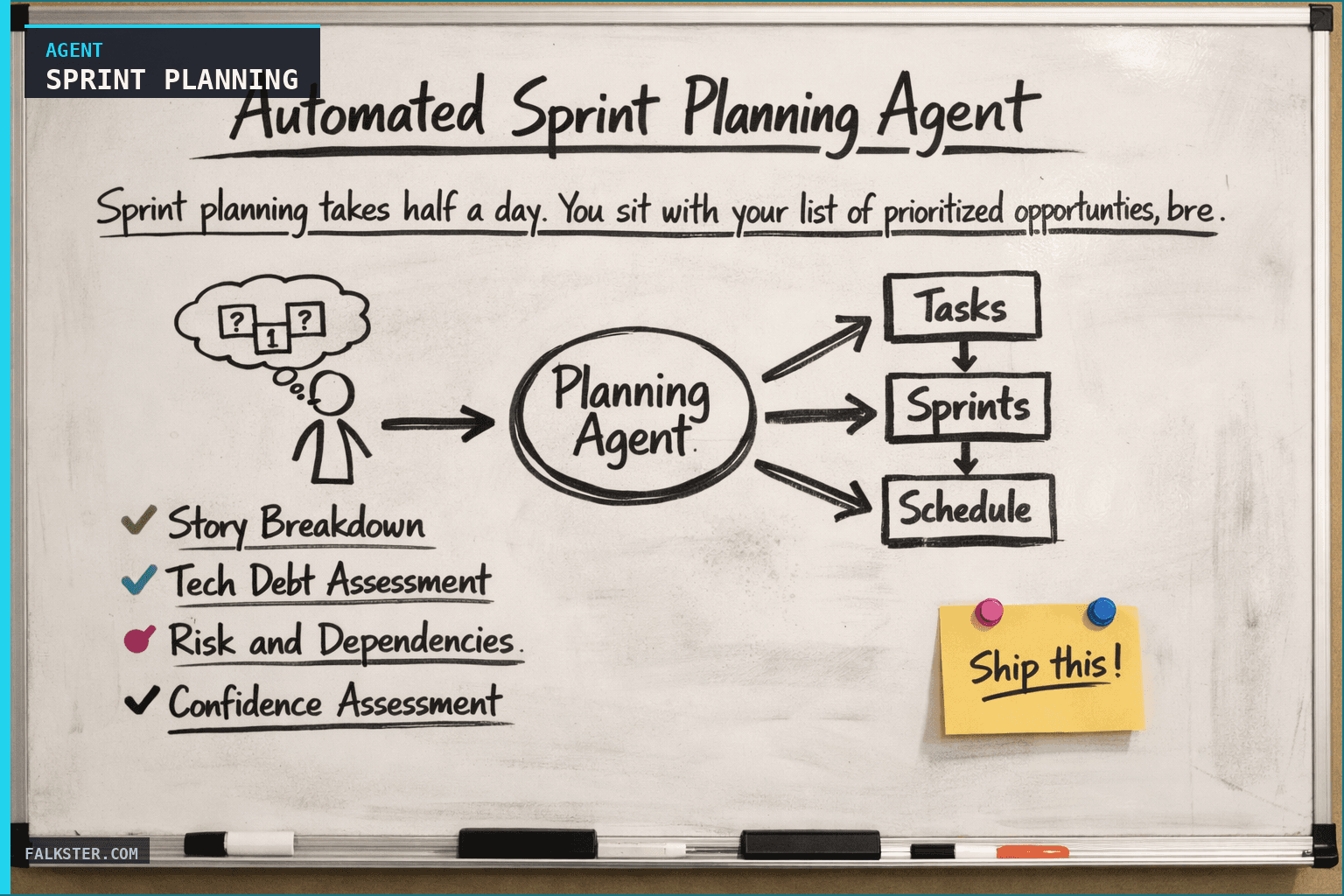
Sprint planning takes half a day. You sit with your list of prioritized opportunities, break them into stories, estimate effort, account for team capacity and tech debt, and move pieces around until something resembles a plan.
By the end you're exhausted and you've probably forgotten half the context that made these opportunities matter.
The Sprint Planning agent does this on Monday mornings. It reads: prioritized opportunities, tech debt backlog, team capacity, and sprint constraints. It produces: a proposed sprint plan with stories, estimates, and explanations of why each item made the cut.
You spend 30 minutes reviewing instead of 4 hours planning.
How It Works
The agent takes structured inputs and applies logic in sequence:
Story generation: For each opportunity, the agent breaks it into user stories. Not generic stories, but specific: "As a [segment] user, I can [do X], so that [outcome]." Including acceptance criteria and technical tasks.
Effort estimation: Using historical velocity and similar stories, the agent estimates story points for each. It flags estimates that feel risky (too much guessing).
Sprint composition: The agent fits stories into the sprint, respecting: team capacity, committed tech debt time, and dependencies. It surfaces: "If we do opportunity A, we have to do tech debt B first. That's 13 points. We have 21 points capacity, so we can add one more opportunity."
Explanation: For each sprint plan, the agent explains: why these opportunities, why not the others, and what trade-offs were made.
Data Sources and Setup
Prerequisites: You'll need:
- Prioritized opportunities: From the Opportunity Prioritization agent
- Jira or Linear: For story backlog, historical velocity, tech debt items
- Team capacity data: Planned time off, support rotations, meetings
- Feature specs and tech context: For realistic effort estimation
- Previous sprints: Historical velocity and story estimation patterns
Schedule: Weekly Monday at 9 AM. Can also run ad-hoc when priorities change.
The Claude Prompt
You are planning our sprint based on prioritized opportunities.

Here are our top prioritized opportunities:
[OPPORTUNITIES: ranked, with impact and effort estimates]

Here's our tech debt backlog:
[TECH DEBT: items, severity, impact on velocity]

Here's our team capacity for the next sprint:
[CAPACITY: team size, planned time off, support load, committed meetings]

Here's our historical context:
[HISTORY: past 4 sprints velocity, similar story estimates, completion rates]

Here are feature specs and dependencies:
[SPECS: technical requirements, dependencies between features]

Please build a sprint plan that includes:

1. **Story Breakdown**
   - For each top 3-5 opportunities, break into 3-5 stories each
   - Format: "As a [role], I can [action], so that [outcome]"
   - Include acceptance criteria and technical tasks
   - Estimate story points using historical patterns

2. **Tech Debt Assessment**
   - Which tech debt items should we include?
   - Why? (blocks other work, affects velocity, or critical for stability?)
   - How much capacity should we allocate?

3. **Sprint Plan**
   - Show the proposed sprint with story points
   - Total capacity vs. committed points
   - Explain why these opportunities made the cut
   - Show the prioritized backlog (what didn't make it and why)

4. **Risk and Dependencies**
   - Are any stories dependent on each other? (order matters)
   - Are any stories dependent on external teams?
   - Which stories carry the most uncertainty in estimation?
   - What could make this sprint go wrong?

5. **Confidence Assessment**
   - How confident are we in this plan? (% chance we complete as planned)
   - What would improve confidence?
   - Which stories are most likely to slip?

Format as a sprint proposal. Be specific: I should be able to load this into Jira and start working.
What you get
Instead of a 4-hour planning session, you get a structured plan you can load straight into Jira, stories and estimates included. It's built off your prioritized opportunities, so you're working on what matters rather than whatever the loudest person in the room wanted. It respects your team's real capacity, tech debt and time off and all, tells you what order to tackle things in, and flags which stories might slip and why.
The payoff: planning drops to 30 minutes, the team argues less about scope and builds more, and you actually finish your sprints because the plan was realistic to start with.
For the full agent fleet and scheduling details, see Your AI Agent Fleet.
Also on Medium
Full archive →AI Agents and the Future of Work: A Pixar-Inspired Journey
What product managers can learn about AI agents from how Pixar runs a film team.
Many AI Agents Are Actually Workflows or Automations in Disguise
How to tell agents from workflows from cron jobs, and why it matters for what you ship.
Frequently asked
What does the Sprint Planning Agent actually do?+
It reads your prioritized opportunities, tech debt backlog, team capacity, and historical velocity from Jira or Linear, then breaks each opportunity into user stories with acceptance criteria, estimates story points using historical patterns, fits stories into the sprint respecting capacity and dependencies, and explains every trade-off. Output is a Jira-ready sprint plan with a confidence score and a list of which stories are most likely to slip.
How long does sprint planning take with versus without the agent?+
Without the agent, sprint planning typically takes 3-4 hours for a full team. With the agent, you spend 30 minutes reviewing and adjusting the proposed plan instead of building it from scratch. The agent does the story breakdown, effort estimation, and capacity fitting. You make the judgment calls on what it flagged.
What inputs does the Sprint Planning Agent need?+
Five inputs: prioritized opportunities (ideally from the Opportunity Prioritization agent), a tech debt backlog with severity ratings, team capacity data including time off and support rotations, feature specs and technical context, and historical sprint data from Jira or Linear showing velocity and past story estimates.
What does the confidence score mean in the sprint plan output?+
The agent estimates a percentage probability that the team completes the sprint as planned, based on historical velocity, estimate uncertainty, and dependency risk. It also lists which specific stories are most likely to slip and what would need to happen for the plan to succeed. This is more useful than a static estimate because it surfaces the risks explicitly.
Can the Sprint Planning Agent run mid-sprint if priorities change?+
Yes. The agent runs weekly on Monday mornings by default but can be triggered ad-hoc when a high-priority opportunity emerges mid-sprint or when significant capacity changes. Re-running it takes the same 30-minute review cycle and produces a new plan that reflects the updated priorities.

Comments (0)
Sign in with LinkedIn to leave a comment.
Sign in with LinkedIn