Stream a simulated run, inspect the notifications it would send on Slack and email, and see exactly where it sits in the 7-stage PM OS flow. No password required.
The short version
The Feature Adoption agent tracks adoption curves daily for every feature shipped in the last 3 months. It pulls from Amplitude or Mixpanel, breaks the data into three signals (trial rate, retention rate, cohort breakdown), and flags lagging segments before the trend hardens. When SMB adoption sits at 12% while enterprise is at 40%, you get a root-cause hypothesis and a recommended intervention (in-app tour, email campaign, onboarding tweak). Daily snapshot at 4 PM, deep dive Monday at 9 AM. Connect feature flags so the agent knows when each user got access, then run it on your three most recent launches.
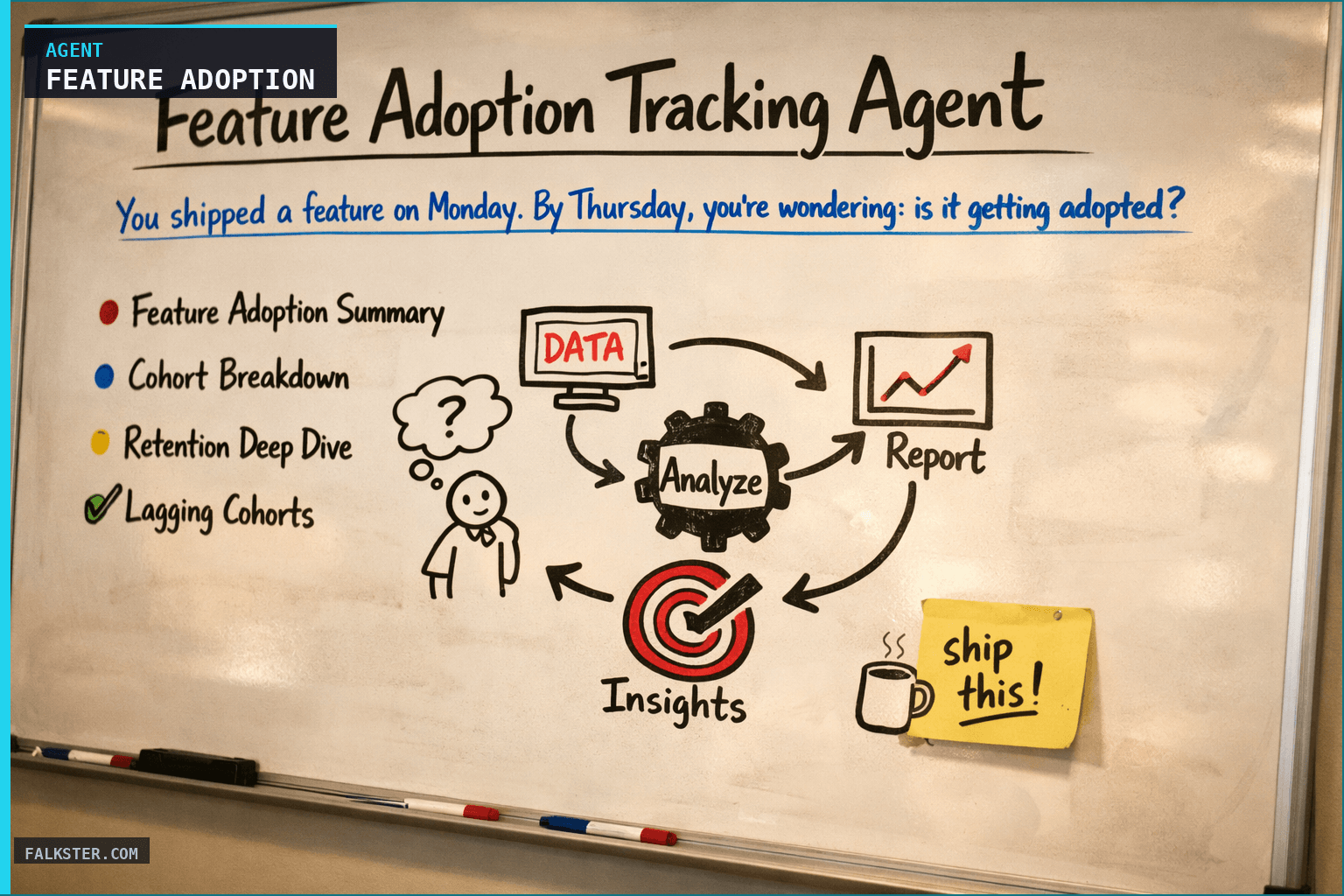
You shipped a feature on Monday. By Thursday, you're wondering: is it getting adopted?
The problem is you won't know for 2-4 weeks. By then you've already moved on to the next feature. And if adoption is slow, you have no idea why - was it hidden in the product? Did the onboarding not explain it? Is it just not valuable?
The Feature Adoption agent tracks adoption curves daily. For any feature released in the past 3 months, you see: what % of your user base has tried it, what % is using it regularly, and which cohorts (segments, tiers, geographies) are using it most. It also identifies: which cohorts are lagging, and what intervention might help them adopt.
How It Works
The agent connects to your analytics and tracks adoption in three ways:
Trial tracking: How many users have tried the feature (performed the core action at least once)? What % of your total user base is this? How fast did trial growth happen?
Retention tracking: Of those who tried it, how many came back to use it again? This is the real adoption signal - first use doesn't count if they never return.
Cohort analysis: Breaking adoption down by segment (SMB/enterprise), company tier (free/paid), geography, or use case. "Enterprise is adopting at 40%, SMB at 12%. Why?"
Intervention recommendation: If a cohort is lagging, the agent suggests why and what might help. "SMB adoption is low, but those who did try it are using it regularly. They might just need better onboarding. Try a Slack notification or in-app tour."
Data Sources and Setup
Prerequisites: You'll need:
- Analytics platform: Amplitude or Mixpanel with feature event tracking
- Feature flags: Rolled out features so you know when each user got access
- CRM / Segment data: Customer attributes (company size, industry, tier)
- Support data: Support tickets related to new features
- Interview/feedback data: Why customers do or don't use new features
- Email/in-app messaging data: What onboarding did they receive?
Schedule: Daily at 4 PM (adoption snapshot). Weekly Monday at 9 AM (deep dive and intervention recommendations).
The Claude Prompt
You are tracking feature adoption and identifying intervention opportunities.

Here are the features we shipped recently:
[FEATURES: release date, description, target audience]

Here's the adoption data from the past 4 weeks:
[ADOPTION DATA:
- Feature: feature name
- Launch date
- Total users with access
- Users who tried it (% and trend)
- Users retaining it (using it 2+ times in past week)
- Adoption by segment (SMB, enterprise, free tier, paid tier, etc.)]

Here's cohort/segment details:
[SEGMENTS: company size, industry, tenure, use case, geography]

Here's support data related to these features:
[SUPPORT: tickets mentioning new features, topics, volume]

Here's feedback we've gathered:
[FEEDBACK: why users like the feature, why some avoid it, what's confusing]

Please analyze and report:

1. **Feature Adoption Summary**
   For each feature:
   - Trial rate (% of user base who tried it)
   - Trial velocity (how fast is trial growing? flat? accelerating?)
   - Retention rate (of those who tried, % using it regularly)
   - Current trend: accelerating / stable / declining adoption?

2. **Cohort Breakdown** (IMPORTANT)
   - Which segments are adopting most? least?
   - Is adoption pattern expected? (does it match target segment?)
   - Any surprises? (a segment you didn't target is adopting heavily? or lagging?)

3. **Retention Deep Dive**
   - Of users who tried the feature, what % never came back?
   - How long did they stay engaged before dropping off?
   - Which cohorts have best retention? worst?

4. **Lagging Cohorts** (PRIORITY)
   For any cohort with under 25% trial rate:
   - Why might they be lagging? (feature doesn't fit their use case? hidden in product? poor onboarding? competitive alternative?)
   - What's the consequence of low adoption? (revenue impact? churn risk?)
   - How do we know? (support tickets? survey? research?)

5. **Intervention Recommendations**
   For each lagging cohort, suggest:
   - Root cause hypothesis
   - Test: how would we validate the root cause?
   - Intervention: what would help them adopt? (better onboarding? email campaign? in-app tour? product changes?)
   - Effort to implement
   - Expected impact (how much would adoption improve?)

6. **Success Features**
   - Which features are breaking through adoption-wise?
   - What are they doing right?
   - Can we apply those lessons to slower features?

Format for quick scanning: I want to see adoption metrics, flagged lagging cohorts, and recommended actions.
What You Get
Instead of wondering if features are being used:
- Daily adoption visibility: You see adoption curves in real-time
- Cohort signals: You know which segments love the feature and which ignore it
- Early intervention: You catch low adoption before it's too late to do something about it
- Validated hypotheses: Not guessing why adoption is low - backed by data
- Actionable recommendations: "SMB adoption is low, but they need better onboarding. Try in-app tour." Not "increase adoption" (unhelpful).
Real outcomes:
- You catch adoption stalls within days, not weeks
- You can run quick interventions (emails, in-app tours) to unblock adoption
- You understand feature-segment fit (some features just aren't for SMB - that's okay to know)
- You build momentum: early wins get attention and more feature launches
For the full agent fleet and scheduling details, see Your AI Agent Fleet. For the OKR tracking layer that ties feature adoption to outcome metrics, see the OKR Progress and Prediction Agent.
Also on Medium
Full archive →AI Agents and the Future of Work: A Pixar-Inspired Journey
What product managers can learn about AI agents from how Pixar runs a film team.
How to Avoid Survivorship Bias in Product Management
Lessons from the British bomber study, applied to PM customer interviews and analytics.
Frequently asked
What does a feature adoption tracking agent actually measure?+
Three signals per feature: trial rate (what percent of your user base tried it at least once), retention rate (of those who tried it, how many came back), and cohort breakdown (which segments are adopting and which are lagging). The agent flags when a cohort falls below 25% trial rate and generates a root-cause hypothesis and intervention recommendation.
How early can this agent catch adoption problems?+
Daily tracking means you see stalls within days, not the two to four weeks it usually takes to notice. When SMB adoption sits at 12% while enterprise is at 40%, you see that on day three, not day twenty. Early detection is the point: most interventions (in-app tour, email campaign, onboarding tweak) are only effective before the non-adoption pattern hardens.
What data sources does the feature adoption agent need?+
An analytics platform (Amplitude or Mixpanel) with feature event tracking, feature flags so you know when each user got access, CRM or Segment data for customer attributes like company size and tier, support data for tickets related to new features, and email or in-app messaging data to understand what onboarding the user received.
How is cohort analysis different from overall adoption metrics?+
Overall adoption tells you the average. Cohort analysis tells you the story behind it. A 30% trial rate overall might mean enterprise is at 60% and SMB is at 5%. That is a completely different problem from uniformly low adoption. The agent breaks adoption by segment, company tier, geography, and use case so you can see where the feature is and is not landing.
What intervention does the agent recommend for a lagging cohort?+
It generates a root-cause hypothesis (hidden in the product, poor onboarding, feature does not fit the use case, competitive alternative) and suggests a specific test to validate it, an intervention to try (Slack notification, in-app tour, email campaign, product change), the effort to implement, and the expected adoption improvement. Not 'increase adoption' but 'SMB users who tried it are retaining well, they just need a Slack nudge to try it.'

Comments (0)
Sign in with LinkedIn to leave a comment.
Sign in with LinkedIn