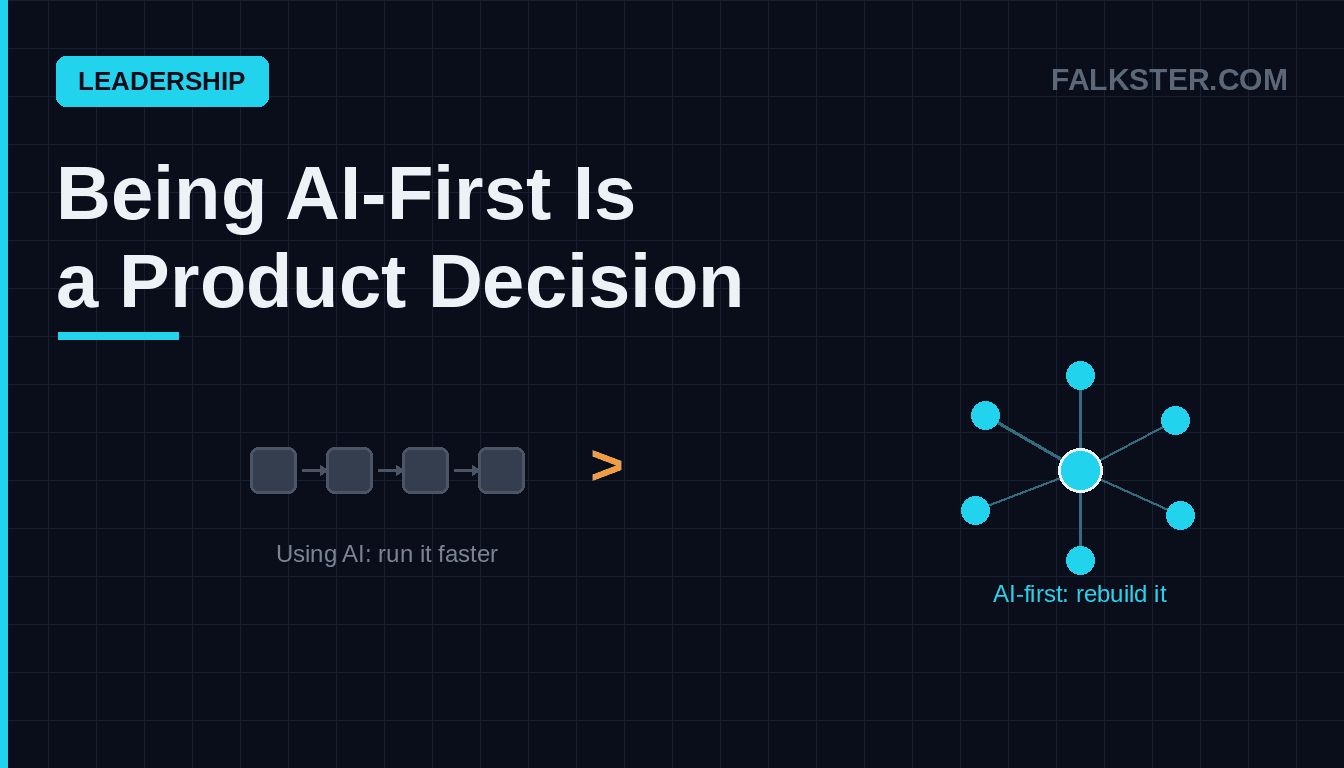
The sharpest thing I read this week was not about product. It was about marketing. Chris Koehler, the CMO of Twilio, sat down with Inc. and drew a line most leaders are still smudging: there is a difference between using AI and being AI-first. Using AI means you take the process you already run and do it faster. Being AI-first means you throw the process out and rebuild it assuming the machine was in the room on day one.
Now swap the word marketing for the word product. The argument does not weaken. It gets louder.
The short version
Being AI-first is a product decision, not a tooling one. Using AI means accelerating the workflow you inherited: faster specs, faster tickets, faster teardowns. Being AI-first means re-engineering the workflow from scratch, assuming AI was there on day one. Most product orgs are doing the first and calling it the second. The capacity gap is the real story, AI does not shrink the team, it lets the team finally clear a decade of deferred work. Roles shift from specialists to generalists while AI becomes the specialist, a film crew instead of a conveyor belt. And once building is cheap, the scarce input is taste: the judgment to ship the one thing that matters and kill the nine that do not. This is the Product Builder thesis arriving from the marketing side of the org chart, and it rests on the same foundation as the Product Operating Model.
Most product teams are optimizing a conveyor belt
Here is the uncomfortable read on where most product orgs actually are. They bought the tools, they let everyone expense the seats, and then they pointed all of that capability at the workflow they already had. Faster tickets. Faster PRDs. Faster competitive teardowns. That is real, and it is worth something, but it is not transformation. It is a conveyor belt that runs at a higher RPM.
Koehler's framing is that the AI-first teams are the ones taking the full process and re-engineering it from scratch rather than accelerating the version they inherited. In product terms, that is the difference between a PM who uses AI to write the spec faster and a Product Builder who asks whether the spec, the handoff, the sprint ritual, and the three-team relay race should exist at all. One is sanding the edges of 2019. The other is building for 2027.
This is the Product Builder thesis I have been making for two years, and it is satisfying to watch a marketing leader arrive at the same place from the opposite side of the org chart. When two functions independently conclude that the operating model is the bottleneck, that is not a trend. That is a tell. The operating model itself is the thing under renovation, which is exactly the argument behind the Product Operating Model.
The capacity gap is the real story, and product has lived it longest
The most quietly radical moment in the piece is when Koehler polls a room of CMOs and asks how many have cut headcount as AI spread through their orgs. The answer was none. His explanation is that they all carry a capacity gap. There is always more they want to build than there are people to build it.
Product has lived inside that gap longer than anyone. Every roadmap is a graveyard. For each thing that ships, ten good ideas lost a prioritization fight, and another twenty never made it into the doc because everyone in the room already knew there was no room. We have spent entire careers apologizing for a backlog we were never staffed to clear.
So the honest framing is this. AI does not shrink the product team. It finally lets the product team do the work it has been deferring since the company was founded. The leaders who read AI as a cost-takeout story are answering a question nobody serious is asking. The leaders who read it as a capacity story are about to clear a decade of debt.
Specialists become the machine, generalists become the team
Koehler's prediction is that teams move from roughly 90 to 95 percent specialists toward horizontal generalists, and that AI becomes the specialist. His analogy is a film crew rather than a production line: prompt architects, curators, narrative leads, someone who owns what you should and should not do with the data.
This is the clearest description of the Product Builder I have seen from outside the product world. The PM whose entire value was coordinating the specialists, routing tickets, chasing status, and translating between design and engineering is being automated by the same forces they were supposed to manage. What survives, and what compounds, is the person who can hold the vision and move across design, code, data, and go-to-market, using AI to do the deep specialist work inside each lane. That person is worth ten of the old coordinator, and the market is about to price them accordingly. This is the same reorganization I describe in PM as a Team of AI Agents.
If you are early in your career and worried this leaves you behind, read it the other way. You have the fewest years of muscle memory in the old model, which makes you the cheapest to retrain and often the best guide for everyone else. That is leverage. Use it loudly.
The skill that actually compounds is taste
Koehler's headline insight is that content used to be the bottleneck and is now the abundance, so the brave move is to pull back and say less. He asks who will be willing to do less when they can do so much more.
The product translation is exact. Features used to be expensive, so shipping was the constraint. AI makes shipping cheap, which means the constraint moves to judgment. When you can build almost anything, the entire game becomes deciding what not to build. Taste stops being a soft word leaders use in design reviews and becomes the single most valuable thing on the team. The moat is no longer who can produce the most. It is who has the conviction to ship the one thing that matters and kill the nine that do not. I made the longer version of this case in Taste Is the Last Moat.
That is the bet I am making with Falkster.AI, and it is the bet I would make if I were running any product org right now. Not more output. Better decisions, made faster, by people who can see the whole picture and have the nerve to subtract.
The move
If you lead a product team, stop asking how AI makes your current process faster. That question has a ceiling and you are already near it. Ask the harder one: if you rebuilt your product organization from scratch this quarter, knowing what these tools can do, what would you never reassemble?
The teams that answer honestly are not going to win on speed or volume. They are going to define what product building looks like for the next decade. And from where I sit, that is the most fun this job has been in years.
One thing worth deciding deliberately rather than by drift, while you are rebuilding: what happens when your data becomes the product. Deeper analysis makes that a choice with consequences, not a byproduct.
Pick one ritual this week, the standup, the PRD template, the quarterly planning offsite, and ask whether it would survive a clean rebuild. Start there.
Sources: Nicole Ramirez, "The Marketing Leaders Getting AI Right Are Playing a Completely Different Game", Inc., featuring Chris Koehler, CMO of Twilio.
Also on Medium
Full archive →Frequently asked
What is the difference between using AI and being AI-first?+
Using AI means you keep the process you already run and do it faster: faster PRDs, faster tickets, faster competitive teardowns. Being AI-first means you throw the inherited process out and rebuild it assuming AI was in the room on day one. The first is a conveyor belt at higher RPM. The second is a different machine. Twilio CMO Chris Koehler drew this line for marketing, and it applies one to one in product.
Does being AI-first mean cutting the product team?+
No. When Koehler polled a room of CMOs on how many had cut headcount as AI spread, the answer was none. They all carry a capacity gap, more they want to build than people to build it. Product has lived inside that gap since the company was founded. AI does not shrink the team, it lets the team finally clear the backlog it was never staffed to clear.
How do roles change on an AI-first product team?+
Teams shift from mostly specialists toward horizontal generalists, and AI becomes the specialist inside each lane. The model is a film crew, not a production line. The PM whose value was coordinating specialists, routing tickets, and chasing status is automated. The person who holds the vision and moves across design, code, data, and go-to-market, using AI for the deep work, is the one who compounds.
Why is taste the skill that matters most when AI makes building cheap?+
When shipping was expensive, shipping was the constraint. AI makes shipping cheap, so the constraint moves to judgment. When you can build almost anything, the game becomes deciding what not to build. Taste stops being a soft design-review word and becomes the most valuable thing on the team. The moat is conviction to ship the one thing that matters and kill the nine that do not.
What is the first move for a product leader who wants to be AI-first?+
Stop asking how AI makes your current process faster, that question has a low ceiling. Ask the harder one: if you rebuilt your product organization from scratch this quarter, knowing what these tools can do, what would you never reassemble? The honest answer names the rituals, handoffs, and relay races that only exist because building used to be slow.

Comments (0)
Sign in with LinkedIn to leave a comment.
Sign in with LinkedIn