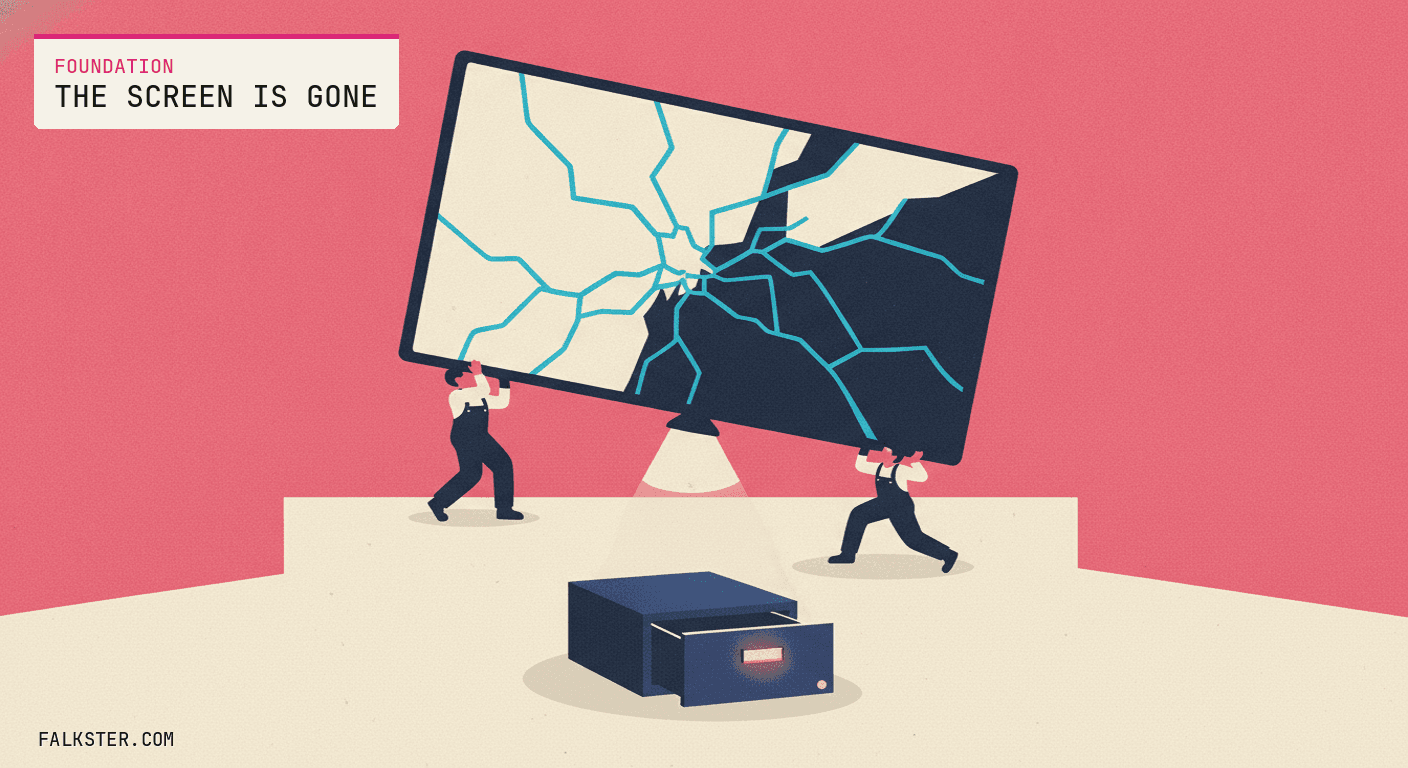
Marc Benioff stood on the Dreamforce stage on Tuesday and said the thing I've been circling for three weeks: AI replaces the UI. A few minutes later Patrick Stokes said the other half. Salesforce's value was never the interface. It's "the trust that all of you, our customers, put in us to hold your data."
Two sentences, two executives, one product definition. The screen is gone. The record stays.
Henry Martin at Salesforce Ben pulled six takeaways from the keynote, and his list is the right list. AIforce at the top, Claudeforce in open beta, the data promise, the SaaSpocalypse rebuttal, Jensen Huang, Dario Amodei. What I want to do is read the six as one argument, because that's what they are.
The short version
At Dreamforce 26 Salesforce made "AI replacing the UI" the headline and packaged it as AIforce: Claudeforce inside Claude, Slackforce inside Slack, Agentforce Coworker inside Lightning, and a headless toolkit of MCP servers, APIs, and skills. Patrick Stokes said the company's value is the trust to hold your data, not the interface. Benioff called the SaaSpocalypse "crazy nonsense" while Jensen Huang called AI "a layer on top of software," and both are right about the same thing: software survives as record and governed action, and software as the thing you look at does not. The promise that "your data does not go in the models" is correct about the model layer and silent about the observation record agents generate wherever they run, which is the asset that compounds. Dario Amodei's five to ten percent value-capture number is real, and the gap is not capability. It is the reasoning behind decisions that nobody wrote down where an agent can read it.
The plugin became the strategy
On August 26 Salesforce put its CRM inside Claude and I wrote that the app layer had volunteered to be the substrate. It was one announcement stapled to an earnings print. It read like a partnership.
On Tuesday it was the keynote.
AIforce is four doors into one record. Claudeforce, which Stokes demoed with the line "everything that you are about to see is something that I asked Claude to do for me." Slackforce, Salesforce context rendered inside Slack. Agentforce Coworker, an AI teammate living inside Lightning for the people who still open Lightning. And a headless toolkit, MCP servers and APIs and plugins and skills, for everyone who wants to build their own door.
Not one of those four is the Salesforce UI.
Martin's framing is that this Dreamforce differed from the last two. 2024 introduced Agentforce, 2025 was Agentforce 360, and 2026 was a suite-level vision rather than one product. That's right, and I'd push it one step. The suite-level vision is that the suite stops being a place. It becomes a thing other places call.
I said last month that plumbing has no daily-active-user ratio because nobody opens plumbing. Salesforce has now said it on its own stage, from strength, in a quarter where it raised guidance. That's the version worth studying. A company doing this from weakness would be hiding it.
Two sentences that agree with each other
The takeaway getting the most play is the SaaSpocalypse rebuttal. Matthew McConaughey opened the show with "it's not the end of software, it's the end of software which makes humans do all the work." Benioff called the end-of-software headlines "crazy nonsense." Then Huang, sharing the stage, said "the end of software is nonsense, this is going to be a layer on top of software."
People are reading that as the incumbents circling the wagons. Read it next to "AI replaces the UI" and it's something more interesting. They're defining which part of software ends.
The record doesn't end. Thirty years of validation rules, permission models, audit trails, and the contractual promise to hold the data don't end. What ends is software as the thing you look at. The interface, the habit, the tab that stays open all day, and the seat that was priced against that habit. Huang's "layer on top" is the thing you look at now, and it isn't Salesforce.
So both sentences are true and they describe the same move. Salesforce keeps the part that's hard to leave and hands off the part that's easy to replace. Whether the seat survives that trade is the question the keynote didn't answer, and I don't think anyone on that stage knows yet. In August I noted that the seats had stayed through the first year of Agentforce and that this was still an attach motion, not a replacement cycle. AIforce is the first move that could change that, because it's the first one that stops asking people to open the app.
The right promise about the wrong layer
Benioff was emphatic on data. "When you're working in Salesforce apps, and when you're working on our platforms, your data is your data. It does not go in the models." Zero data retention, tested repeatedly by security teams, model providers answer the question and keep nothing.
Good. Necessary. I'd want it in writing from any vendor I bought. And it answers one question, which is whether Anthropic keeps your data.
Here's the question it doesn't answer. Every time an agent acts on that data, something gets generated that isn't the data. Which action ran. Whether a human reversed it, and how fast. What got escalated and what got approved. Which rule fired and whether the outcome closed the loop. That's an observation record, and it's the only asset in the relationship that compounds, because it's the thing that makes the thousandth action better than the first.
Zero data retention at the model layer says nothing about it. It accrues wherever the agents run. And Stokes told you where the agents run when he said the value is the trust to hold your data. Read that sentence one more time. He is describing the post-UI moat, and it is exactly the right moat. I made the same argument two weeks ago from the other direction, that written context is rented and the earned record is what stays. Salesforce is building the earned record on top of the largest CRM install base there is, and it's calling the model layer a commodity in public.
If you're the buyer, the question to ask is not "does the model keep my data." Ask who owns the trace of what the agents did in your org, who can read it, and whether it leaves with you. The first question has a clean answer now. The second one is where your leverage lives.
Safety is an engineering problem, and confidence is the wrong gate
Huang's section was the loudest, and Martin is right that it was a show. Safety as "an engineering problem." "If you build a product or a service and you're not confident in its functionality, capability or safety, then don't release it." No new laws needed, market forces are already there. Job destruction concerns dismissed as nonsense.
I'll leave the regulation argument to people who work on regulation. The engineering claim is one I can check against my own build, and it's half right.
Safety is an engineering problem. It's also not a confidence problem, and "don't release it if you're not confident" is the framing that gets teams hurt. Confidence is a number a model produces about itself. The gate that matters at runtime is how bad it is if the model is wrong and whether you can take it back. Draft an email, fully reversible, let it run. Update a record, reversible with a receipt, let it run with a trail. Touch money, stop and ask. I wrote that taxonomy up last week when Salesforce named the harness, and it's the piece of the harness that still isn't on the slide. Reversibility is a product decision, it has to exist before governance has anything to enforce, and no amount of confidence substitutes for it.
Market forces will sort this out only if buyers measure it. Right now most don't. They measure agent count.
Amodei's ten percent
Dario Amodei said he'd been surprised that "such a pace is possible in the business world," and then gave the number that I think is the most important thing said all day. Current deployment captures "five or ten percent of what the possible value of the technology is."
I believe the number. I'd argue with the diagnosis everyone will attach to it, which is that the models need to get better before the other ninety percent shows up.
The gap I see, in every company I talk to and in my own, isn't capability. It's that the reasoning behind decisions was never written down anywhere an agent can read it. Your CRM holds what happened. Your flows and rules hold how it's supposed to happen. Nothing holds why the discount routes through finance in one region and not another, or why the last three architects killed the integration that keeps getting proposed. An agent that inherits the what and the how without the why follows the rule perfectly right up to the moment the rule shouldn't apply.
That's a capture problem at write time, and it's the one layer in the whole stack you can't buy later. It's also why the ten percent is stuck. The agents work. They're working on incomplete context, and the missing part isn't in any vendor's harness because it was never in any system to begin with.
Benioff mentioned the "Salesforce alumni" now at Anthropic. Martin notes more than 45 have moved since early 2026. I read that as the same story. The people who understand how enterprise work actually gets decided are going to where the acting happens, because the acting is what generates the record.
What I'm changing in Heidi
I build an agentic company brain, multi-tenant, agents that act in team chat with a guard around every action and a ledger of what happened. Three things from Tuesday go straight into the roadmap.
Our UI is not the product either. If Salesforce can say it, I can. Heidi already runs in Slack and Teams because that's where the work is. The next cut goes further: every capability we build has to be callable from somewhere we don't own before it gets a screen we do. The screen is the last thing built, not the first.
The observation record is the contract. We already write a receipt for every act and label the outcome. What we haven't done is put that record in front of the customer as the thing they own. That changes. The trace of what the agents did in your tenant is yours, readable, and exportable, and I'm going to say so in the terms rather than in a blog post.
Confidence is not a gate. It never was in our guard, but I've watched enough demos this week where it is. We gate on reversibility and evidence strength, and confidence is an input to both, not a substitute for either. That stays.
Try this week
Count something. Take your team's Salesforce sessions from the last five working days, or whatever your system of record is. How many of them were reads? Someone opened the app to find out a number, a status, a name, and closed it.
Every one of those is a question that could have been asked in Slack. That count is your seat exposure. Not a forecast, a measurement, and it tells you whether the four doors Salesforce just opened are a convenience for your team or a replacement.
Then go find where the reasoning behind one recurring decision lives. If it's a thread or a head, you've found the ninety percent.
Sources: Henry Martin, "The 6 Biggest Takeaways From the Dreamforce '26 Main Keynote," Salesforce Ben (Sept 15, 2026) · Salesforce and Anthropic announce Claudeforce · Salesforce Q2 FY27 press release
This post sits in the running argument on SaaS to AI Business Models: software priced per seat is priced against a habit that AI just removed, and the pricing model has to follow the work.
Related answer: Does zero data retention mean the vendor keeps nothing from your AI agents?
Frequently asked
What did Marc Benioff mean by AI replacing the UI at Dreamforce 26?+
That the Salesforce screen stops being where the work happens. AIforce bundles four ways to reach CRM data without opening Salesforce: Claudeforce inside Claude, Slackforce inside Slack, Agentforce Coworker inside Lightning, and a headless toolkit of MCP servers, APIs, plugins, and skills. The record and the governed actions stay in Salesforce. The daily habit moves to whichever surface the user already lives in.
What is Claudeforce and how do you get it?+
Claudeforce is the Salesforce plugin for Claude, built with Anthropic. Per the keynote, it ships with 37 prebuilt sales skills, uses MCP servers, and runs with zero data retention on the model side. It is in open beta through the AppExchange: find the Salesforce for Claude plugin, fill in a form with your org ID, and it activates.
Is the SaaSpocalypse real or nonsense?+
Both claims made on stage are true at once. Benioff called the SaaSpocalypse crazy nonsense and Jensen Huang called AI a layer on top of software. Software is not ending. Software as the thing you look at is ending, which is exactly what AI replacing the UI means. The company survives as the system of record and the governed action layer. The interface, and the seat priced against it, is what gets absorbed.
Does zero data retention mean Salesforce does not keep what the agents learn?+
No. Zero data retention is a promise about the model provider: your business data answers a question and Anthropic does not keep it. It says nothing about the observation record generated wherever the agents run, which actions were taken, reversed, approved, or escalated. That record accrues to whoever operates the agents. The question to ask any vendor is who owns that record, who can read it, and whether it ports.
Why does Dario Amodei say businesses capture only five or ten percent of AI's value?+
He said the pace of deployment surprised him and that current use captures five or ten percent of what the technology could do. My read is that the gap is not model capability. It is that most companies have never written down the reasoning behind their decisions anywhere an agent can read it, so the agent inherits the rules without the exceptions. That is a capture problem at write time, not a model problem.
What should a CPO do differently after the Dreamforce 26 keynote?+
Stop measuring your product by time in your UI, because your biggest competitor just stopped. Count completed work instead. Then find out where the reasoning behind your team's recurring decisions is written down. If the answer is a Slack thread or somebody's head, that is the layer no harness can sell you, and it is the one that decides whether the agents you plug in are worth the credits.

Comments (0)
Sign in with LinkedIn to leave a comment.
Sign in with LinkedIn