I have now seen this post seven or eight times in a month, usually with a few thousand reactions under it.
Salesforce replaced 4,000 people with chatbots and is now rehiring. IKEA reskilled its people and unlocked $1.4B in new revenue. Same technology, very different results. A leader chasing efficiency cuts jobs. A smarter one uses AI to help their people do more.
It is a lovely story. It is also being used, over and over, as evidence that AI does not work, and that is what gets me. Because the facts underneath it are mostly real, the arrangement of those facts is junk, and the conclusion people draw from it is close to the opposite of what the evidence supports.
Let me take it apart, and then say the more useful thing.
The short version
The viral LinkedIn story, Salesforce cut people while IKEA reskilled them, gets quoted as proof that AI automation fails and human judgment wins. The facts are mostly real, but the comparison is junk and the conclusion is backwards. The two companies used different technology a decade apart: IKEA's Billie was a 2021 intent router, Salesforce's Agentforce a 2025 agent system. The famous 47% is a containment rate misread as a quality score. The load-bearing claims, rehiring at 1.5x and a Benioff regret quote, are unsourced. More important, both halves are stories of AI working: IKEA only freed capacity because Billie succeeded, and both firms ran the same play, moving deflected-work staff toward revenue. The real lesson is not augment instead of replace. It is that freed capacity becomes a new business line only when there is unserved demand next to the work you automated, and almost nobody checks whether theirs does.
What is actually on the record
Salesforce: Benioff said on the Logan Bartlett Show in September 2025 that he took customer support from 9,000 heads to about 5,000. Agentforce went live at the start of 2025. Support costs down 17%. Roughly half of customer conversations handled by agents. A Salesforce spokesperson said support cases declined so they stopped backfilling support engineer roles, and that hundreds of employees were redeployed into professional services, sales, and customer success. Separately, Salesforce said it was hiring 3,000 to 5,000 salespeople to get its AE count to 20,000.
IKEA: Ingka Group launched a chatbot called Billie in fiscal 2021. Between 2021 and 2023 it handled about 3.2 million interactions and resolved roughly 47% of them, saving around €13 million. Ingka reskilled 8,500 call center staff into remote interior design advisers. The remote selling channel produced €1.3 billion in FY22, about 3.3% of group sales, with a target of 10% by 2028. Fortune reported in July that the channel did €1.25 billion last fiscal year, up from €1.08 billion, growing 15 to 20% a year across 24 remote sales centers, with an internal customer happiness score of 89% against 60% before Billie.
Good numbers. Real companies. Now watch what happens when you staple them together.
Four things wrong with the story as told
The technology is not the same. Billie launched in fiscal 2021. It is an NLP intent router, the kind of thing that maps "where is my order" to a lookup. ChatGPT did not exist yet. The reskilling ran through 2023 and the €1.3 billion is fiscal 2022. Salesforce deployed Agentforce at the start of 2025 against a completely different class of system. The post's own closing line, that the technology is the same but the results are different, is the one claim in it that is flatly untrue. These are two different decades of capability.
The 47% is being misread. In the post it becomes "AI was 47% better at the simple questions." It is not a quality comparison against humans. It is Billie's containment rate, the share of inbound inquiries resolved without a person getting involved. Those are not the same number and they do not support the same argument. If you are going to build a thesis on one statistic, read the statistic.
I cannot find the rehiring-at-1.5x claim anywhere. I looked. What is on the record points the other way: support headcount down, support costs down 17%, no backfill, people redeployed internally, and thousands of new sales hires. Hiring account executives is not rehiring support agents at a premium. If someone has the source, I will happily correct this, but right now it reads like a number that got invented because the story needed one.
The Benioff regret quote is doing a lot of work and I cannot source it either. What he actually said in the interview was that this was the most exciting thing to happen at Salesforce in nine months and that he did not think it was dystopian at all. Maybe he has softened since. But "the CEO admits they moved too fast" is the load-bearing beam of the whole post, and it is resting on nothing I can find.
The bigger problem: it argues the opposite
Here is what actually annoys me, more than the sloppy numbers.
The story circulates as proof that AI does not work. Read it again. Both halves are stories about AI working.
Salesforce's automation hit its target. Half of conversations handled, cases down, cost down 17%. Whatever you think of the labor decision, the technology did the job it was pointed at. What people are calling a failure is a headcount choice, not a model performance result. Those are different arguments and collapsing them is how you end up comforted instead of informed.
IKEA is the same. The entire premise of the IKEA half is that Billie succeeded. If the bot had not eaten 47% of the queue, there would have been no freed capacity, no reskilling program, and no €1.3 billion channel. IKEA is the strongest pro-automation case study in the deck, and it keeps getting quoted by people who want to believe automation fails.
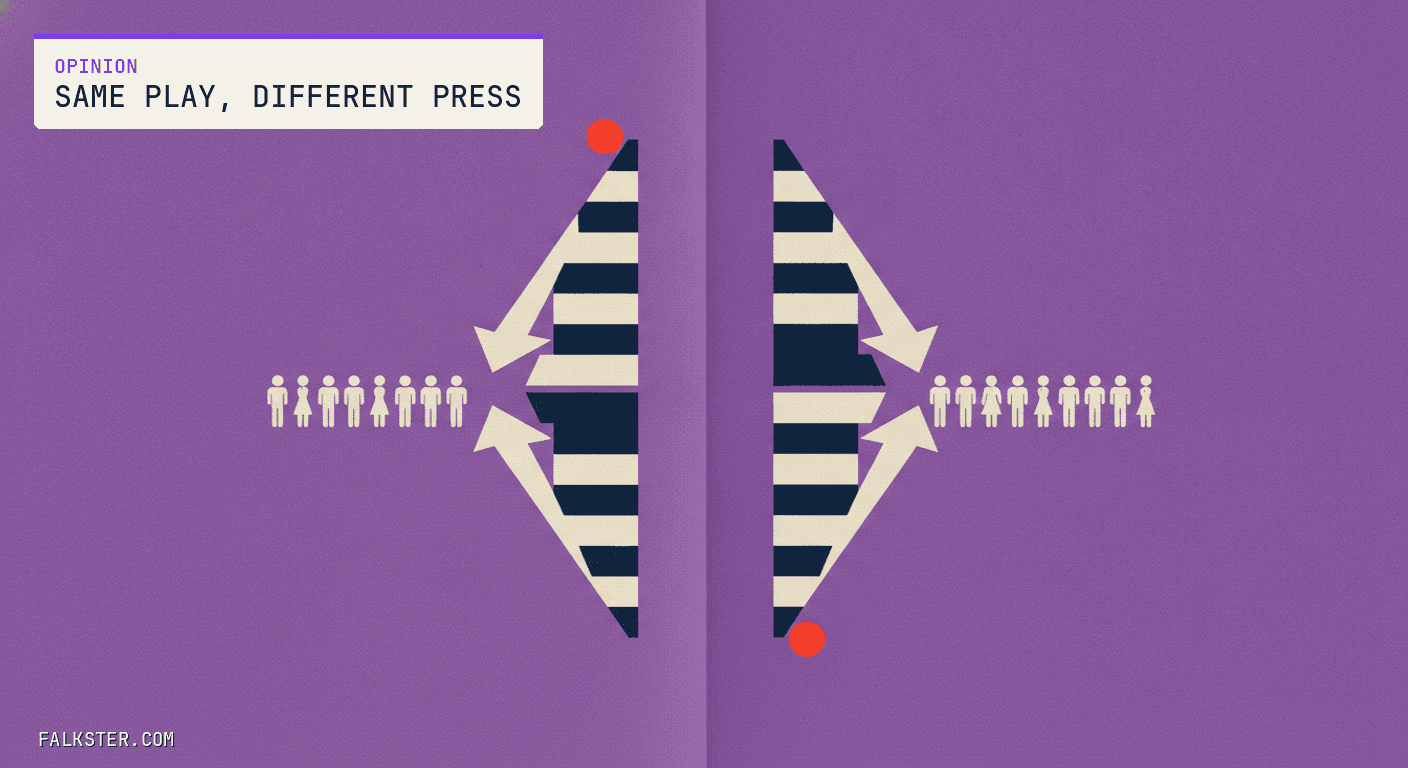
And then there is the part nobody mentions. Both companies did the same thing. IKEA moved call center staff into a remote sales channel. Salesforce moved support staff into professional services, sales, and customer success and hired thousands more sellers on top. Both took people out of work that could be deflected and pointed them at revenue. One got announced as reskilling. One got announced by a CEO saying he needed fewer heads. The mechanics are close to identical. The press coverage is not, and the LinkedIn version is downstream of the press coverage, not the mechanics.
What IKEA actually did that is worth copying
Strip out the morality and there is a real lesson in here, and it is not "be nice to your people."
IKEA looked at the 53% Billie could not resolve and asked what those queries had in common. The answer was not that the model needed another training run. Customers were not asking whether the sofa was in stock. They were asking whether it would look right in their living room. That is a different job, and it is a job with a purchase attached to it.
So the sequence was: automate the deflectable work, read the residue as a demand map rather than a backlog, and discover that the leftover was a sales motion nobody had staffed. The 8,500 people already knew the catalog cold, which made them credible in the new role from week one. That is why it worked.
Now apply that to Salesforce. What is the equivalent? A B2B SaaS customer filing a support ticket about an integration failure is not one good conversation away from a bigger contract. There is no design consultation hiding in the residue. The upsell motion in enterprise software lives with the AE and the CSM, which is precisely where Salesforce moved people and where they are hiring. They ran the same play. Their queue just did not contain a billion euros.
So the transferable lesson is not augment instead of replace. It is this: automation frees capacity, and whether that capacity becomes a new business line or a severance package depends entirely on whether there is unserved demand sitting adjacent to the work you just automated. Most queues do not have that. Some do. The work is finding out which one you have, and almost nobody does that work before deciding.
"Reskill your people" is not a strategy. It is an outcome that requires somewhere to reskill them to.
Why the comfortable version is expensive
I would let this go if it were harmless. It is not.
The story tells leaders that AI stalls out on anything complex, that human judgment is a moat, and that the companies who cut are the ones who will regret it. Believe that and you do not do the demand mapping. You do not analyze what your automation cannot handle. You wait, feel virtuous, and skip the exact step that made IKEA work.
It is also two data points, cherry-picked, four years apart, in different industries, under different technology, reported by different press cycles. That is not evidence. It is an anecdote with a moral attached. And the IKEA story is not even finished: Ingka has not ruled out future cuts, and its own executives have been asked directly whether Billie eventually comes for the design advisers too.
I am not arguing for firing people. I am arguing that if you want to make the case against reckless automation, make it with real evidence, because there is plenty. Use the reliability data. Use the reversal rate on agent actions. Use the escalation numbers. Do not use a 2021 chatbot and a misread containment rate and hope nobody checks.
Pick one thing to try this week
Pull the last 200 requests your automation could not handle. Not the ones it got wrong, the ones it declined or escalated. Read them yourself, not as a quality backlog but as a list of things people wanted and could not get.
If a theme shows up more than twice, you have found the same thing IKEA found. If nothing does, you have learned something more valuable and considerably less pleasant, which is that your freed capacity has nowhere to go and no amount of reskilling language will change that.
Either way you will know something the people resharing this post do not.
Sources: Marc Benioff on the Logan Bartlett Show (September 2025), as reported by Fortune, KTVU, and The Register; Salesforce statements on Agentforce and redeployment; Storyboard18 on Salesforce sales hiring; CIO and PYMNTS on Ingka Group's Billie rollout and remote selling channel; Fortune, "Inside Ikea's big bet on humans in the age of AI" (July 30, 2026).
Frequently asked
Does the IKEA versus Salesforce story prove AI automation does not work?+
No. It is quoted as proof AI fails, but both halves are stories of AI working. Salesforce's Agentforce hit its target: about half of conversations handled, cases down, support cost down 17%. IKEA's Billie deflected 47% of inquiries, which is the only reason capacity was freed to reskill 8,500 people into a €1.3 billion channel. What people call a failure at Salesforce is a headcount choice, not a model-performance result.
Is Salesforce's and IKEA's AI 'the same technology'?+
No, and that is the story's central false claim. IKEA's Billie launched in fiscal 2021 as an NLP intent router, before ChatGPT existed, and the reskilling and the €1.3 billion figure are from 2022. Salesforce deployed Agentforce at the start of 2025, a different class of system. They are two different decades of capability.
What does the 47% figure actually mean?+
It is Billie's containment rate, the share of inbound inquiries resolved without a human getting involved. It is not a quality comparison showing AI was '47% better' than people. Those are different numbers and they support different arguments.
What is the real, transferable lesson from IKEA?+
Automation frees capacity, and whether that capacity becomes a new business line or a severance package depends on whether there is unserved demand sitting next to the work you automated. IKEA read the 53% Billie could not resolve as a demand map (customers asking whether the sofa would look right at home) and staffed a sales motion. Most queues do not contain a billion euros; the work is finding out which one you have.
Did Salesforce and IKEA really do different things?+
The mechanics were close to identical. Both took people out of deflectable work and pointed them at revenue: IKEA moved call-center staff into remote selling; Salesforce redeployed support into professional services, sales, and customer success and hired thousands more sellers. One was announced as reskilling, one as needing fewer heads. The press coverage differed; the mechanics did not.
What should you do this week instead of resharing the story?+
Pull the last 200 requests your automation could not handle, the ones it declined or escalated, and read them as a list of things people wanted and could not get. If a theme repeats more than twice, you have found what IKEA found. If nothing does, your freed capacity has nowhere to go, and no reskilling language changes that.

Comments (0)
Sign in with LinkedIn to leave a comment.
Sign in with LinkedIn