The short version
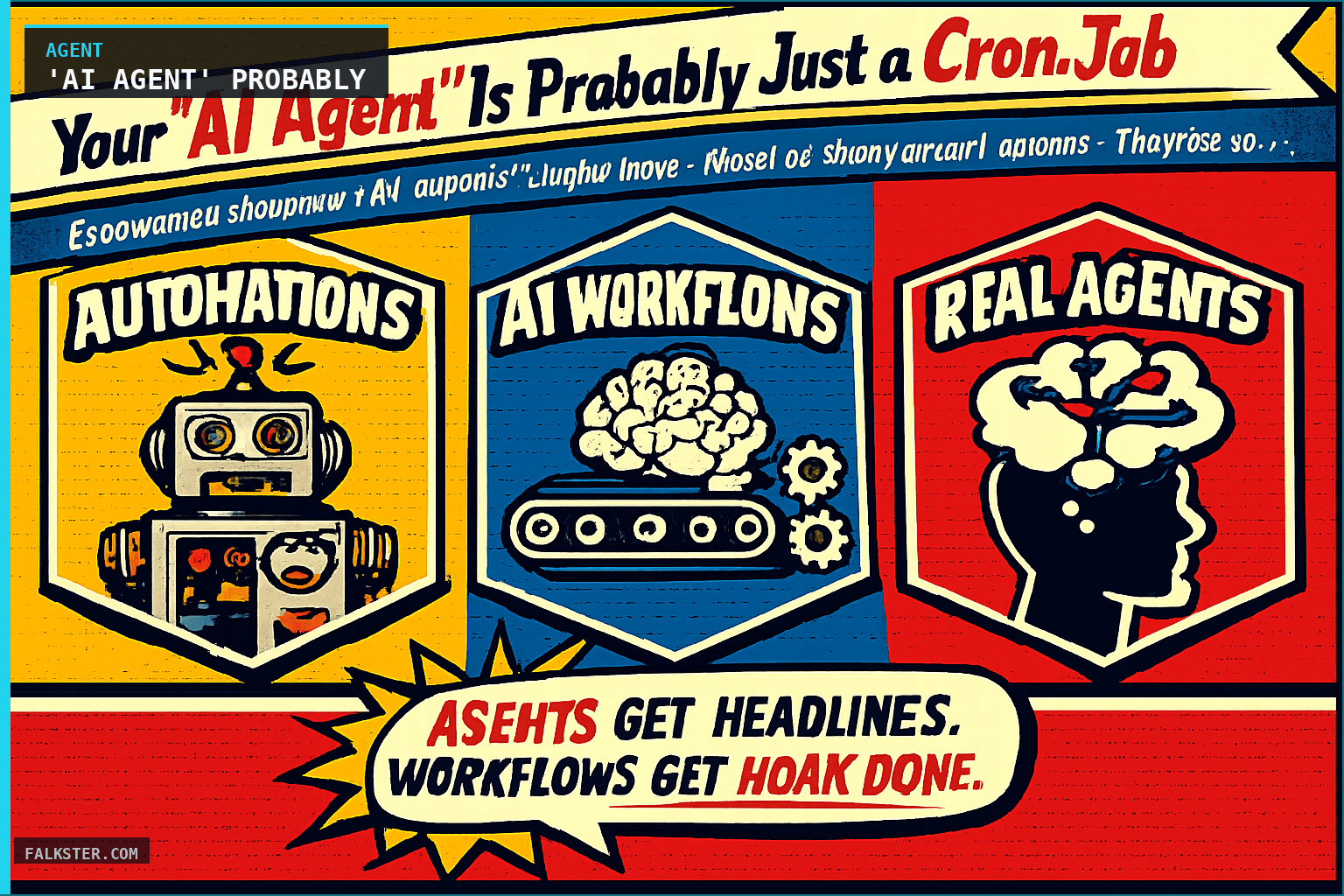
Most things marketed as AI agents are actually automations or workflows with a chatbot bolted on. The distinction matters because it changes your architecture, pricing, reliability story, and customer promise. Automations follow rules. Workflows add a language model at fixed steps in a deterministic pipeline. Agents decide what to do next based on context, adapt to unexpected input, and produce variable outputs. Most enterprise AI value today lives in the workflow tier. Agents get the headlines, but well-built AI workflows get the work done. Don't oversell a cron job as an agent because the word sounds better in the pitch deck.
Everyone's shipping "AI agents" right now. Most of them aren't agents. They're automations or workflows wearing a trench coat.
This isn't just a naming problem. If you're building product around AI, the distinction between an automation, a workflow, and a real agent changes your architecture, your pricing model, your reliability story, and what you promise customers. Get it wrong and you set expectations you can't meet.
I run 18 agents as part of my PM practice. Some of them really are agents. Some are honestly closer to fancy automations. Knowing which is which helps me set the right expectations and invest tuning time where it matters.
Three things that look the same but aren't
Automations follow rules. If X happens, do Y. No judgment, no variation. Your email drip campaign that sends a message on day 3 after signup is an automation. It's fast, reliable, and does exactly what you told it to. It'll also do exactly the wrong thing if the conditions change and nobody updates the rules.
AI workflows add a language model to a deterministic pipeline. You get a support ticket, an LLM classifies it, routes it to the right queue, maybe drafts a response. There's intelligence at specific steps, but the overall flow is still fixed. Step 1 always leads to step 2. The AI makes individual steps smarter, but it doesn't decide what steps to take.
Real agents make decisions about what to do next based on context. They can change their approach when something unexpected happens. They compose different skills together depending on the situation. They're non-deterministic, which is both their power and their risk.
How to tell what you're actually looking at
Ask these questions about any "AI agent" you're evaluating or building:
Does it decide what to do, or just how to do a predefined thing? If the sequence of steps is hardcoded and the AI only handles execution within each step, it's a workflow. If the AI decides which steps to take based on what it's seeing, it's closer to an agent.
Can it handle a situation it wasn't explicitly designed for? Automations break on edge cases. Workflows handle them poorly. Agents can (sometimes) adapt. If your "agent" falls over the moment something unexpected happens, it's not an agent.
Does it learn from feedback? True agents adjust their behavior over time. Most things marketed as agents today don't. They run the same way every time, which is fine, but call it what it is.
Is the output predictable? If you run it ten times on the same input and get the same result every time, it's an automation or a tightly constrained workflow. Agents produce variable outputs because they're making judgment calls.
Why this matters for product work
If you're a PM building AI features, this distinction shapes your entire approach:
Reliability expectations are different. Automations should work 100% of the time. Workflows should be highly reliable with occasional AI missteps. Agents are inherently less predictable. You need to design the right guardrails and human-in-the-loop checkpoints for each type.
Pricing models change. Automations work great on per-seat or per-action pricing. Workflows can be priced by volume. Agents, if they're truly autonomous, should be priced on outcomes because that's what you're selling. If you price an agent like a workflow, you're either leaving money on the table or setting yourself up for disappointed customers.
The build vs. buy decision shifts. Automations are commoditized. Workflows are becoming commoditized. True agentic capabilities are still hard to build well. That's where the moat is, if you can get the reliability right.
What I've learned from running my own
My daily focus agent is honestly more of an AI workflow. It pulls from fixed data sources, runs a prompt, and gives me a summary. The sequence doesn't change. The AI just makes the output useful. And that's fine. I don't need it to be agentic. I need it to work every morning.
My competitive intel agent, on the other hand, is more agentic. It decides which competitors to dig into based on what changed, chooses which sources to prioritize, and adjusts its depth depending on what it finds. It surprises me sometimes, which is the hallmark of something actually agentic.
The point isn't that agents are better than workflows or automations. Each has its place. The point is knowing which one you need for a given job, and not overselling a workflow as an agent just because the word sounds better in a pitch deck.
The honest taxonomy
When I set up a new automated process, I ask myself:
Is this a rule? Build an automation. Fast, cheap, reliable.
Is this a fixed process where some steps need intelligence? Build a workflow with AI. Predictable structure, smart execution.
Is this a problem where the right approach depends on what the AI discovers along the way? Build an agent. Accept the unpredictability. Invest in guardrails.
Most of the real value in enterprise AI today lives in the workflow tier. Agents get the headlines, but well-built AI workflows get the work done. Don't let the hype push you past what your use case actually needs.
Also on Medium
Full archive →Many AI Agents Are Actually Workflows or Automations in Disguise
How to tell agents from workflows from cron jobs, and why it matters for what you ship.
AI Agents and the Future of Work: A Pixar-Inspired Journey
What product managers can learn about AI agents from how Pixar runs a film team.
Frequently asked
What is the difference between AI agents, workflows, and automations?+
Automations follow fixed rules: if X then Y, no judgment. AI workflows add a language model at specific steps inside a deterministic pipeline, making individual steps smarter without changing the overall flow. Real AI agents decide what to do next based on context, handle unexpected inputs, and produce variable outputs. Most things marketed as AI agents today are actually AI workflows.
How do I tell if what I'm building is actually an agent?+
Ask four questions: Does it decide what to do, or just how to do a predefined thing? Can it handle a situation it wasn't explicitly designed for? Does it learn from feedback over time? Is the output variable across runs on the same input? If all four answers are yes, you have an agent. If one or more are no, you have a workflow or automation.
Why does the distinction between agents and workflows matter for product teams?+
It changes your reliability expectations, pricing model, and build-vs-buy decision. Automations should work 100% of the time. Workflows should be highly reliable with bounded AI missteps. Agents are inherently less predictable and need guardrails and human-in-the-loop checkpoints. Pricing an agent like a workflow either leaves money on the table or sets up disappointed customers.
Is it bad to build an AI workflow instead of a real agent?+
No. Most enterprise AI value lives in the workflow tier. Workflows are predictable, easier to debug, and faster to build. The point is not that agents are better, it is knowing which one your use case actually needs. Overselling a workflow as an agent because the word sounds better in a pitch deck sets expectations you cannot meet.
What is an example of a real AI agent versus an AI workflow?+
A daily focus agent that pulls from fixed data sources, runs a prompt, and outputs a summary is an AI workflow: the sequence does not change and the AI makes execution within each step useful. A competitive intel agent that decides which competitors to dig into based on what changed, picks which sources to prioritize, and adjusts depth based on what it finds is genuinely agentic: it surprises you sometimes, which is the hallmark.

Comments (0)
Sign in with LinkedIn to leave a comment.
Sign in with LinkedIn