The short version
Each of the ten common PM roles (Technical, Growth, AI, Product Owner, Platform, Generalist, Product Ops, Data, PMM, E-Commerce) needs a different AI agent stack. The agents aren't one-size-fits-all. A Growth PM lives in Product Health configured for funnel metrics, AARRR, and Red Flag for signup drops. A Platform PM lives in Product Health configured for API uptime and Documentation Gaps for the API docs that ARE their product. A Generalist needs Daily Focus and Weekly Ops Digest. The Product Health agent appears in almost every stack, but configured differently each time. Configuration matters more than capability. Pick three agents that match your actual role, run them reliably, then add one at a time.
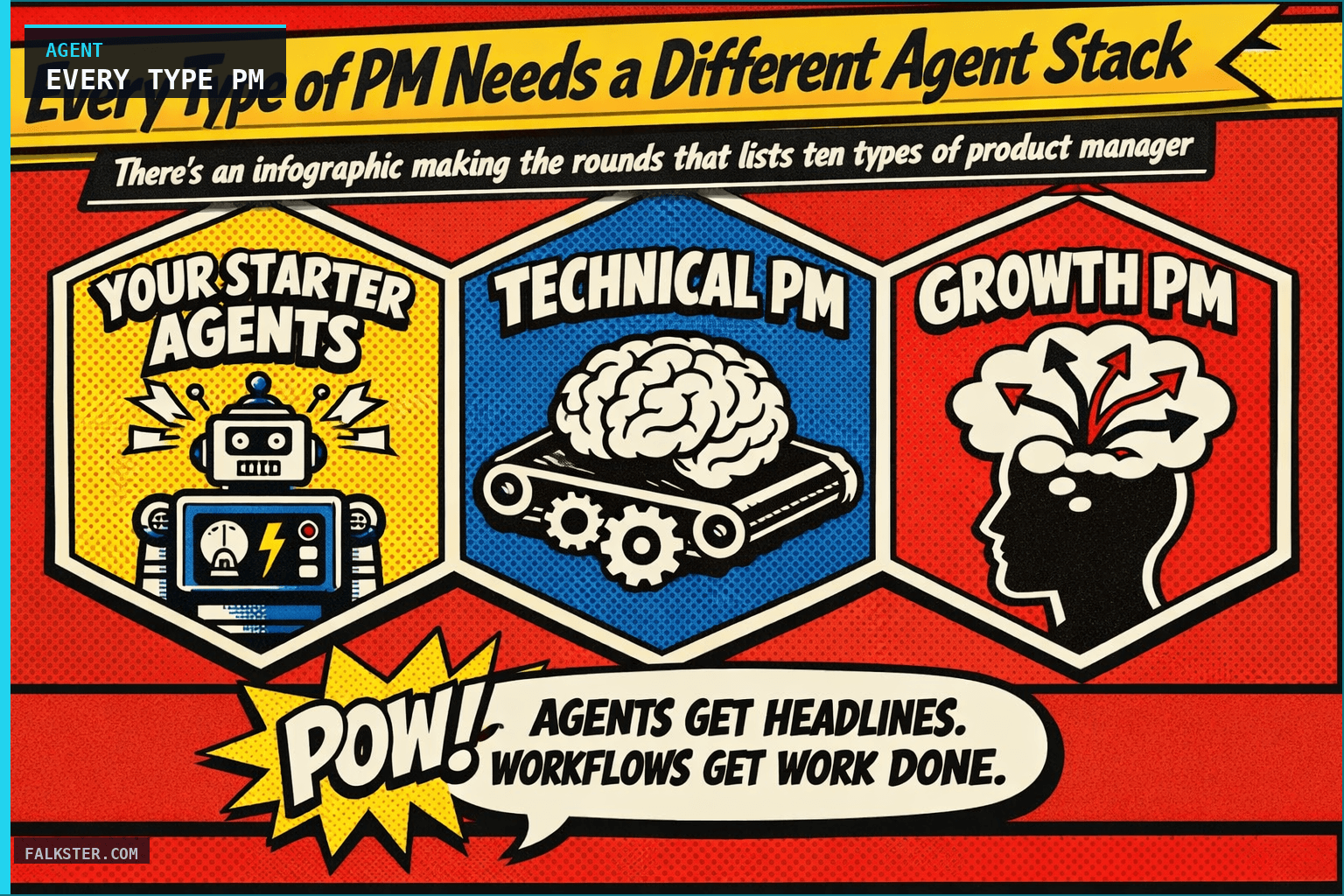
There's an infographic making the rounds that lists ten types of product managers. Technical PM, Growth PM, AI PM, Product Owner, Platform PM, Generalist PM, Product Ops, Data PM, Product Marketing Manager, E-Commerce PM. It's a solid taxonomy. But here's what nobody's talking about: each of these roles should be running a completely different set of AI agents.
I run 45 agents as part of my daily practice. Not all of them would make sense for a Growth PM. And a Platform PM needs agents I don't use at all. The mistake most people make is treating AI agents as one-size-fits-all. They're not. Your agent stack should mirror your actual job, not some generic PM toolkit.
Here's how I'd set it up for each role.
Technical PM
You're the bridge between engineering and business. You live in roadmaps, tech debt backlogs, and dependency chains.
Your starter agents:
The Engineering Capacity Agent is your first build. It watches sprint velocity, flags when a team is overloaded before standup, and tracks how much capacity is going to maintenance vs. new work. For a Technical PM this is table stakes.
Pair it with the Release Readiness Agent. It checks CI/CD status, open blockers, and whether documentation is keeping up with the code. You shouldn't be manually chasing engineers to find out if the release is on track. The agent tells you by 9am.
Third: the Documentation Gaps Agent. Technical PMs own the API docs, the integration guides, the architecture diagrams. This agent scans what shipped versus what's documented and tells you what's missing.
Growth PM
You care about funnels, experiments, and activation metrics. Your agents should be watching the numbers while you design the next test.
Your starter agents:
Start with the Product Health Agent configured for growth metrics. DAU/MAU ratios, activation rates, trial-to-paid conversion. Set it to flag anything that moves more than 10% from the rolling average.
The AARRR Dashboard template gives you the framework. But an agent that actively watches those pirate metrics and pings you when acquisition drops or retention spikes is more valuable than a dashboard you check when you remember to.
Add the Red Flag Detection Agent tuned for signup funnel drops. If your onboarding flow breaks on mobile at 2am, you want to know before the weekly review.
AI Product Manager
You're integrating AI features into the product. You work closely with ML engineers and data scientists. Your agents need to track model performance, not just product metrics.
Your starter agents:
The Product Health Agent again, but configured for model-specific metrics. Latency, accuracy drift, hallucination rates, cost per inference. These change faster than traditional product metrics and you can't afford weekly check-ins.
Competitive Intel Agent is critical here. The AI landscape shifts weekly. New models drop, pricing changes, capabilities expand. Your agent should monitor competitor changelogs, Anthropic/OpenAI/Google announcements, and Hacker News threads so you're never caught off guard in a strategy discussion.
The Market Intel Agent rounds it out. Track emerging use cases, regulatory changes, and what customers are doing with AI in your space.
Product Owner
You run the backlog. You're in grooming sessions, writing user stories, prioritizing sprint work. Your problem isn't strategy. It's throughput and clarity.
Your starter agents:
The PM Issues Agent is purpose-built for this. It scans your issue tracker for stale tickets, stories missing acceptance criteria, bugs that haven't been triaged, and PRDs that reference deprecated features.
The Daily Focus Agent pulls together what's in flight today, what's blocked, and what needs your decision. For a PO running multiple teams, this replaces the 30 minutes of tab-switching you do every morning.
Team Triage Agent helps you catch process breakdowns. Are stories sitting in review too long? Is one engineer carrying all the load? The agent surfaces patterns you'd miss in the daily noise.
Platform PM
You own APIs, infrastructure, integrations. Your users are internal teams and external developers. Reliability is everything.
Your starter agents:
Product Health Agent configured for platform metrics. API uptime, p99 latency, error rates by endpoint, rate limit hits. If a partner integration is hammering your API, you need to know before they file a ticket.
Release Checker Agent for tracking what's deployed across environments. Platform PMs juggle staging, production, and sometimes customer-specific deployments. The agent keeps a running ledger.
Documentation Gaps Agent is even more critical here than for Technical PMs. Your API docs are your product. If a new endpoint ships without documentation, developers won't find it. The agent catches this the day it happens.
Generalist PM
You do everything. Strategy, execution, stakeholder management, customer calls. Your problem is context-switching and making sure nothing falls through the cracks.
Your starter agents:
The Daily Focus Agent is your lifeline. It synthesizes across all your workstreams and tells you the three things that matter most today.
Weekly Ops Digest pulls together what happened across your product this week. For a generalist managing multiple surfaces, this is the difference between walking into Monday's leadership meeting prepared and winging it.
Roadmap Tracker Agent watches whether work-in-progress still aligns with the quarterly goals. Generalists lose sight of the big picture fastest because they're deep in the details all day.
Product Operations Manager
You're the systems thinker. Process efficiency, cross-team communication, resource allocation. You probably already love automation.
Your starter agents:
Product Ops Agent is literally built for you. It monitors process health across teams, flags communication breakdowns, and tracks operational metrics.
Engineering Capacity Agent gives you the resource view. Who's overloaded, where's the slack, which teams are consistently underestimating.
Customer Commitments Agent tracks what's been promised to customers and whether the teams are on track to deliver. For Ops, this is where deals, engineering, and product intersect. The agent keeps you honest.
Data Product Manager
You build dashboards, data pipelines, and analytics products. Accuracy and freshness are your quality bar.
Your starter agents:
Product Dashboard Agent is your meta-tool. Use it to monitor the health of the dashboards you build for others. Are data pipelines running? Are refresh times within SLA? Is the data your stakeholders see actually current?
Red Flag Detection Agent configured for data quality. Null rates spiking, row counts dropping, schema drift. These are silent killers for a Data PM's credibility.
Executive Report Agent helps you package the story. You have the data. The agent helps you turn it into a narrative that lands with leadership.
Product Marketing Manager
You bridge product and market. Launches, positioning, competitive narratives. Your agents should keep you connected to what's happening outside the building.
Your starter agents:
Competitive Intel Agent is non-negotiable. You need to know the moment a competitor changes pricing, ships a feature, or publishes a blog post that challenges your positioning.
GTM Monitoring Agent tracks your launch metrics. Adoption of new features, press coverage, social mentions. Did the launch land or did it flop? The agent gives you signal before the formal readout.
Market Intel Agent watches the broader space. Analyst reports, industry trends, category shifts. You can't write compelling positioning if you're not tracking where the market is going.
E-Commerce Product Manager
You optimize purchase flows, manage listings, and live or die by conversion rates. Speed matters more here than in most PM roles.
Your starter agents:
Product Health Agent focused on e-commerce vitals. Cart abandonment rate, checkout completion, page load time by device, search-to-purchase ratio. Set aggressive thresholds. In e-commerce, a 0.5% conversion drop is real money.
Red Flag Detection Agent for payment failures, inventory mismatches, and broken product pages. Every hour a checkout flow is broken costs revenue.
AARRR Dashboard adapted for commerce. Acquisition channels, activation (first purchase), retention (repeat purchase rate), revenue per user, referral program performance.
The pattern you should notice
A few things repeat across all ten roles.
The Product Health Agent shows up in almost every stack, just configured differently each time. Same agent. The metrics it watches change everything. Configuration matters more than capability.
Every role also wants at least one agent that watches for problems (Red Flag, PM Issues, Documentation Gaps) and one that synthesizes context (Daily Focus, Weekly Ops, Executive Report). The watcher catches fires. The synthesizer saves you the context-switching tax.
And the roles closest to the market, Growth, PMM, E-Commerce, lean on external-facing agents, while the roles closest to the code, Technical, Platform, Data, lean on internal ones. Generalists and Product Ops need both.
Don't try to run all 45 on day one. Pick the three that match your actual role, get them working reliably, then add one at a time as you find the gaps. The best agent stack is the one you trust enough to act on.
Also on Medium
Full archive →AI Agents and the Future of Work: A Pixar-Inspired Journey
What product managers can learn about AI agents from how Pixar runs a film team.
Many AI Agents Are Actually Workflows or Automations in Disguise
How to tell agents from workflows from cron jobs, and why it matters for what you ship.
Frequently asked
Do all product managers need the same AI agent stack?+
No, and that's the main point. The Product Health Agent appears across almost every PM role, but configured differently each time. A Growth PM watches DAU/MAU and activation rates. A Platform PM watches API uptime and error rates by endpoint. A Technical PM watches sprint velocity and PR throughput. Configuration matters more than capability.
What is the best starting agent stack for a new PM?+
For most generalist PMs, start with three: Daily Focus (synthesizes what matters today across all workstreams), Product Health (monitors your north star metric), and Red Flag Detection (catches anomalies before they become crises). Get those three working reliably, then add one at a time based on where you're feeling blind.
What agents does a Technical PM need that others don't?+
The Engineering Capacity Agent and the Release Readiness Agent are table stakes for Technical PMs. Capacity watches sprint velocity and flags overloaded teams before standup. Release Readiness checks CI/CD status, open blockers, and whether documentation is keeping up with code. The Documentation Gaps Agent rounds it out for API-heavy products.
Why do Growth PMs and E-Commerce PMs need similar agents?+
Both roles live and die by funnel metrics and conversion rates. Both need an agent watching those metrics 24/7 and alerting on drops before the weekly review. The difference is threshold sensitivity: in e-commerce, a 0.5 percent conversion drop is real money and you want to know within hours. For growth PMs, the AARRR framework shapes which metrics matter at each stage.
What is the pattern across all ten PM role stacks?+
Every stack includes at least one watcher agent (Red Flag, PM Issues, Documentation Gaps) that catches fires, and one synthesizer agent (Daily Focus, Weekly Ops, Executive Report) that prevents context-switching tax. Roles closest to the market (Growth, PMM, E-Commerce) lean on external-facing agents. Roles closest to the code (Technical, Platform, Data) lean on internal ones.

Comments (0)
Sign in with LinkedIn to leave a comment.
Sign in with LinkedIn