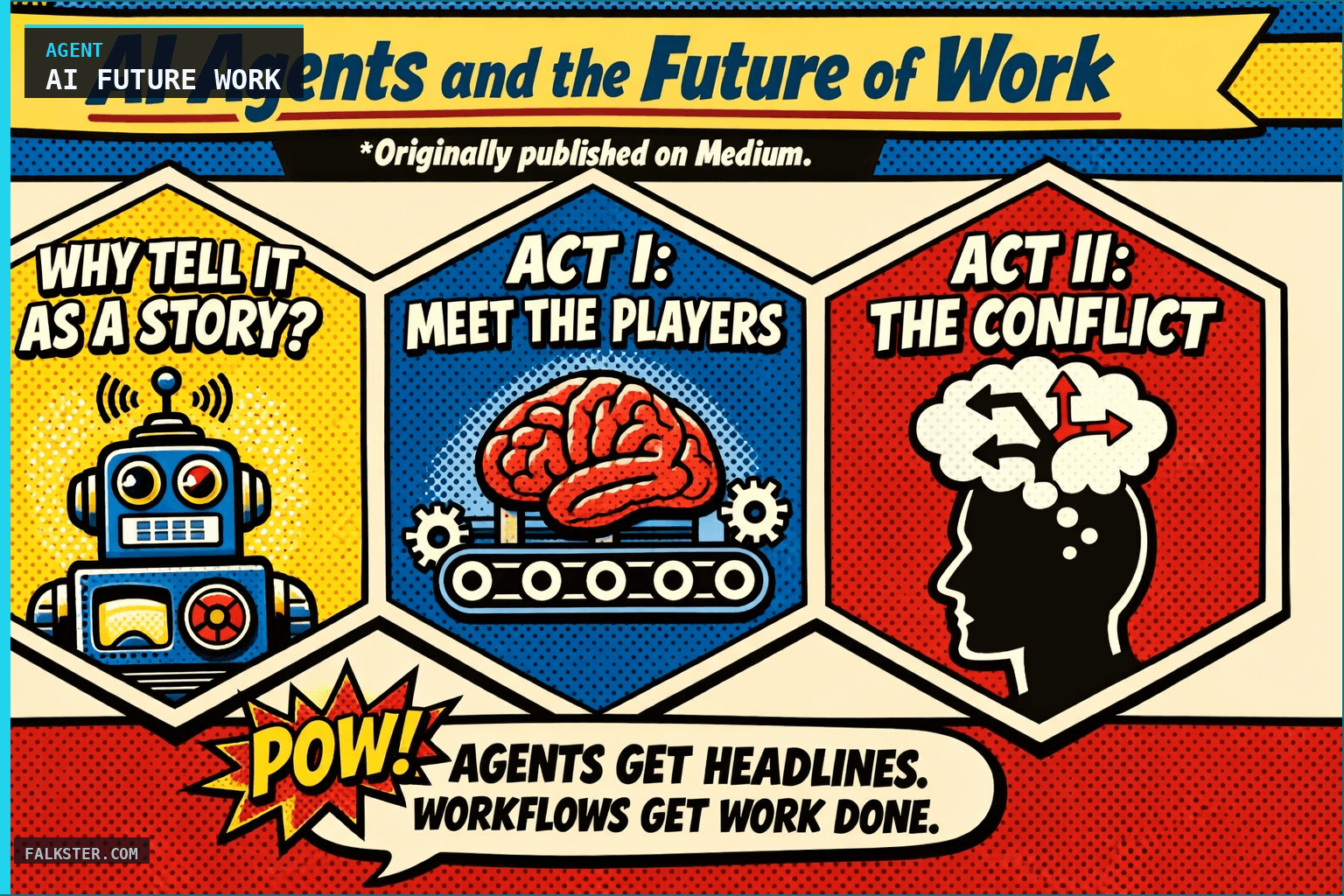
Originally published on Medium.
The short version
A narrative-style exploration of what happens when AI agents become coworkers. Casey watches her mid-sized SaaS company deploy an AI agent platform, watches the agents flounder for two months because they're "starving" without a knowledge graph, then watches the team rebuild the workflow around humans plus agents. By month six the metrics are extreme: 40% faster project delivery, 70% less decision latency, 85% less rework, employee satisfaction up. The lesson lands somewhere else. Companies need to invest in their knowledge graph, stay obsessed with outcomes over outputs, retrain people instead of cutting them loose, and choose ethics over expedience. This is already happening at the companies paying attention.
Why tell it as a story?
Big ideas stay abstract until you put a person inside them. A story lets you walk in someone's shoes, feel the tension, and watch the change happen.
Pixar built a whole studio on that. Take a huge concept, make it human. So here's the story of Casey and how AI agents changed the way we work.
Act I: Meet the Players
Casey knocked on the conference room door. Two years as a project manager at a mid-sized SaaS company had taught her that new platform announcements usually meant extra work for her team.
"We're deploying the new AI Agent Platform next month," said Marcus, the CTO, clicking through slides. "These aren't chatbots. They're autonomous agents that can coordinate work across our entire system."
Casey leaned forward. "What does that mean for us?"
"It means you'll have digital agents running alongside your team. They'll handle routine tasks, surface insights, and keep everything moving. Think of them as extremely competent assistants who never sleep and never forget."
The room was quiet. Everyone was thinking the same thing: What happens to my job?
Act II: The Conflict
The first month was chaos.
The agents started with simple tasks: scheduling meetings, pulling reports, sending reminders. But the knowledge they had was scattered. Information lived in Slack, in spreadsheets, in people's heads, in three different project management tools that didn't talk to each other.
The agents would confidently suggest timelines that violated dependencies. They'd schedule resources that weren't actually available. They'd provide insights that were technically true but strategically useless.
"These agents are dumb," complained Tom from engineering. "I'm spending more time correcting them than they save me."
Casey felt the frustration. The promise was there, but the execution was crumbling.
Then she had a conversation with Dr. Patel, the Head of Data Science.
"The agents aren't dumb," Dr. Patel explained. "They're starving. We're throwing them scraps and expecting them to build a mansion."
Act III: Building a Knowledge Graph
"What they need," Dr. Patel continued, "is a knowledge graph. A digital map of how your business actually works."
Casey listened as Dr. Patel described it: a living, breathing representation of the company.
Not just "Project X is in progress." But "Project X depends on Component Y, which is owned by Tom, who is stretched thin, and relies on data from the warehouse, which is currently unstable, so we should expect a three-day delay."
It took three months. The team had to catalog dependencies, connect data sources, define relationships, and model the business logic that had lived only in people's experience.
But when it was done, everything changed.
The agents suddenly had context. They understood constraints. They could reason about ripple effects. They moved from helpful to indispensable.
Act IV: Building Smarter Workflows
With the knowledge graph in place, Casey and her team redesigned their workflows.
Instead of "agent tells human what to do," they created something different: humans and agents working as a team.
Agents would handle the groundwork: gathering data, identifying options, surfacing dependencies, flagging risks. Then a human would make the decision. The agent would execute.
Or agents would handle 90% of the routine case, and escalate to a human for the 10% that required judgment.
The magic was automation elevating people. No one got replaced.
Act V: Letting Go of Legacy Tools
Three months in, something unexpected happened: people stopped using their old tools.
The project management app that had been "essential" got abandoned. The spreadsheet dashboards that had taken hours to build each month were suddenly irrelevant. The status meeting that had consumed two hours every Friday became a 20-minute sync.
It felt like loss.
"We're dismantling things we built," said Sarah from operations. "It's like watching your work become obsolete."
Casey understood. But she reframed it: "We're not losing the work. We're graduating it. The agents are carrying it forward better than we ever could."
What the agents replaced was the friction that tools created.
Act VI: Accelerating Quality and Efficiency
By month six, the metrics were staggering.
Project delivery time: down 40%. Decision latency: down 70%. Rework due to miscommunication: down 85%. And something unexpected: employee satisfaction was up.
People weren't exhausted by status updates and data gathering. They were doing the work that actually mattered.
But the metrics told only part of the story. The real shift was qualitative.
Marcus pulled Casey aside. "We used to have two modes: fire-fighting or planning. We were always in reactive mode."
"And now?" Casey asked.
"Now the agents handle the reactive stuff. We get to be proactive. We spot trends three months out instead of three days out."
Act VII: Ethics and Impact
Not everything was smooth.
In month seven, an agent recommended laying off the customer support team. Technically, the agent was right: it had learned to handle 95% of customer issues autonomously.
But Casey pushed back hard. "This isn't just about efficiency. This is about people. We transition, we retrain, we find them higher-value work. We don't just cut them loose."
The organization learned an important lesson: powerful technology requires thoughtful governance. Agents could optimize for efficiency. Humans had to optimize for impact.
They built ethical guidelines into the agent framework. Decisions affecting employment, privacy, or safety required human review. Transparency became non-negotiable.
Casey led the effort to retrain the support team into quality assurance and agent management roles. It was harder than just letting them go. It was also the right thing to do.
Act VIII: A New Way to Work
By month nine, the transformation was complete.
Meetings were shorter because they had better information. Decisions were faster because the options were clearer. Execution was smoother because the agents caught problems before they became crises.
But the biggest shift was more subtle.
People had time to think. Time to learn. Time to collaborate in ways that spreadsheets and status updates never allowed.
Engineers could prototype instead of managing dependencies. Project managers could strategize instead of tracking status. Executives could innovate instead of reacting.
"This is what I imagined when I took the job," Casey told Marcus. "Actual work on things that matter."
Act IX: Future-Proofing
On her last day in the role (Casey had been promoted to VP of Operations), she sat with the next generation of leaders.
"This is just the beginning," she warned them. "The agents will get smarter. AR will let them interface with physical work. Robotics will let them do manual labor. The next wave of ML will make them even more autonomous."
"So how do we stay ahead?" someone asked.
"You keep doing what we're doing. You invest in your knowledge graph. You stay obsessed with outcomes, not outputs. You remember that agents are tools, and humans are the point."
"And when the next revolution comes?" another voice asked.
"You'll be ready because you built the muscles to adapt. Because you valued your people enough to retrain them. Because you chose ethics over expedience."
Final Scene: Harmony
A year later, Casey walked through the office. It looked different now.
No status meeting rooms. No crisis huddles. No people glued to email.
Instead, she saw people at whiteboards. People in deep work mode with headphones. People having real conversations because they actually had time to talk.
The agents were there, embedded in every workflow, invisible in their competence.
The future wasn't about agents replacing humans. It was about humans and agents finding harmony.
This was a story about technology freeing people to do work that mattered.
And that, Casey thought, was the real revolution.
The Lesson
Casey's story isn't science fiction. It's the present, playing out at the companies that moved early.
The ones pulling ahead understood that agents aren't a productivity tweak. They're a chance to rethink how we work, who we become, and what we value.
The agents are already here. The only real question is whether your org will be ready to work alongside them.
For a practitioner's guide to building the agent fleet Casey's team wished they had, see Your AI Agent Fleet. For how the knowledge graph investment Casey's team made translates into a modern product operating model, see The AI Product Operating Model. For real agent blueprints you can deploy this week, see Agents for Every PM.
Also on Medium
Full archive →AI Agents and the Future of Work: A Pixar-Inspired Journey
What product managers can learn about AI agents from how Pixar runs a film team.
Many AI Agents Are Actually Workflows or Automations in Disguise
How to tell agents from workflows from cron jobs, and why it matters for what you ship.
Frequently asked
What is the main lesson from the Pixar-style AI agents story?+
Agents fail when they are data-starved. Casey's team spent two months with broken agents because the institutional knowledge was scattered across Slack, spreadsheets, and three project management tools. Once they built a knowledge graph modeling how the business actually works, the agents went from frustrating to indispensable. The lesson: build the knowledge graph before you build the agents.
What results did Casey's company see after deploying AI agents properly?+
By month six: project delivery time down 40%, decision latency down 70%, rework from miscommunication down 85%, and employee satisfaction up. The qualitative shift was equally significant: the team moved from reactive firefighting to proactive strategy, spotting trends three months out instead of three days out.
What is a knowledge graph and why do AI agents need one?+
A knowledge graph is a living representation of how the business works: not just 'Project X is in progress' but 'Project X depends on Component Y, owned by Tom, who is stretched thin, relying on a currently unstable data warehouse, so expect a three-day delay.' Agents without this context produce confident but strategically useless output. The graph is what gives them the ability to reason about constraints and ripple effects.
What happened to the customer support team when the agent could handle 95% of requests?+
Instead of laying them off, the company retransitioned them into quality assurance and agent management roles. It was harder than cutting them loose and took more organizational effort. The story frames this as the right move: companies that treat AI deployment as a workforce-cutting exercise lose customer trust and face regulatory and reputational risk. Retraining is the responsible path and builds more sustainable advantage.
How should companies think about ethics in AI agent deployment?+
Build ethical guidelines into the agent framework from the start: decisions affecting employment, privacy, or safety require human review, and transparency is non-negotiable. The story's lesson is that agents can optimize efficiently for the wrong outcome if humans don't define what 'good' means beyond cost savings. Ethics governance is not a legal checkbox; it is a product decision.

Comments (0)
Sign in with LinkedIn to leave a comment.
Sign in with LinkedIn