Originally published on Medium.
The short version
Many vendor "AI agents" are actually automations or workflows wearing an expensive suit. The distinction matters because each behaves differently. Automations are rule-based and deterministic. AI workflows add language model capabilities at fixed steps in a deterministic process. Real agents are autonomous, adaptive, and non-deterministic, with continuous learning. Five characteristics separate real agents: autonomy, adaptability, contextual understanding, skill composition, continuous learning. Most enterprise AI value today lives in the workflow tier (Wave 2, 2024-2026). Agentic AI (Wave 3) is emerging. Know which wave you need before believing the vendor hype.
The marketing problem
Every vendor now claims to have "AI agents." Consultancies promise to deploy them. Startups call their products "agentic platforms."
Dig into what they've actually built and the picture changes. A lot of these aren't agents. They're automations or workflows wearing an expensive suit and a trendy name.
The difference isn't semantics. It decides what the thing can do, how much it can learn, and what it's worth to you. Get it wrong and you buy inflated expectations, a failed rollout, and a team let down by technology that never matched the pitch.
If you want to see what real agents look like on PM work, Your AI Agent Fleet maps a practical fleet across the seven stages of the product operating model.
The three types
An automation is a predetermined sequence of actions triggered by a condition. "If an email arrives with the subject line 'Invoice,' extract the amount and send it to accounting." Deterministic. Every time condition X occurs, action Y follows. No learning, no adaptation, no reasoning about context.
Automations are valuable. They're easy to build, easy to maintain, and they pay back fast. They're just not agents.
An AI workflow adds AI capabilities to a deterministic process. "When a support ticket arrives, classify the sentiment. If negative, route to senior support. If positive, send to the standard team. Draft a response template." Still deterministic. The sequence is fixed. But the AI makes each step smarter.
Workflows beat automations on nuance. They handle variation and cut down on the number of explicit rules you have to write. They still don't learn. The workflow runs the same logic every time.
Then there's a real agent. It's autonomous. It makes decisions without a human in the loop, it handles situations it hasn't seen before, and its behavior isn't fully scripted.
"Given a new customer inquiry, the agent works out what information it needs, what systems to query, what questions to ask, and what to recommend, adapting as it learns."
The path isn't fixed. The logic shifts with context, learning, and new information. That's different in kind. It's powerful, and it's much harder to build, predict, and control.
Five things a real agent has
Five things separate a real agent from a workflow in a costume. Autonomy, adaptability, contextual understanding, skill composition, and learning. Here's what each one looks like when it's real.
1. Autonomy
Does it decide and act on its own, or just run predetermined steps? A real agent has agency. It picks its approach, makes judgment calls, and acts without waiting for approval, though it should escalate the edge cases that matter.
2. Adaptability
Can it handle a situation nobody programmed it for? Or does it fall over the moment reality drifts from the expected pattern? Real agents generalize. They carry principles into new contexts instead of needing a rewrite every time the environment shifts.
3. Contextual understanding
Does it know why it's doing something, not just what the next step is? Real agents hold a model of their environment. They know the constraints, the dependencies, and the consequences, and they reason about whether an action will actually solve the problem.
4. Skill composition
Can it combine capabilities to reach a goal, or does it walk one fixed path? Real agents are multi-skilled. They know which capability to reach for and when, and they stitch them together for the messy problems.
5. Continuous learning
Does it get better from feedback and outcomes, or run the same logic every deployment? Real agents learn. From mistakes, from wins, from human corrections, from patterns in the data. Each pass sharpens them.
Six questions for the demo
Before you believe the pitch, put six questions to the vendor:
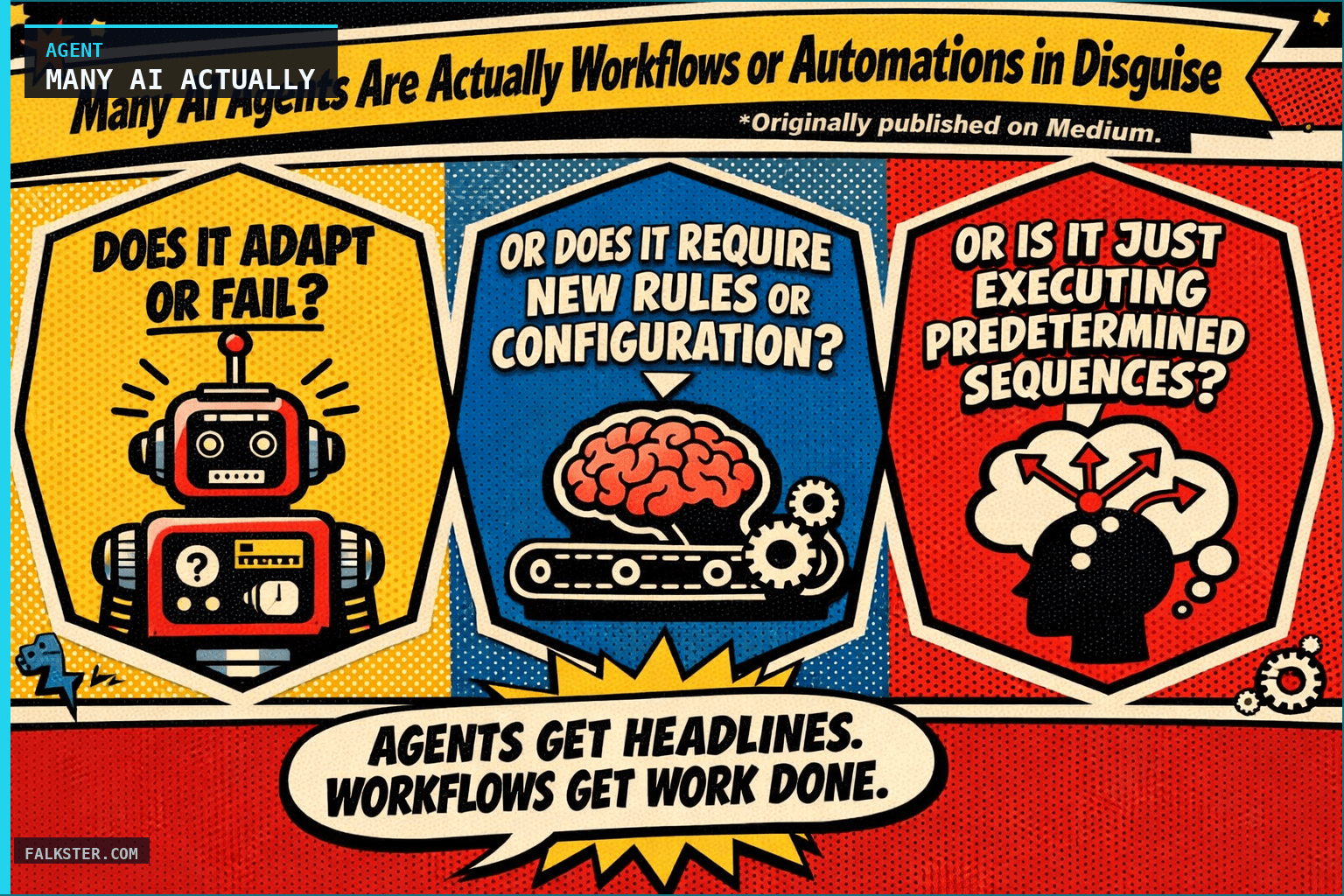
- "What happens if the input is different from what you expect?" Does it adapt or fail?
- "Can it handle a situation it wasn't specifically trained for?" Or does that mean new rules and config?
- "What decisions does it actually make?" Or is it running a predetermined sequence?
- "How does it improve over time?" Does it learn from outcomes?
- "What can go wrong?" What causes a bad decision, and how do you stop it?
- "How much human oversight does it really need?" If it needs sign-off on every action, it isn't autonomous.
If the answers come back "it doesn't," "it needs retraining," "it just follows rules," and "it needs a human on most decisions," you don't have an agent. You have an automation or a workflow. Nothing wrong with that. Just be honest with yourself about what you're buying.
Where each one belongs
Each type has a job. Automations run the routine, predictable work. They're cheap, fast, and easy, so point them at high-volume, low-complexity tasks. Workflows make that routine work smarter and back a human decision instead of replacing it. Real agents take the complex, adaptive work that needs judgment and learning. They're expensive to build right, but they reach problems that used to need a senior person.
None of this is about replacing humans. It's about matching work to whatever handles it best. Agents take the adaptive, judgment-heavy work. Automations take the tedious, high-volume, predictable stuff. Humans keep the creative and strategic work, the relationships, and the exceptions that actually matter.
What it takes to build a real one
If you want an actual agent, you're investing in four things.
A decision-making core that can reason about a problem, form an approach, and adapt to what comes back. Usually a large language model with extended context, retrieval, and reasoning on top.
A skill graph that models the business: your data, your processes, your constraints, your objectives. The agent queries it to understand what it can do and what matters.
Orchestration, so the agent can break a goal into steps, run them in parallel or in sequence, and change course based on intermediate results.
And a human in the loop, with real ways for people to review the consequential calls, correct them, and sharpen the agent's judgment over time.
That's a lot more work than a workflow. It costs you data infrastructure, model work, and organizational change. The payoff is on the same scale.
Why does the label matter this much? Because it sets what you expect and what you get. A vendor who promises "agents" and ships "workflows" isn't lying, just inflating the word. But if you were counting on an autonomous, adaptive system and you get deterministic rules, you'll be disappointed.
So be precise about what you need. Kill manual data entry? Automation or workflow. Back a human decision with more signal? Workflow. Handle novel problems and learn over time? Now you need a real agent.
The three waves
There's a clear arc here. Wave 1 was automations, 2015 to 2020, when rule-based RPA swept through the enterprise. Wave 2 is workflows, and it's where most of us live right now (2024 to 2026), language models making existing processes smarter. Wave 3 is agentic AI, just emerging: autonomous agents that reason, learn, and adapt.
Each wave builds on the last. Most organizations are still in Wave 2. A few are stepping into Wave 3.
Know which wave you're in. Know which one you actually need. And stay skeptical when the pitch runs ahead of the product. The advantage goes to the teams that can tell these apart and build for the one they need. For where to start, PM as a Team of AI Agents shows how to sort PM tasks into each tier.
Also on Medium
Full archive →Many AI Agents Are Actually Workflows or Automations in Disguise
How to tell agents from workflows from cron jobs, and why it matters for what you ship.
AI Agents and the Future of Work: A Pixar-Inspired Journey
What product managers can learn about AI agents from how Pixar runs a film team.
Frequently asked
What is the difference between an automation, an AI workflow, and an AI agent?+
Automations are rule-based and deterministic: if condition X, then action Y, every time. AI workflows add language model capabilities at fixed steps in a deterministic process, making execution smarter while the sequence stays predetermined. Real AI agents are autonomous and non-deterministic: they make decisions without human intervention, adapt to novel situations, and change their behavior based on context, learning, and new information.
How do you tell if a vendor's 'AI agent' is really just a workflow?+
Ask six questions: What happens if the input differs from what you expect? Can it handle situations it was not specifically trained for? What decisions does it actually make? How does it improve over time? What can go wrong? How much human oversight does it actually need? If the answers are 'it fails,' 'it needs new rules,' 'it follows predetermined steps,' and 'it needs approval for most actions,' you have an automation or workflow, not an agent.
What are the five characteristics of a real AI agent?+
Autonomy (makes decisions independently without waiting for human approval), adaptability (handles novel situations it was not explicitly programmed for), contextual understanding (knows why it is taking an action, not just what the next step is), skill composition (combines multiple capabilities to achieve goals), and continuous learning (improves over time from feedback and outcomes).
What are the three waves of enterprise AI adoption?+
Wave 1 (2015-2020): rule-based automations and RPA. Wave 2 (2024-2026): AI workflows where language models make existing deterministic processes smarter. Wave 3 (emerging now): real agentic AI with autonomous reasoning, learning, and adaptation. Most enterprise AI value today is in Wave 2. Wave 3 is beginning. Knowing which wave you actually need before evaluating vendors saves significant time and budget.
When should you use automations versus AI workflows versus real agents?+
Automations are right for high-volume, low-complexity, predictable tasks where rules cover all cases. AI workflows are right where you want to amplify human decision-making and handle nuance without full autonomy. Real agents are right only for complex, adaptive work that requires genuine judgment and learning from outcomes. Building a real agent when you need a workflow is expensive and unreliable; using an automation when you need adaptive behavior will fail at the edges.

Comments (0)
Sign in with LinkedIn to leave a comment.
Sign in with LinkedIn