Stream a simulated run, inspect the notifications it would send on Slack and email, and see exactly where it sits in the 7-stage PM OS flow. No password required.
The short version
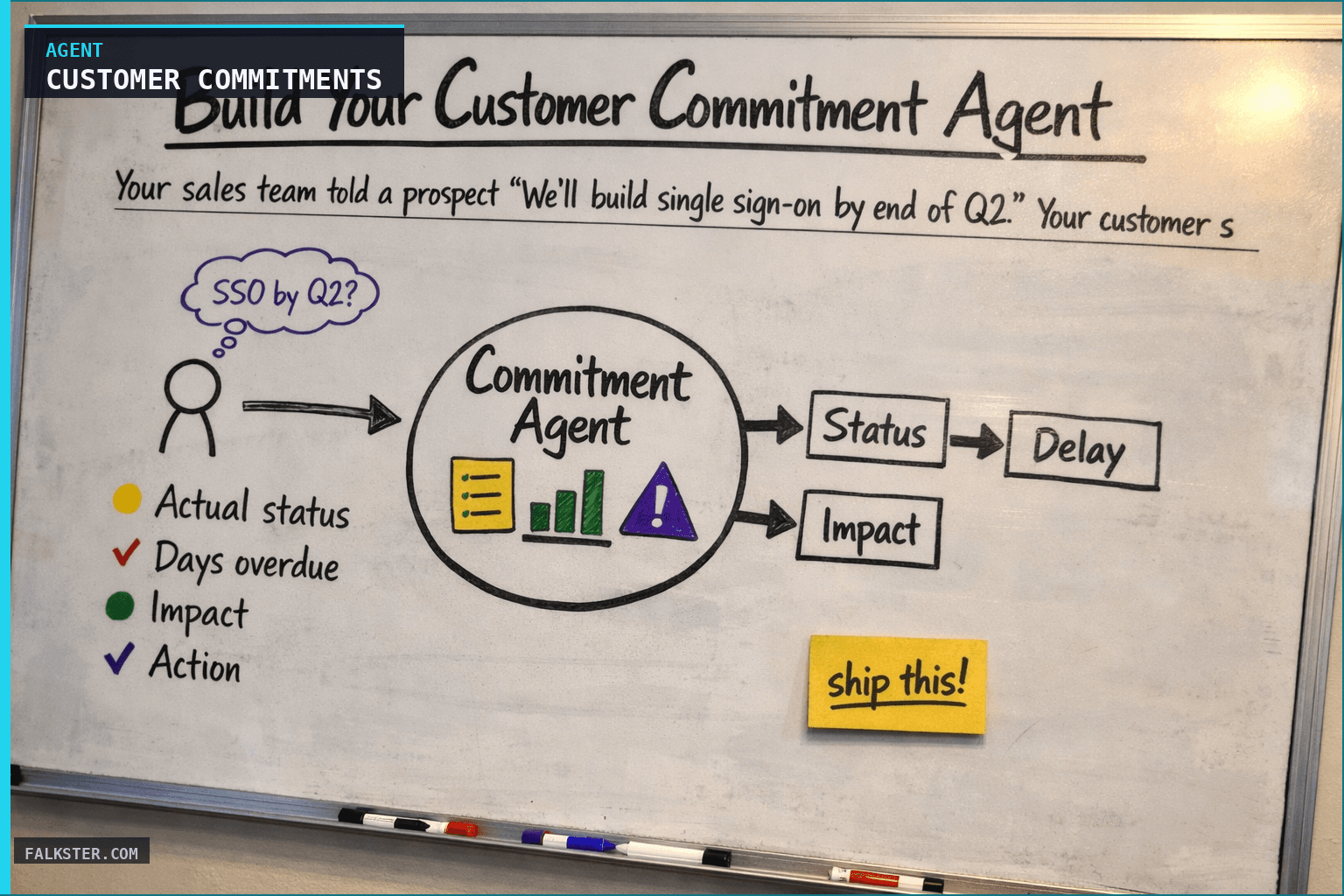
The Customer Commitment agent tracks every promise sales, customer success, and leadership make to customers, cross-references each one against the actual roadmap, and tells you which commitments are overdue, at risk, or were never planned. It runs twice a week, Tuesday and Friday at 9 AM, reading Gong call transcripts, Salesforce deal notes, CS meeting notes, and Slack. The output is a four-category report (overdue, at-risk, no roadmap item, new this week) with ARR exposure attached to each. I built this after losing a $500k deal to a forgotten promise. The quarterly commitment accuracy score (% delivered on time) is the most uncomfortable number it surfaces.
Your sales team told a prospect "We'll build single sign-on by end of Q2." Your customer success team told a customer "Integration with Stripe is on the roadmap for next month." Leadership committed to another prospect "Advanced analytics will be live in June." It's now April. You have no idea which of these promises are on track, which are at risk, and which have been completely forgotten.
This is the problem the Customer Commitment Agent solves.
The Real Problem (It's Accountability, Not Tracking)
Every product company makes promises to customers. Sales makes them to close deals. Customer success makes them to retain accounts. Leadership makes them to reassure prospects. These promises are made in:
- Gong call recordings (stored, never reviewed)
- CRM deal notes (in Salesforce somewhere)
- CS meeting notes (scattered across Google Docs)
- Slack conversations (gone in a week)
- Email threads (buried in everyone's inbox)
- Executive meeting minutes (nobody's reading those)
Without central tracking, what happens:
Q1: Sales promises feature X by end of Q2 to close TechCorp ($500k ARR). It works. You close the deal.
March: You ship feature X roadmap item. But it takes longer than planned. ETA slips from Q2 to late Q2, then to Q3.
May: TechCorp asks for an update. You say "Coming soon." You check the roadmap. It's scheduled for Q3. You realize nobody told them the delay. You can't tell them it's delayed because you never told them when it was coming. They're upset.
June: TechCorp is evaluating alternatives. You scramble. You should have been managing this commitment since January.
The Customer Commitment Agent prevents this. It tracks every promise, compares it to the actual roadmap, flags commitments that are at risk, and alerts you to misalignments between what you promised and what you're building.
What This Agent Does
Twice a week, Tuesday and Friday mornings, the agent delivers a report that answers three questions. What have we promised customers? Are we tracking to deliver? What's at risk?
It reads sales call transcripts, CRM notes, CS meeting notes, and the roadmap, then tells you exactly which commitments are overdue, at risk, or don't exist on the roadmap yet.
Overdue Commitments
Features promised and the deadline has passed:
Commitment: "Single sign-on for enterprises" Promised to: TechCorp ($500k ARR, Renewal in Q3) Source: Gong call, Jan 15, 2026. Sales said "End of Q1." Actual status: Not on roadmap. No work started. Days overdue: 15 Impact: $500k ARR at risk of churn / account likely evaluating alternatives Action: Immediate conversation with sales and customer needed
Commitment: "Advanced reporting dashboards" Promised to: DataInc ($200k ARR, Expansion opportunity $100k) Source: CS call notes, Jan 20 Promised date: "February" Actual status: In dev, 70% complete. Ship date now April 5. Days overdue: 33 Impact: $100k expansion at risk + retention risk Action: Need to contact customer this week with update and revised ETA
At-Risk Commitments
Promises due within 2 weeks, but the roadmap shows delays:
Commitment: "API rate limit increases" Promised to: APIVendor ($150k ARR, using for 3 integrations) Promised date: "Mid-April" Roadmap status: Scheduled for April 30 (2-week slip from initial plan) Days until deadline: 14 Risk level: HIGH, customer needs feature for product launch Action: Flag to engineering. Can we accelerate? If not, notify customer today.
Commitment: "Custom branding for white-label customers" Promised to: Reseller (indirect, 5+ customer accounts at stake) Promised date: "End of April" Roadmap status: Not planned yet. Waiting on design review. Days until deadline: 29 Risk level: MEDIUM, design phase hasn't started Action: Get design commitment. If delayed beyond April, tell customer now.
Commitments with No Roadmap Item
Promised but never actually planned:
Commitment: "HIPAA compliance certification" Promised to: HealthTech ($50k ARR, healthcare vertical expansion opportunity) Source: Leadership email, Jan 30, "We're working on it" Roadmap status: NOT ON ROADMAP. No epic created. No work started. Promised date: "Q2" Days since promise: 32 Impact: $50k expansion on hold pending compliance Action: Create roadmap item immediately. Get compliance team to scope work. Notify customer.
Commitment: "Kubernetes support for self-hosted deployments" Promised to: Enterprise customer (large renewal, $2m ARR) Source: Leadership call, Feb 15 Roadmap status: NOT ON ROADMAP Promised date: "Q3" Days since promise: 15 Impact: Renewal conversation starting in May. Need to have plan. Action: Determine feasibility. Can we do it? If yes, roadmap it. If no, tell customer now.
New Commitments Added This Week
Visibility into what was just promised:
Commitment: "Zapier integration" Promised to: Platform customer (wants to connect us to their ecosystem) Source: Sales call yesterday Promised date: "May 1" Roadmap impact: Needs dev + integration work (~3 weeks) Risk: LOW (reasonable timeline, sufficient notice) Notes: Sales estimates $50k upsell if we build
Commitment: "Custom data export in CSV/Parquet" Promised to: Data analytics customer Source: CS meeting note Promised date: "April" Roadmap impact: Feature available already? Or does this need new work? Risk: MEDIUM (unclear if scope already exists) Notes: Need to clarify scope with CS before committing
Commitment Accuracy Score
Quarterly metric: What % of commitments made last quarter were delivered on time?
Q1 Commitments: 12 total
- Delivered on time: 8 (67%)
- Delivered late: 3 (25%)
- Not delivered: 1 (8%)
- Accuracy: 67%
This is a signal. 67% means 1/3 of your promises fail or slip. That's rough. It tells you:
- Sales is over-promising
- Roadmap estimates are unrealistic
- You need better cross-functional accountability
- Or all three
Customer Impact Summary
At-risk ARR from overdue/at-risk commitments:
High Risk (commitment overdue or at immediate risk):
- TechCorp: $500k (SSO overdue)
- APIVendor: $150k (rate limits at risk)
- Subtotal: $650k
Medium Risk (due within 2-4 weeks, roadmap shows slip):
- DataInc: $200k (reporting late)
- Reseller: TBD (branding)
- Subtotal: $200k
Total ARR at risk: $850k
This is the number you should care about. If 1/3 of your commitments slip, and those commitments have significant ARR attached, you have a real problem. You need to either:
- Get better at commitments (don't over-promise)
- Get better at delivering (ship faster)
- Get better at managing expectations (tell customers early if slipping)
How It Works: The Commitment Tracking Logic
The agent doesn't randomly assign risk. It uses a scoring system:
1. Find every commitment:
- Scan Gong calls for phrases like "We'll build," "Next quarter," "By end of," "Ship date"
- Scan CRM notes for commitments in deal notes or custom commitment fields
- Scan CS notes for promised features/timelines
- Scan email threads for leadership commitments
- Log each commitment with: what was promised, to whom, when, who promised it
2. Cross-reference the roadmap:
- Is this feature on the roadmap? If yes, when's the ETA?
- Does the roadmap ETA match the customer promise? If not, flag it.
- Is this already shipped? If yes, mark as delivered.
- Is this not on the roadmap? If not, flag as "no roadmap item."
3. Assess risk:
- If promised date < today: OVERDUE
- If promised date < today + 14 days AND roadmap shows slip: AT RISK
- If promised but not on roadmap: NO ROADMAP ITEM
- If promised and roadmap matches: ON TRACK
4. Estimate customer impact:
- Look up customer ARR
- Look up renewal date (if near, higher risk)
- Assess: Is this a deal-breaker feature? Expansion opportunity? Or nice-to-have?
- Flag accounts with $100k+ ARR separately
Why This Actually Works
I built this because we lost deals and customers due to forgotten commitments. We promised single sign-on to close a $500k deal. Months later, the customer was mad it wasn't shipped yet. We said "it's on the roadmap," but the actual ETA was 6 months away. We should have told them that upfront or never promised it.
The Customer Commitment Agent catches three kinds of problem you'd normally miss.
The forgotten promise. Sales closed TechCorp with a promise of feature X. Nobody documented it in the CRM. Months pass. The customer mentions it and you realize that feature isn't on the roadmap. You promised it informally and forgot.
The slipping deadline. You promised a feature in Q2. Roadmap said April 15. It's now April 10 and engineering says it'll ship April 30. The customer hasn't been told. If they'd known two weeks ago it would slip, they'd have managed their own expectations. Now they're surprised and mad.
And the leadership over-promise. CEO in a sales call says "We'll have HIPAA compliance by Q2." Huge commitment. Never scoped, never estimated, never roadmapped. Engineering has no idea. When Q2 comes, you're scrambling to explain why it's not done.
This agent surfaces all three. It tells you which commitments are real, which are at risk, and which need action now.
Data sources and setup
Prerequisites: Complete the Claude setup guide first. This agent needs the following MCP connections active:
- Salesforce - deal notes, customer ARR, renewal dates
- Gong - sales call transcripts and timestamps
- Slack - team discussions and commitment mentions
Schedule: Runs bi-weekly on Tuesday and Friday at 9:00 AM via cron. Output posts to Slack.
Quick test: Open Claude and ask: "List all customer commitments from the last 2 weeks: feature promises, timeline commitments, and integration agreements. Flag any at risk."
For the full agent fleet and scheduling details, see Your AI Agent Fleet.
What Good Looks Like
After running this agent for one month:
Week 1: You realize how many commitments you've made and forgot about. The report flags 8 overdue or at-risk commitments you didn't even know existed. You're embarrassed. You also realize this is probably costing you deals.
Week 2: Sales team starts documenting commitments in the CRM more consistently because they know the agent is tracking them. You have fewer "wait, did we promise that?" conversations. You proactively tell the team: if you promise something, it goes in the system.
Week 3: You catch a commitment that was about to slip. Engineering says a feature will ship April 30, but you promised it April 15. You tell the customer on April 8 instead of April 15. They're disappointed but not blindsided. You save the relationship.
Week 4: You see the commitment accuracy metric. It's 60%. You realize this is a real problem. You make a change: sales is no longer allowed to promise timelines. They promise features and you give the timeline. Accountability improves.
Final thought
Every promise creates an expectation. Break it and you lose trust. Over-promise and miss, and you lose the customer.
This agent won't stop your team from over-promising. But it makes those promises visible, tracks them, and alerts you when they're at risk. It gives you a chance to fix it before the customer finds out.
Your sales team will keep making promises. Your customer success team will keep reassuring customers. Your leadership will keep closing deals with commitments. But with this agent, you'll never again say "when was that supposed to ship?" and realize nobody knows.
Sources: Gong, Salesforce, Slack.
Download the artifact
Ready to use. Copy into your project or share with your team.
Also on Medium
Full archive →AI Agents and the Future of Work: A Pixar-Inspired Journey
What product managers can learn about AI agents from how Pixar runs a film team.
Many AI Agents Are Actually Workflows or Automations in Disguise
How to tell agents from workflows from cron jobs, and why it matters for what you ship.
Frequently asked
What does the Customer Commitment agent track?+
Every promise your sales team, customer success team, and leadership make to customers or prospects: feature commitments, timeline commitments, integration agreements. It reads Gong call transcripts, Salesforce deal notes, CS meeting notes, and Slack, then cross-references each promise against the actual roadmap.
How often does the agent run and what does it output?+
Twice a week, Tuesday and Friday at 9 AM. The output is a four-category report: overdue commitments (deadline passed), at-risk commitments (due within 14 days with roadmap slippage), commitments with no roadmap item (promised but never planned), and new commitments added this week. Each entry includes the ARR at risk.
What is the commitment accuracy score?+
A quarterly metric showing what percentage of commitments made last quarter were delivered on time. A score of 67% means one in three promises slipped or failed. It surfaces whether the root cause is sales over-promising, unrealistic roadmap estimates, or weak cross-functional accountability.
How does the agent find commitments in Gong calls?+
It scans transcripts for phrases like 'We'll build,' 'Next quarter,' 'By end of,' and 'Ship date.' Each detected commitment is logged with what was promised, to whom, when, and who made the promise. The agent then looks up whether that feature exists on the roadmap and whether the roadmap ETA matches the customer promise.
I built this because of a real loss. What was it?+
We lost a $500k deal because we promised single sign-on to close it and then forgot about the promise. Months later the customer was angry it hadn't shipped. The feature wasn't even on the roadmap. The Customer Commitment Agent catches that exact scenario: a promise made and never documented in the system.

Comments (0)
Sign in with LinkedIn to leave a comment.
Sign in with LinkedIn