Stream a simulated run, inspect the notifications it would send on Slack and email, and see exactly where it sits in the 7-stage PM OS flow. No password required.
The short version
The Roadmap Progress Tracker agent runs every weekday at 9 AM and cross-references your roadmap against engineering reality. It checks four systems: Jira or Linear (roadmap status), engineering tickets (last activity), GitHub commits (real code activity), and PM updates in Slack. The output is a six-section report with discrepancy alerts ("in progress" with zero commits in 5 days), stale tickets, missing engineering tickets, ETA accuracy trends, ownership gaps, and a daily summary. The point is to stop operating on faith and start operating on data. Roadmaps and engineering work live in separate systems and drift weekly. Run it tomorrow and check how many of your "in progress" items had a commit this week.
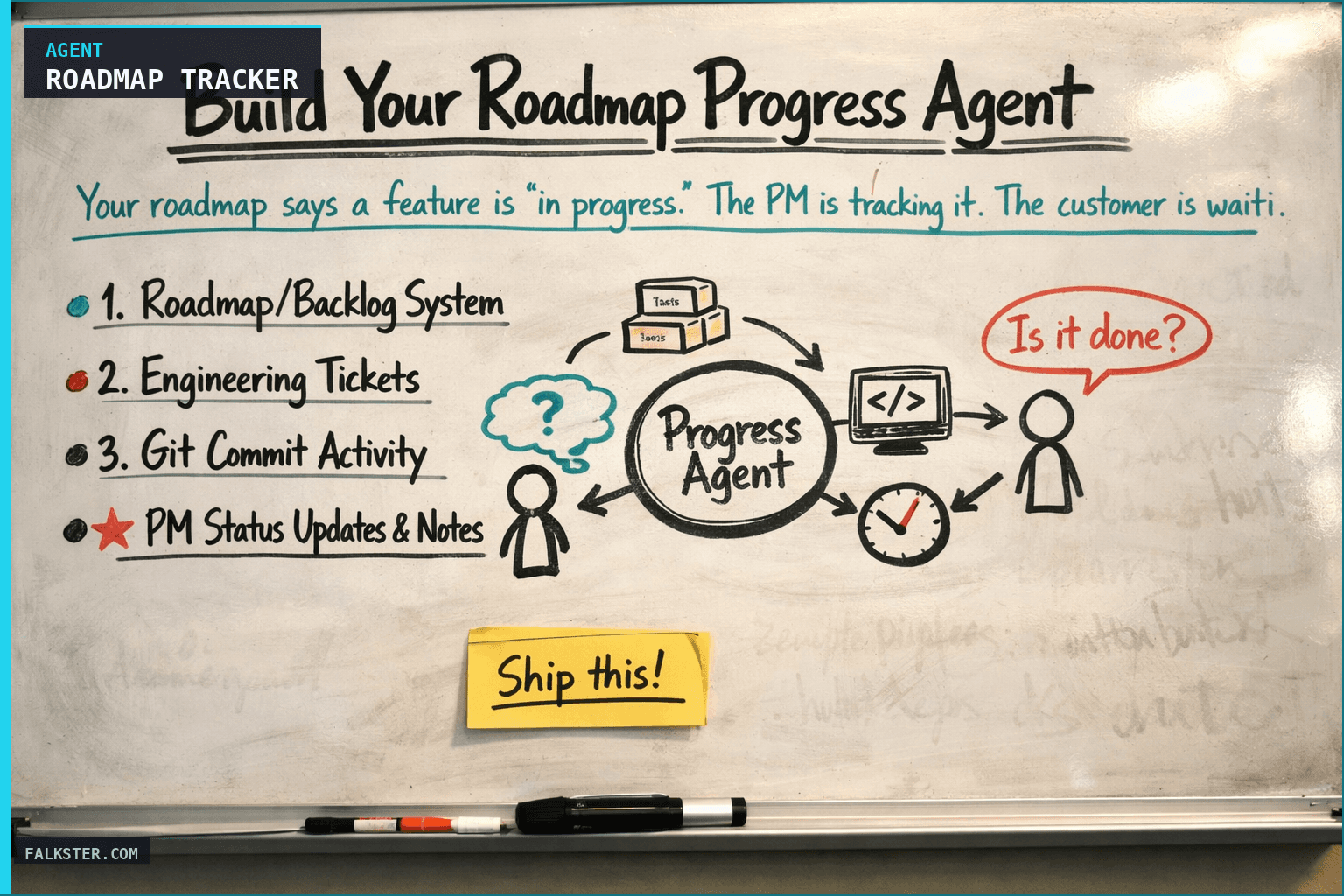
Your roadmap says a feature is "in progress." The PM is tracking it. The customer is waiting for it. Engineering status updates say it's on schedule.
Then you check the commit history. Zero commits in 5 days.
This is the moment most PMs realize they have no idea what's actually happening in engineering.
The problem is simple: the roadmap and engineering work exist in separate systems. Your roadmap lives in Jira/Asana. Engineering tickets live in a different Jira board (or Linear, or GitHub). The PM updates the roadmap based on what engineering told them. Engineering is often honest, but sometimes they're just guessing about the timeline too.
So you have two systems of record, and they're frequently out of sync. A feature marked "in progress" on the roadmap has no corresponding engineering activity. A blocking issue appeared in Slack but never made it to the roadmap. An engineering ticket has been "in progress" for 6 weeks with no movement.
What if an agent cross-referenced these systems daily and showed you exactly where reality diverged from the plan?
Why PMs Need to See Engineering Reality
Most PMs operate on trust. Engineering says "we're on track," so you believe it. But that's not visibility, that's hope.
Here's what happened at a company I advised: a feature was scheduled to launch mid-quarter. The PM tracked it. The customer knew about it. The CEO mentioned it in a board update. But the engineering team had actually de-prioritized it in favor of technical debt. The PM didn't know until a week before launch.
Then there was a panic. Hard decision: slip the customer feature or cut technical debt work. Customer was upset either way.
If the PM had a system that cross-referenced roadmap status against actual engineering activity daily, they would have seen the divergence a month earlier. They could have raised the prioritization question with leadership then, instead of in a crisis.
Here's the pattern I see: the PM-engineering gap grows over time. Week 1 of a feature, the roadmap and commits are aligned. Week 3, they're slightly out of sync (roadmap shows "in progress," commits show "no activity"). Week 6, they're completely misaligned (roadmap shows "done," engineering shows "still in progress").
Without a daily cross-check, you don't notice until it's too late.
What a good Roadmap Progress Agent does: it looks at your roadmap, finds the corresponding engineering tickets, checks the commit history, and asks simple questions:
- "Roadmap says this is in progress. But no commits in 5 days. Why is that?"
- "Engineering ticket created 6 weeks ago. Still in progress. Is this a blocker or abandoned work?"
- "Roadmap item has no engineering ticket at all. Should it?"
- "Feature was supposed to be done by now. How accurate are ETAs actually?"
These are hard questions, but the answers keep you grounded in reality.
How It Works: The Cross-Reference System
The Roadmap Progress Tracker Agent monitors four systems and cross-references them:
1. Roadmap/Backlog System
The agent scans your product roadmap (Jira, Linear, Asana) for:
- All items marked "In Progress"
- All items with ETA = this week or next week
- Items that have been "Blocked" for > 7 days
- Items completed in past 7 days (to calculate velocity)
It extracts: feature name, status, ETA, PM owner, and any link to an engineering ticket.
2. Engineering Tickets
For each roadmap item, the agent finds the corresponding engineering ticket and checks:
- Current status (In Progress / Done / Blocked)
- Last activity date (when was code last touched?)
- Estimated completion date
- Open blockers or dependencies
If a roadmap item has no engineering ticket, the agent flags this.
3. Git Commit Activity
The agent checks GitHub/GitLab for:
- Recent commits to branches related to roadmap items
- Pull request status (are PRs open and waiting for review?)
- Commit frequency (is engineering actively working on this?)
- Stale branches (not touched in 3+ weeks)
For each feature marked "in progress," it asks: "Is there actual code activity?"
4. PM Status Updates & Notes
The agent scans PM communication (Slack, Notion, email) for:
- Items flagged as "at risk" or "slow"
- ETA adjustments (did we slip the timeline?)
- Scope changes (did the feature get smaller or bigger?)
- Engineering blockers mentioned
It connects PM narrative to engineering reality: "PM said 'slowed down,' but is engineering blocked or re-prioritized?"
What the Daily Report Looks Like
Every weekday at 9:00 AM, you get a cross-reference report with six sections:
Section 1: Discrepancy Alerts
🚨 CRITICAL DISCREPANCIES:

🔴 "In Progress" But No Engineering Activity:
1. "Bulk Export" - Roadmap says: "In Progress, ETA Feb 28"
   Reality: Eng ticket #2834 has 0 commits in 5 days, no PR activity
   Status: Work stalled or not started
   Recommended action: Engineering lead check-in TODAY

2. "SAML Auth" - Roadmap says: "Blocked, ETA Mar 1"
   Reality: No engineering ticket created yet, waiting on BE refactor
   Status: Can't start until blocker clears
   Recommended action: Get ETA on blocker, communicate risk to customer

🟡 MISALIGNMENT:
3. "Webhook Redesign" - Roadmap says: "In Progress, ETA Feb 20"
   Reality: 3 commits/week (active), but 1 PR waiting on code review
   Status: Work happening but code review backing up
   Recommended action: Accelerate PR review
This is your reality check. You see which roadmap items diverge from engineering reality.
Section 2: Stale Tickets
⏱️ STALE WORK (No activity in 14+ days):

🔴 CRITICAL (>21 days):
- Eng ticket #2878 "Refactor authentication module"
  In Progress since Jan 20, last commit Dec 28
  → Orphaned work. Recommend: assign owner, resume, or remove.

🟡 WARNING (14-21 days):
- Eng ticket #2834 "Bulk Export Feature"
  Last commit 5 days ago, velocity slowing down
  → Check in with engineer (blocked? re-prioritized? bandwidth?)
This is your abandoned work detection. You see tickets that have been sitting for weeks.
Section 3: Missing Engineering Tickets
🔲 ROADMAP ITEMS WITH NO ENGINEERING TICKETS:

- "Advanced Permissions System" - Roadmap: "Planned for Q2"
  No eng ticket created yet
  → Action: Create epic + break into tickets

- "SAML Auth" - Roadmap: "Blocked, waiting on BE refactor"
  No auth feature ticket yet (blocked on #2845)
  → Action: Create ticket once blocker clears
This is your scope tracking. You see items that are "planned" but haven't made it to engineering yet.
Section 4: ETA Accuracy & Velocity Trends
📊 ETA ACCURACY:

RECENT COMPLETIONS (this week):
- "OAuth Integration": Roadmap ETA Feb 8, Actual: Feb 7 ✅
- "API Versioning": Roadmap ETA Feb 10, Actual: Feb 12 (↑2 days late)

ACCURACY TREND (past 30 days):
- On time or early: 6 items (55%)
- 1-3 days late: 3 items (27%)
- 4+ days late: 2 items (18%)
- Average variance: +1.8 days

VELOCITY TREND:
- This week: 2 items completed
- Last week: 3 items completed
- 4-week average: 2.25 items/week
- Note: Velocity declining (was 2.8/week in January)

IMPLICATIONS FOR CURRENT ROADMAP:
- 3 items with ETA this week: expect 2 on time, 1 slips by 1-2 days
- 5 items with ETA next week: expect 3-4 on time
This is your historical accuracy. You see how good PM ETAs actually are and adjust future estimates.
Section 5: PM Ownership & Engagement
👤 OWNERSHIP STATUS:

Clear ownership & recent engagement:
- "Custom Fields API" - PM: Alex (last update: today) ✅
- "Webhook Redesign" - PM: Casey (last update: 3 days ago) ✅

Stale or unclear ownership:
- "SAML Auth" - PM: Unassigned 🔴
  → Action: Assign PM immediately

- "Bulk Export" - PM: Jamie (last update: 5 days ago, no activity)
  → Check in on status
This is your engagement check. You see which roadmap items have active PM involvement.
Section 6: Weekly Summary
One paragraph with roadmap-to-reality alignment and immediate actions:
SUMMARY:
Most roadmap items are aligned with engineering reality. 8 of 11 are progressing actively.
However, 3 items need attention: (1) "Bulk Export" stalled (0 commits in 5 days - check blockers),
(2) "SAML Auth" needs PM owner and clear scope, (3) "Webhook Redesign" ETA may slip if PR reviews
don't accelerate.

ETA accuracy is decent (average +1.8 days variance) but slightly declining. Velocity at 2.25 items/week
(down from 2.8 in January). Current roadmap assumes 2.5 items/week - slightly optimistic.

IMMEDIATE ACTIONS:
1. Engineering lead check-in on "Bulk Export" status (0 commits in 5 days)
2. Assign PM owner to "SAML Auth" by EOD today
3. Accelerate PR review cycle for "Webhook Redesign"
Data sources and setup
Prerequisites: Complete the Claude setup guide first. This agent needs the following MCP connections active:
- Jira - reads roadmap items, engineering tickets, and status
- GitHub - reads commit history and PR activity
- Slack - reads PM status updates and engineering discussions
- Salesforce - reads customer escalations and account context (optional)
- Gong - reads call transcripts for context on feature requests (optional)
Schedule: Runs weekdays at 9:00 AM via cron. Output posts to Slack and emails product leadership.
Quick test: Open Claude and ask: "Show me all roadmap items that are behind schedule or have unresolved dependency risks."
For the full agent fleet and scheduling details, see Your AI Agent Fleet.
What changes when you have this
Without the agent, you're operating on faith. The roadmap says everything's on track, engineers say they're busy, a customer asks when their feature ships, and you give your best guess.
With it, you're operating on data. The roadmap gets cross-checked against real engineering activity every day. You know which items are at risk weeks out. When the customer asks, you can say "on track" or "we need to rescope" and mean it.
The difference is alignment. The roadmap turns into a shared reality between product and engineering instead of an aspirational doc that quietly drifts from what's being built.
Most days the discrepancies are minor, one feature moving a little slower than expected. But two or three times a month the agent catches something real: work that stalled, an ETA that has to slip, a ticket that got orphaned. That's the payoff for a daily glance.
Getting started this week
The full setup, with the cross-reference rules, the ETA accuracy math, velocity tracking, and a copy-paste prompt, is in the artifact below.
Download it. Create a Claude Project, paste the prompt, connect your data sources, set it for weekday mornings at 9:00 AM. By next week you'll have your first report, and you'll see exactly where the roadmap matches engineering reality and where it diverges, what your ETA accuracy actually is, what your team's real velocity is. Better commitments follow from that.
Download the Complete Agent Setup
Download the full agent instruction file
This includes:
- Complete agent prompt (copy-paste ready)
- All data sources with cross-reference rules
- Full report structure with examples
- ETA accuracy calculation framework
- Velocity tracking methodology
- Setup instructions for Claude Projects
- Customization guide for your workflow
Use this to set up your own Roadmap Progress Tracker Agent. Takes about 30 minutes to configure data sources, then it runs automatically every weekday morning.
Download the artifact
Ready to use. Copy into your project or share with your team.
Also on Medium
Full archive →AI Agents and the Future of Work: A Pixar-Inspired Journey
What product managers can learn about AI agents from how Pixar runs a film team.
Many AI Agents Are Actually Workflows or Automations in Disguise
How to tell agents from workflows from cron jobs, and why it matters for what you ship.
Frequently asked
Why do roadmaps drift from engineering reality?+
Roadmaps and engineering work live in separate systems and get updated independently. The PM marks a feature 'in progress' based on what engineering told them. Engineering gets pulled onto something else. By week three, the roadmap still says 'in progress' but there have been zero commits. Without a daily cross-check, you don't see the drift until it's a crisis.
What does the Roadmap Progress Agent check every morning?+
It cross-references four systems: Jira or Linear for roadmap status, engineering tickets for last activity date, GitHub commits for real code activity, and Slack for PM status updates. It asks: 'in progress' with zero commits in 5 days? Stale ticket, no activity in 14-plus days? Roadmap item with no engineering ticket? ETA accuracy declining? Each gets flagged.
What is ETA accuracy tracking and why does it matter?+
The agent calculates how accurate your past ETAs actually were, not how optimistic they sounded. It tracks on-time delivery percentage, average variance in days, and velocity trend over 4 weeks. If your team has been running at plus-2-day average variance for 30 days, you should be adding buffer to every current commitment automatically.
How does this agent prevent the scenario where a customer-facing feature quietly slips?+
The discrepancy alert fires within 5 days of zero commit activity on any 'in progress' roadmap item. That's weeks before the missed deadline, when you still have options: check on blockers, de-scope, or adjust the customer commitment proactively. The PM at the company in the post learned about a four-week slip one week before launch because they had no cross-reference system.
What data sources and setup does the Roadmap Progress Agent require?+
Jira for roadmap items and engineering tickets, GitHub for commit history and PR activity, and Slack for PM status updates. Salesforce and Gong are optional for customer context. Runs weekdays at 9 AM via cron, outputs to Slack and emails product leadership.

Comments (0)
Sign in with LinkedIn to leave a comment.
Sign in with LinkedIn