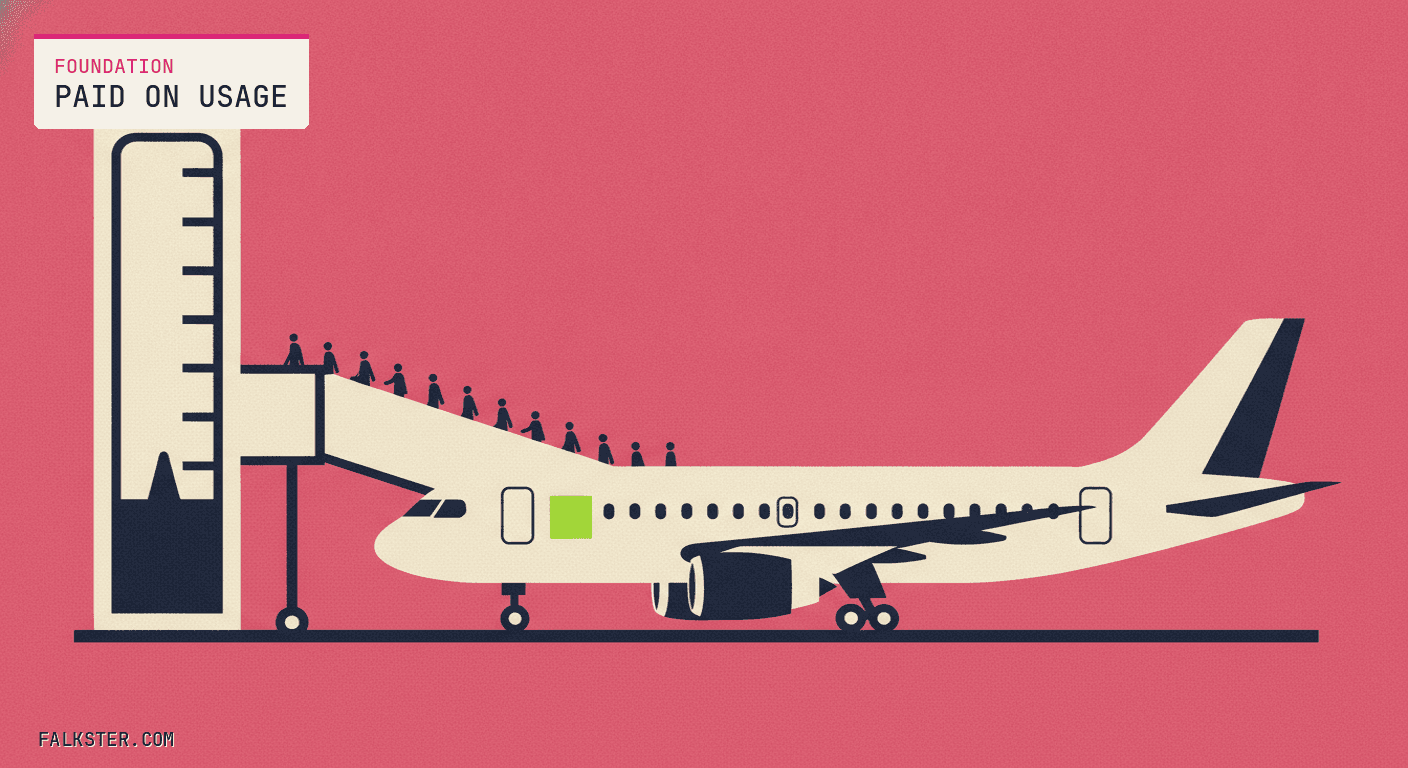
Everything I have written about landing so far is a critique: it is the constraint, it is the expensive column, and it is nobody's job. A critique without a counter-case is just a complaint. So here is a company that solved the landing problem, and it did not do it with a better org chart or a Head of Landing. It did it with pricing.
The short version
Snowflake made landing its business model. It sells consumption: customers buy credits and pay as they run queries and workloads, so revenue only arrives when the product is actually used. That one choice converts landing from a thing nobody owns into the only way the company gets paid, which is why its net revenue retention has run around 126 to 127 percent, meaning the average existing customer expands materially every year. A signup that never becomes usage is worth zero under consumption pricing, so no function can book its win at the contract; everyone is paid on adoption. The pricing does the accountability work the org chart could not, and the go-to-market motion is aligned to match, with sales engineers owning the path from proof-of-concept to production rather than stopping at the signature. The transferable lesson is not "copy the meter." It is "denominate your revenue in the thing that only happens when you land."
The move
Most software of the last two decades was priced per seat. You sign a contract for a number of licenses, and you pay for those licenses whether or not anyone logs in. That model has a quiet flaw that only became fatal recently: it lets the company book the win at the moment of purchase, before any landing happens. The seat is sold. The revenue is recognized. Whether the customer's behavior actually changed is now someone else's problem, and as I argued in who owns landing, that someone is usually no one.
Snowflake priced the other way. Customers consume credits to run queries, process data, and increasingly to run AI models against their own data. You pay for what you use. That means the revenue does not exist until the customer does the thing. There is no way to declare victory at the contract, because the contract is just a promise to meter. The win is booked in arrears, as usage, which is to say the win is booked only when the product lands.
Sit with what that does to the whole company. Under per-seat pricing, landing is a virtue you have to organize for against the grain of your own incentives. Under consumption pricing, landing is the grain. Nobody has to be assigned to care about adoption, because nobody gets paid until adoption happens. The pricing model is doing the job the org chart failed at, and it is doing it to every function at once.
The proof is in the retention number
The cleanest evidence that this works is net revenue retention, which measures what this year's existing customers spend versus last year's, expansion minus churn. Above 100 percent means customers grow their spend over time. Snowflake's has run around 126 to 127 percent in recent reporting, down from higher in its earlier hypergrowth years but still strong. That number is landing measured in dollars. It says the average customer arrives, adopts, expands their usage, and stays.
You do not get a retention number like that from a good launch. You get it from a product that repeatedly becomes a durable habit across an account, one workload at a time. The "land and expand" motion everyone name-checks is real here in a specific way: the company lands a first workload, then funds the post-sale work of migrating more workloads onto the platform, and the pricing means each migrated workload shows up directly as revenue. Expansion is not an upsell bolted on after the fact. It is the same landing motion, run again, and metered.
The half people skip
Pricing sets the incentive. It does not, by itself, do the work. The part that is easy to miss is that Snowflake also aligned the go-to-market motion to the pricing. Sales engineers own the path from a proof-of-concept to production workloads, not just the path to a signature. The people closest to the customer are compensated and organized around getting workloads live, because live workloads are what generate revenue. The pricing makes that staffing rational, and the staffing makes the pricing pay off. Both halves matter, and the reason the whole thing holds together is that they point the same direction.
This is the answer to the objection that consumption pricing is just a billing trick. It is not a trick if the entire motion behind it is built to drive usage. It is a trick if you slap a meter on a product and keep a sales team that disappears after the close. The meter creates the incentive to land; the aligned motion is how you actually do it.
Where the counter-case has limits
I am not claiming consumption pricing is a universal solvent, and it would be dishonest to. It fits products where customer value scales with usage and usage can be metered cleanly: data, compute, messaging, payments, tokens. It fits worse for products with flat, occasional use, or where metering would tax the exact engagement you are trying to grow. There are also real downsides Snowflake itself has lived: consumption revenue is harder to forecast, a customer optimizing their bill can shrink your revenue without churning, and a soft quarter of customer activity hits you immediately instead of being smoothed by a subscription. Getting paid only when the customer runs is a discipline, not a free lunch.
So the lesson is not "everyone should bill by the query." The lesson is one level up. Snowflake did not out-organize the landing problem. It re-denominated its revenue in a unit that only moves when landing happens, and then it built the motion to move that unit. Whatever your product is, there is some measurable thing that only happens when a customer actually adopts. The question the counter-case asks you is whether your revenue, or at least your internal scorecard, is denominated in that thing or in a proxy you can hit without landing anything.
I have been making a version of this argument about my own category, that charging per seat when the work moved to agents is charging for the wrong thing. The Snowflake case is the constructive side of that same coin. Price the outcome, and landing stops being nobody's job, because it becomes the only job that pays.
Try this week
You probably cannot re-price your product this week. You can do the smaller version.
Find the metric that only moves when a customer actually adopts, the usage event that a signup cannot fake, and make it the number your team is accountable for, even while revenue is still denominated in seats. Put it on the wall next to the launch metrics. If your scorecard rewards signatures and your product only wins on usage, you are optimizing for the thing you can hit without landing anything, and you will keep shipping launches that go quiet in month two. Denominate the scorecard in adoption first. If it works, the pricing conversation gets a lot easier, because you will have the retention curve to prove it.
Sources: Snowflake Q4 and full-year fiscal 2025 results (net revenue retention 126% as of January 31, 2025), Snowflake investor relations. Snowflake FY2026 filings (net revenue retention 127% as of October 31, 2025), U.S. Securities and Exchange Commission. Net revenue retention and consumption-model background, Snowflake 10-Q filings.
Also on Medium
Full archive →Frequently asked
Which company got landing right, and how?+
Snowflake, by making landing its business model. It charges for consumption: customers buy credits and pay as they run queries and workloads, so revenue only arrives when the product is actually used. That single pricing choice turns landing from a thing nobody owns into the only way the company gets paid, which is why its net revenue retention has run around 126 to 127 percent, meaning existing customers expand materially year over year.
Why does consumption pricing force landing?+
Because a signup that never becomes usage is worth nothing under consumption pricing. In a per-seat model you book the seat whether or not the person uses it, so the org can declare victory at the contract. Under consumption, no function books its win until the customer's behavior changes and workloads move onto the platform. The pricing model does the accountability work the org chart failed to do.
Is consumption pricing right for every product?+
No. It fits products where usage scales with customer value and can be metered cleanly, like data, compute, messaging, and payments. It is harder for products with flat, low-frequency use or where metering would punish the exact engagement you want. The transferable lesson is not 'copy Snowflake's meter.' It is 'denominate your revenue in the thing that only happens when you land,' whatever that thing is for you.
What is net revenue retention and why does it prove landing?+
Net revenue retention measures how much revenue this year's cohort of existing customers generates versus last year, including expansion and churn. Above 100 percent means customers grow their spend over time. Snowflake's roughly 126 to 127 percent means the average customer lands, expands, and stays, which is landing measured in dollars. It is the cleanest single proof that a product became a durable habit, not a one-time sale.
What did Snowflake do besides pricing?+
It aligned the go-to-market motion to the pricing: sales engineers own the path from proof-of-concept to production workloads, not just the signature, and the land-and-expand playbook explicitly funds the post-sale work of migrating more workloads onto the platform. The pricing sets the incentive and the GTM motion staffs the landing. Both halves matter; the pricing is what makes the staffing rational.
What is the takeaway for a product leader who can't change pricing overnight?+
Find the metric that only moves when a customer actually adopts, and make it the number your team is accountable for, even before you can re-price. If revenue is denominated in seats, at least denominate your internal scorecard in active usage and expansion, so the org optimizes for the landing it cannot yet bill for. Structure the incentive toward adoption and the pricing can follow.

Comments (0)
Sign in with LinkedIn to leave a comment.
Sign in with LinkedIn