Miro sold for $1.355 billion in enterprise value against about $600 million in ARR. Call it 2.3 times.
The company is profitable. It carries roughly $435 million in net cash. Close to 90% of that revenue comes from business and enterprise customers, which is exactly the revenue mix every board claims to want. Four million paying users, a hundred million registered. And it went for something like a tenth of the $17.5 billion mark it carried after the $400 million round ICONIQ led in January 2022.
Josipa Majic covered the deal for Forbes under the headline that SaaS unicorns are selling for scraps, and the finance read in that piece is right as far as it goes. Multiples unwound. The zero-rate era priced growth; this era prices cash flow. Buyers consolidated onto suites and killed the duplicate line items. The IPO window for a $600 million ARR collaboration tool is not really a window, it is a painting of one. Bending Spoons is running a very good playbook against all of that, and Miro is the second billion-dollar catch in five weeks, after Airtable went for $1.285 billion against roughly $480 million of ARR still growing north of 20%.
All true. All insufficient.
The short version
Compression explains the range. It does not explain where inside the range a company lands. Profitable enterprise software with 90% business revenue trades well above 2.3x right now, every week, in deals that get a quarter of this attention. So the interesting question is not why Miro's multiple fell. It is why a company with fundamentals near the top of the cohort cleared at the bottom of it.
My answer is a product answer, and it extends the thread I have been pulling since August. Airtable repriced because its moat was denominated in accumulated human effort, and agents make effort cheap. Chegg and Stack Overflow repriced on the same mechanism with content as the unit. Miro is the next denomination down, and the unit is legibility. I wrote the narrow version of this up separately: why Miro sold for only 2.3x ARR. A whiteboard is the least machine-readable artifact in the product stack, and it got priced at the exact moment machine-readability started deciding what a company becomes.
Here is the line from the deal that I keep coming back to. Some Miro shareholders agreed to roll $295 million of their proceeds into newly issued Bending Spoons stock instead of taking cash. Read that as what it is. A slice of the cap table sat with a choice between owning more Miro and owning the company that buys Miros, and picked the buyer.
A multiple is a story about the next five years
That is all it is. Revenue is the present tense. The multiple is the part where somebody has to say out loud what this thing becomes.
For Miro in 2021 the story was easy and everybody told it the same way: the canvas becomes the place distributed teams think, then it absorbs the work that happens around the thinking, and the surface where the work gets described eventually eats the tools where the work gets done.
The first half happened. The second half never did, and I do not think a single board meeting is where it died.
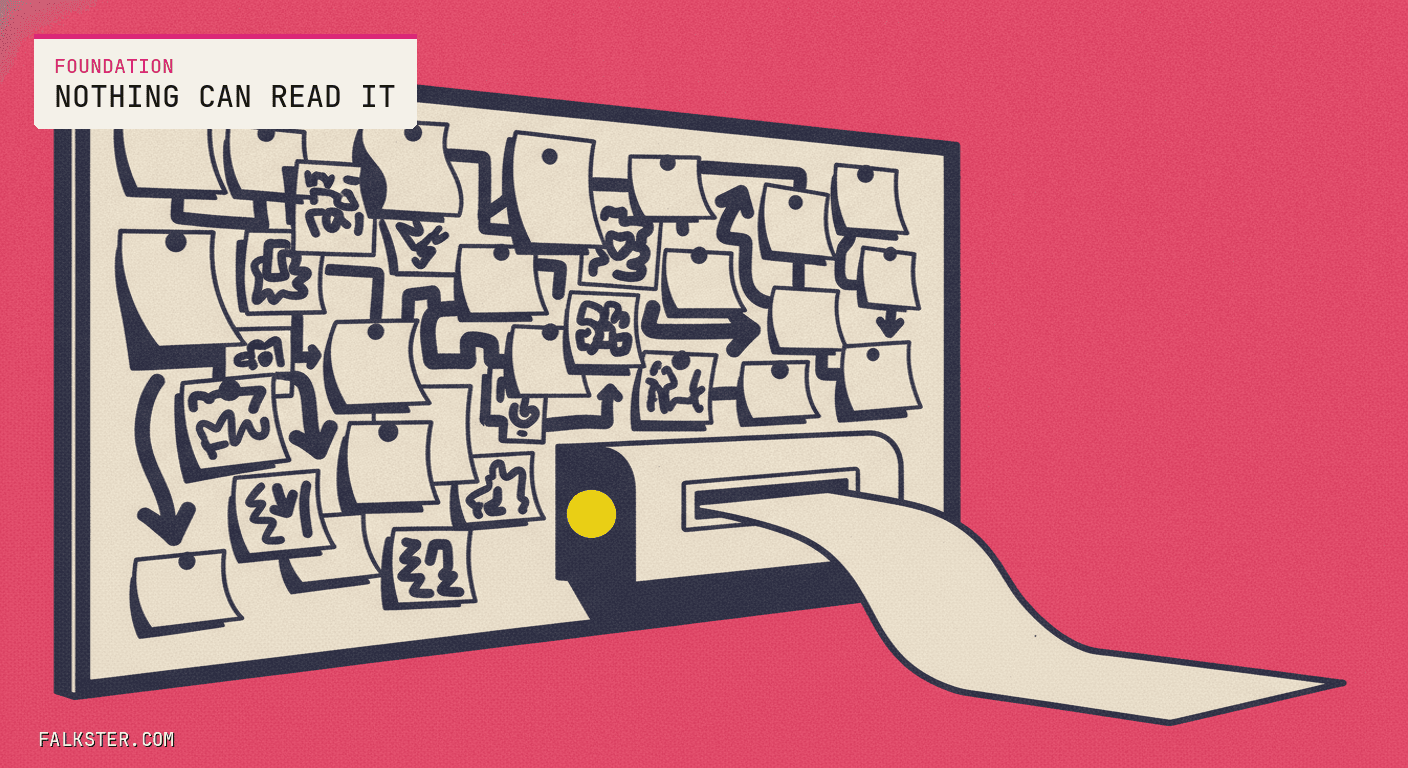
A whiteboard's whole value proposition is that it imposes no schema. Anything can go anywhere. That is a genuine feature, it is why the format has survived every attempt to replace it with structured tooling, and it is why the workshop feels good. It is also the reason nothing downstream can read the output. The board is where a decision gets made and then, always, re-entered by hand somewhere that has a data model. Into Jira. Into a doc. Into a spec. Into a slide for the people who were not in the room.
That re-entry tax was invisible when a human was going to do the next step anyway. It is not invisible anymore.
I have been arguing for a while now that the PRD is collapsing into a small number of artifacts that have to be machine-readable, because the thing consuming them is increasingly not a person. Evals, not prose, carry the spec. Intent has to be structured or the agent cannot act on it. Run that argument forward and the least legible artifact in the entire product stack is the one sitting on the whiteboard. Beautiful to a human in the room that afternoon. Illegible to everything else, forever.
Which brings me to the honest version of the question. When did you last reopen a board older than a month?
Miro has shipped AI features. This is not a story about a company that did not notice. It is a story about a company whose core surface is optimized for the exact property that makes work hard to hand off to a machine, and about buyers who, consciously or not, priced that.
It is also not really a Figma-and-Canva story, which is where most of the coverage went. Competition costs you growth rate. Miro kept growing and stayed profitable. Losing the story about what you become is a different failure and it shows up in a different number, and the number it shows up in is the multiple.
What this actually means if you are building something
The uncomfortable part first, because the useful part is on the other side of it.
If your product's primary output is a description of work rather than the work, your multiple is exposed in a way your ARR chart will not warn you about. Revenue can be healthy for years while the terminal story quietly stops being tellable. Miro's revenue told nobody anything was wrong, because nothing was wrong with the revenue.
Second, and this is the part the cohort framing sands down, the people who paid for this are not the late-stage funds. The preference stack mostly gets them their capital back. Late-stage returns collapse, sure, but capital comes home. Anyone who joined from 2021 forward and took options struck against a $17.5 billion mark is underwater, and those are the people who produced $600 million of extremely real ARR while the paper number was busy being wrong.
Then they get hit a second time. Majic's piece makes the point plainly and it deserves more than a footnote: Bending Spoons is not a passive holder. The playbook is aggressive post-acquisition restructuring, and it has historically included significant staff cuts. That is the model working as designed, not a betrayal of anything. Buy profitable, established software below replacement cost, take out the operating expense, run the cash flow. If you are pricing an acquisition on cash flow rather than on growth, headcount is the first lever and it is the one that moves fastest.
So the two groups with the least say in the timing absorb most of the cost. Worth holding on to when the next deck tells you the team is the most important asset.
And the forward-looking part, which I think is genuinely good news. Legibility is buildable. It is a product decision, available to you this quarter, mostly unglamorous. Every place your product lets a human make a decision and then requires a human to re-enter that decision somewhere else is a place you are volunteering to be the artifact layer. Those seams are findable. Most teams have never gone looking because the tax was always paid by somebody in another tool.
And the exit path itself has changed shape, which is the thing founders should actually update on. For a decade the assumed endings were an IPO or a strategic buyer who wanted you for the product. What Airtable and Miro say is that for a large, recognizable, moderately growing collaboration company, the live bid now comes from a roll-up, and it comes at two to three times ARR. Not because your product is bad. Because that is who is buying. Funds holding 2021 positions should be marking them to these comps rather than to the last round, and if you are on a board where that has not happened yet, you already know what the next conversation is.
Bending Spoons will not stop at two. The rest of the cohort gets to choose between 2.3x today and a worse number from the same buyer in eighteen months. That is their problem. Yours is upstream of it.
Try this week
Take your product's most-used surface and trace one real user decision all the way through. Where does it get made, and where does it have to be typed in again by a person before anything downstream can use it?
Count the re-entries. Not the clicks, the re-entries.
If the answer is more than one, you already know which layer you are in, and you have time to move.
Sources: Forbes on the Bending Spoons acquisition of Miro, TechCrunch on Miro's $17.5B round, Miro newsroom, Series C.
Also on Medium
Full archive →AI Agents and the Future of Work: A Pixar-Inspired Journey
What product managers can learn about AI agents from how Pixar runs a film team.
Many AI Agents Are Actually Workflows or Automations in Disguise
How to tell agents from workflows from cron jobs, and why it matters for what you ship.
Frequently asked
What multiple did Miro sell for?+
Bending Spoons is acquiring Miro at a $1.355 billion enterprise value against roughly $600 million in ARR, about 2.3 times revenue. Miro is profitable, carries roughly $435 million in net cash, and takes close to 90% of its revenue from business and enterprise customers. It was marked at $17.5 billion after the $400 million round ICONIQ led in January 2022.
Is the Miro deal just SaaS valuation compression?+
Compression is real and it explains the range. It does not explain the position inside the range. Profitable enterprise software with 90% business revenue clears well above 2.3x routinely, in deals that get a fraction of this attention. The question worth asking is why a company with fundamentals near the top of the cohort landed at the bottom of it.
Why would a whiteboard product carry a lower multiple than its fundamentals suggest?+
Because a whiteboard's core value proposition is that it imposes no schema, and that same property makes its output unreadable to anything downstream. A board is where a decision gets made and then re-entered by hand into a tool that has a data model. That re-entry tax was invisible while a human was doing the next step anyway. Once the thing consuming the artifact is an agent, the least machine-readable surface in the stack is the one with the weakest story about the next five years.
How does this relate to the Airtable repricing?+
Airtable repriced because its moat was denominated in accumulated human effort, and agents make effort cheap. Miro is the next denomination down. Its exposure is legibility: whether the artifact it produces can be consumed by anything other than a person who was in the room. Same mechanism, different unit.
Who actually absorbs the cost in a deal like this?+
Not the late-stage funds, mostly. The preference stack returns their capital even as returns collapse. Anyone who joined from 2021 forward with options struck against a $17.5 billion mark is underwater, and Bending Spoons has historically followed acquisitions with aggressive restructuring and significant staff cuts. That is the model working as designed, not a betrayal. If you price an acquisition on cash flow rather than growth, headcount is the fastest lever.
What has changed about the exit path for a collaboration company?+
For a decade the assumed endings were an IPO or a strategic buyer who wanted the product. Airtable and Miro say that for a large, recognizable, moderately growing collaboration company, the live bid now comes from a roll-up at two to three times ARR. Funds still carrying 2021 positions should be marking to these comps rather than to the last round.

Comments (0)
Sign in with LinkedIn to leave a comment.
Sign in with LinkedIn