The short version
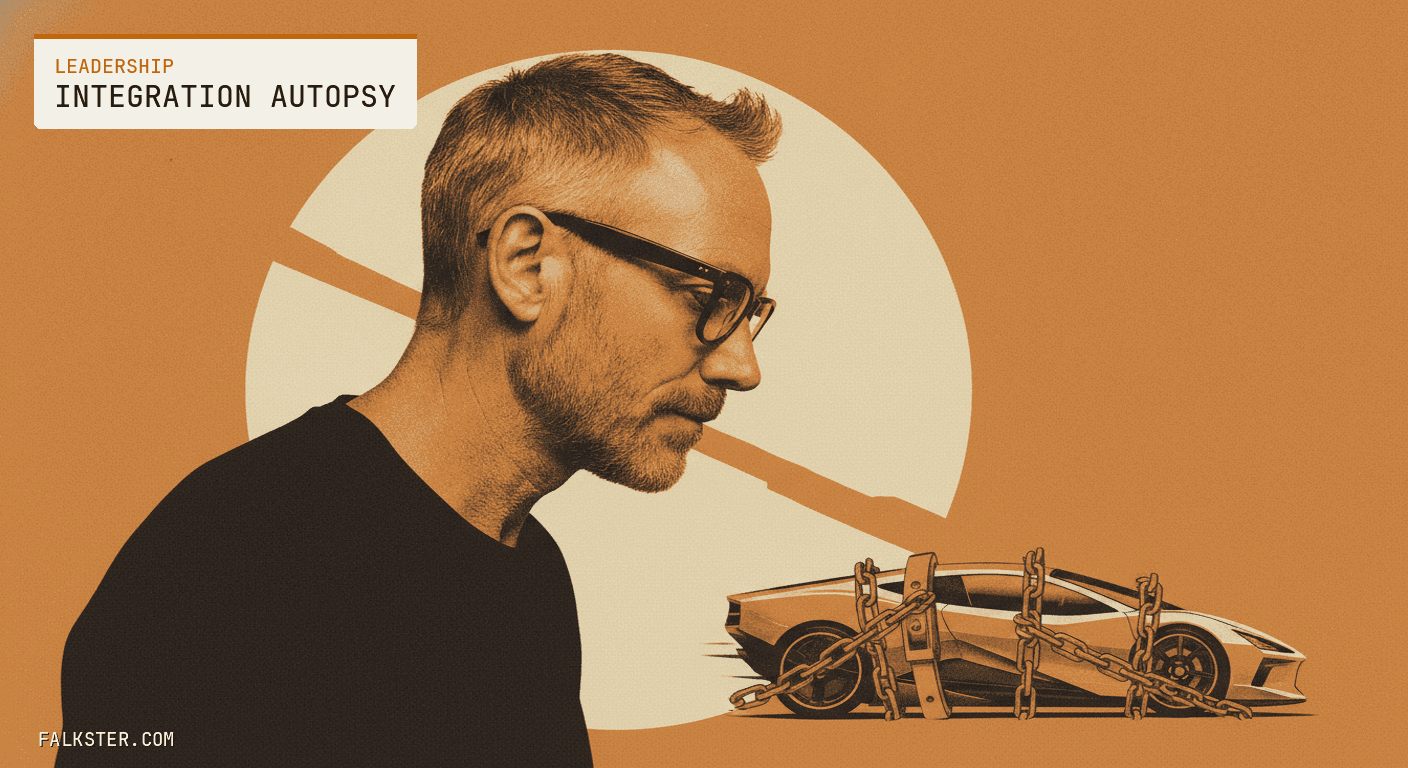
Why acquisitions fail at integration is not a mystery, it is a pattern, and I watched it run three times inside Salesforce across the Marketing Cloud, Quip, and Slack-era waves. The acquired team dies in three predictable steps. First it loses its constraint, the scarcity of money, people, and time that was forcing sharp decisions. Then it inherits the parent's process, the reviews and planning cycles and approval chains built for a giant organization. Then it stops shipping, because the velocity and focus that made it worth buying have been engineered out of it. Integration is where products go to die, and the cause of death is almost always the same: the parent removed the forcing function and added friction in its place. AI-native acquisitions will fail the exact same way unless the parent deliberately protects the team's loop, because an AI team's speed depends entirely on a short feedback loop and full decision authority.
I have been inside three acquisitions at Salesforce. Different teams, different decades, different products. The autopsy reads the same every time. If you have ever watched a sharp acquired team go quiet eighteen months after the deal closed and wondered what happened, here is the pattern, and it is more predictable than anyone in corp dev wants to admit.
Step one: the constraint disappears
A startup is fast for reasons people misremember. We tell ourselves it is the talent, the passion, the mission. Those help. But the underrated engine is the constraint. A startup has too little money, too few people, and not enough time, and that scarcity forces brutal prioritization. You cannot build the wrong thing for six months because you will be dead in four. The constraint is a forcing function that makes the team sharp.
The day the acquisition closes, the parent removes the constraint. Suddenly there is budget. There are bodies. There is runway measured in the parent's balance sheet, which is to say effectively infinite from the team's old vantage point. This feels like a gift. It is the first cut.
Without the constraint, the ruthless prioritization that made the team fast loses its reason to exist. The team can now afford to build the thing it would have killed last year. It can hire instead of focus. It can plan instead of ship. Nobody decides to slow down. The forcing function just quietly switches off, and the sharpness it was producing fades with it.
A startup's speed comes partly from scarcity. The parent's first act is to remove the scarcity. Everyone calls it support. It is the beginning of the autopsy.
Step two: the parent's process moves in
Now the team inherits the parent's operating system. Not maliciously. The parent has a way of doing things, reviews, planning cycles, security and legal and brand gates, cross-functional alignment, a quarterly cadence built to coordinate thousands of people. The acquired team gets slotted into it because that is the path of least resistance for everyone above them.
Each individual piece of process is defensible. The security review protects customers. The brand review protects the company. The planning cycle coordinates dependencies. None of it is stupid. But the aggregate is a system designed for a ten-thousand-person organization, and you have just dropped a forty-person team into it. The team that used to decide and ship in a week now waits three weeks for alignment, two weeks for review, a planning cycle to even get on the roadmap.
The loop that made them fast was short. Decide, build, ship, learn, repeat, on a timescale of days. The parent's process stretches that loop to a timescale of quarters. Same people, same talent, a loop that is now ten times longer. Output is a function of loop length, and the loop just got expensive. This is the mechanism behind the dual transformation problem: the parent needs the acquired team to run a different operating model than the core, and instead assimilates it into the core's model and wonders why the magic died.
Step three: it stops shipping
Constraint gone, process inherited, the third step is automatic. The team stops shipping at the rate that made it worth buying.
This is the part that confuses leadership, because by every visible measure things look fine. The team is staffed. The people are still talented. They are busy, in meetings, producing documents, attending reviews. The activity is high and the output is low, which is the signature of a team that has lost its loop. Eighteen months after close, the question goes around: what happened to that team we paid so much for? They were on fire when we bought them.
Nothing happened to the team. Something happened to the system the team lived in. Velocity was never a property of the people alone, it was a property of the people plus a short loop plus a hard constraint plus the authority to decide. Integration broke all three. The loop lengthened, the constraint vanished, and decision authority floated up into the parent's hierarchy. The people are exactly as good as they were. The machine that turned their talent into shipped product is gone.
What the parents who get it right actually do
The good news is that this is preventable, and a few acquirers do prevent it. They treat velocity as the asset they paid for and defend it on purpose, instead of assimilating it away.
They keep the team small enough that it still has to make hard tradeoffs, which means resisting the urge to flood it with headcount. They give it a clear outcome to own rather than a seat in the standard planning machine. And critically, they assign a senior sponsor whose actual job is to absorb the parent's process so the team does not have to: to stand between the forty-person team and the ten-thousand-person operating system and take the meetings, the reviews, and the alignment tax personally so the team can keep its short loop. That role is rare because it has no glory and enormous value.
The pattern is not subtle once you have seen it three times. The parent's instinct is to integrate, standardize, and support. The right move is often to isolate, protect, and constrain. It feels wrong because it looks like withholding the parent's resources from a team you just spent a fortune on. But the resources were never the asset. The loop was.
Why AI-native acquisitions will fail the same way
Here is the forward-looking part. Everyone in 2026 is acquiring AI teams, and most of these acquisitions are going to die in exactly the three steps above, for a reason that is now sharper than ever.
An AI-native team's speed depends almost entirely on a short loop and full decision authority. When build capacity is no longer the bottleneck, the bottleneck becomes approval latency. A small team that can go from customer outcome to shipped prototype in a day is fast because nothing sits between the decision and the build. Drop that team into a heavyweight planning and review process and the entire AI advantage evaporates, because you have reintroduced the only bottleneck that AI removed. The team can still build in an afternoon. It now waits a quarter for permission to ship what it built.
This is the constraint shift I keep coming back to in the old PM versus product builder argument, viewed from inside an acquisition. The scarce resource moved from build capacity to judgment and loop speed. An acquirer that protects budget but destroys the loop has protected the worthless thing and destroyed the valuable one. At Falkster.AI the entire architecture, listening agents extracting customer outcomes, agent-to-agent dispatch, same-day prototypes, is a short loop with full decision authority. Run the standard integration playbook on a team like that and the loop dies first, taking everything that made the team worth buying with it.
AI removed the build bottleneck and left approval latency as the only one. An acquirer that protects budget but lengthens the loop has saved the worthless thing and killed the valuable one.
Pick one thing to try
If you are about to acquire a team, or you just did, name the team's loop before you touch anything else. Write down how long it takes them to go from a decision to a shipped change, and what makes that loop short: their constraint, their authority, their feedback cycle. Then, for every piece of parent process you are about to apply, ask one question: does this lengthen the loop? If it does, either keep it off the team or put a senior sponsor between them and it. Defend the loop like it is the asset, because it is the asset. Everything else you bought, the people, the product, the revenue, is downstream of whether the loop survives integration. Most acquisitions die because nobody made loop-protection a single person's explicit job. Make it someone's job before the autopsy starts.
Sources: Harvard Business Review, on why acquisitions fail and post-merger integration · Marty Cagan / Silicon Valley Product Group, on protecting team velocity and operating models · Lenny Rachitsky, on org design and acquired-team integration
Also on Medium
Full archive →Frequently asked
Why do acquisitions fail during integration?+
They fail in a predictable three-step pattern. First the acquired team loses the constraint that made it fast, usually scarcity of money, people, or time, which had been forcing sharp decisions. Then it inherits the parent's process: the reviews, the planning cycles, the approval chains built for a much larger organization. Then it stops shipping, because the thing that made it worth buying, its velocity and focus, has been engineered out of it. I watched this happen three times inside Salesforce.
What is the most common integration mistake big companies make?+
Removing the acquired team's constraint while adding the parent's overhead. A startup ships fast partly because it has no choice: limited runway and headcount force ruthless prioritization. The parent removes that pressure with budget and bodies, then layers on process, and is then surprised when velocity collapses. The team did not get lazy. The parent deleted the forcing function and replaced it with friction.
How can a parent company keep an acquired team's velocity?+
Protect the team's constraint and shield it from parent process for as long as possible. Keep the team small enough that it still has to make hard tradeoffs, give it a clear outcome rather than a seat in the standard planning machine, and assign a senior sponsor whose job is to absorb the parent's process so the team does not have to. The companies that integrate well treat velocity as the asset they bought and defend it deliberately, instead of assimilating it away.
Why does the acquired team stop shipping?+
Because shipping was a property of a system, and the integration dismantled the system. The team's speed came from a tight feedback loop, a hard constraint, and the authority to decide. Integration usually breaks all three: the loop lengthens through added reviews, the constraint disappears, and decision authority moves up into the parent. The people are the same. The system that made them fast is gone, so the output goes with it.
Will AI-native acquisitions fail the same way?+
Yes, unless the parent protects the team's velocity on purpose. AI lets a small team ship at a rate that depends entirely on a short loop and full decision authority. Drop that team into a heavyweight planning and review process and the AI advantage evaporates, because the bottleneck moves from build capacity to approval latency. The acquirers who win the AI era will be the ones who treat the acquired team's loop as the asset and defend it, rather than assimilating it into the mothership cadence.

Comments (0)
Sign in with LinkedIn to leave a comment.
Sign in with LinkedIn