Aakash Gupta opens his write-up of the Tim Herbig episode with two numbers from the same month. Pieter Levels posted that with Claude Code doing the building he had outrun his to-do list for the first time in his life, at about 10x his normal output. John Cutler asked a CEO claiming his teams were 100x more effective whether there was 100x more demand for the product, and got "crickets."
Herbig's sentence for the gap between those two is the best one in the piece: "When features get cheap, not having chosen the right feature, funnily enough, gets more expensive."
I have the invoice for that sentence. It also shows why one line of his strategy test needs replacing.
The short version
Tim Herbig, via Aakash Gupta's October 14 write-up, says a product strategy is a product for the team: it works if it lets them intentionally say yes or no over 6 to 18 months, and "you know it's working if most of your team's energy goes to work connected to the strategy." The second half is an input measure, and it passes when the strategy has never been asked to refuse anything. Mine passed it every week this spring while I said yes to 39 agent builds in 80 days, each minutes to build and each connected to the plan, and 13 ended with zero references anywhere else in the system. The rewrite: a strategy is working when it produced a no this week that cost something a named person wanted. Count the nos, each with its cost and what it protected, next to the yes count and its orphan rate. Keep Roger Martin's flip as the test for whether a line can say no at all. Herbig's piece landed the same week Dan Hockenmaier wrote that speed is not a moat and two roster writers covered REA, a tool that rebuilds any feature from the binary. The choice is the only expensive thing left.
What Herbig actually says
Most of the write-up I would hand to a new head of product unchanged.
Treat the strategy like a product. It is for the team and the stakeholders, and it has one job: let them say yes or no on purpose over a 6 to 18 month horizon. Herbig was once handed a strategy with 14 priorities, which is a list, not a strategy. The three parts that make a no possible are a narrative (why act, why now), a playing field (who, which problems, what they use today instead), and winning moves (what value, how we stand apart), and the answers have to be opinionated enough to enforce a refusal.
The test for whether a line can refuse anything comes from Roger Martin: the opposite of a real choice is not stupid. "Make salespeople more efficient" fails, because nobody would argue for slower salespeople. "By being in person with clients" passes, because virtual contact is a real alternative. One of Herbig's clients calls this the stupidity flip. Of seven lines on his sample used-car marketplace, only two survive, and both are operational mechanism choices rather than headline phrases.
On AI, he is blunt in the right direction. Use it for research, synthesis, scenarios, and pressure tests, and stay accountable for the consequences. Treating AI as the value proposition is wrong because almost no technology in history has been one on its own. And on metrics, a line I would pin above every AI dashboard: "tokens used is not a value exchange for your customers. It's a value exchange for Anthropic."
Then the success test. You know the strategy is working if most of the team's energy goes to work connected to it.
The test that cannot fail
That line is an input measure, and it has a specific failure: it passes when the strategy has never been asked.
In Twenty Minutes Is Not a Reason to Build I counted my own spring. Thirty-nine agent builds approved in 80 days. Each one took minutes. Each one was connected to the strategy, because at that build cost every reasonable idea is connected to the strategy; the plan is broad enough and the build is cheap enough that nothing in it contradicts anything. Thirteen of the 39 ended with zero references anywhere else in the system. They did not fail the strategy. They were never put to it.
Run Herbig's test on that spring and it passes. Most of my energy went to work connected to the strategy. The test cannot distinguish between a strategy that chose and a strategy that was never consulted, because both produce teams whose work is "connected."
Cutler's CEO passed the same test. A hundred times the effectiveness, every bit of it connected to the plan, and no additional demand. Energy connected to a strategy is what you get when building is free. It stopped being evidence the day it stopped being scarce.
The rewrite
A strategy is working when it produced a no this week that cost something a named person wanted.
Not a no in the abstract. A specific refusal, with a cost: a feature a customer asked for, a build a PM had already prototyped, a segment a salesperson wanted to chase, and the name of the person who wanted the yes. If nobody wanted it, it was not a no, it was a thing that did not come up.
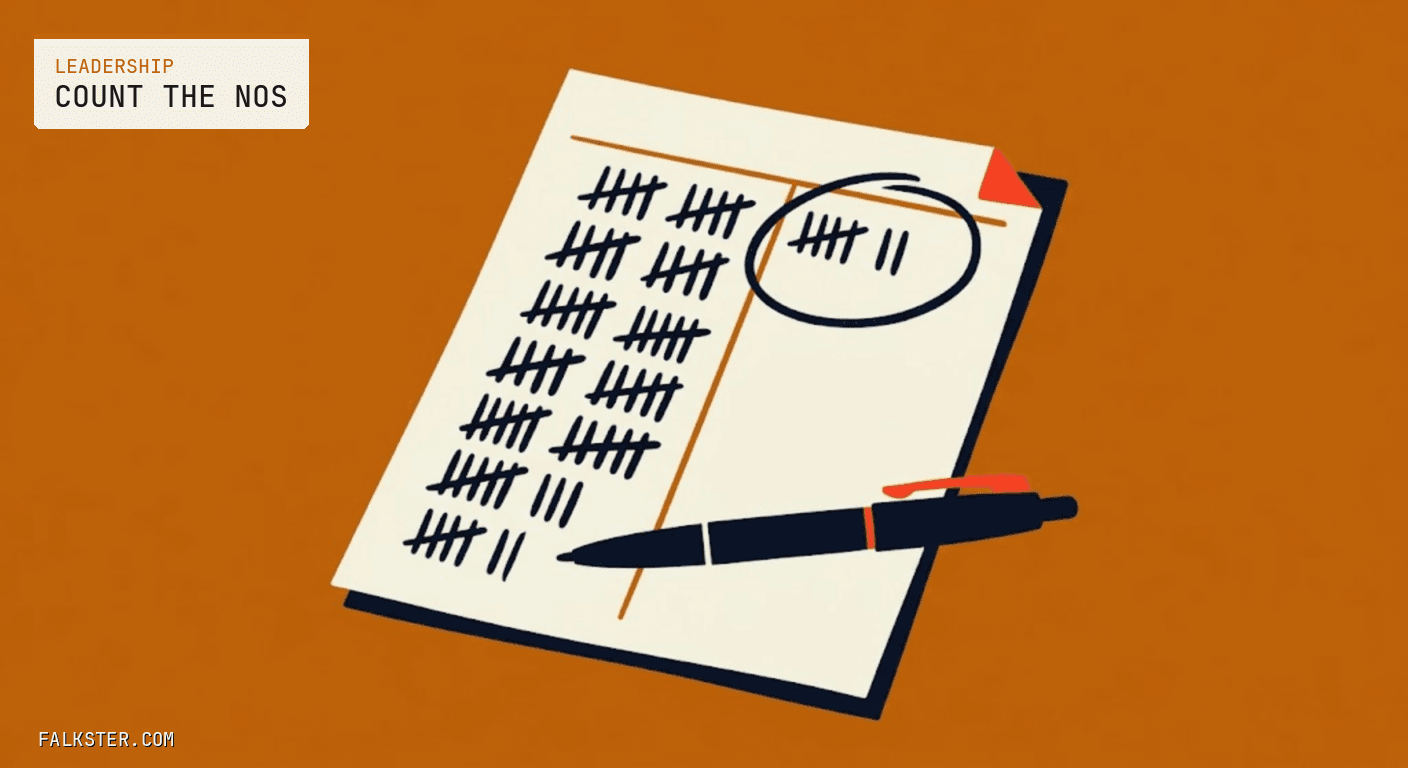
So count the nos. The ledger has five columns: the date, what was refused, who wanted it, what it cost to refuse, and what the refusal protected. Publish it next to the yes count and the yes count's orphan rate, which in my case was 13 of 39. A month with an empty ledger means the strategy is a description of what the team is doing, and a description does not need a document.
Keep Martin's flip as the gate on the document itself. Before a line goes into the strategy, flip it. If the opposite is stupid, the line cannot produce a no and does not belong there. Try it on the two lines most AI strategy decks open with. "Price on outcomes" survives, because credits are a real alternative that most of the market has chosen. "Ship faster" does not, because nobody argues for slower. Most of what fails the flip is the part the deck opens with.
Where the no comes from
A ledger needs a loop that produces entries, and the one I use is One Problem a Week. Name the one constraint in a sentence, as a problem rather than a theme. One owner. What Friday has to prove. Repeat, because the constraint moves the moment you fix it. Everything else on the list waits, and the waiting is the no. It runs at every level, and it is the half of leadership agents cannot do, because they are good at surfacing problems and no good at picking one.
Herbig's own metrics advice points the same way. Before the framework, answer two questions in plain English: what will you do differently, and how will you know it worked. A no is the clearest "do differently" there is, and the ledger is how you know.
Somebody Has to Steer: The CPO Now Owns the Operating Model is the org-level version: when build cost collapses, the leadership work is deciding which coordination stops being necessary, and saying so out loud. The no ledger is where that gets said.
Three writers, one week
The reason to write this now is that Herbig did not land alone.
The same week, Dan Hockenmaier wrote on Lenny's Newsletter that speed is not a moat, because a company that has to sprint forever will misstep and get caught, and that distribution and brand are fuel rather than compounding advantages. I argued the opposite on distribution in Distribution Beats Product, and AI Made It Harsher, and I still would, but his point about speed is the same point as Herbig's: output is not the scarce thing.
And two writers on my roster covered REA, Reverse Engineer Anything, within a day of each other. Nate B. Jones walked through it at 200,000 GitHub stars. Basia Kubicka's post this morning, at 242,000, closed with the question: "If any feature can be rebuilt in an afternoon, what's left to compete on?"
Three writers, one answer from three directions. When the build is free and the feature can be copied from the binary, the only expensive thing left is the choice. A strategy that cannot show you the choices it made this week, with their cost, is not making any.
This is the Product Leadership argument at the level of the strategy document: the org and its artifacts were calibrated to a build cost that collapsed, and the leadership work is saying out loud what stops. Herbig has the right test for whether a line can say no. The ledger is the test for whether it did.
This week: open your strategy and flip every line. Keep the ones whose opposite is not stupid. Then start the ledger with last week's nos. If you cannot fill one row, that is the finding.
Related answer: How do you know if a product strategy is working?
Sources: Aakash Gupta, "How you need to think about product strategy in the age of AI," Product Growth, October 14, 2026, the newsletter write-up read in full; the episode was not watched, and John Cutler, Pieter Levels, and Roger Martin are cited as Gupta reports them. Dan Hockenmaier, "How to tell if a startup has a moat," Lenny's Newsletter, October 13, 2026, the free first section read; the rest is paid and not cited. Basia Kubicka, LinkedIn post on REA, October 16, 2026, read in full. Nate B. Jones, "Reverse Engineer Anything (REA): 5 Places to Point Your AI," October 15, 2026, preview only. Falk Gottlob, "Twenty Minutes Is Not a Reason to Build" and "One Problem a Week."
Also on Medium
Full archive →Frequently asked
How does Tim Herbig say you know a product strategy is working?+
Per Aakash Gupta's October 14, 2026 write-up of their episode, Herbig treats the strategy like a product: it is for the team and stakeholders, it works if it helps them intentionally say yes or no to opportunities over a 6 to 18 month horizon, and you know it is working if most of the team's energy goes to work connected to the strategy. He also uses Roger Martin's test that a real choice is one whose opposite is not stupid.
What is wrong with measuring a strategy by how much energy goes to it?+
It is an input measure, and it passes when the strategy has never been asked to say no. I said yes to 39 agent builds in 80 days, every one connected to the strategy and minutes to build, and 13 ended with zero references anywhere else in the system. Nothing contradicted the plan. The plan never refused anything, because at a build cost of minutes nothing reaches the no. John Cutler's CEO claiming 100x effectiveness with no extra demand would have passed the same test.
What should you count instead?+
The nos. A strategy is working when it produced a refusal this week that cost something a named person wanted. Keep a ledger with each no, what it cost, what it protected, and who wanted the yes, published next to the yes count and its orphan rate. If the ledger is empty for a month, the strategy is a description, not a decision.
What is the stupidity flip?+
Roger Martin's test, as Herbig applies it: state the opposite of a strategy line, and if the opposite is stupid on its face, the line was never a choice. Make salespeople more efficient fails, because nobody would argue for slower salespeople. Make them more efficient by being in person with clients passes, because virtual contact is a real alternative. Of seven lines on Herbig's sample marketplace, only two survive, and both are operational mechanism choices.
How do you produce a no on a schedule?+
Run the loop I wrote up as One Problem a Week: name the one constraint in a sentence, as a problem rather than a theme, put one owner on it, decide what Friday has to prove, and repeat. Everything else on the list waits, and the waiting is the no. It runs at every level, not only for the CEO, and it is the half of leadership agents cannot do, because they surface problems well and choose among them badly.
Why does this matter more now?+
Because three writers reached the same conclusion in one week from different directions. Herbig: when features get cheap, not choosing the right one gets expensive. Dan Hockenmaier on Lenny's Newsletter: speed is not a moat and distribution is fuel rather than a compounding advantage. Basia Kubicka and Nate B. Jones on REA, a tool that rebuilds any feature from the binary: if any feature can be rebuilt in an afternoon, what is left to compete on. The choice is the only expensive thing left.

Comments (0)
Sign in with LinkedIn to leave a comment.
Sign in with LinkedIn