The short version
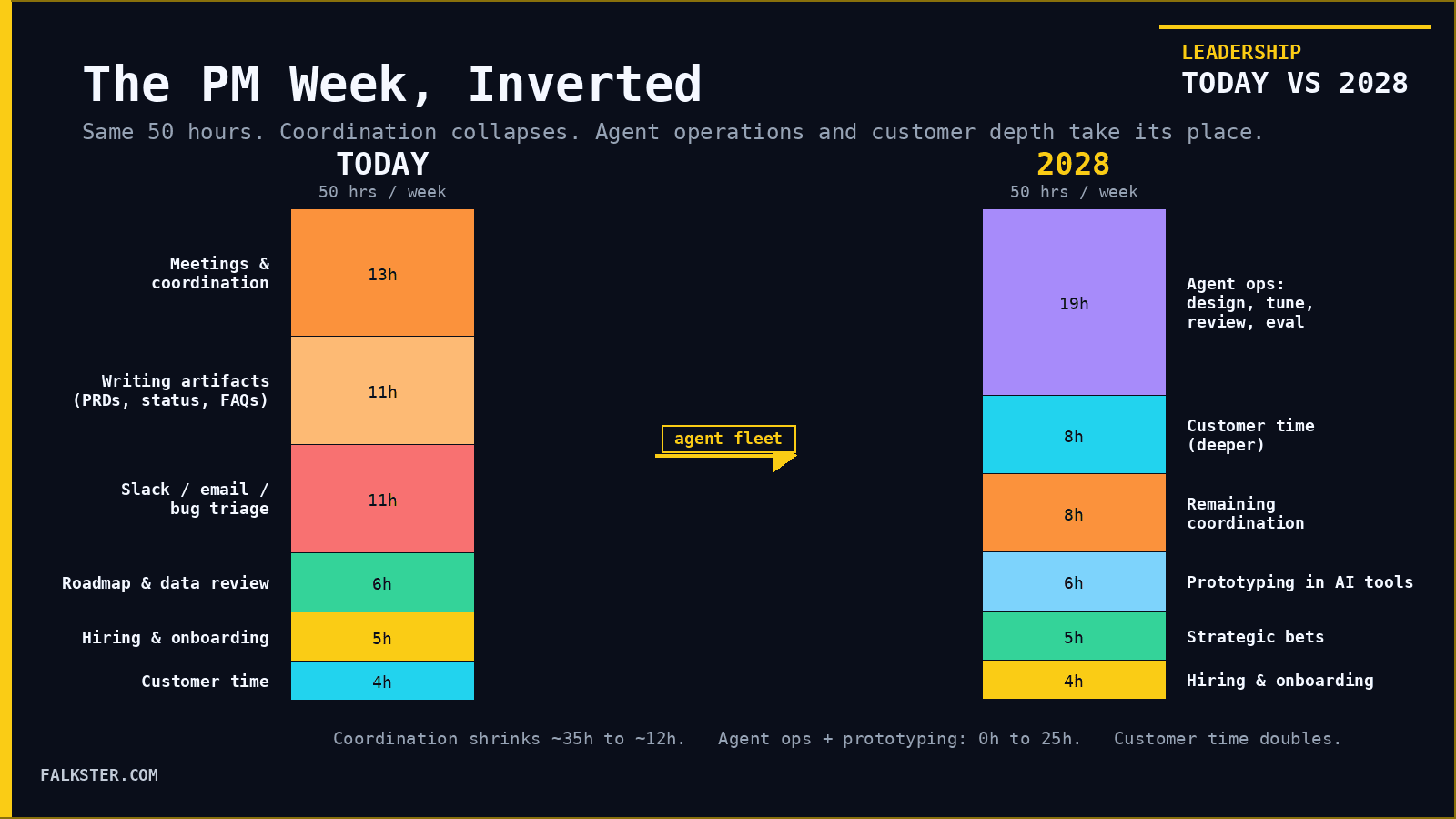
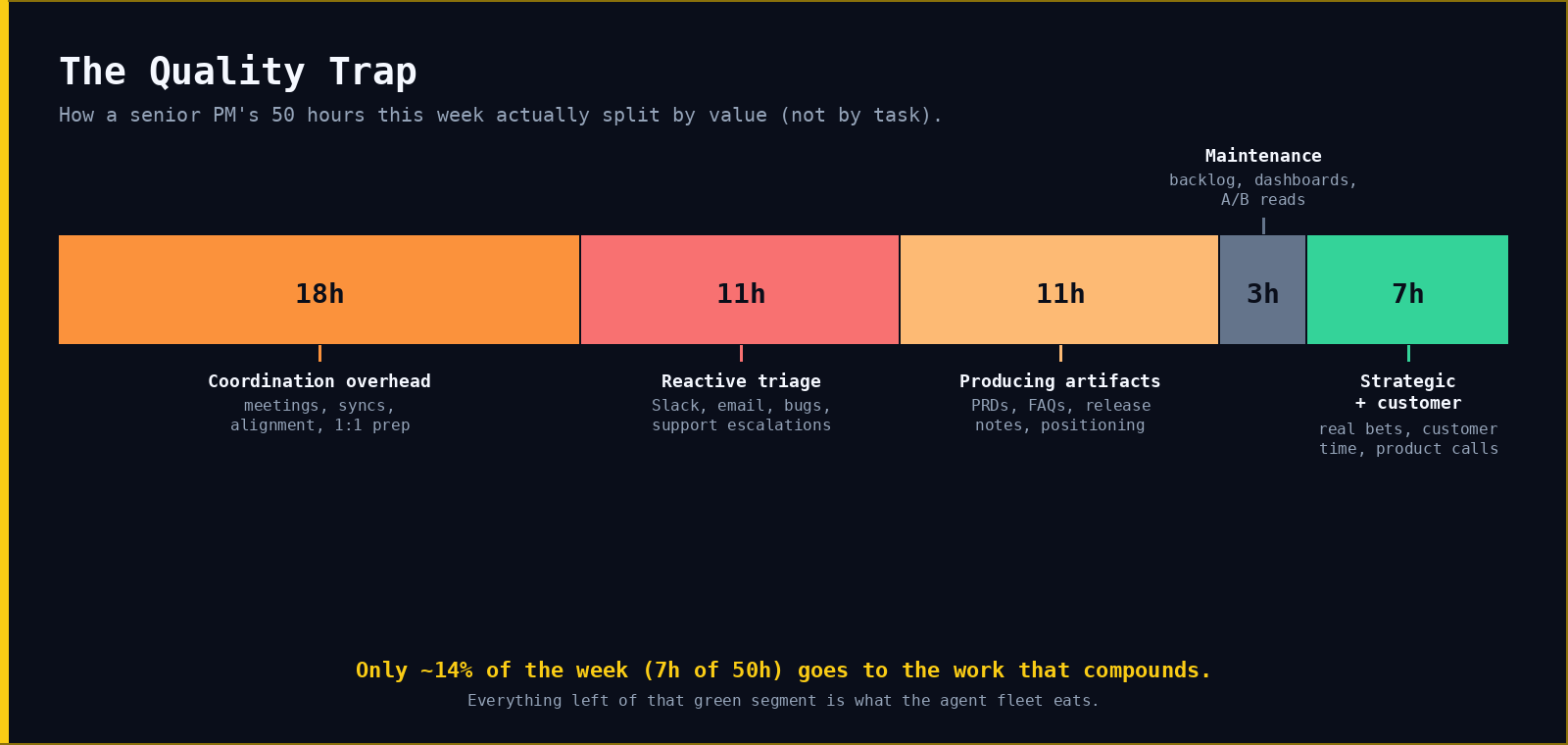
A senior PM at a 50 to 500 person company spends about 50 hours a week today. Roughly 43 of those hours are coordination, triage, and artifact production. Only about 7 hours, around 14% of the week, touch a real bet, a real customer, or a real strategic call. The rest is overhead. In 2028 the hours stay the same. The shape inverts. About 30 of those 50 hours move to designing, reviewing, and operating an agent fleet that does the coordination work in the background. The remaining 20 hours go to the things humans are still uniquely good at: strategic bet selection, customer time at depth, prototyping the actual thing, and shipping a working prototype to at least one real customer every single week. The PM job is not getting eliminated. It is getting compressed, then sharpened. The PMs who survive this are the ones who treat agents as a team they manage, and who walk into every Monday with a working artifact in production, not a doc.
The headline shift
PMs today are coordinators. PMs in 2028 are curators and builders. The job moves from producing documents to operating a system that produces them, AND to shipping a real thing every week. From typing the spec to evaluating the spec the agent typed. From scheduling the interview to deciding what to do with the insight the discovery agent surfaced. From writing about a feature to shipping it behind a flag to one volunteer customer by Wednesday.
The hours do not shrink. The leverage does the opposite of shrinking.
Side-by-side: every task, today and future
Here is what a working week looks like today, and what each of those tasks becomes once the agent fleet is mature. I sized the "today" column to a real 50-hour week at a startup PM job, not a fictional 40. The "future" column assumes a fleet of roughly 10 to 15 specialized agents the PM owns and tunes.
| Task today | Hours / week now | What it becomes in 2028 | Hours / week future |
|---|---|---|---|
| Writing PRDs and product specs | 4.0 | Shipping a working prototype to at least one real customer | 0 (rolls into prototyping) |
| Sprint planning meetings | 2.0 | Async standing brief, reviewed in 15 minutes | 0.25 |
| Daily standups | 2.5 | Eliminated. Agent-emitted activity digest replaces it | 0 |
| Customer interview scheduling and prep | 1.0 | Discovery agent schedules, sends pre-reads, transcribes | 0 |
| Synthesizing interview notes | 3.0 | Insight agent clusters across every interview continuously | 0.5 (review) |
| Status updates to leadership | 3.0 | Outcome agent drafts weekly; PM edits and signs | 0.5 |
| Roadmap maintenance in Productboard or Aha! | 2.0 | Bet-tracker agent maintains the live state | 0.25 |
| Competitive intel and market scanning | 2.0 | Market-watch agent produces a weekly digest | 0.25 (read) |
| Slack triage: mentions, notifications, threads | 4.0 | Personal triage agent routes, drafts, summarizes | 1.0 |
| Email triage | 3.0 | Same agent as above | 0.5 |
| Bug triage and severity calls | 2.0 | Triage agent ranks; PM only touches ambiguous cases | 0.5 |
| Backlog grooming sessions | 2.0 | Agent maintains backlog priority continuously | 0 |
| Reading A/B test results | 1.0 | Experiment agent surfaces winners, losers, context | 0.25 |
| Checking metric dashboards | 2.0 | Signal agent pages PM only when something deviates | 0.5 |
| 1:1 prep with execs | 1.0 | Briefing agent assembles the deck the night before | 0.25 |
| Design review meetings | 2.0 | Design crit agent gives first pass; humans on hard calls | 1.0 |
| Engineering syncs | 3.0 | Build status agent surfaces blockers; PM tackles hard decisions | 1.0 |
| Writing launch FAQs | 1.0 | Launch agent drafts; PM approves | 0.25 |
| Drafting positioning and messaging | 2.0 | Marketing-handoff agent drafts; PM finalizes | 0.5 |
| Writing release notes | 0.5 | Auto-generated by build agent from merged PRs | 0 |
| Stakeholder alignment and politics | 3.0 | Mostly unchanged. Humans still need humans to disagree with them | 3.0 |
| Hiring and reviewing candidates | 2.0 | Mostly unchanged, with an interview-prep agent in support | 2.0 |
| Onboarding new hires | 1.0 | Mostly unchanged. Coaching is human work | 1.0 |
| Quarterly planning rituals | 2.0 | Halved. Agent assembles the input deck; humans make the bets | 1.0 |
| Customer support escalations | 1.0 | Support agent triages; PM only sees the strategic ones | 0.25 |
| Subtotal (current job) | 50.0 | 15.25 |
That leaves 34.75 hours a week. Those hours do not disappear. They move to a new column of work that nobody does today, because the surface area does not yet exist.
| New work that did not exist before | Hours / week future |
|---|---|
| Designing and tuning the agent fleet | 6.0 |
| Reviewing agent outputs and approving decisions | 8.0 |
| Writing evals (the new unit test for product work) | 4.0 |
| Prototyping AND shipping a prototype to one real customer | 6.0 |
| Setting outcome thresholds for agent autonomy | 1.0 |
| Strategic bet selection at higher cadence | 3.0 |
| Deeper customer time, fewer but better interviews | 4.0 |
| Cross-functional alignment that still needs a human | 2.75 |
| New work subtotal | 34.75 |
Total time: same 50 hours. Different job.
A normal PM week today, hour by hour
If you mapped a typical week on a calendar, you'd see a senior PM at a growth-stage company doing roughly this:
Monday is meetings. Sprint kickoff. Weekly product team sync. A leadership review of last week's metrics. Maybe an engineering one-on-one. Six to seven hours of synchronous time before lunch.
Tuesday is writing day in theory. In practice it gets eaten. Three hours go to a PRD that nobody will read in full. One hour goes to a status doc for the VP of Product. Another hour to a launch FAQ. One hour goes to Slack interruptions.
Wednesday is customer time, allegedly. There are two interviews on the calendar. They take an hour each, plus 30 minutes of prep and 45 minutes of synthesis afterward. The other four hours go to design reviews, roadmap edits in Productboard, and an unscheduled escalation from sales.
Thursday is "deep work day" that the calendar invitation says is blocked. Half of it survives. The other half is consumed by a competitive intel rabbit hole, a bug triage call, and three Slack DMs that turn into half-hour conversations.
Friday is half-meetings and half-writing. The retrospective. A stakeholder one-on-one. The week's outcome doc. Two hours of "catching up" that is really email and Slack debt.
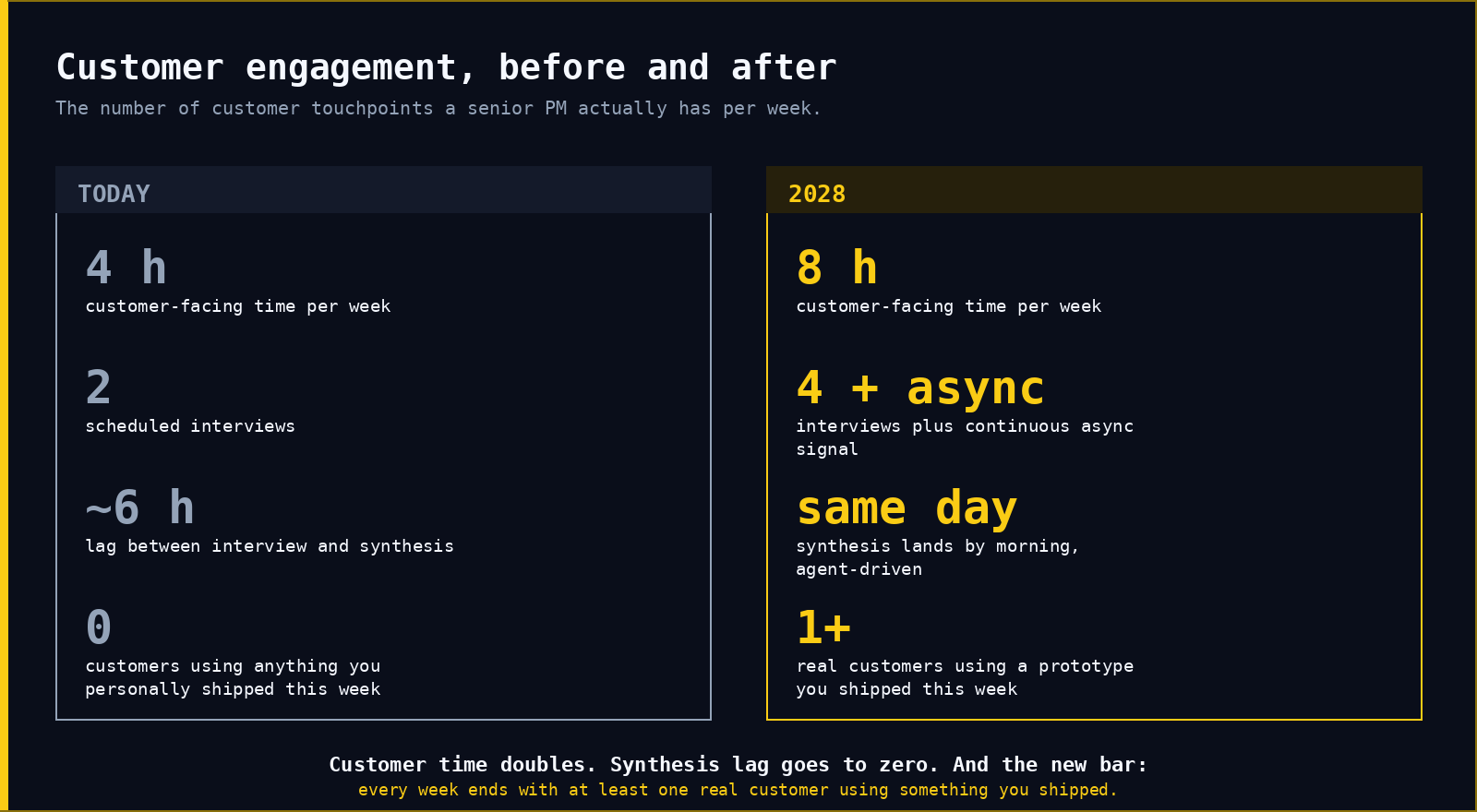
Across the week, the PM probably touched a customer for 4 hours, made one or two real strategic calls, shipped no actual product themselves, and produced something like 6,000 words of internal artifacts.
This is the load that the agent fleet is designed to relieve.
The same week in 2028
The hours stay 50. The texture changes completely.
Monday morning, the PM opens the dashboard. Three agents have run overnight: the discovery agent has synthesized eight new interview transcripts and surfaced two emerging themes. The metric signal agent has flagged a 6% drop in week-4 retention on a recent cohort. The competitor agent has produced a 400-word digest of three relevant moves in the market. The PM spends 90 minutes reading, asking follow-up questions, and pulling on the threads that matter. By 10:30 they have a working hypothesis about the retention drop.
Then they open Cursor or v0 or Bolt or whatever the AI coding stack looks like, and they prototype the proposed fix. By the end of Monday they have a working version of the change deployed behind a feature flag in production. They've gated it to one volunteer customer who agreed to test it. By Tuesday morning the customer is using it. By Tuesday afternoon the PM has a real signal: did it move the metric, did the customer hate it, did the customer not even notice. That live artifact replaces the PRD they used to spend Tuesday writing. No 12-page doc. No internal demo. The actual thing, in someone's actual workflow, before lunch on day two.
Tuesday is agent design day. The PM has noticed their pricing-watch agent is producing too many false positives. They sit down, look at the last 50 outputs, write five new evals, retune the prompt, run the eval suite, and ship the updated agent. Two hours, max. Then they spend three hours reviewing the week's queue of agent-produced decisions: which roadmap changes did the bet-tracker agent stage, which support escalations did the triage agent surface, which design crit comments did the design agent flag for human attention. They approve, override, or escalate each one.
Wednesday is customer day, and now it is actually a customer day. Four interviews, all already scheduled by the agent, with pre-reads in the PM's inbox the night before. The PM is sharper and more present because the synthesis is no longer their job. The agent will produce the cluster the next morning.
Thursday is strategy day, and it is real. Three hours go to portfolio review with the head of product. Two hours go to a prototype of the next bet. One hour is a working session with engineering on a hard architectural call.
Friday is review and feedback. The outcome agent has drafted the weekly summary. The PM edits it down by 40%, adds two judgment calls the agent cannot make, and sends it. Then they spend two hours auditing one agent that has been drifting and one new agent they want to graduate from "human in the loop" to "fully autonomous on this narrow task."
Across the week the PM has touched 10 to 15 customers' worth of insight, made five to seven real strategic calls, shipped one working prototype to at least one real customer, and tuned three agents. They typed less than 1,000 words.
This is what compression looks like.
What changes underneath
The deep shift is not what gets automated. It is what becomes the unit of product work.
Today the unit is the document. The PRD. The brief. The launch memo. PMs are measured, hired, and fired on documents.
In 2028 the unit is the working artifact plus its evals plus one real customer using it. Either a prototype shipped behind a feature flag to a consenting customer, or an agent that operates a piece of the system, or both. Documents become a side effect of building.
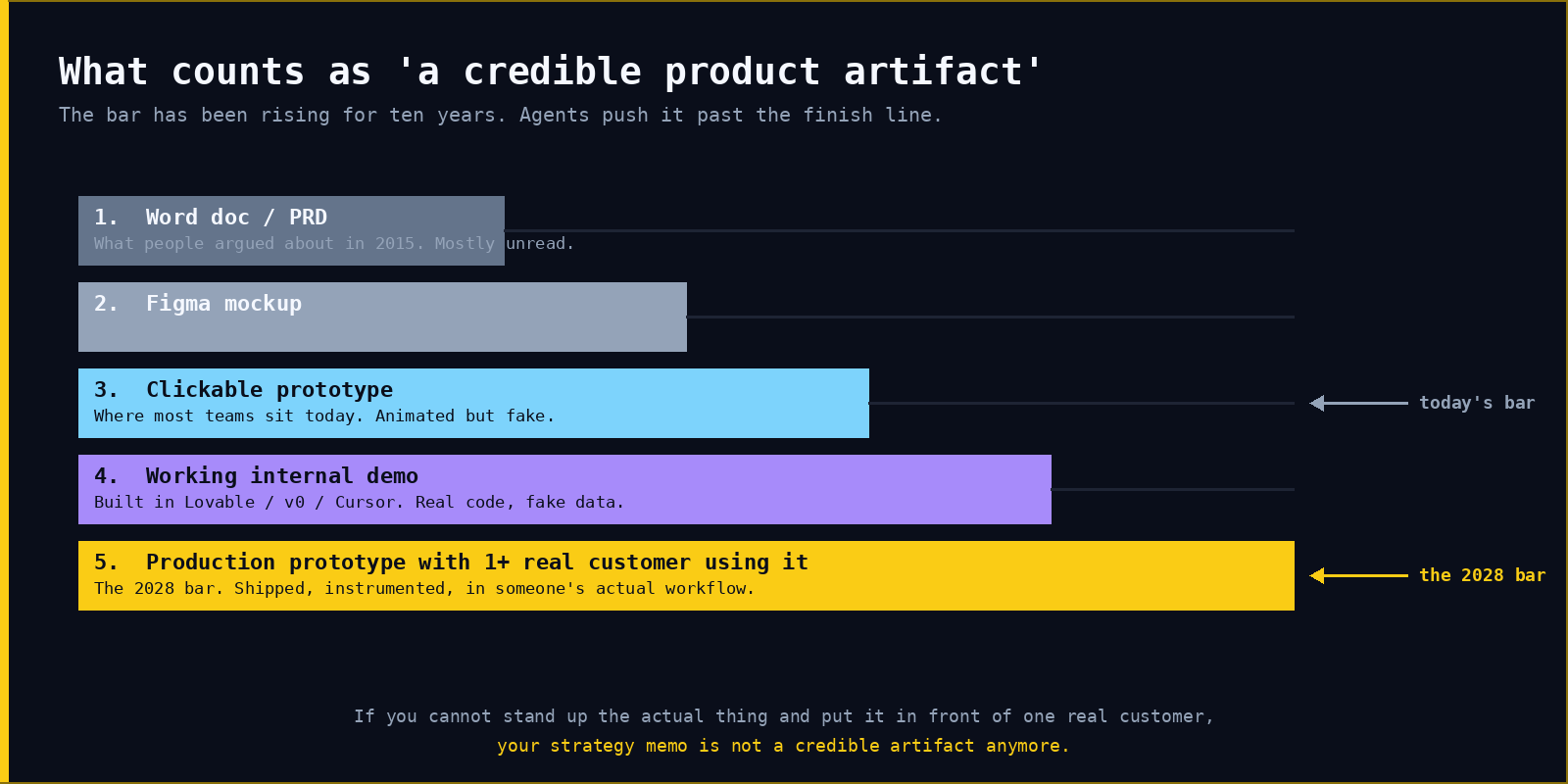
The bar matters. A mockup is not a prototype. A clickable Figma is not a prototype. Even a working internal demo with fake data is not the 2028 bar. The bar is: shipped, instrumented, behind a flag, with one consenting customer actively using it in their real workflow. If you cannot get to that bar in a week, you do not yet have a credible argument for the bet.
A second shift: the unit of measurement moves from output to outcome. Today a PM is judged on roadmap velocity, feature ship rate, and how many PRDs they wrote. In 2028, when an agent ships PRDs as fast as you can review them, those metrics are noise. What's left is: did the bet move the metric. That is the only thing that scales.
Third shift: coordination work was 70% of the PM job and 90% of the burnout. Strip it out and the human work that remains is the most interesting part of product management. Bet selection. Customer empathy. Trade-offs under ambiguity. Calling shots. That is the job a lot of us thought we signed up for and were always too underwater to do.
The 50 hours stop hurting.
Who survives this shift
Three skills become disproportionately valuable:
Prototyping ability that ends in production. Not engineering. The skill is: stand up a working version of your idea, deploy it behind a feature flag, and put it in front of one real customer this week. With Lovable, v0, Cursor, Claude, and a 30-minute feature-flag setup, this is achievable for any PM who spends the time to learn the stack. The PMs who refuse to prototype will be outcompeted by the ones who walk into the room and say "one customer started using this version yesterday and here's what happened."
Eval design. A PM who can write a clean eval for an agent or a feature has the same instinct as a good test-driven engineer. They can specify success. That skill was always rare. Now it is load bearing.
Customer instinct sharpened by time. The PMs who use the freed-up 4 to 6 hours of synthesis time to do four extra customer conversations a week pull dramatically ahead. The PMs who use that time to do more meetings get reabsorbed.
The PMs who do not survive are the ones whose value was tied to producing documents and running meetings. That job is being eaten.
What to do this week
Two things to try this week. Both small. Both real.
The first is automation. Pick one task off the table above that currently eats more than 2 hours of your week. Stand up an agent that does it. Could be a status-update agent that drafts your weekly update. Could be a competitive-watch agent. Could be a discovery synthesis agent. Spend a Friday afternoon. Use Claude or ChatGPT or your stack of choice. Define the input. Define the output. Write three evals: what good looks like, what bad looks like, what an edge case looks like. Ship it. Run it for two weeks. See how much time it gives you back.
The second is the harder one and the more important one. Pick the smallest end-to-end version of your next bet, and ship it to one real customer this week. Not a slide. Not a mock. Not an internal demo. The actual thing, deployed behind a feature flag, gated to one consenting customer, instrumented enough that you can see whether they used it. Use Lovable, v0, Cursor, whatever. The goal is not a beautiful product. The goal is one real human in your product workflow on Friday who was not there on Monday.
Do both once and you will feel the pull of the next one.
Related reading on the same shift:
- PM as a team of AI agents, the operating model under all of this
- Your AI agent fleet, the full list of agents I run and how they connect
- The impact loop, how to measure outcomes in a world where output is free
- The PM agent stack overview, the categories of agents and what each one does
- The triad is dead, pods are dead, why the team shape changes too
- Agents for every PM, getting started with your first three agents
Sources: my own time-tracking data across the last two years at Smartcat, plus four CPO peers who shared anonymized week breakdowns. The 2028 column is forward-looking, but the underlying agents already exist in early form across my fleet today.
Also on Medium
Full archive →AI Agents and the Future of Work: A Pixar-Inspired Journey
What product managers can learn about AI agents from how Pixar runs a film team.
Many AI Agents Are Actually Workflows or Automations in Disguise
How to tell agents from workflows from cron jobs, and why it matters for what you ship.
Frequently asked
How much of a PM's time today is spent on coordination versus actual product thinking?+
On a 50-hour week, roughly 43 hours go to coordination, triage, and artifact production. Only 7 hours, around 14% of the week, touch real bets, real customer depth, or real product calls. The rest is overhead. Most PMs already know this. They just do not have permission to say it out loud.
What is the biggest thing AI agents take off a PM's plate first?+
Writing. Specs, status updates, release notes, FAQs, briefs, summary docs. All of it. Discovery synthesis goes next, then backlog grooming, then competitive intel. The hard human work moves to designing the agents that produce these outputs, and reviewing what they ship.
Will PMs need to write code in the future?+
PMs will need to prototype. That is not the same as shipping production code with full engineering rigor. With AI coding tools the bar is now: can you stand up a working version of the thing you are arguing for, ship it behind a feature flag, and put it in front of at least one real customer this week. If you cannot, your strategy memo is not a credible artifact anymore.
What replaces the PRD?+
A working prototype that one real customer is using in production, a set of evals, and an outcome target. The prototype shows what AND who is using it. The evals define quality. The outcome target is what success looks like. Together they replace the 12-page PRD that nobody read past page two.
What does 'prototype' mean here? A Figma mock?+
No. A Figma mock is level 2 on the bar. The 2028 bar is level 5: a real, instrumented prototype shipped behind a feature flag to at least one consenting customer who is using it in their actual workflow. Animated mocks and clickable prototypes are no longer enough. The thing has to work and someone real has to be using it.
How does customer engagement change?+
Customer time doubles, from about 4 hours to 8 hours a week. The synthesis lag goes from days to same-day. And every week ends with at least one real customer using something the PM personally shipped. Today the PM is upstream of customers. In 2028 the PM is in the loop with them.
How do you measure a PM whose work is mostly agent supervision?+
By the outcomes the agents produce, not the activity. Did discovery throughput go up. Did time-to-decision shrink. Did the team ship more bets without dropping quality. The PM is now an operator of a small system, not a contributor of typed documents.
What is the one task that doesn't transfer to agents?+
Making the call when the data is ambiguous, the stakeholders disagree, and the cost of being wrong is high. Strategic judgment under uncertainty stays human. Everything around it gets automated.

Comments (0)
Sign in with LinkedIn to leave a comment.
Sign in with LinkedIn