Emily Kramer analyzed more than 1,100 B2B marketing job posts this month, most of them from 345 private startups, and her read on product marketing is that the seat is splitting in two. Systems-building PMMs who set the shared context everyone works from. Campaign-managing PMMs who run launches and campaigns. Among the systems she names is a positioning file every agent reads.
That one line is the whole next five years of this job.
Because here's what changed. The prototype is free. Ramp's non-engineers shipped more than 7,000 pull requests last quarter, as Rich Holmes reported from the company's CEO. When anyone can build the thing by Friday, the build stops being the expensive decision. The expensive decision is the one before it: which problem, for whom, against what alternative, and why they'd switch.
That's positioning. And it has to be written before the build, in the same file as the problem statement, by the two people who own its halves.
This is part 2 of The Product Marketing Transition. Part 1 argued product marketing reports to the CPO. This part is about the first seam that argument closes, the one between PM and PMM.
The short version
When a prototype costs a day, the problem statement and the positioning are one document, because they answer the same first questions: who is this for, what do they do today instead, what's different, and why would they believe it. Positioning written after the build only describes what the prototype already decided. Emily Kramer's analysis of more than 1,100 job posts shows product marketing splitting into systems builders and campaign runners, with a positioning file every agent reads as one of the systems. Richard Melick argues PMMs belong in GitHub, and 28.1% of PMMs already carry roadmap planning. So the PM owns the problem and the evidence, the PMM owns the alternatives and the claim, and both write one file in the repo next to the spec. That only works if both owners answer to the leader who owns the outcome, the CPO.
One file, two owners
Put a problem statement next to a positioning doc and read the first half of each. Who's the customer. What they use today. What hurts about it. Same three questions. The documents only diverge after that, and the divergence is the useful part.
The PM owns the problem and the evidence for it. What the customer is trying to get done, how often, what it costs them, and what the data says. The PMM owns the alternatives and the claim. What the buyer would compare you to, what you do that they can't, and the one sentence a skeptical buyer will believe. Design owns the behavior, as the Design Transition argued in who owns the spec.
When the build took a quarter, those halves could live in different decks, written months apart. That's over. If the prototype exists by Friday and the positioning gets written the week after, the prototype has already made the positioning decisions, and nobody made them on purpose.
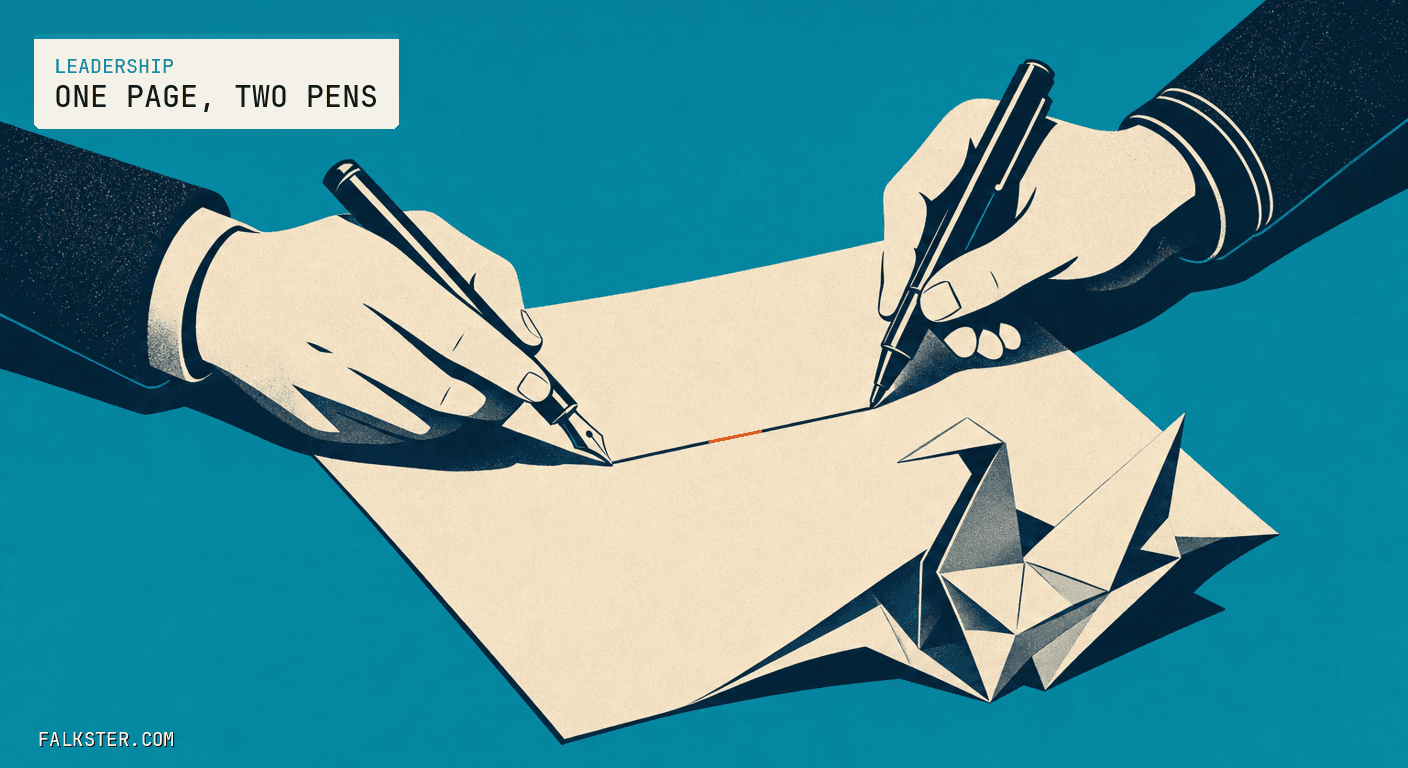
So one file. Two named owners, each on their own section. It lives in the repo, next to the spec, because that's where the agents doing the building read their context.
Richard Melick made the practical version of this case on October 21: product marketers belong in GitHub, in the issues, the pull requests, the project boards, and the releases. He cites the Product Marketing Alliance's 2025 finding that 28.1% of PMMs report responsibility for roadmap planning, a share that has risen three years running. He's writing for security PMMs. The argument travels.
The title fades, the seat moves
Jordan Chenevier-Truchet argued in early October that the PMM title is "living on borrowed time." Strip out what AI already does, the launch decks, battlecards, one-pagers, and web copy, and what's left is understanding the audience and deciding what to tell them. He thinks every marketer ends up doing that. At Ahrefs, he notes, no one holds a PMM title.
I agree with the diagnosis and land somewhere else. The title may well fade. The seat doesn't disappear, it moves. The systems-building PMM in Kramer's split is the one whose work feeds the build: the positioning file, the claims, the alternatives, the context every agent reads. That work has to sit where the build sits. The campaign half can stay in marketing, and should.
Kramer's numbers point the same way. 44% of the PMM posts she read ask for AI skills, and 23% ask for running campaigns end to end, well below the 35% across all the marketing posts. One Director or VP of PMM post she quotes, from Runway, says the hire will be "measured on the growth of the business." That's an outcome number.
The experiment agent needs a claim to test
Kyle Poyar's State of B2B GTM survey of 300 software GTM leaders has Claude as the most impactful GTM tool, named by 110 respondents, more than three times the next one, with Claude Code the most popular Claude product. His takeaway is that Claude Code is now a required skill for GTM teams. He also names positioning and messaging as the next battleground, because every company sounds the same.
Put those together. Go-to-market people are working in the same tools as the builders, and the scarce thing is a point of view worth testing.
Figma shows where that goes. On How I AI, Claire Vo's guest Ezra Mechaber demoed AutoXP, an agent that runs growth experiments with one human checkpoint. I have that from the show notes, so that's all I'll claim about it. But the shape is clear. When an agent can run the experiment, the human's job is the hypothesis and the checkpoint. And a growth hypothesis is a positioning claim: this buyer, this alternative, this reason to switch.
So who holds the checkpoint? The person who owns the claim. If that person sits in another org, the agent waits on a meeting.
Why it's one team under the CPO
Here's the piece of the larger case this part makes. The loop runs customer, spec, build, story, adoption, and the PM and PMM own the two ends of the first half of it. Problem and claim. If they report to different executives, they carry different scorecards into the same file. The PM is measured on what shipped. The PMM is measured on pipeline or launch reach. Each section gets approved on a different calendar.
That was survivable when the build took a quarter. It isn't when the prototype ships before the argument ends.
Under the CPO it's one conversation and one number. The CPO answers for whether what shipped got bought and used, which is the only number both halves of the file serve. That's why The CPO Transition keeps landing on the same claim, that the CPO owns the operating model, and why I wrote in July that GTM is not someone else's job for the PM. That post had the PM absorbing go-to-market. This is the next step. Not the PM doing the PMM's job. Two owners, one file, one boss.
The decision for a CPO or CEO this quarter is concrete. Pick the product areas where prototypes now ship weekly. Pair a PM and a PMM on each, give them one problem-and-positioning file in the repo, and put both on the same outcome number. Then decide whether the reporting line moves now or at the next planning cycle. Waiting longer than that means the prototypes keep deciding.
What I expect
These are my predictions, not facts. I'll check them in later parts.
By the end of 2027, at AI-native software companies, the PRD and the positioning doc are one artifact. Changes to its positioning section need a PMM review the way code needs a code review.
Within two years, more PMM job posts at AI-native companies ask for working in the product repo than for running launches end to end. Kramer's 23% for campaigns is the number to watch fall.
By 2028, the first question in a product review is the positioning claim the prototype tested, not the demo. Demos are free. Claims aren't.
One thing to try this week
Pick the next prototype on your roadmap, before anyone builds it. Put the PM and the PMM in a room for an hour and have them write one page together: who it's for, what they use today instead, what's different, the one claim the buyer should believe, and what the prototype has to prove.
Commit it to the repo next to the spec, where the agents will read it. If they can't agree in an hour, you just found the real work, and it happened before the build instead of after.
Sources: Emily Kramer, "I analyzed 1,100+ marketing job posts. They're stuck in 2023.," MKT1 Newsletter, October 19, 2026, including the Runway job post she quotes. Richard Melick, "The PMM Who Ships: Product Marketers Belong in GitHub," Kingfisher, October 21, 2026, for the Product Marketing Alliance roadmap figure as he cites it. Jordan Chenevier-Truchet, "Everyone's a PMM now?!," Bullish, October 6, 2026. Kyle Poyar, "What's working in B2B GTM in 2026," Growth Unhinged, October 14, 2026. Rich Holmes, "Reddit's CEO warns Google's 'AI Mode does not drive traffic'," Department of Product, November 1, 2026, for Ramp's pull request figure as he reports it. Claire Vo with Ezra Mechaber, "How Figma's PMs actually use AI every day," How I AI, Lenny's Newsletter, November 2, 2026, show notes only.
Part of the running argument on Product Leadership: the product org chart was calibrated to a build cost that collapsed, and when the prototype is free, the problem statement and the positioning become one file with two owners, who have to answer to the CPO who owns the outcome.
Related answer: Who owns positioning when the prototype is free?
Frequently asked
Who owns positioning when the prototype is free?+
The PM and the PMM own it together, in one file, before the build starts. The PM owns the problem and the evidence for it. The PMM owns the competitive alternatives and the claim the buyer will believe. When a prototype costs a day, that file is the first expensive decision, and it belongs in the repo next to the spec, where people and agents read it.
Why are the problem statement and the positioning one document now?+
Because they answer the same first questions: who is this for, what do they do today instead, and why would they switch. When the build took a quarter they could be written months apart. When the prototype exists by Friday, positioning written after the build is just a description of whatever the prototype already decided.
What did Emily Kramer find about product marketing job posts?+
In her October 2026 analysis of more than 1,100 B2B marketing job posts, Kramer describes product marketing splitting into systems-building PMMs who set shared context and campaign-managing PMMs who run launches. 44% of PMM posts ask for AI skills and 23% ask for running campaigns end to end. One of the systems she names is a positioning file every agent reads.
Should product marketers work in GitHub?+
Richard Melick argues they should, at four points: issues, pull requests, project boards, and releases. He cites the Product Marketing Alliance finding that 28.1% of PMMs report responsibility for roadmap planning, a share that has risen three years in a row. Falk's view is that the positioning file belongs in the same repo as the spec, so working there is part of the job.
Why should PM and PMM sit under the same leader?+
Because the file has two owners and the loop runs at prototype speed. If the PM and the PMM answer to different executives with different scorecards, the prototype ships before the argument about who it's for ends. Under the CPO, who owns whether what shipped got bought and used, it's one conversation and one outcome number.
What are Falk's predictions for PM and PMM?+
Three, labeled as predictions. By the end of 2027, the PRD and the positioning doc are one artifact at AI-native software companies, with a PMM review required on positioning changes. Within two years, more PMM job posts at AI-native companies ask for working in the product repo than for running launches end to end. And by 2028, the first question in a product review is the positioning claim the prototype tested, not the demo.

Comments (0)
Sign in with LinkedIn to leave a comment.
Sign in with LinkedIn