Jakob Nielsen published a long piece on flow this week, and I read it twice, once as a designer and once as the person whose agents were running while I read. It is the fullest thing he has written on the subject: Csikszentmihalyi's preconditions, the response-time limits from his own 1993 book, Doherty's threshold, Gloria Mark's 23 minutes, 16 guidelines. Anyone who ships software should read it.
It also carries the best single sentence about AI latency I have seen, and the sentence is wrong about where the wait is going. That is the rewrite.
The short version
Jakob Nielsen's "Flow in UX" (October 21, 2026) restates his 1993 response-time limits as the physics of flow, 0.1 seconds feels instant, 1 second keeps the train of thought, 10 seconds holds attention, and says current AI chatbots violate the 1-second contract with 10 to 60 second waits. His prediction: as inference latency falls below a second, AI stops feeling like an oracle you petition and becomes a material you shape, so today's AI latency is the worst you will ever suffer. Right about chat, wrong about the direction. The slow case for agents is leaving the screen. The design handbook's Latency Is Interface chapter has six bands, picked by the realistic slow case and never the median, and the sixth band, open-ended agent work, is barely latency at all because nobody is waiting. On falkster.com's own fleet the Monday scan fetches 94 sources, and the session that follows reads, writes, and publishes three posts with nobody watching; 44 appointed agents, 15 still naming a morning slot. The rewrite: the 1-second contract holds for the first three bands, and the sixth band's contract is three lines at the next session, what it did, what it is doing, and what you can still take back, with the undo window written next to the gap between sessions. Nielsen's other claim, that approving AI output has no flow channel, is right about the direction and wrong about the verb: the trust ladder has four tiers, and the flow lives in Tier 3, where the person edits.
What Nielsen wrote
The piece is about a state, not a diagram. Flow is total absorption, and its preconditions are the three things a designer controls: clear goals, immediate feedback, and a challenge matched to skill. Its enemies are latency and interruption, and he spends most of the article on those two.
On latency he quotes himself, and he has earned it. The 1993 limits: 0.1 seconds for the feeling that the system reacts at once, 1 second for keeping the user's train of thought intact, 10 seconds for holding attention on the dialogue at all. He calls the middle one the 1-second contract. He adds Doherty and Thadani's 1982 IBM result, programmers' completed transactions per hour more than doubling, 180 to 371, when response fell from 3 seconds to 0.3, and names it the most persuasive case for sub-second response you can put in front of a CFO. On interruption he brings Gloria Mark's 23 minutes, Adamczyk and Bailey's finding that the same interruption at a task boundary cut annoyance by 56%, and the one-sentence summary of notification design: deliver at the seams, and let the user decide.
Then AI. Chatbots violate the 1-second contract as a matter of routine, with 10 to 60 second generation latencies. Streaming is this era's percent-done indicator. And the prediction: as inference latency falls below 1 second over the next few years, AI will stop feeling like an oracle you petition and start feeling like a material you shape. "Today's AI latency is the worst you'll ever suffer. The human limits it must eventually meet were fixed by 1968."
He adds a second AI claim a few paragraphs later, and I will come back to it. A job that consists of approving AI output has no flow channel at all, because the challenge has been exported to the machine and only the vigilance remains. Keep the human on the challenging side. Automate the chores, not the challenge.
Where the wait went
Right about chat. The prompt-wait-read loop is turn-taking with a slow intermediary, the wait is shrinking, and when it gets under a second the interaction will feel different. I believe the prediction for that band.
But that band is not where my waits are any more, and I doubt it is where yours are heading either.
Here is the slow case on falkster.com. On Monday a scan fetches 94 sources and writes a digest. The session that follows reads the posts in full, writes three pieces, generates covers, runs the checks, and publishes. Nobody watches it. I am not in front of a spinner for 10 seconds or 60; I am asleep or in a meeting, and the result is waiting at the start of my next session. 44 Appointed Agents, One Attention Budget: Three Lines on the Charter counts the fleet at 44 agents, 15 of them still naming a morning slot. None of them has a 1-second problem. The median wait, if you could call it that, is a night.
The chat wait is shrinking toward a second. The agent wait is leaving the screen. Both are true, and the second one is the design problem nobody has a contract for, because the contract Nielsen wrote in 1993 assumes someone is sitting there.
Six bands, and the sixth has no second
The design handbook's chapter Latency Is Interface was written for exactly this, and it starts where most latency conversations go wrong: somebody asks how long it takes, somebody says about three seconds, and everything gets built for three seconds. Three seconds is the median, and the median is the case that needed no design. Pick the band by the realistic slow case.
Six bands, each with a different answer. Under 100 milliseconds needs nothing. Up to a second needs stillness: no flicker, no disabled control, no layout shift, which is Nielsen's guideline 13 said from the other side. Up to ten seconds needs the work named in place, "reading your last three reports," not a spinner in a corner. Up to two minutes needs honest progress and a cancel, because the person will look away and you are designing for the return. Up to hours needs a job with a lifecycle, something you can find again.
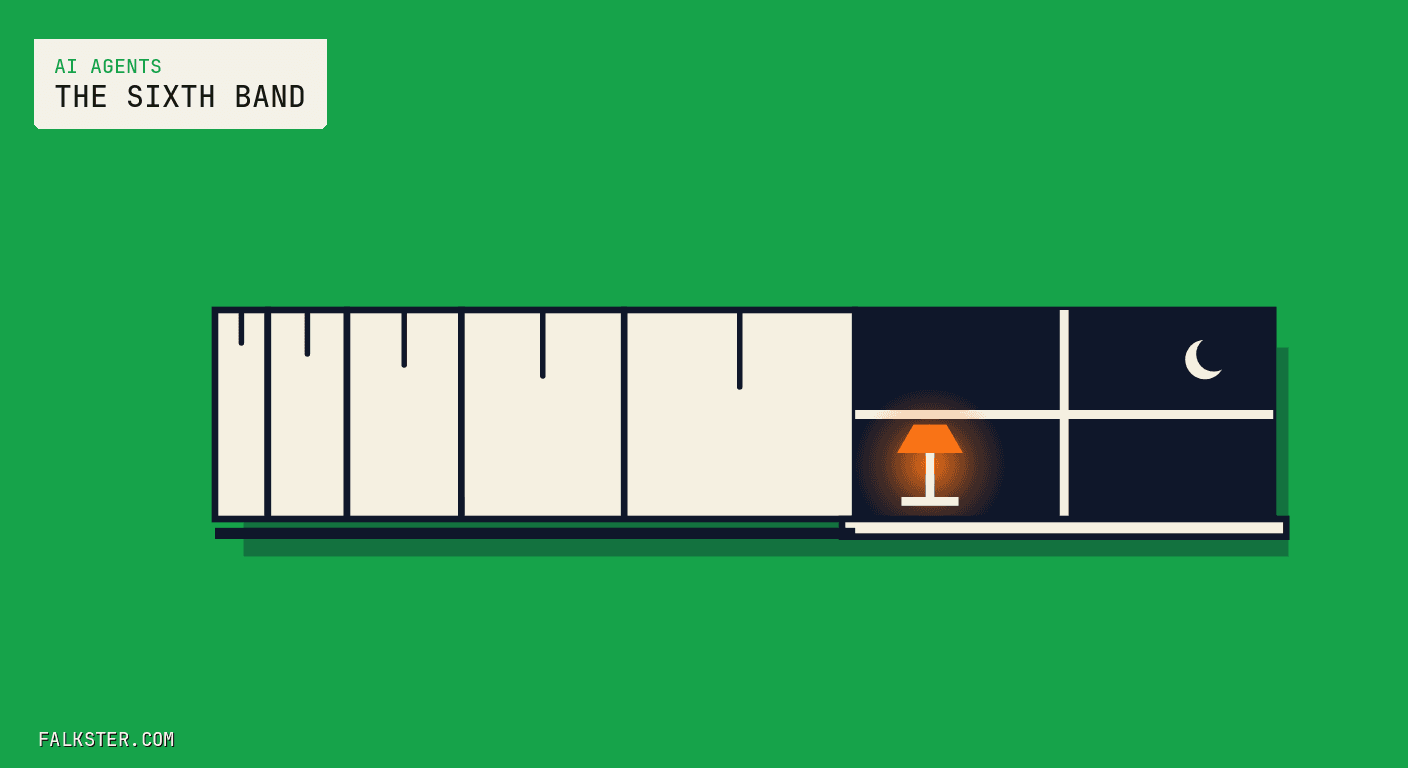
And the sixth band, open-ended agent work, overnight or across sessions, is barely latency at all. Nobody is waiting, so a loading state is the wrong object. The design problem is legibility: one sentence on what it is doing right now, a running account of what it has already done, a summary waiting at the start of the next session before anything else competes for attention, and a stop control that is honest about what stopping leaves half finished.
That running account is the same surface as the one in Undo Is a Design Primitive, where undo for an autonomous system splits into three problems: the reversal, the notification, and the window between them. Teams build the first, add the second late, and almost never name the third. An action that is technically reversible but whose window closed while the user slept is not reversible in any way that matters to them.
So the rewrite. Nielsen's 1-second contract holds for bands one to three, and I would print it on the wall. For the sixth band the contract is three lines at the start of the next session:
What it did, as a running account the person can act on, row by row.
What it is doing now, in one sentence.
What can still be taken back, with the undo window written next to the gap between sessions. If the window is two hours and the gap is nine, say so on the first screen, because the person reading at 8 a.m. is about to find out that 3 a.m. was the deadline.
Nielsen's own guideline 9 is the shape of this: batch notifications and deliver the digest at a scheduled moment instead of retailing each ping at 23 minutes apiece. He wrote it for pings. It is also the only humane shape for work that took hours, and the digest is where the three lines go.
Approving is the wrong verb
The second claim. Nielsen says a job that consists of approving AI output has no flow channel, and he is right, and it is the reason I would not describe the job that way.
The handbook chapter PM-as-Editor: Managing a Fleet of Agents runs a four-tier trust ladder. Tier 1 ships without review. Tier 2 ships after a one-minute sanity check. Tier 3 ships after a real edit. Tier 4, the agent assists and the person authors. A job made entirely of Tier 2 is Nielsen's apathy corner, low challenge and low skill and a growing stack of yeses, and nothing about it gets better by keeping the human on the hard side of every task. That caps the fleet at what one person can look at.
The flow channel is Tier 3. Editing is a challenge matched to skill: the agent's draft is the material, the eval bar is the goal, and the feedback is immediate because the edit is the output. So the design job is not to keep the human on the challenging side of the collaboration. It is to move work down the ladder, Tier 2 to Tier 1 as the evals earn it, so the person's hours land in Tier 3 where the editing is. Three posts published themselves this morning on falkster.com because that work reached Tier 1. The hour I spend on the fleet goes to the drafts that still need an editor, and that hour has a flow channel.
Under Enterprise AI Agents the claim is that agent count is a vanity metric and what matters is how many deployed agents still complete production work after ninety days. The agents that survive on my fleet are the ones whose morning digest answers the three lines, because those are the ones I can act on without reconstructing the night. The ones that died were legible in neither direction: no account of what they did, no window on what I could undo. Latency never came into it.
This week: find your slowest realistic case, not the median, and write down which band it is in. If it is the sixth, open the first screen the person sees at their next session and check for the three lines. If the undo window is shorter than the gap between sessions and the screen does not say so, that is the design task, and it is design's to write.
Related answer: What should an overnight agent show you the next morning?
Sources: Jakob Nielsen, "Flow in UX," Jakob Nielsen on UX, October 21, 2026, read in full. The studies he cites (Csikszentmihalyi and LeFevre 1989, Doherty and Thadani 1982, Gloria Mark, Adamczyk and Bailey 2004) are mentioned only as he reports them; I did not open them for this post. Falk Gottlob, "Latency Is Interface" and "Undo Is a Design Primitive" (The Design Operating Model), "PM-as-Editor: Managing a Fleet of Agents" (The Handbook), and "44 Appointed Agents, One Attention Budget: Three Lines on the Charter" (October 14, 2026).
Also on Medium
Full archive →AI Agents and the Future of Work: A Pixar-Inspired Journey
What product managers can learn about AI agents from how Pixar runs a film team.
Many AI Agents Are Actually Workflows or Automations in Disguise
How to tell agents from workflows from cron jobs, and why it matters for what you ship.
Frequently asked
What does Jakob Nielsen's Flow in UX article argue about AI latency?+
Published October 21, 2026: flow has three preconditions a designer controls (clear goals, immediate feedback, challenge matched to skill) and two enemies, latency and interruption. His response-time limits from 1993 still hold: 0.1 seconds feels instantaneous, 1 second keeps the train of thought, 10 seconds is the outer limit for attention. Current AI chatbots violate the 1-second contract with 10 to 60 second generation latencies, streaming is this era's percent-done indicator, and his prediction is that as inference latency falls below a second AI will stop feeling like an oracle you petition and start feeling like a material you shape. Today's AI latency, he writes, is the worst you will ever suffer.
Where is that prediction wrong?+
It is right about chat and wrong about where the wait is going. The slow case for agents is not shrinking toward a second; it is moving off the screen into sessions that run for hours or overnight. The design handbook's Latency Is Interface chapter has six bands and the sixth, open-ended agent work, is barely latency at all, because nobody is waiting. The design problem is what the person finds when they come back.
What are the six latency bands?+
Under 100 milliseconds needs nothing. Up to a second needs stillness, no flicker and no disabled control. Up to ten seconds needs the work named in place, not a generic spinner. Up to two minutes needs honest progress and a cancel. Up to hours needs a job with a lifecycle. Open-ended agent work needs legibility instead of a loading state. Pick the band by the realistic slow case rather than the median, because the median is the case that needed no design.
What does an overnight agent owe the user at the next session?+
Three lines. What it did, as a running account the person can act on, which doubles as the undo surface. What it is doing now, in one sentence. And what can still be taken back, with the undo window written next to the gap between sessions, because an action whose window closed at 3 a.m. is not reversible to the person reading at 8. Undo Is a Design Primitive splits undo into the reversal, the notification, and the window, and the window is where the trust lives.
Nielsen says approving AI output has no flow channel. Is he right?+
Right about the direction, wrong about the verb. The PM-as-Editor trust ladder has four tiers: Tier 1 ships without review, Tier 2 after a one-minute sanity check, Tier 3 after a real edit, Tier 4 the agent assists and the person authors. A job made only of Tier 2 approvals has no flow channel, which is his point. The flow lives in Tier 3, where the person edits, and the design job is moving work down the ladder so the person's attention goes where the editing is, not keeping the human on the hard side of every task.
How does this show up on falkster.com's own fleet?+
The Monday creator scan fetches 94 sources and writes a digest, and the session that follows reads the posts, writes three pieces, and publishes them with nobody watching; the result lands at the start of the next session. The fleet is 44 appointed agents, 15 of them still naming a morning slot. That is Nielsen's guideline 9, deliver the digest at a scheduled moment, applied to work measured in hours.

Comments (0)
Sign in with LinkedIn to leave a comment.
Sign in with LinkedIn