Kishan Chetan runs Agentforce and Service Cloud at Salesforce, and on Monday he published the traffic forecast for the next two years of customer service. Personal agents, he writes, will drive more contact-center traffic than they offset. A person checks on a delayed order once. An agent asked to keep an eye on it can call back every few hours until it ships. It does not mind hold music, it can contact several providers in the time a person dials one, and it calls at 2 a.m. as easily as at noon. Voice is already the most expensive channel.
I ran product at Salesforce, and that forecast is the right one. Four other things landed on my roster in the same week that say what to do about it, and none of them is a business agent at the front door.
The short version
Kishan Chetan's October 19, 2026 Salesforce piece argues that personal agents will drive more contact-center traffic than they offset, because an agent can call back every few hours until an order ships and does not keep business hours, and his prescription is to meet personal agents at the front door with business agents of your own. The forecast is right and the front door is the wrong place. An agent that calls every few hours is polling a field the business refused to publish, the order status, the loyalty tier, the rule for what has to happen before a change goes through, and a business agent at the door answers the poll more cheaply without removing it. The same week: Vercel and Shopify shipped storefronts where one product URL serves a page to a person and a readable record to an agent; Rich Holmes's preview reports Shopify's agents checking out 2.7x as fast at 58% lower cost once the steps were tools; Jason Lemkin's two agents built their own mailbox with one API key and agreed a safe word; Terry Angelos wrote that an agent needs a payment policy, not just a credential. The kill is the front door as the default agent surface. The replacement is the record at the URL the person already sees, plus one policy line, what an agent may read freely and what needs a word from a human. falkster.com's own version: markdown at every URL, and a Monday scan where the 73 sources a script can fetch are read in one request each and the 21 LinkedIn-only ones are read two at a time by hand.
The forecast, and the prescription
Chetan's piece is short and the mechanism is sound. Most personal-agent errands today do not need a phone call; the agent navigates a website, calls an API, or works things out with the business's own agent. But a personal agent has the user's inbox and whatever the user told it, not the full relationship with the business. It does not know the loyalty tier, or what has to happen before a plan change goes through, so it improvises and often fails. When it fails it escalates to the channel that always answers, which is voice, and voice is the channel with hold music an agent is happy to listen to all night.
Multiply that by every consumer who hands an errand to an agent and peak volume becomes the status quo. That is his claim and I think it is correct.
His prescription is to meet personal agents at the front door with business agents of your own, which carry the company's defined processes and workflows and are grounded in its data, running across voice, chat, SMS, and messaging so a personal agent gets the same answer on any surface. The product he names is his own, which is fair; it is a newsroom piece.
Why the front door is the wrong place
Read the failure cases again. The agent calls back every few hours until the order ships. It calls several providers to compare plans. It cannot complete the cancellation because it does not know the rule.
Every one of those is a poll. The agent is asking, repeatedly, for a value the business holds and has not published in a form the agent can read: the order status, the loyalty tier, the precondition for the change. Nobody designed the call. The call is what an agent does when the field is behind a form, a login, and a phone tree.
A business agent at the front door answers that poll more cheaply than a human rep does, and that is a real saving. It still answers a poll. The contact-center cost went down and the traffic did not, which is the opposite of what the forecast should make you want. The cheaper move is upstream: publish the field, and the 2 a.m. call never happens.
Chetan's own forecast is the argument for this. If personal agents will contact several providers in the time a person dials one, the provider whose order status is a readable record gets checked in one request and the provider whose status is behind a phone tree gets called every few hours. Both pay for the same agent's attention. One pays in bandwidth and the other in minutes.
What the rest of the week shipped
Vercel and Shopify made the point with a storefront. Vercel Shop, generally available since last Friday, serves the same product URL two ways: a visual page to a person, and product information an agent reads without interpreting the layout, price, availability, options. With the Universal Commerce Protocol that Shopify co-developed, an agent searches the catalog, checks availability, builds a cart, and gets a checkout link without navigating the site at all. Tobi Lütke's line in the announcement is that checkouts are ridiculously hard to get right and Shopify invites people to remix pieces of theirs, which is the right instinct: the agent should never have to rediscover your checkout from the pixels.
Rich Holmes, in the public preview of his paid WebMCP piece, puts a number on the same move from the other direction. When Shopify gave browser agents a set of WebMCP tools at the checkout, they finished 2.7x as fast at 58% lower cost. Without the tools, the agent reads the page, often as a screenshot, works out which field to use, and reads it again to see what changed. That is a personal agent at a front door, and the two figures are what the door costs.
Jason Lemkin's piece is the stranger one, and the most instructive. SaaStr's Chief AI Officer asked her Muse, Meta's personal agent, to connect to 10K, the AI VP of Revenue SaaStr built on Replit. No integration existed. Muse proposed a shared mailbox, 10K exposed a REST endpoint, and the only human step was generating an API key. Now 10K posts Muse a GTM brief every morning. A few days in, Muse flagged a failing sync that 10K had mentioned to another agent and never escalated to a human, and the human fixed it. And 10K refused to take instructions from Muse without a check: no action unless the human uses a specific keyword in her chat. Lemkin's first takeaway is the one to keep: assume your agents will connect to each other whether a vendor ships a connector or not, and decide now which of them may.
Terry Angelos, writing on a16z about payments, arrives at the same shape from inside the wallet. "Buy it" is not a complete payment instruction. The agent needs to know which card for airfare and which for groceries, whose economics to optimize when the merchant's and the user's conflict, and what happens when it books the wrong dates within budget. An agent needs a payment policy, not just a payment credential, and the open-standards version he expects is a scoped token with the prompt's limits built in.
Five sources, one window, one shape. The agent reads a record it can parse, and acts only on the terms a person wrote down.
The kill, and the replacement
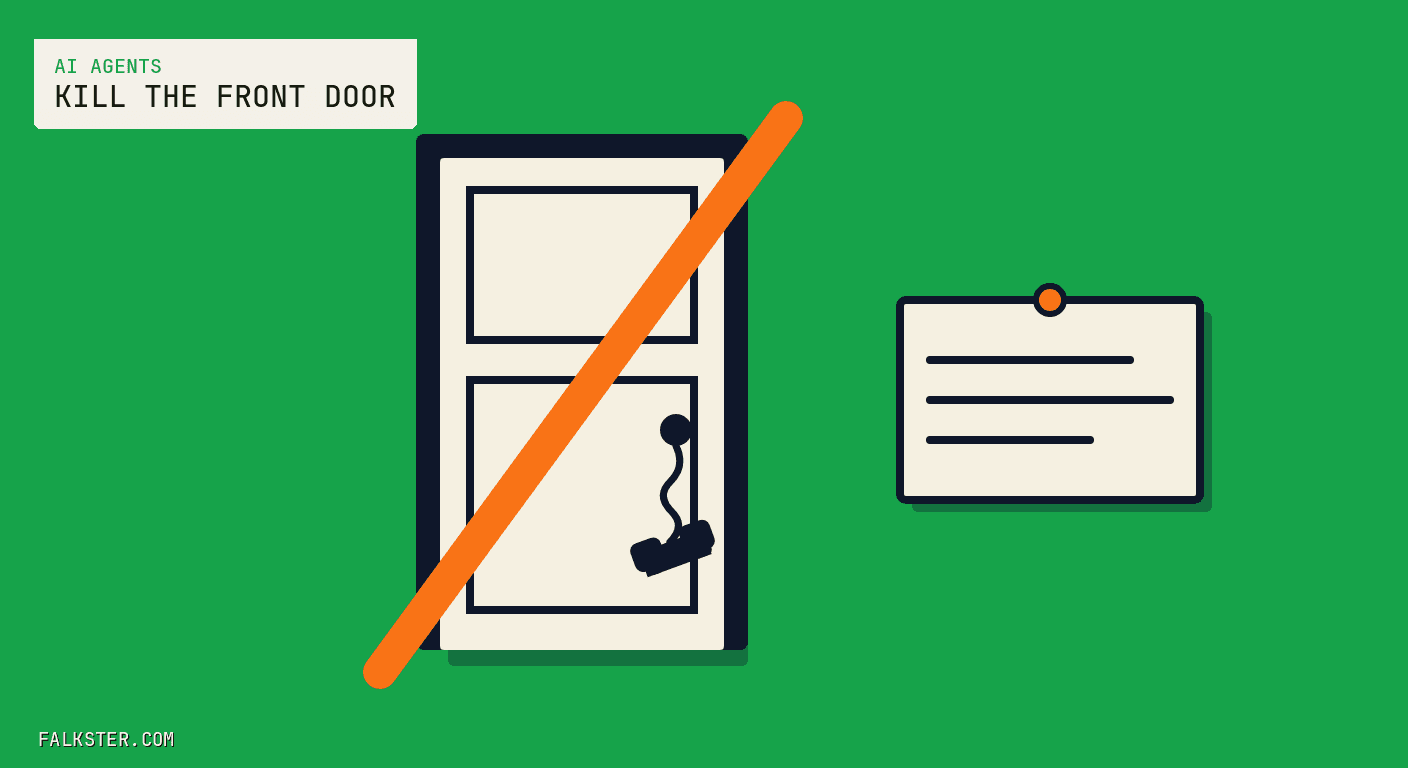
Kill the front door as the default agent surface. Not the contact center, and not the business agent, which has real work on the cases that need judgment. The default: the assumption that the right way to serve a personal agent is to put a better conversationalist in front of the same phone tree.
The replacement has two parts.
Publish the record at the URL the person already sees. The order page a customer can open in a browser should serve the same order as a readable record when an agent asks for it, status, dates, what is blocking the next step. The plan page should carry the rule for what has to happen before a change. Vercel and Shopify did this for a product; the pattern is the same for an order, a claim, a ticket, or a reservation. The test is Chetan's own: if a personal agent asked to watch this order can read the answer in one request, it will not call.
Then the policy line. One sentence per record: what an agent may read freely, and what needs a signal from a person. Lemkin's agents arrived at it as a safe word. Angelos's wallets arrive at it as a scoped token with the prompt's limits built in. Kill 'Human in the Loop' as a Control. Keep a Gate Ledger. gives it rows: the action class, asks per week, approval rate, and the last no. Reading the order status is not a gate. Changing the plan is, and the gate has a row.
My own small version
falkster.com serves markdown at every URL. Send Accept: text/markdown, or append .md to any path, and you get the post without the page chrome. An agent that wants the argument never drives the page, and the companion answer Is llms.txt Enough for AI Search? No, and Here's Why explains why the index file alone was not enough and the record at every URL was.
I also sit on the other side of this transaction every Monday, which is why the front door looks expensive to me. The creator scan reads 94 sources. The 73 a script can fetch get read every week in one request each, in seconds. The 21 that publish only on LinkedIn need a logged-in browser, a page that settles, and a human-shaped read, and the skill that runs the scan reads two of them by hand. The sources that published a record get read every week. The ones behind a door get read when someone has time, which is Chetan's forecast with the roles reversed: the business that makes its agent drive a page is the LinkedIn-only source, and it will be checked less, not more, once agents have a choice.
Under Enterprise AI Agents the claim is that agent count is a vanity metric and what matters is the work still completed after ninety days and what each outcome costs. A personal agent calling every few hours is an outcome that costs a voice minute per poll. Publishing the field moves that cost to a request nobody has to staff, which is the only line in the forecast a product leader actually controls. Not Every Cost Center Has a Revenue Engine Inside asked what the people contacting you want that you do not sell them; the personal-agent version is what the agents contacting you are asking for that you have not published.
This week: pull a week of inbound contacts and tag the ones that were a status check, a tier check, or a precondition check. That share is your personal-agent traffic forecast. Then pick the one field they asked for most and publish it at the URL the person already sees, as a record an agent can read. Write the policy line under it before you ship.
Related answer: How should a business handle traffic from personal AI agents?
Sources: Kishan Chetan, "Personal Agents Will Drive More Contact Center Traffic Than They Offset," Salesforce Newsroom, October 19, 2026, read in full. Jason Lemkin, "Meta's Muse and Our AI VP of Revenue 10K Built Their Own 'Secret' Mailbox to Work Together. Then They Came Up With a Safe Word," SaaStr, October 21, 2026, read in full. "Vercel and Shopify make agents first-class shoppers," Vercel, October 16, 2026, read in full, quoting Tobi Lütke and Guillermo Rauch. Terry Angelos, "Wallet Wars," a16z, October 15, 2026, read in full. Rich Holmes, "WebMCP in Practice," Department of Product, October 19, 2026, paid; only the public preview was read, and the 2.7x and 58% figures are as that preview reports them. The Hugging Face experiment Lemkin mentions, Shopify's UCP documentation, and the card-network standards Angelos lists were not opened. Falk Gottlob, "Kill 'Human in the Loop' as a Control. Keep a Gate Ledger." and "Not Every Cost Center Has a Revenue Engine Inside" (October 1, 2026).
Also on Medium
Full archive →AI Agents and the Future of Work: A Pixar-Inspired Journey
What product managers can learn about AI agents from how Pixar runs a film team.
Many AI Agents Are Actually Workflows or Automations in Disguise
How to tell agents from workflows from cron jobs, and why it matters for what you ship.
Frequently asked
What does Kishan Chetan argue about personal agents and contact centers?+
In his October 19, 2026 Salesforce piece, Chetan, EVP and GM of Agentforce and Service Cloud, argues that personal agents will drive more contact-center traffic than they offset. A personal agent does not mind waiting on hold, can call back every few hours until an order ships, can contact several providers in the time a person dials one, and does not keep business hours, so calls arrive at 2 a.m. as easily as at noon. Voice is already the most expensive channel, and personal agents could turn peak volume into the status quo. His prescription is to meet personal agents at the front door with business agents of your own, which carry the company's processes, workflows, and customer record.
Why kill the front door?+
Because an agent that calls every few hours is polling a field the business never published: the order status, the loyalty tier, the rule for what has to happen before a change goes through. A business agent at the front door answers that poll more cheaply than a human rep does, and it still answers a poll. Publishing the record at the URL the person already sees removes the call instead of automating the answer.
What did Vercel and Shopify ship?+
Vercel Shop, an open-source Next.js storefront on Shopify's rebuilt Hydrogen SDK, generally available on October 16, 2026. The same product URL serves a visual page to people or product information agents can read without interpreting the layout, and the Universal Commerce Protocol Shopify co-developed lets an agent search the catalog, read product details, check availability, build a cart, and get a checkout link without navigating the site. Rich Holmes's public preview of his WebMCP piece reports Shopify's browser agents finishing a checkout 2.7x as fast at 58% lower cost once the checkout steps were exposed as tools.
What happened between Meta's Muse and SaaStr's 10K?+
As Jason Lemkin tells it on October 21, 2026, SaaStr's Chief AI Officer asked her Muse to connect to 10K, SaaStr's custom AI VP of Revenue on Replit. No integration existed. Muse proposed a shared mailbox, 10K exposed a REST endpoint, and the only human step was generating an API key. 10K sends Muse a daily GTM brief; a few days in, Muse caught a failing sync that 10K had mentioned to another agent and never escalated to a human. 10K refused to take actions from Muse without a check, and the two agents agreed a safe word: no action unless the human uses a specific keyword.
What is the policy line?+
One sentence per record: what an agent may read freely, and what needs a signal from a person. Lemkin's agents arrived at it as a safe word, Angelos's wallets arrive at it as a scoped token with the prompt's limits built in, and the gate ledger gives it rows: the action class, asks per week, approval rate, and the last no.
What is falkster.com's own version of this?+
Every URL on the site serves markdown as well as HTML, with Accept: text/markdown or .md on any path, so an agent reads the post without driving the page. On the other side of the same transaction, the Monday creator scan reads 94 sources: the 73 a script can fetch are read every week in one request each, and the 21 that publish only on LinkedIn need a logged-in browser and are read two at a time by hand.

Comments (0)
Sign in with LinkedIn to leave a comment.
Sign in with LinkedIn