Salesforce announced Tottenham Hotspur's Agentforce rollout this morning. I read the release twice, once as someone who ran product at Salesforce and knows how these get written, and once as the CPO who'd get this slide in a vendor QBR. Both reads landed on the same sentence.
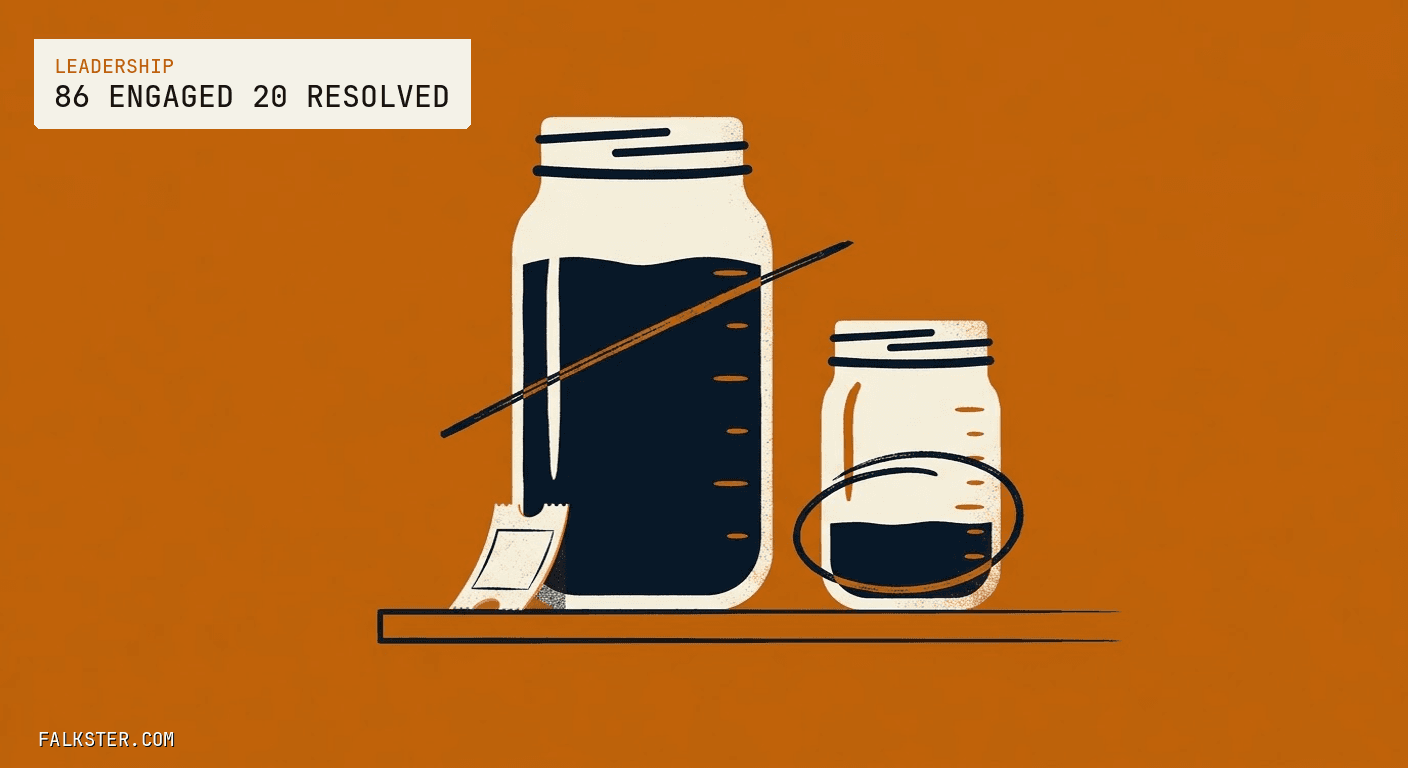
The headline number for Ask Spurs, the club's new fan agent, is an 86% engagement rate. Two paragraphs later: 20% of interactions resolved by Agentforce alone.
The short version
Salesforce's Tottenham Hotspur release leads with an 86% engagement rate for Ask Spurs and reports, lower down, that 20% of interactions are resolved by Agentforce alone, with the rest handed to a human. Nothing in the release defines engagement or resolved. Engagement is true of any chatbot a visitor cannot get past, so it carries no information about whether the agent works; by the release's own figures, four in five interactions were not resolved by the agent alone. The number to lead with is the resolution rate under a stated definition. Jason Lemkin's write-up of the Gorgias benchmark puts the top support agents at 64% to 75% resolved with a median of 48%, counting zero human touch; my own per-resolved pricing held for 98% of cases on a 48-hour definition and the other 2% became more than 200 contested cases a week. Kill the engagement rate as the headline on any agent launch. Lead with resolution, scored three ways, and print the hand-off count beside it.
What the release actually says
The part worth forwarding is the data work. Over two years the club replaced about 30 systems, connected more than 10, and unified over 4.6 million fan accounts into SpursID profiles through Data 360 and Snowflake Zero Copy. Ask Spurs sits on top of that, in eleven languages, on the website and the club app, answering ticketing, membership, retail, and stadium questions for members and guests. When it can't resolve something, it hands the conversation to a human on the support team.
Then the numbers. "Ask Spurs has an 86% engagement rate, with 20% of interactions resolved by Agentforce alone."
That's it. No definition of engagement. No definition of resolved. No hand-off count, though one is implied: if 20% are resolved alone and the rest go to a person, the support team is still taking four in five.
I'm not arguing with the club, or with the people quoted. Two years of systems consolidation is real work and the agent is a sensible thing to put on top of it. I'm arguing with which number got the headline.
Engagement is the number that can't be wrong
An engagement rate on a chat widget measures whether the widget opened and the person typed. For an agent placed in the support path of a site with millions of fans, that's close to a tautology. The fan had a question. The box was there. They engaged.
It tells you nothing about whether the question was answered, and it can't go down in any way that would embarrass anyone. That's exactly why it ends up at the top of the release, and exactly why it should be the first number a product leader strikes.
I wrote Rank AI Features by Downside Exposure, Not Engagement about the same instinct on the roadmap side. Engagement is the column that always looks fine. The column that matters is what happens when the agent is wrong, and a fan asking about a ticket refund in the wrong language is not a low-stakes wrong.
Amber Roberts at Databricks made the general version of the point this week, in an interview about why almost nobody can prove ROI on agents: a company claiming it's 40% more efficient has said something meaningful only if quality held steady. Her diagnosis of the gap is that the people buying AI and the people using it are different people. The engagement headline is written for the first group.
The definition is where the money is
The number I'd have led with is the 20%, and I'd have led with its definition.
One Support Agent, Three Resolution Rates is the long version. The short one: per Jason Lemkin's write-up, Gorgias tested 13 vendors on 212 live ecommerce stores and found the top five resolving 64% to 75% of conversations, with a median of 48%. That benchmark counts a resolution only with zero human touch and no push out of the channel. Gorgias's own customer reporting, Lemkin notes, counts one once 72 hours pass without a human agent helping, so a customer who gave up counts as resolved.
Same agent, two definitions, two very different rates.
I've lived the gap between them. When I priced a support agent per resolved ticket, the contract definition was 48 hours without the issue coming back. It held for 98% of cases. The other 2% turned into more than 200 contested cases a week, every one of them an argument about one word. The definition is where the money and the disputes live, and a release that prints a resolution rate without one has printed a number nobody can check.
Fan support is not ecommerce support, so the Gorgias median is a reference point rather than a verdict on Ask Spurs. Twenty percent resolved alone, in eleven languages, in front of a fan base of millions, with clean hand-offs, might be a perfectly good early number. The release doesn't make that case. It makes the 86% case.
I've also seen the inverse mistake. The IKEA Story Does Not Prove What You Think It Proves is about a containment rate that got read as a quality score. The fix is the same in both directions: say what the number counts.
The kill, and what replaces it
Kill the engagement rate as the headline on an agent launch. Inside the company, in the vendor deck, in the press release.
Lead with the resolution rate under a stated definition, and score it three ways, the way I'd score any agent before a renewal: zero human touch, the definition on the invoice, and no related follow-up within seven days. Three rates, not one. Print the hand-off count next to them, because the team on the other end of the hand-off is the cost line the engagement number hides.
Engagement can stay in the deck. It's a usage number and usage numbers have a place. It's just not the place at the top.
This belongs to the Product Leadership argument that the CPO's job in an agent rollout is to own the definition before anyone owns the number. Whoever defines resolved decides what the agent is worth.
This week: take the last agent metric a vendor or a team put in front of you and ask what it counts. If the answer is "the widget opened," ask for the resolution rate, ask how it's defined, and ask what happened to the rest.
Related answer: Should an AI agent launch lead with its engagement rate?
Sources: Salesforce News, "Tottenham Hotspur Launches Ask Spurs on Agentforce," press release, October 15, 2026, read in full. Databricks Blog, "Everyone's adopting AI agents. Almost no one can prove the ROI. Here's why," an interview with Amber Roberts, October 13, 2026, read in full. One Support Agent, Three Resolution Rates, falkster.com, for the Gorgias benchmark as Jason Lemkin reported it and for the 98% and 200-cases-a-week figures from my own per-resolved pricing.
Also on Medium
Full archive →AI Agents and the Future of Work: A Pixar-Inspired Journey
What product managers can learn about AI agents from how Pixar runs a film team.
Many AI Agents Are Actually Workflows or Automations in Disguise
How to tell agents from workflows from cron jobs, and why it matters for what you ship.
Frequently asked
What numbers did Salesforce report for Tottenham Hotspur's Ask Spurs agent?+
The October 15, 2026 release says Ask Spurs has an 86% engagement rate, with 20% of interactions resolved by Agentforce alone, and that unresolved conversations are handed to a human on the club's support team. It also reports about 30 systems replaced, more than 10 connected, and over 4.6 million fan accounts unified into SpursID profiles. The release does not define engagement rate or resolved.
Why is engagement rate the wrong headline for an AI agent launch?+
Because it is true of any chatbot a visitor cannot get past. If the widget opens and the person types, the interaction is engaged, whether or not anything was answered. The number that carries information is how many interactions the agent closed, under a definition the reader can check, and how many it handed to a person. In the Tottenham release that number is 20%, which by its own figures means four in five interactions were not resolved by the agent alone.
What resolution rate should a support agent be compared against?+
Per Jason Lemkin's write-up of the Gorgias benchmark, which tested 13 vendors on 212 live ecommerce stores, the top five resolved 64% to 75% of conversations with a median of 48%, counting a resolution only with zero human touch and no push out of the channel. A fan support agent is a different domain, so the comparison is a reference point, not a verdict. The point is that the benchmark states its definition and the release does not.
What happens when the definition of resolved is loose?+
The customer who gave up counts as resolved. Gorgias's own customer reporting, as Lemkin notes, counts a resolution once 72 hours pass without a human agent helping. When I priced per resolved ticket with a 48-hour definition, it held for 98% of cases and the other 2% became more than 200 contested cases a week. The definition is where the money and the disputes live.
What should an agent launch report instead of engagement?+
The resolution rate under a stated definition, scored three ways: zero human touch, the definition on the invoice, and no related follow-up within seven days. Next to it, the hand-off count, and the cost of a wrong answer for the kind of question the agent handles. Engagement can stay in the deck as a usage number. It should not be the headline.
Does a 20% resolution rate mean the agent is failing?+
Not on its own. Twenty percent resolved alone, with the rest handed cleanly to a person, could be a reasonable early number for a multilingual agent in front of a fan base of millions. The release never makes that case, which is the problem. It leads with the 86%, and the 86% is the number that cannot be wrong.

Comments (0)
Sign in with LinkedIn to leave a comment.
Sign in with LinkedIn