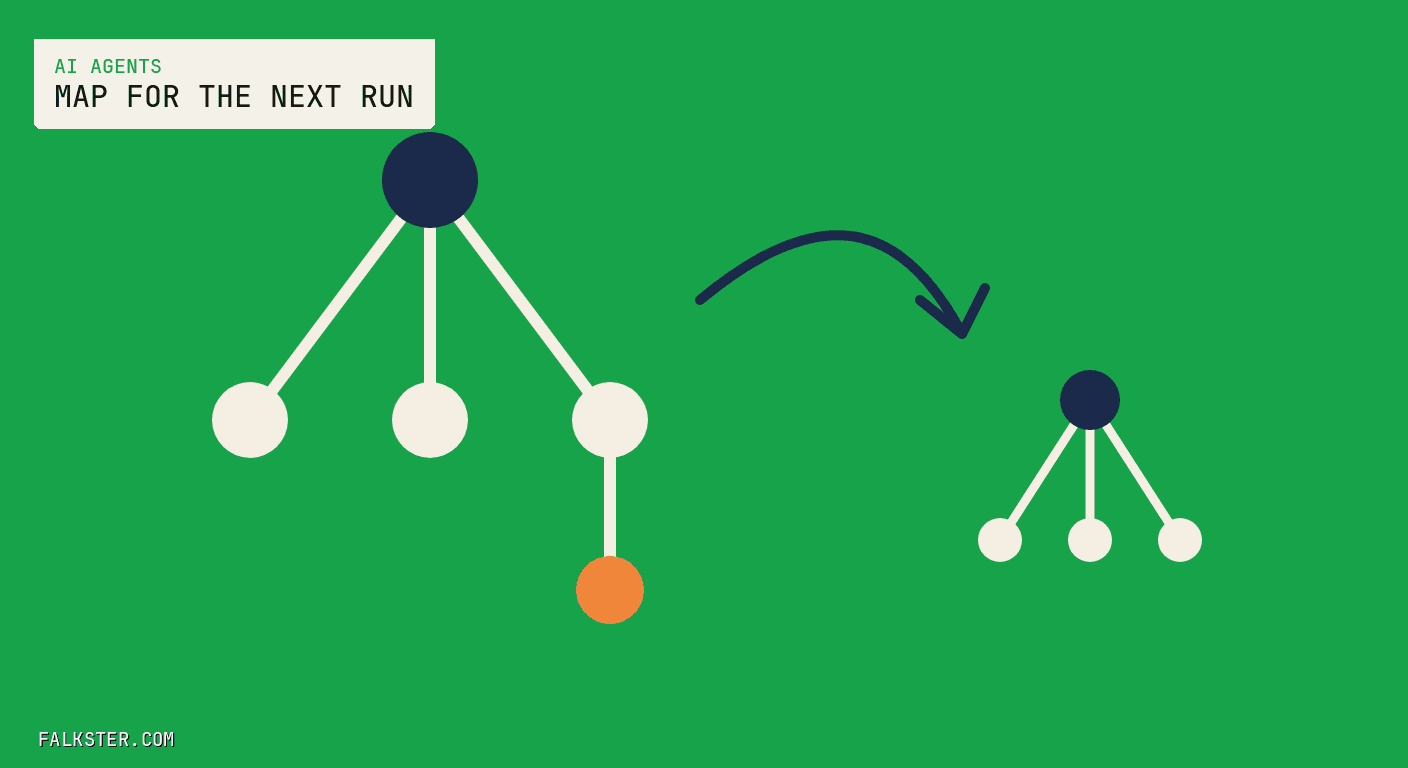
Three posts in two days put the oversight of long-running agents on the table, and all three design for the person who comes back. This is an Agent Drop: the run report written for the reader most fleets actually have, which is the next run.
The short version
Jakob Nielsen's November 6 roundup leads with two papers: Mittal and co-authors' MANDATE taxonomy (6,623 agent failures from Reddit in 23 categories; the biggest group, 29%, is agents that keep going after progress stopped; severity and noticeability correlated at minus 0.61) and Suh and co-authors' Atlas (a decision tree instead of a transcript; 14 researchers reviewing 84-minute runs saw transparency rise from 3.8 to 6.0 and workload fall from 12.0 to 8.8 with the same information). His five upgrades: mandate at the root, forks in the breadcrumbs, no agent grading its own homework, a stop rule per run, quiet failures made loud. Alex Wang's November 5 edition says stop conditions matter more than prompting, and Sydney Runkle and Thushanth Bengre at LangChain shipped async subagents the same day with an orchestrator that lists every unfinished task. In my audit of 39 scheduled agents, 13 had no human reader, so the map's first reader is the next run. The creator scan that feeds this blog has written 37 reports since September 19, each ending with the forks; on October 30 it left Sierra's ARR post on file and the November 2 run published from it with nobody in between. The template: the mandate line, the forks with dates, the evidence state per source, the stop rule used, and the quiet failures as a line, plus one rule, a fork three runs in a row expires into the mandate, and a grade that is a test the next run executes.
What landed this week
Nielsen opens his roundup with the line that agentic AI has resurrected batch processing: hand the agent a big job, come back hours later to results you did not watch being made. Two papers, as he reports them, cover what goes wrong while you are away and how to make sense of the run afterward.
Shravika Mittal and co-authors at Georgia Tech and Microsoft analyzed 163,487 Reddit posts about AI agents, extracted 6,623 accounts of failures, and sorted them into 23 categories in 7 groups, a taxonomy they call MANDATE. The largest group, 29% of reports, is termination and resources, led by agents that keep spinning after progress stops; one apologized 64 times and tried to stop itself 294 times. Over 18 months, adherence failures such as ignored instructions fell from 31% to 21% of reports while termination failures grew, which the authors read as agents getting better at obeying, so users delegated bigger jobs. Among 73 experienced users, the more severe a failure, the harder it was to notice, a correlation of minus 0.61; security circumvention scored 4.2 for severity and 2.2 for noticeability. Only half could recall a specific incident unaided, and all of them recognized the categories on sight.
Sangho Suh and co-authors at Ai2 and the University of Washington built Atlas, a workspace for reviewing completed runs as a trajectory tree: the goal at the root, a branch for every direction pursued, deferred, or ruled out, with reasons. Fourteen researchers each reviewed two runs averaging 84 minutes and 170 artifacts, one in Atlas and one in a chat panel. Decision transparency rose from a median of 3.8 to 6.0 on a 7-point scale, workload fell from 12.0 to 8.8 on NASA-TLX, and 8 of the 14 revisited abandoned branches when choosing the next step. In a field trial, one participant's chat summary implied an experiment had succeeded and the tree showed the agent never obtained the dataset. The transcript held the same information. Nobody could find it.
Nielsen's five upgrades from the two papers: make the mandate the root of the map; breadcrumbs must include the forks, every option rejected or deferred and why; do not let the agent grade its own homework, back every summary with evidence; give every run a stop rule, time limits with progress watchdogs and finite retry budgets; and flag the quiet failures, since the most severe are the least noticeable.
Two more on the same day. Alex Wang's November 5 edition of Learn AI Together, on Oracle's and NVIDIA's long-running agent stacks: "Designing authority, checkpoints and stop conditions may matter more than better prompting," with the evaluation questions did it finish, recover, escalate, know when to stop. And Sydney Runkle and Thushanth Bengre at LangChain shipped async subagents: an orchestrator that stays with the user while background workers run, five tools (start, check, update, cancel, list), every unfinished task listed in the orchestrator's system prompt. The subagent definition in the post carries an async flag and an update_strategy. No time limit, progress watchdog, or retry budget appears in it; the stop is the orchestrator calling cancel.
The reader the three posts assume
All three are written for a person who returns. Atlas measured how well 14 researchers understood a run. Nielsen's upgrades are the interface for that person. Wang's stop conditions are set by that person. LangChain's orchestrator reports to that person.
Here is my problem with the person. 70% of LangChain's Agent Runs Are Scheduled. Count the Ones Somebody Read. has the audit of my own fleet: of 39 appointed agents, 13 were orphans running clean output that nothing outside the fleet read. For those 13, and for a good share of the rest, the thing that read the run report was the next run. The Enterprise AI Agents thesis is that the number that matters for an agent is the one a person acts on, and in a scheduled fleet the first thing that acts on a run report is the run after it.
So the map's first reader is a run, and a map written for a run is a different artifact from one written for a researcher with 84 minutes.
The shipped example
The creator scan that feeds this blog is one of those agents. It reads the roster, writes a report, and the report ends with the forks. Thirty-seven reports since September 19. Twenty-one carry a "read and not used, on file for a later run" list with the reason each source was set aside. Twenty-nine record paywalls and partial reads, source by source. Three record sources that could not be opened at all.
Suh's finding that 8 of 14 researchers revisited abandoned branches has a version here with no researcher. On October 30 the report left Sierra's $400M ARR post unopened and on file, with the reason. The November 2 run read the file first, opened the post, and published from it. Nobody was in between. The road not taken was taken by the next run, because the previous one wrote it down where the next one looks.
The same reports carry the quiet failures as lines, not footnotes: a browser that answered with a sign-in wall, an image API out of credit, a feed that went silent. Agents Prompt People Now, Says Arca. Put the Default on Silence in the Ask. is the companion rule for the asks a run sends: owner, evidence, default on silence, expiry.
The drop
Five fields, in the order the next run reads them.
The mandate line. Which decision file the run read, and its date. The run that reads this knows whether it is working from the same mandate or a newer one, which is the one thing a transcript never says.
The forks. Every source or branch set aside, with the reason and the date. Not "see transcript." The reason is what lets the next run decide without re-reading.
The evidence state, per cited source. Read in full, public section only, not opened. This is the line that keeps an unread source out of a published post, and it is the field the Atlas field-trial case was missing: the summary said success, the evidence state would have said dataset not obtained.
The stop rule used. One attempt per browser step, no sign-in, which API was tried and what it answered. The next run inherits the budget instead of discovering it.
The quiet failures, as a line in the notes. Nielsen's point that the most severe failures are the least noticeable means the report has to promote them, and a footnote is where they go to be unnoticed.
One rule on top. A fork that appears three runs in a row expires into the mandate, either as a task the next run must do or as a written reason it was dropped. Without the rule the forks list only grows, and a list that only grows is the transcript with better formatting.
And the grade. Nielsen's upgrade is evidence links for a person to click. The fleet version is a check that runs before anything is published: on this site the no-invented-metrics spec and the authority check, which fail the commit on a number without a source or a post without its evidence. The design handbook's The Failure Inventory(coming Nov 25) is the same move for interfaces, write the worst plausible outputs first, and Scoring Your Own Work(coming Nov 18) is why the score has to be a rubric and not a feeling. The agent does not grade its own homework. A test does, and the human reads the report of a run that already passed.
This week, if you run scheduled agents: open the last report from any one of them and check whether it names the mandate it ran under, the forks it left, and what it did not read. If it has none of those, the next run is starting from the transcript, which is to say from nothing.
Related answer: What should a long-running agent's run report contain when nobody is watching?
Sources: Jakob Nielsen, "UX Roundup: Slow AI | Emphasis | Goals vs. Execution | Too Many Apps | AI Homework | Cookie Banners | Productivity | Elaboration Likelihood Model," UX Tigers, November 6, 2026, read in full; every figure from the MANDATE paper by Shravika Mittal and co-authors and the Atlas paper by Sangho Suh and co-authors is as Nielsen reports it, and neither paper was opened for this post. Alex Wang, "Long-Running Agents / AI Factories / Business Context: 5 Shifts Big Tech Keeps Betting On," Learn AI Together, November 5, 2026, read in full. Sydney Runkle and Thushanth Bengre, "Agents Are Going Async," LangChain, November 5, 2026, read in full. Falk Gottlob, "70% of LangChain's Agent Runs Are Scheduled. Count the Ones Somebody Read." (the 13 of 39) and "Agents Prompt People Now, Says Arca. Put the Default on Silence in the Ask.." The 37, 21, 29, and 3 are counts of the creator scan digests in this repository as of November 6, 2026, and the Sierra hand-off is recorded in the October 30 and November 2 digests.
Also on Medium
Full archive →AI Agents and the Future of Work: A Pixar-Inspired Journey
What product managers can learn about AI agents from how Pixar runs a film team.
Many AI Agents Are Actually Workflows or Automations in Disguise
How to tell agents from workflows from cron jobs, and why it matters for what you ship.
Frequently asked
What do the two papers in Nielsen's roundup report?+
As Jakob Nielsen reports them on November 6, 2026: Shravika Mittal and co-authors at Georgia Tech and Microsoft analyzed 163,487 Reddit posts, extracted 6,623 accounts of agent failures, and sorted them into 23 categories in 7 groups (MANDATE); termination and resource failures were the largest group at 29%, adherence failures fell from 31% to 21% of reports over 18 months, and among 73 experienced users severity and noticeability correlated at minus 0.61. Sangho Suh and co-authors at Ai2 and the University of Washington built Atlas, a trajectory tree for reviewing runs; 14 researchers reviewing runs averaging 84 minutes and 170 artifacts saw decision transparency rise from a median of 3.8 to 6.0 and NASA-TLX workload fall from 12.0 to 8.8 against a transcript with the same information. Neither paper was opened for this post.
What are Nielsen's five upgrades for slow AI?+
Make the mandate the root of the map; include the forks in the breadcrumbs, every option rejected or deferred and why; do not let the agent grade its own homework, back every summary with evidence; give every run a stop rule pairing time limits with progress watchdogs and finite retry budgets; and flag the quiet failures, since the most severe are the least noticeable.
Why write the run report for the next run instead of the person?+
Because in a fleet of scheduled agents the person is often not there. In the audit of 39 appointed agents on falkster.com, 13 were orphans whose output nothing outside the fleet read. The creator scan's 37 digests since September 19, 2026 are read first by the following run; on October 30 the digest left Sierra's ARR post unopened and on file, and the November 2 run took it from the file and published it, with no person in between.
What are the five fields of the template?+
The mandate line naming the decision file and its date; the forks with the reason and the date each was set aside; the evidence state per cited source, read in full, public section only, or not opened; the stop rule used, for example one attempt per browser step and no sign-in; and the quiet failures as a line in the notes rather than a footnote, such as a browser unavailable or an API out of credit.
What is the three-run rule?+
An item on the forks list three runs in a row expires into the mandate, either as a task the next run must do or as a written reason it was dropped. Without it the forks list only grows, and a list that only grows is the transcript Nielsen is arguing against.
How is the homework graded if no person reads the run?+
By a test the next run executes before anything is published: on falkster.com the no-invented-metrics spec and the authority check, which fail the commit on a number without a source or a post without its evidence links. Nielsen's evidence links are for a human to click; the version for a fleet is a check that runs.

Comments (0)
Sign in with LinkedIn to leave a comment.
Sign in with LinkedIn