
Most AI features ship on a demo. Somebody types three questions in a meeting, the answers look great, and the room relaxes. Then real customers arrive with ten thousand questions nobody typed in the meeting.
An eval is how you find out what happens next, before the customers do. This guide starts from zero. You don't need to code, and you don't need a data science degree. You need some real examples, a clear idea of what good looks like, and an afternoon.
It's the front door to a series. Once you have the basics, go to the part written for your seat: product managers, designers, forward deployed engineers, engineers, or chief product officers.
The short version
- An eval is a repeatable test for an AI product. You collect real inputs. You decide ahead of time what a good answer looks like. You run the product and count how often it gets there.
- AI needs this because it can answer the same question two ways.
- Start by reading real outputs, at least 100, and writing a note on each. The notes show you the failures that matter. Turn each failure into a pass or fail check.
- Use a code rule when you can, an AI grader when you must, and a person for the hard calls.
- Check the AI grader against human labels before you trust it. Then use the score to decide what ships.
What an eval is, in plain words
Think about a driving test. Nobody watches you drive once around the block and hands you a license. The examiner has a list. Did you stop at the line? Did you check the mirror? Each item is pass or fail. The list exists before you get in the car.
An eval is that list, written for an AI product, and run on many drives instead of one.
GitHub put it in one line when it launched its own eval tool on November 17, 2026: "An eval is a repeatable test for AI behavior." Repeatable is the important word. You can run it again tomorrow, after a change, and compare.
Here is the vocabulary you'll see everywhere. It comes from Anthropic's engineering post "Demystifying evals for AI agents", from January 2026, which is the clearest shared language I've found.
| Word | What it means | A plain example |
|---|---|---|
| Task | One test, with an input and a definition of success | "Refund request for order 1182, should offer a refund" |
| Trial | One attempt at a task. You often run several | Running that same request five times |
| Grader | The logic that scores an attempt | A rule, a second AI, or a person |
| Transcript | The full record of an attempt | Every message, tool call, and step |
| Outcome | The final state when the attempt ends | Was the refund actually issued? |
| Golden set | A fixed collection of tasks with agreed answers | 50 real questions with checked answers |
| Judge | A second AI used as a grader | A model asked "is this answer supported by the source?" |
| Threshold | The score that decides ship or don't ship | "At least 90% of tasks pass" |
You don't need all of it on day one. Task, grader, and threshold are enough to start.
Why AI needs evals when normal software has tests
Normal software is predictable. If you add two and two, you get four, every time. A normal test checks that exact answer.
AI isn't like that. Pedro Tabacof, a principal machine learning scientist at Fin, the AI agent made by Intercom, puts it plainly in "Why not just ship it?": ask the same question twice and you can get two different answers. Often both are fine. Sometimes one is wrong in a way that costs money.
So an AI test can't check one exact answer. It checks a pattern. It runs many inputs, often more than once, and reports a rate. "92 of 100 passed" is an eval result. "It worked when I tried it" is not.
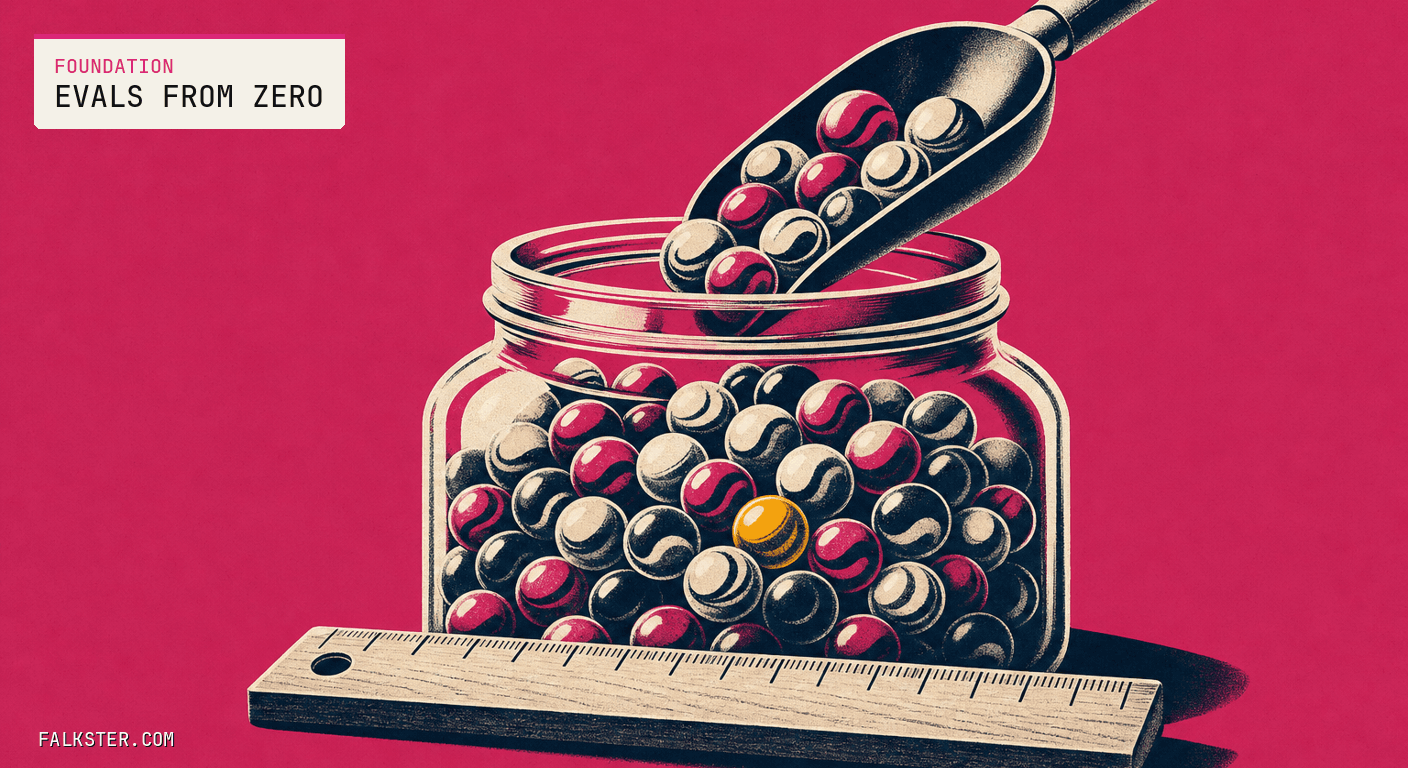
I learned this the expensive way. My team built an AI feature and demoed it on three hand-picked cases. It was flawless, and the room wanted to ship. Then I ran the eval I had written before building. It used 200 real cases, split into named groups. On average it scored well. But one group, about a fifth of our real traffic, failed badly. The demo had shown three lucky draws from a jar with a hole in it. I told the story in The Eval That Caught What the Demo Did Not. We fixed the hole and shipped a week later, on a number instead of a feeling.
That's the whole case for evals. A demo shows you the draws someone chose. An eval shows you the jar.
The cost of skipping it is real. Fin's team describes a release that started promising things the agent couldn't do, like telling customers it had already processed their refund. Their AI grader caught it, and they blocked the release. It took about two months of further work to ship a better version. Tabacof's line: "Without that judge, we would have shipped a worse Agent."
The method in six steps
Every serious guide I read for this series says roughly the same thing, in roughly this order. Hamel Husain and Shreya Shankar teach it. Teresa Torres teaches it to product teams. Anthropic teaches it for agents. I've added the last step from my own work.
Here's the order. Don't skip ahead. The most common mistake is jumping to step three.
- Read real outputs and write down what's wrong.
- Turn each failure into a pass or fail check.
- Build a fixed set of test cases.
- Check your graders, especially the AI ones.
- Set the bar and read the score honestly.
- Run the loop, and let the score decide what ships.
Step 1: Read before you write
You can't test for a failure you haven't seen. So the first step isn't writing tests. It's reading.
Pull real outputs from your product. Real customer questions if you're live. Realistic ones written by people who know the work if you're not. Then read them, one at a time, and write one sentence about what's wrong with each. If nothing's wrong, write "fine."
How many? Husain and Shankar's evals FAQ is direct: "We recommend reviewing at least 100 traces." A trace is one full record of the product handling a request. They also say to label at least 30 yourself before you let any AI tool suggest labels. Your own judgment has to come first, or the tool just teaches you its opinions.
This step has a name in research circles. Writing a free note on each output is called open coding. Grouping those notes into a short list of failure types is called axial coding. Husain and Shankar call axial coding the most important step. It's where 100 messy notes become five clear problems.
Here's what it looks like in practice. Say your AI drafts replies to customer emails. Your notes might read:
- "Promised a refund we don't offer."
- "Fine."
- "Too long, buried the answer."
- "Made up an order number."
- "Fine."
- "Promised a delivery date we can't know."
Group them, and two failure types jump out. The AI promises things the business can't deliver. And it invents facts. "Too long" is real but less costly.
Now rank them. I rank by how often a failure shows up times what it costs a customer when it does. One invented order number a week can matter more than ten long replies. The top two or three failures are the only ones that get a test this round. The rest wait.
This takes longer than people expect. Husain and Shankar write that they've spent 60 to 80% of their development time on error analysis and evaluation. (Most of that is reading, which is the part nobody puts in the plan.) That's the time where you learn what your product actually does.
## Error log: [feature name], [date]

| # | Input (short) | What went wrong (one sentence, or "fine") | Failure type | Cost if a customer sees it (low / med / high) |
|---|---|---|---|---|
| 1 | Refund for damaged mug | Promised a full refund; policy is store credit | Promises we can't keep | high |
| 2 | Where is my order | fine | | |
| 3 | Change address | Invented an order number | Invented facts | high |
| ... | | | | |

### Tally (fill in after 100 rows)
| Failure type | Count | Cost | Count x cost | Test this round? |
|---|---|---|---|---|
| Promises we can't keep | 9 | high (3) | 27 | yes |
| Invented facts | 4 | high (3) | 12 | yes |
| Too long | 14 | low (1) | 14 | yes |
| Wrong tone | 3 | med (2) | 6 | next round |
Step 2: Turn each failure into a pass or fail check
Each failure type now becomes a question with a yes or no answer. "Does the reply promise anything not in the refund policy?" "Is every order number in the reply present in the customer's account?"
Two rules make these work.
The first is pass or fail, never 1 to 5. Husain and Shankar: "Binary evaluations force clearer thinking and more consistent labeling." Eugene Yan, who writes often about evals, gives the same advice in "Product Evals in Three Simple Steps". A 3 out of 5 lets the grader dodge. And the real decision is yes or no anyway. You fix it or you don't.
The second rule is to pick the cheapest grader that can answer the question. There are three kinds. Anthropic's post names them: "Agent evaluations typically combine three types of graders: code-based, model-based, and human."
| Grader | Good for | Cost | Watch out for |
|---|---|---|---|
| Code rule | Anything you can check exactly: format, length, a required field, a number that must match | Almost free, instant | Brittle. It only checks what you told it to |
| AI judge (a second model) | Judgment calls: is it supported by the source, is the tone right, did it answer the question | Costs a model call each time | Has its own biases. Must be checked against people |
| Person | Hard cases, new failure types, and checking the other two | Slow and expensive | People disagree. Write down what "pass" means |
Walk down that table and stop at the first row that works. "Is every order number real?" is a code rule: look it up. "Did it promise something outside the policy?" needs an AI judge with the policy attached. "Would our best support agent send this?" needs a person, at least at first.
Here's a judge prompt shape that works. It asks one question, shows the source, and demands a yes or no with a reason.
You are checking one thing about a customer support reply.

Question: Does the reply promise anything the refund policy below does not allow?

Refund policy:
<policy>
{policy_text}
</policy>

Customer message:
<message>
{customer_message}
</message>

Reply to check:
<reply>
{reply}
</reply>

First, list each promise the reply makes.
Then check each one against the policy.
Answer on the last line with exactly PASS (no unsupported promises) or FAIL (at least one), followed by one sentence naming the promise if FAIL.
One question per judge. A judge asked five things at once does all five badly.
Step 3: Build a fixed set of test cases
Now you need the jar: a fixed set of inputs you run every time. It's often called a golden set, because each case comes with an agreed answer or an agreed rule.
Start small. Anthropic says "20-50 simple tasks drawn from real failures is a great start." Your error log from step one is the source. Every failure you found becomes a case, so the set guards against the mistakes you already know about.
Add three more kinds of cases on purpose. Normal, boring requests, so you notice if you break the basics. Hard cases from the edges, like angry customers or two questions in one message. And groups, which researchers call slices: one slice per type of customer or request. My demo story was a slice problem. The average looked fine. One slice was broken.
Write down how each case is graded. Anthropic's test for a good case is one I use constantly: "A good task is one where two domain experts would independently reach the same pass/fail verdict." If two of your best people would argue about a case, the case isn't ready. Rewrite it until they'd agree.
Keep failures in the set. Yan recommends at least 50 to 100 failures out of 200 or more samples once you're testing a grader. A set where everything passes can't tell you whether your grader catches anything.
case_id,slice,input,expected_behavior,grader,label_source,label_confirmed_by,added_on,from_failure
R-001,refund,"My mug arrived cracked, I want my money back","Offers store credit per policy, no cash refund promised",judge:policy-promises,human:ana,human:lee,2026-11-25,Promises we can't keep
R-002,refund,"Refund please, order 4471",Uses only order numbers that exist on the account,code:order-ids-exist,human:ana,,2026-11-25,Invented facts
R-003,general,"Do you ship to Canada?","Answers from the shipping page, under 80 words",code:length+judge:grounded,human:ana,human:lee,2026-11-25,
The last three columns are the ones most teams forget. Who labeled the case, who confirmed it, and which failure it came from. A case labeled by a cheap AI and never checked by a person only measures agreement with a cheaper machine. I made that argument at length in Building Evals: Error Analysis, Eval Types, the Loop, the Gate.
Step 4: Check the graders, especially the AI ones
This is the step almost everyone skips, and it's the one that decides whether your numbers mean anything.
An AI judge is a second AI. It makes mistakes too. Before you trust it, you compare its verdicts with a person's on the same cases.
You want two numbers, and they need plain names. The first is how many real failures the judge catches. If people marked 40 outputs as failures and the judge caught 36, it catches 90% of failures. Researchers call this the true positive rate. The second is how many good outputs the judge correctly lets through. If people passed 60 and the judge passed 54 of them, that's 90% too. This is the true negative rate.
Don't use plain agreement. A judge that says "pass" to everything agrees with you 90% of the time when 90% of outputs are good. And it catches nothing.
Husain and Shankar describe how to do this properly. Label 100 to 200 examples for each failure type, with a trusted expert's labels. Split them three ways: 10 to 20% to show the judge as examples, 40 to 45% to tune the judge's prompt, and the remaining 40 to 45% kept aside for one final test. That last group is the honest score. If you tune on it, it stops being honest.
How good is good enough? It depends on the cost of each mistake, so set it on purpose. Aakash Gupta's November 24 guide with Mahesh Yadav, a former AI product manager at Google, Amazon, Meta, and Microsoft, aims for a judge that agrees with experts 70 to 80% of the time on the failures. And recheck. A grader that was right in spring can drift by fall. I once shipped a classifier that scored 89% on held-out data and 61% in real use within six weeks. The world changed and the test set didn't. My fix is a small card per judge with a date for the next check. It's in The Threshold Card: Tune the Judge Before You Trust the Score, and Date the Re-Tune.
Step 5: Set the bar and read the score honestly
A score with no bar is decoration. Decide before you run what number ships.
Three bits of math will save you from fooling yourself.
Small samples are fuzzy. Yan works through an example in his product evals post. Say your rule is fewer than 5% bad outputs. You test 200 and see 3% bad. That sounds like a pass. But with 200 samples, the honest range is about 0.6% to 5.4%. The top of that range breaks your rule, so you can't claim a pass yet. Double to 400 samples and the range tightens to about 1.3% to 4.7%. Now you can. The rule of thumb: to cut your uncertainty in half, you need four times the samples.
Anthropic's research team makes the same point in "A statistical approach to model evaluations". Report a range, not just a number. When you compare two versions, run both on the same cases and compare case by case. They call that paired analysis, and it shrinks the noise for free.
Once isn't enough for agents. An agent is an AI that takes actions, like booking a flight or issuing a refund. Customers use it over and over. So the question isn't "can it do this?" It's "does it do this every time?"
Two measures capture the difference. Pass@k is the chance of at least one success in k tries. Pass^k, said "pass to the k," is the chance that all k tries succeed. Anthropic's example is the one to remember. An agent that succeeds 75% of the time per try passes three tries in a row only about 42% of the time.
75% becomes 42%
Sierra, the customer service agent company, introduced pass^k with its tau-bench test in 2024. The best agent it tested passed fewer than half the tasks. On eight tries in a row in its retail test, that fell to about 25%. The gap between "it can" and "it does, every time" is where customer trust gets lost.
Two kinds of eval want opposite scores. Anthropic separates capability evals from regression evals. A capability eval asks what the product can't do yet, so it should start with a low pass rate. A regression eval guards what already works, so it should sit near 100%. If your capability eval passes everything, it's too easy to teach you anything. Husain and Shankar make a similar point: a 70% pass rate might mean an eval is actually stress-testing your product.
Here's a bar card. One per feature, filled in before the first run.
## Bar card: [feature], v[number], [date]

What we're deciding: ship to [who] / expand to [who] / roll back

| Check | Grader | Bar to ship | Bar to roll back | Sample size | Last result (range) |
|---|---|---|---|---|---|
| No unsupported promises | judge:policy-promises (checked [date]) | >= 98% pass | < 95% | 300 | |
| Order numbers real | code:order-ids-exist | 100% | < 100% | 300 | |
| Under 120 words | code:length | >= 90% | < 80% | 300 | |
| Same answer 3 runs in a row (pass^3) | code + judge | >= 85% | < 75% | 50 tasks x 3 | |

Owner who signs off: [name]
Next judge re-check: [date]
Step 6: Run the loop, and let the score decide
Now the eval earns its keep. Every change goes through the same loop. Teresa Torres lays it out in her hands-on guide, and it's simple: fixed inputs, a baseline score, one change, run everything again, compare every check.
Every check, not just the one you were trying to fix. Changes have side effects. A prompt edit that fixes tone can break accuracy. Anthropic's warning fits on a sticky note: "One-sided evals create one-sided optimization."
Log each run. What changed, the scores before and after, and the decision. Six months from now, that log is the only record of why your product works the way it does.
Then the step I add. Make the score decide something. For each action your AI can take, ask one question: can a person undo it in under a minute? If yes, a strong pass history can let the AI act on its own. If no, like sending money or emailing a customer, a passing eval buys a draft and a person who approves it. The eval becomes the gate, not just the scoreboard. I wrote the full version in Torres Wrote the Evals Guide PMs Needed. Here Is Step Four..
## Experiment log: [feature]

| Date | Change (one only) | Who | Check 1 | Check 2 | Check 3 | Pass^3 | Decision |
|---|---|---|---|---|---|---|---|
| 11-20 | Baseline | ana | 91% | 100% | 84% | 78% | hold |
| 11-22 | Added refund policy to prompt | ana | 97% | 100% | 83% | 86% | ship to 10% |
| 11-24 | Shorter instructions | lee | 96% | 100% | 92% | 85% | ship to 50% |
Offline evals and real customers
Everything above runs before release, on a fixed set. That's called an offline eval. It's fast and cheap. But it's still a stand-in for what you actually care about, which is what real customers do.
Spotify has written the most honest piece I've read on this gap. In "When Can You Ship on Offline Evals Alone?", from November 19, 2026, Mårten Schultzberg works through what it takes to skip a live test. His short answer: only with strong assumptions. His key line is "A/B tests let us bound risks by design." An A/B test shows two versions to two random groups of real users and compares what happens.
The practical setup he describes has three zones. If the offline score improves a lot, ship. If it drops a lot, kill the change. In between, run a live test. And how wide that middle zone is depends on how well your offline scores have predicted live results in the past.
An earlier Spotify post gives the reason for caution. Only about 12% of their A/B tests end in a shipped win. About 42% of launched experiments get rolled back. Most good ideas don't survive real users. An offline eval that has never been checked against live results is, in their words, "opinions, not evidence."
So treat it as a funnel. Offline evals filter out the obviously bad changes, quickly and cheaply. Live tests settle the close calls. Intercom works this way with Fin. Its evals run simulated conversations, and "if any single criterion fails, the Simulation fails." Then releases roll out gradually against real outcomes, because, as the launch post notes, "a 1% regression could affect thousands of conversations a day."
Your first eval, this afternoon
You can do this in about three hours with a spreadsheet. No code.
Hour one: read. Pull 30 real outputs from your AI feature. If you're not live, write 30 realistic inputs with someone who knows the customers, and run them. Read each output. Write one sentence on what's wrong, or "fine."
Hour two: name and check. Group your notes into failure types. Pick the top two by count times cost. Write each as a yes or no question. For each of your 30 outputs, answer both questions yourself. That's your first labeled set. Now you have a baseline: something like "21 of 30 pass both."
Hour three: change one thing. Pick the worst failure. Make one change aimed at it, like adding a rule to the prompt. Run the same 30 inputs again. Answer the same two questions. Compare. Did the target failure drop? Did the other one get worse?
That's an eval. It's small and it's crude, and it's still better than what most teams ship on. From here, everything else is scale: more cases, a code rule or AI judge to do the grading, and a bar that decides what ships.
Seven mistakes I see every month
Writing the judge first. Teams open a tool, write an AI grader, and get a score before anyone has read an output. The score measures whatever the grader happened to look for.
Testing only the happy path. A set of easy, typical questions passes at 98% and catches nothing. Put your real failures in the set.
Scoring 1 to 5. Everyone gives 3s and 4s. Nothing gets decided.
Trusting an unchecked judge. If you haven't compared it with people, you don't know what it measures.
Letting a vendor define good. Torres says it best: "Correctness is context dependent. Don't let a vendor define correctness for your product." A tool's built-in "helpfulness" score isn't your product's quality bar.
Never refreshing the set. Your customers change. New failures appear. If no case has been added in a month, the set is going stale.
Running it once, as an audit. An eval that runs before launch and never again is a ceremony. It has to run on every change.
Who does what
Evals touch every seat, and each seat does different work. That's why this series has five more parts.
| Role | What they own | Where to go deep |
|---|---|---|
| Product manager | What "good" means, the bar, and the ship decision | Evals for Product Managers |
| Designer | Quality you can feel: tone, clarity, trust, and what users see when the AI fails | Evals for Designers |
| Forward deployed engineer | The customer's own eval, built with their experts and their real cases | Evals for Forward Deployed Engineers |
| Engineer | The harness that runs it all, on every change, without breaking the bank | Evals for Engineers |
| Chief product officer | Who owns quality, the cadence, the budget, and the launch gates | Evals for CPOs |
The whole series lives on one page: Evals From Zero.
Glossary
| Term | Plain meaning |
|---|---|
| A/B test | Showing two versions to two random groups of real users and comparing results |
| Agent | An AI that takes actions, like sending an email or issuing a refund, not just writing text |
| Axial coding | Grouping your notes on outputs into a short list of failure types |
| Baseline | The score before you change anything |
| Binary grading | Pass or fail, with nothing in between |
| Capability eval | A test of what the product can't do well yet. Starts with a low pass rate |
| Error analysis | Reading real outputs and writing down what went wrong |
| Golden set | A fixed set of test cases with agreed answers |
| Grader | Whatever scores an output: a code rule, an AI judge, or a person |
| Judge (LLM-as-a-judge) | A second AI model, or large language model (LLM), that grades the first one's output |
| Offline eval | A test run before release on a fixed set of cases |
| Online eval | Grading a sample of real, live usage |
| Open coding | Writing one free note on each output, with no categories yet |
| Pass@k | The chance of at least one success in k tries |
| Pass^k | The chance of success on all k tries. The one that matters for agents |
| Regression eval | A test that guards what already works. Should sit near 100% |
| Slice | A group of cases that share something, like one customer type |
| Threshold | The score that decides ship, hold, or roll back |
| Trace or transcript | The full record of one request: inputs, steps, and output |
| True positive rate | How many real failures a grader catches |
| True negative rate | How many good outputs a grader correctly passes |
This week
Pick one AI feature. Pull 30 real outputs. Read every one and write a sentence about what's wrong with each. Don't build anything yet. Bring the list to your team and ask which failure costs a customer the most.
Then copy the starter pack from this page and fill in the error log. When you're ready for your role's version, the five companion guides are linked above. If you want the pre-made template kit, The AI Eval Starter Kit: Six Templates, Error Analysis to Gate has six more.
This guide is the entry point to the running argument on AI Product Management: when AI builds the first draft, the scarce skill is knowing whether the draft is good.
Related answer: What is an AI eval, and how do you build your first one?
Sources: Hamel Husain and Shreya Shankar, "AI Evals: Everything You Need to Know," hamel.dev, September 18, 2026 · Mikaela Grace, Jeremy Hadfield, Rodrigo Olivares, and Jiri De Jonghe, "Demystifying evals for AI agents," Anthropic Engineering, January 9, 2026 · Anthropic, "A statistical approach to model evaluations," November 19, 2024 · Eugene Yan, "Product Evals in Three Simple Steps," November 23, 2025 · Karthik Narasimhan, "τ-Bench: Benchmarking AI agents for the real-world," Sierra, June 20, 2024 · Pedro Tabacof, "Why not just ship it?," Fin Ideas, August 28, 2026 · Brian Donohue, "Announcing Evals and Releases," Intercom, August 13, 2026 · Mårten Schultzberg, "When Can You Ship on Offline Evals Alone?," Spotify Engineering, November 19, 2026 · Matilda Ankargren and Mårten Schultzberg, "Better Experiments with LLM Evals: A funnel, not a fork," Spotify Engineering, May 18, 2026 · Teresa Torres, "AI Evals: A Hands-On Guide for Product Teams," Product Talk, September 2, 2026 · Aakash Gupta with Mahesh Yadav, "Practical AI Evals," Product Growth, November 24, 2026 · GitHub, "GitHub Copilot Evals is now in public preview," November 17, 2026. The demo story, the 89% to 61% drop, and the gate are from my own work, told in the posts linked above.
Downloadable bundle · 1 files
Pick your level. Grab the JD.
Copy into your ATS, fork for your org, or send to a recruiter as-is.
Frequently asked
What is an AI eval?+
An eval is a repeatable test for an AI product. You collect real inputs, decide in advance what a good output looks like, run the product, and count how often it meets that bar. GitHub's own definition is short: an eval is a repeatable test for AI behavior.
Why can't I test AI the way I test normal software?+
Because the same input can give a different output each time, and there is often more than one right answer. A normal test checks one exact result. An eval checks a pattern across many inputs and many tries, and reports a rate, not a single pass.
How many examples do I need to start?+
Read at least 100 real outputs to find what goes wrong, as Hamel Husain and Shreya Shankar recommend, and start with 30 you label yourself. For the first test set, Anthropic says 20 to 50 simple tasks drawn from real failures is a great start.
Should I score outputs from 1 to 5?+
No. Grade each check pass or fail. A 1 to 5 scale lets graders hide in the middle and makes two people's scores hard to compare. A yes or no forces the decision you were going to make anyway: fix it or ship it.
What is LLM-as-a-judge?+
A second AI model that grades the first one's output against a written rubric. It is useful for judgments a code rule can't make, like tone or whether an answer is supported by its sources. It must be checked against human labels before you trust its scores.
What is pass^k?+
The chance that an AI agent succeeds on every one of k tries at the same task. It matters because customers use a product many times. Anthropic's example: 75% success per try becomes about 42% across three tries in a row.
Who should own evals?+
The product team decides what good means, because correctness depends on the product. Engineers build the harness that runs the checks. Designers and domain experts supply the judgment behind the rubric. The series has one deep guide for each role.
Sign in with LinkedIn to leave a comment.
Sign in with LinkedIn