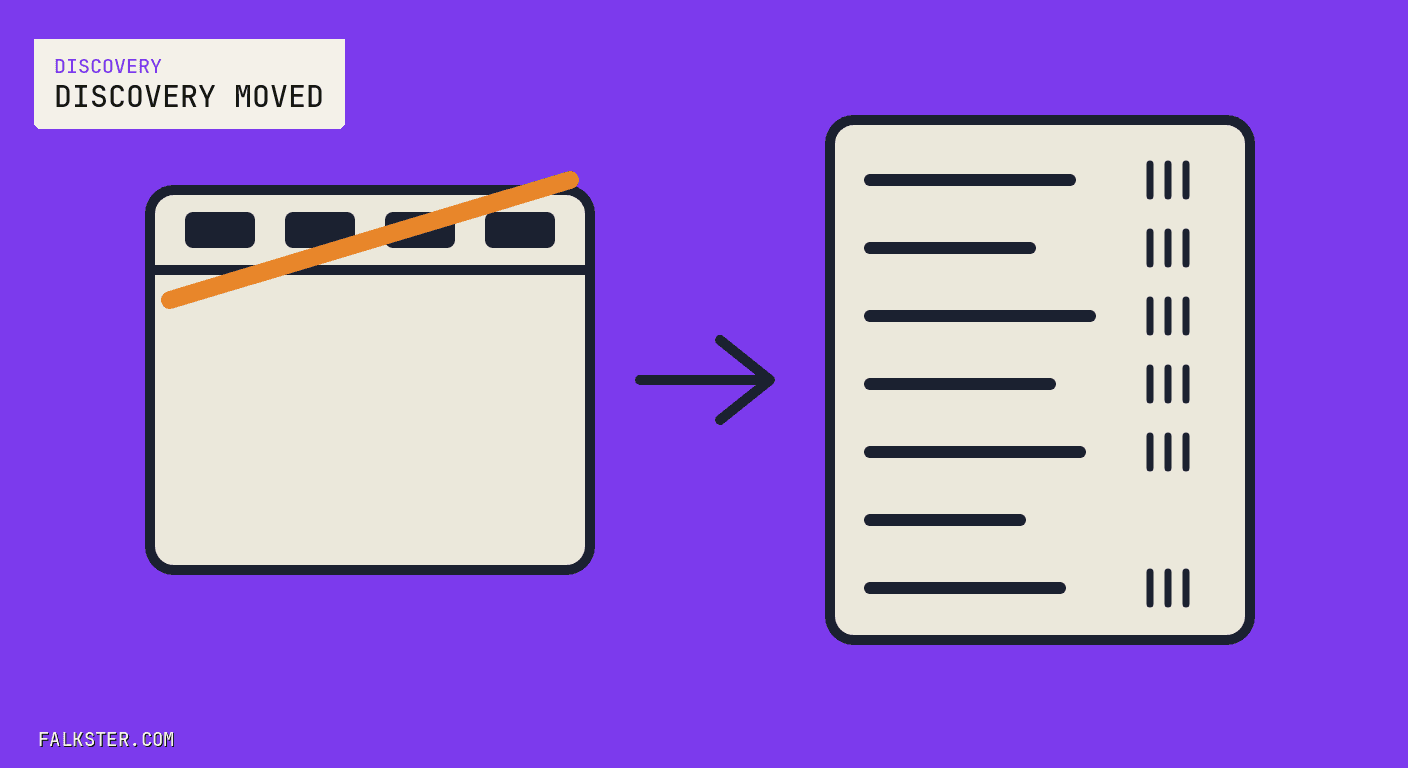
Elena Verna wrote the obituary for feature discovery this week, and Paweł Huryn published the room it moved into on the same day. This is a Rewrite.
The short version
Elena Verna's November 5 post says feature discovery, the losing battle of maybe 0.1% adoption for anything outside a product's core, becomes largely unnecessary when the customer says what they want to accomplish and the AI figures out which capabilities to invoke; the operator of the software changed, engagement may fall while value rises, and AI is not another feature, AI is the product. Her own aside gives the shape away: at Lovable she barely thinks about adoption, except when the agent does not know about some feature and she makes a scene in a Slack channel to get it fixed. Paweł Huryn's harness post the same day has the room that scene lives in: the model only talks, the harness is the hands, each tool has a short manual the model reads, about 8,200 tokens sit in the window before anyone types with two thirds of it the web search tool's manual, and the words the agent reads are part of the product. Feature discovery did not end. It moved from the user into the harness as the tool list and the skill set, the adoption curve came with it, and now it has a token bill. The Rewrite: adoption's unit is the tool call, the dashboard is fires per capability and acted-on per fire, the capability with no fires in a month comes out of the manual, and engagement falling while value rises is why the price moves to the outcome, where my migration reached 91% outcome revenue.
Verna's case
The argument is a good one, and she has the record to make it, having spent a career on onboarding journeys, navigation, lifecycle campaigns, and nudges. Later-stage product teams exist to expand product-market fit, which means more features, and nobody uses them, maybe 0.1% of the base. The tension is structural: more capability means more complexity, and the less motivated users you are trying to reach are the ones least willing to learn it. The fixes, in her telling: put the feature in the core flow until the core flow is a cockpit, reorganize the navigation, hide features to make room for features, unship some, personalize, which turns out to be very hard and needs whole teams called Product, Lifecycle Marketing, and Growth.
Then the turn. The customer tells the product what they want to accomplish and the AI figures out which capabilities to invoke. The user gets value from functionality they do not know exists. This is not a prompt box replacing buttons; it is a change in who operates the software, and as agents reach products through APIs and MCPs you may not open the underlying software at all. So the premise of feature discovery falls apart. The new problems are trust, transparency, reversibility, and use case discovery, since a minimal prompt box removes the cues a menu used to give. Engagement metrics may go down while value goes up. And the closing claim: AI is not another feature, AI is the product, so companies that add a sparkle icon to an existing product have built one more feature their growth team will spend six months pushing.
The sentence I keep coming back to is the aside about her own work. At Lovable she barely thinks about adoption. She does occasionally get outraged about the agent not knowing about some feature, and makes a scene in a Slack channel to get it fixed.
The room it moved into
That scene is a zero-adoption ticket. The feature exists, the operator does not use it, someone escalates. The only thing that changed is who the operator is and who filed the ticket. The user who filed it is the one person at the company who reads the agent's manual.
Huryn's post the same day is the manual. The public section of his harness build, the part before the paywall, says it plainly: the model is a capable colleague who can only talk, and the harness is the hands, the notebook, and the safety rules. Five local tools, read, write, edit, bash, find, each a short manual the model reads and a function the harness runs, plus web search. He measured his harness's starting context at about 8,200 tokens before anyone types, and two thirds of it is the web search tool's manual. His line for product managers: the words the agent reads are part of the product, think of it as a user experience for the agents.
That is navigation. A tool list with a manual per tool is a menu with a tooltip per item, read by a model instead of a person, and paid for in tokens on every call instead of in pixels. The capability the agent "does not know about" is the capability whose manual line is missing, buried, or worded so the model never matches it to the task. Same curve, new operator, with a bill.
Ben Hylak's line, as Simon Willison quoted it on October 29, is the joke version: every product he uses should be a headless MCP feeding into an agent, except his own, where customers love the UI. Three posts in one week moved the human out of the navigation. The exception is where every team will argue it belongs.
The number I already have
43 Skills, 39 Auto-Activate. Kill the Skill Count. Keep the Four You Type. has the shape from my side. Huryn's October 29 skills post shipped 43 skills with 39 auto-activating. Figma's PM OS, per Claire Vo's show notes, is 31 skills used by 60 to 70 PMs. And in my own agent-maintained context library, 30 of 51 commits since March 30 have no author I can attribute, which means 30 standing instructions to my agents that nobody typed a trigger for and nobody counted. The metric I replaced the skill count with was a fire count and an acted-on count per skill, with auto-activation off until the count earned it.
That is the feature adoption dashboard, one layer down. Fires per skill is feature usage. Acted-on per fire is whether the usage produced anything. The 0.1% feature is now the tool the model never calls.
And the fleet has the same number at the agent level. 70% of LangChain's Agent Runs Are Scheduled. Count the Ones Somebody Read. found 13 of my 39 appointed agents were orphans, running clean output that nothing outside the fleet read. Adoption did not disappear when the operator became software. It became harder to see, because the operator does not complain.
The Rewrite
Verna's line is that the AI figures out which capabilities to invoke. Here is the version I would ship.
Adoption's unit is the tool call, not the click. Every capability the product exposes to the agent gets counted the way a feature used to be counted, and the manual line is the feature's placement in the navigation.
The dashboard is fires per capability and acted-on per fire. Zero fires is the old 0.1%, with a cause you can read: the line is missing, buried, or worded wrong. Fires without acted-on is the old "clicked and left."
A capability with no fires in a month comes out of the manual. That is the part the human era never had. Huryn's 8,200 tokens are paid on every call, and the dead feature in the menu used to cost nothing to leave there. Now it costs on every turn, and the cache rule he describes, never edit what was already sent, means the manual is the one part of the context you cannot trim mid-session.
And engagement falling while value rising is not a dashboard problem to be entertained by. It is the reason the price moves to the outcome. A product the user barely touches because the agent did the work cannot be priced on logins. SaaS to AI Business Models is the thesis, and the migration I ran is the number: outcome revenue reached 91% by month 22, after we killed the per-seat tier and priced the work. Verna's entertaining growth dashboards are the per-seat dashboard losing its unit, and the AI Product Management thesis is the job that replaces it: deciding which capabilities the agent should have in its manual at all.
The operator changed. The operator has an adoption curve too, and this one reads the manual.
This week, if your product has an agent in front of it: pull the tool list the agent sees, count fires per tool for the last thirty days, and find the zeros. Each one is a feature with 0% adoption that is also costing tokens on every call. Decide which it is, a missing manual line or a dead feature, and fix the line or pull it.
Related answer: Is feature discovery over when an AI agent picks the capabilities?
Sources: Elena Verna, "The end of feature discovery as we know it.," Elena's Growth Scoop, November 5, 2026, read in full; her 0.1%, the 47 kinds of nudge, and the Lovable aside are as she wrote them. Paweł Huryn, "Agent Harness: How I Built My Own Claude Code, Step by Step," The Product Compass, November 5, 2026, public section read in full; the paid section was not read and nothing from it is claimed; the 8,200 tokens, the five tools, and the quoted line are as he published them. Simon Willison, "A quote from Ben Hylak," October 29, 2026. Falk Gottlob, "43 Skills, 39 Auto-Activate. Kill the Skill Count. Keep the Four You Type." and "70% of LangChain's Agent Runs Are Scheduled. Count the Ones Somebody Read.."
Frequently asked
What does Elena Verna argue in 'The end of feature discovery as we know it'?+
That feature discovery and adoption have been a losing battle for decades, with maybe 0.1% of a user base adopting anything outside a product's core, and that AI makes the problem largely unnecessary rather than easier: customers say what they want to accomplish and the AI figures out which capabilities to invoke. She argues the operator of the software changed from the human to the AI, that engagement metrics may fall while customer value rises, that use case discovery remains a problem because a prompt box removes the cues a menu gave, and that bolting AI on as one more feature recreates the discovery problem, because AI is not another feature, AI is the product.
Why has feature discovery moved into the harness rather than ended?+
Because the agent chooses capabilities from a tool list and a skill set, each described by a manual the model reads, and that list is the new navigation. Paweł Huryn's November 5, 2026 harness post measures about 8,200 tokens in the context window before anyone types, two thirds of it the web search tool's manual, and says the words the agent reads are part of the product. Verna's own aside, that she makes a scene in Slack when Lovable's agent does not know about a feature, is a zero-adoption ticket filed by the one user who reads the manual. The curve moved; it did not flatten.
What replaces the feature adoption dashboard?+
Fires per capability and acted-on per fire. I replaced the skill count with that pair after finding 30 of 51 commits in my own agent-maintained library had no author I could attribute, against Huryn's 43 skills with 39 auto-activating and Figma's 31-skill PM OS. A capability with no fires in a month comes out of the manual, because every line of the manual costs tokens on every call.
How does engagement falling while value rises change the business model?+
It is the reason pricing moves to the outcome. A product the user barely touches because the agent did the work cannot be priced on logins or seats; it gets priced on what was resolved. In the per-seat sunset I ran, outcome revenue reached 91% by month 22. Verna's entertaining growth dashboards are the per-seat dashboard losing its unit.
Is Ben Hylak's headless MCP line serious?+
It is a joke with a point. As Simon Willison quoted it on October 29, 2026, every product he uses should be a headless MCP feeding into an agent, except his own, where customers love the UI. Three posts in one week moved the human out of the navigation, and the exception is where every product team will argue it belongs.

Comments (0)
Sign in with LinkedIn to leave a comment.
Sign in with LinkedIn