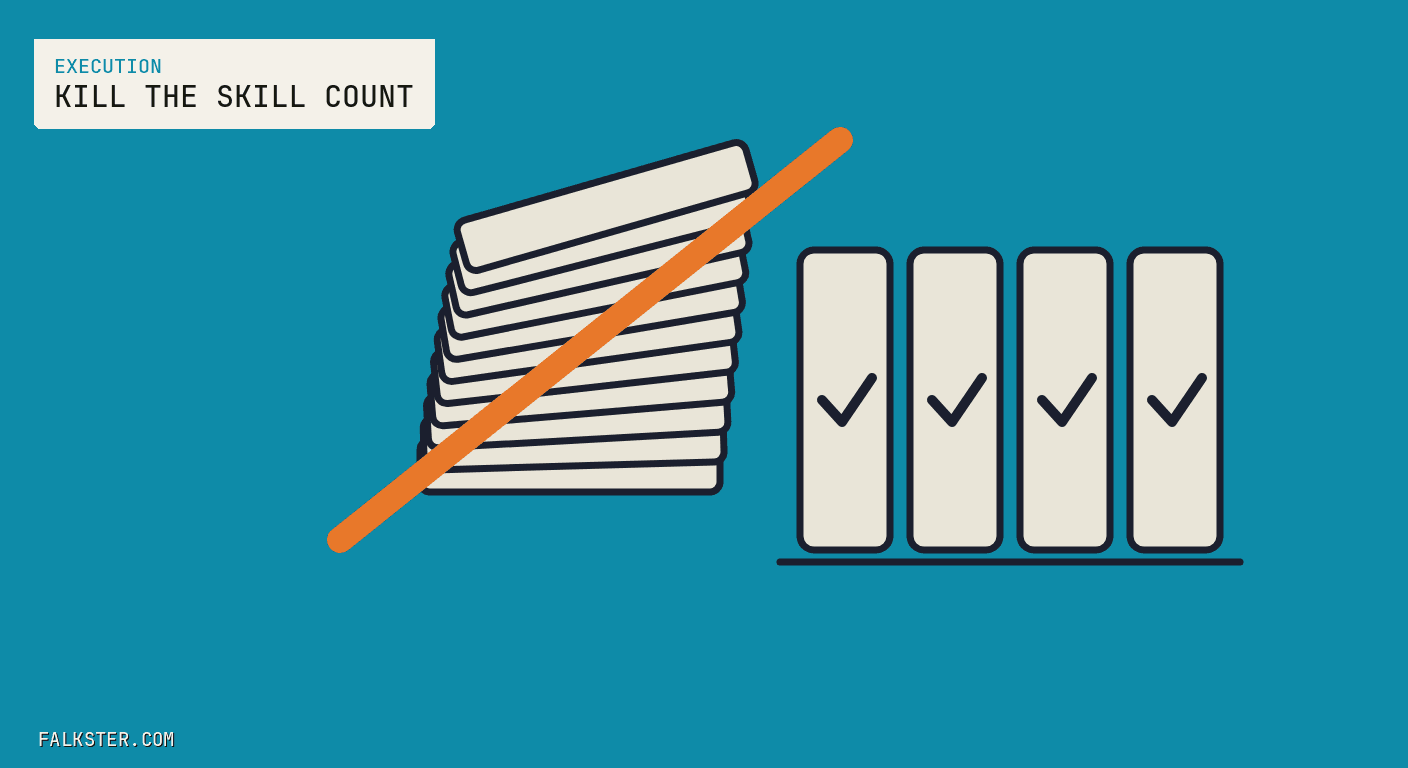
Two PM skill packs landed in one week, and both led with the number of skills. This is a Kill List entry for that number, with the counts from my own repo that say why.
The short version
Paweł Huryn's October 29 post ships 43 MIT-licensed skills for people who build with Claude Code, Codex, or Cursor without reading the code, and the convenience line is that 39 of the 43 auto-activate while you start only four by hand: start-here, ship-check, handover, and retro. Four days later the show notes of Claire Vo's How I AI episode with Ezra Mechaber describe Figma's PM OS, a 31-skill repo used by 60 to 70 PMs, with skills built, roasted, and whittled down. In my own agent-maintained context library, 30 of 51 commits since March 30 have no author I can attribute, and Dan McAteer's supervisor mod spoke on 99 of his 111 turns before he started skimming it. An auto-activating skill is a standing instruction nobody typed the trigger for and nobody counted. Kill the skill count as the headline. Replace it with a fire count and an acted-on count per skill, auto off by default until the count earns it, and keep the four you type, because those are the gates and "silence is not go" is the product.
What landed this week
Huryn's pack is the more complete document, so most of what follows is about it. The collection lives at phuryn/product-engineering on GitHub, 43 skills, most learned building his own products, for people who want to research the market, listen to users, pick a value proposition, decide how to grow, and learn from real usage without living in the code. The process it drives: say what you have, let agents research and propose, plan if the change is complex, build with one session coordinating, another building, and a different session reviewing every change, click through the flows yourself, run a release review, then release on evidence you approve. His line under that last step: "Silence is not go."
And the activation model, which the post presents as the convenience: "Most of them auto-activate: 39 of the 43. You start only four: start-here, ship-check, handover and retro."
Mechaber's episode I have only through Claire Vo's show notes, so that is all I will claim. PM OS started as his personal Claude Code setup and became a shared repo of 31 skills that 60 to 70 PMs at Figma use, with hooks and private sub-repos. The skills were built, roasted, and whittled down. There is a bug-bash agent, a chief-of-staff setup, and AutoXP, an agent that runs growth experiments with one human checkpoint.
Two packs, two counts. 43 and 31. The number on the README is the number both are known by.
The counts from my own repo
I ran the count the packs do not run, in Who Writes Your Agent's Rules? I Counted the Commits. My library is one CLAUDE.md and ten skill and agent files, 2,322 lines, in git. Fifty-one commits touching them since March 30. At least 21 carry an agent co-author line. The other 30 I cannot attribute: some I typed, some an agent typed without the trailer, and the count is what showed me I could not split them. Twenty-three lines carry my name and a date. Those are the rules I trust, because a person said them and the date says when.
The lesson there was not that agents should stop maintaining the library. It was that agent-maintained is fine and unread is the problem. Thirty commits with no author is what an auto-activating skill pack looks like from the inside after six months.
Then the number from The Mod Fired on 99 of 111 Turns. Off by Default Is the Design.. Dan McAteer built a supervisor mod for Claude Code that fired on 99 of his 111 turns since October 15, and he started skimming past it. Anthropic ships six built-in mods, and the only one that watches the agent on the user's behalf, You Should Know, is the only one off by default. It saved him from discarding 45 files of work. It still ships off.
That post ends with three lines for anything that spends a person's attention on an agent's behalf: off by default, a budget, and a count from day one of turns the person acted on against turns it spoke. A skill that auto-activates is exactly that kind of thing. It spends the agent's context and the person's trust without anyone typing the trigger.
Thirty-nine standing instructions
Put the two together and the convenience line reads differently.
Thirty-nine skills that activate on their own are thirty-nine standing instructions nobody typed. On the session that shipped the bug, nobody will be able to say which of the 39 fired and which did not, because the pack does not count. The file my agents read first has 28 standing decisions in it, each with a name and a date, and Agents Idle 80% Waiting on Humans. Put the Date on the Decision. is the story of why every one of them was stamped by hand.
The four Huryn makes you type are the other kind. Start-here is where you say what you have. Ship-check is before a release. Handover is the gap between sessions. Retro is after. Each is a place a person decides, and each shows up in the log as a thing somebody started. His release rule only works there: "silence is not go" needs a gate you can see was reached. That line is the product. The other 39 are plumbing, and plumbing you cannot inspect is the kind that floods the basement.
Figma's "whittled down" is the same instinct from the other direction. Somebody at Figma looked at a longer list and cut it. The show notes do not say by what number, and that is the number to ask for.
The replacement
Kill the skill count on the README as the headline, and anything downstream of it: "we standardized on 31," "the pack covers the whole lifecycle," "most of them just work."
Per skill, two columns from day one. Fires: the sessions in which the skill activated. Acted-on: the sessions in which a person did something because it did, kept a change, answered a question it raised, stopped a release. The same two columns I keep for a mod, and the ratio is the only evidence a skill has earned its place.
Auto off by default. A skill earns auto-activation when its acted-on count justifies the fires, and loses it when the ratio drifts toward McAteer's 99 to a handful. Until then it is typed, which costs the builder a slash command and buys a log entry with a name on it.
Keep the four you type, typed. They are the gates, and a gate you cannot see trip is not a gate.
Under AI Product Management the claim is that AI collapsed the cost of the parts PMs were trained to be good at and left the parts nobody trained for. Starting the work, checking the release, handing over, and looking back are the parts nobody trained for, and they are the four Huryn kept by hand. The 39 are the parts that got cheap.
This week: open your skill repo, pick the five skills you believe fire most, and find the session where each last fired and what changed because of it. If you cannot find the session, you have the first row of the count.
Related answer: How many skills should a PM skill pack auto-activate?
Sources: Paweł Huryn, "Product Engineering: 43 Free Skills From the First Idea to Paying Users. MIT.," The Product Compass, October 29, 2026, read in full. Claire Vo, "How Figma's PMs actually use AI every day | Ezra Mechaber (PM, Figma)," How I AI on Lenny's Newsletter, November 2, 2026, show notes only; the episode was not watched and nothing past the notes is claimed. Dan McAteer, "Claude Mods: Flipping the Harness Inside Out," Latent Space, October 21, 2026, as cited in the mod post below; the 99 of 111 and the six built-in mods are as he reports them. Falk Gottlob, "Who Writes Your Agent's Rules? I Counted the Commits" (October 10, 2026), "The Mod Fired on 99 of 111 Turns. Off by Default Is the Design." (October 21, 2026), and "Agents Idle 80% Waiting on Humans. Put the Date on the Decision." (October 19, 2026).
Frequently asked
What did Paweł Huryn publish?+
On October 29, 2026, phuryn/product-engineering on GitHub: 43 MIT-licensed skills for PMs, founders, and designers who build with Claude Code, Codex, or Cursor without reading the code, covering market research, listening to users, value proposition, growth, and learning from real users. Per the post, 39 of the 43 auto-activate and you start only four by hand: start-here, ship-check, handover, and retro. The build step has one session coordinate, another build, and a different session review every change, and the release step ends with 'Silence is not go.'
What is Figma's PM OS?+
Per Claire Vo's show notes on her November 2, 2026 How I AI episode with Ezra Mechaber, a growth PM at Figma: a shared repo of 31 skills, grown from his personal Claude Code setup, that 60 to 70 PMs at Figma use, with hooks and private sub-repos, and skills that were built, roasted, and whittled down. The notes also describe AutoXP, an agent that runs growth experiments with one human checkpoint. I cite the show notes only; the episode itself is not claimed here.
Why is the skill count the wrong headline?+
Because an auto-activating skill is a standing instruction nobody typed the trigger for and nobody counted. In my own agent-maintained context library, in git, 30 of 51 commits since March 30 have no author I can attribute, and only 23 lines carry a name and a date. Dan McAteer's supervisor mod spoke on 99 of his 111 turns and he started skimming it. The count that tells you a skill earned its place is how often it fired and how often a person acted on what it did, and a README count of 43 or 31 contains neither.
What replaces it?+
Two columns per skill, fires and acted-on, kept from day one, the same two columns I keep for any mod or agent that spends a person's attention. Auto-activation off by default, and a skill earns auto when its acted-on count justifies the fires. The skills you start by hand stay typed, because those are the gates, and a gate you cannot see trip is not a gate.
Which four skills should stay typed?+
Huryn's four: start-here, ship-check, handover, and retro. They are the start of a piece of work, the check before a release, the handover, and the review after. Each one is a place a person decides, and his release rule, silence is not go, only works if the gate was typed and you can see it in the log.

Comments (0)
Sign in with LinkedIn to leave a comment.
Sign in with LinkedIn