Dan McAteer published a post this morning that I would hand to anyone designing a surface where an agent talks to a person. It is the most honest account of the problem I have read, because he published his own number, and the number argues with his conclusion.
The post is about Claude Mods, the plugin system that lets a user change how Claude Code behaves and what it shows at runtime. McAteer's frame for it is bigger than the feature. As models absorb more of the agent harness into their weights, he argues, the part that is left faces the human. He calls that part the Attention Interface: the layer that decides when the agent interrupts you, what it shows you, and which decisions it needs you to make. Mods let the user and the agent build that layer together, in code.
He then compares three systems, ChatGPT's Intelligent UI, Cursor's PR Routing and Approval, and Claude Mods, and lands on what he thinks separates them: who gets to design the attention interface. The lab, the team, or you. Mods win because you do.
I think the axis is wrong, and his own post is the evidence.
The short version
Dan McAteer's "Claude Mods: Flipping the Harness Inside Out" (Latent Space, October 21, 2026) argues that the human-facing part of the agent harness, which he calls the Attention Interface, is now the layer that matters, and that Claude Mods win over ChatGPT's Intelligent UI and Cursor's PR routing because the user designs the interface in code. His evidence points at a different variable. Anthropic ships six built-in mods and the only one that watches the agent on the user's behalf, You Should Know, is the only one off by default. His own Next Steps Supervisor fired on 99 of his 111 turns since October 15, and he started skimming past it. Who writes the interface is not the design decision. The default and the budget are. The fleet I run reached the same place: 39 agents audited in April, 13 firing in one morning window with nobody planning it, 13 orphans nothing read, 44 agents today with 15 still in that window. Before a mod or an agent speaks, three lines: off by default, a budget per session, and a count of turns the person acted on against turns it spoke.
What he built and what he counted
Two mods carry the post. The first is Anthropic's. You Should Know runs a side agent that watches the main agent and raises a note above the prompt when it sees something you are likely to miss. His example is a real one: Claude had simplified some UI copy, rebuilt, and taken before-and-after screenshots, and everything looked done. You Should Know flagged that the file being edited, and about 45 others, already carried uncommitted work, so discarding the demo edits later would have discarded that too. Useful, and the kind of thing that is invisible in a trace.
The second is his. Next Steps Supervisor runs after any turn that edited files, ran commands, or made eight or more tool calls, and offers next steps as clickable buttons. It is part of ModSmith, an open-source plugin he built.
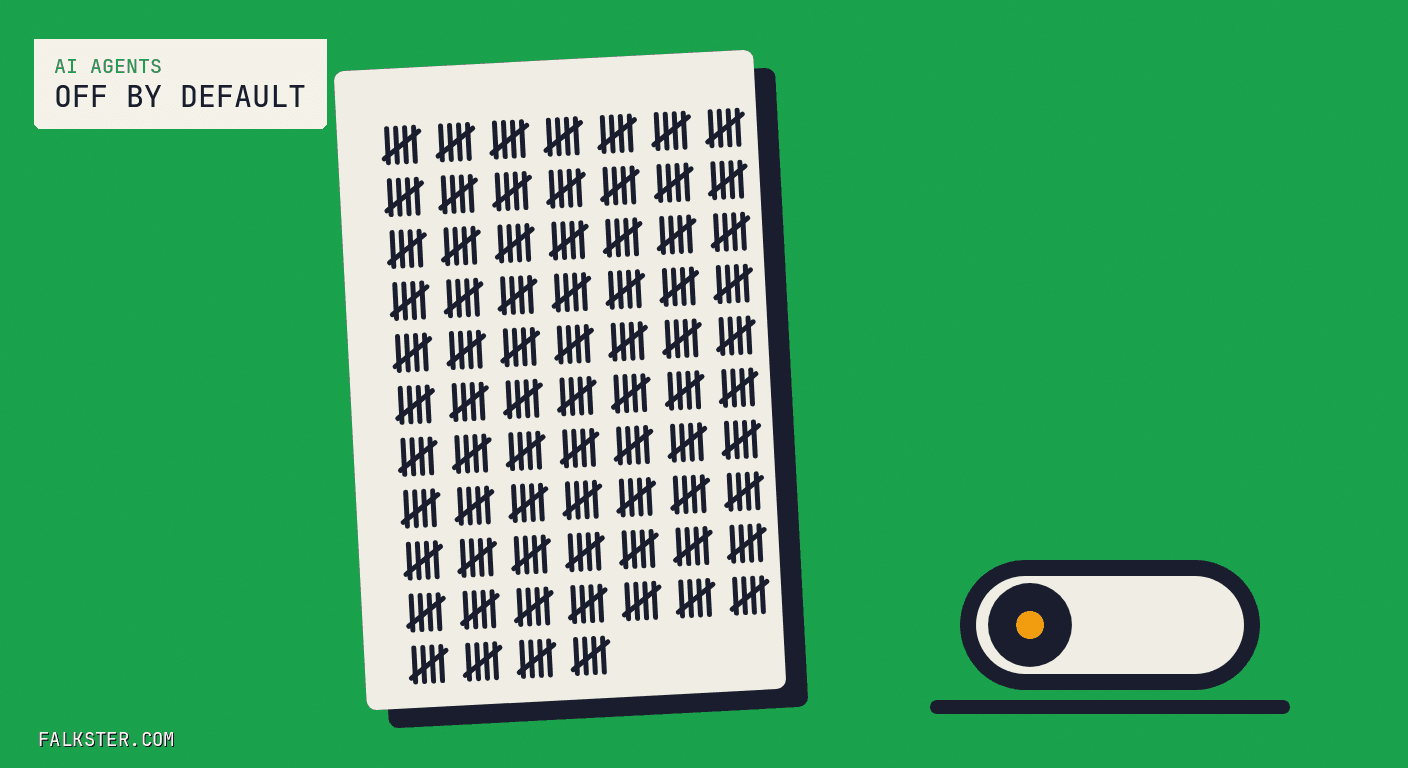
Then the paragraph most people writing about their own tool would have cut. Since he installed the supervisor on October 15, 99 of his 111 turns met the bar, and it spoke on all of them. Some verdicts were useful. Others were noise. When a mod speaks on almost every turn, he writes, he starts skimming past it, which defeats the point of an attention interface. Each check also costs, by the mod's own README, about 5,000 to 6,000 input-equivalent tokens on a 50,000-token session, more when the cache has expired. And a mod runs with the user's permissions, unsandboxed, which is Anthropic's own wording as he quotes it.
He gives himself a test for whether a mod earned its place: did it surface something I would have missed, make a decision easier, or let me act without more output to read. If not, window-dressing.
That is the right test. It is also not a test of who wrote the code.
The variable his evidence points at
Look at the two mods side by side. Anthropic built one, McAteer built one. Anthropic shipped theirs off. He shipped his on, with a trigger condition that in practice is nearly every turn.
Six built-in mods exist, and five of them work in the background without asking for anything: loading AGENTS.md, drawing the diff pane, teaching Claude to write mods, guarding what an organization manages, sending telemetry. The one that spends the user's attention is the one Anthropic made the user opt into. That is a design decision about a default, made by the people who presumably have the most data on how often a side agent has something worth saying.
McAteer's comparison table gives ChatGPT's Intelligent UI one control at launch, turning the visuals down, and treats that as a weakness. Cursor's PR routing lets the team set a risk threshold and reads approval policy from the base branch so an agent cannot relax review on its own pull request, and he treats the fixed workflow as a limitation. Both of those are budget controls. A threshold is a budget. A visuals-down setting is a budget. Programmability gave McAteer the power to set his supervisor's budget anywhere he liked, and the first setting he picked spent 99 of 111 turns.
So the difference that decides whether an attention interface works is not who designs it. It is what the default is, and how much of a person's attention a single piece may draw before someone counts. McAteer agrees in practice: his fix for a noisy session is /supervisor off. Off is the control that worked.
The fleet version of the same number
I have been on the other side of this with agents rather than mods, and the shape is identical.
44 Appointed Agents, One Attention Budget: Three Lines on the Charter started from Jakob Nielsen's point that the interruption budget belongs to the user and every appointed agent draws on the same account. In April I audited the 39 agents I had appointed by then. Thirteen fired between 7 and 9 a.m. local time, and nobody had designed that. Each one was built with some version of "tell me the most important thing from yesterday," and each drifted to the hour the answer is useful. Thirteen of 39 were orphans: zero references from anything outside the fleet, no page, no ritual, no other agent reading them. Several had run reliably for over a month producing clean output that nothing consumed.
The fleet is 44 today, and 15 of the 44 still name a 7, 8, or 9 a.m. time. Six months later, each agent is still right on its own, and the window still chooses itself.
Every one of those agents was designed carefully. I wrote the charters. The combined burden was designed by nobody, and I found it in an audit, not in my mornings. McAteer's supervisor is one agent with the same property: designed carefully, by the person who would bear the cost, and the cost still arrived at 99 of 111 before he noticed.
The design handbook has the rule for this already. Disclosure Without Overwhelm argues that how much to show is the wrong question, and that the real decision is which disclosure level is the default for which reader in which moment. It also carries the test that separates a useful disclosure from decoration: whether it changes what a reasonable reader would do next. McAteer's three-part test is that test, written from inside one engineer's terminal. The chapter adds the part his post is missing. The default is a design decision, and showing everything makes the user responsible for checking work they never asked to supervise.
Three lines before it speaks
For a mod, an appointed agent, a side agent, a suggestion strip, anything that spends a person's attention on an agent's behalf:
- Off by default. The reader opts in. Anthropic did this with the one mod that watches the agent for you, and it is the correct call even when the mod is good. You Should Know saved McAteer from discarding 45 files of work and it still ships off.
- A budget line. How many times per session, or per day, the piece may interrupt. Not a precision target, since a mod can raise its precision by saying less. A share of the person's attention, decided before the trigger condition is written. "After any turn with eight or more tool calls" is a trigger. It is not a budget.
- A count, from day one. Two columns: turns where the person acted on what the piece said, and turns where it spoke. McAteer published the second column. Nobody publishes the first, and it is the one that says whether the piece earned its place. In my fleet the equivalent was counting what read each agent's output. The orphans had zero. The agents that mattered had three or more references from outside the fleet.
The Stop Rule is the same discipline pointed at a single loop: attempts, spend, and the name it escalates to, written before the loop runs. This is the version for the loop's voice.
Where this sits
McAteer ends with the right next step, and I would sharpen it. He wants the harness to read his session transcripts, find where he keeps correcting the agent or checking the same thing by hand, and propose a mod. Yes, and the same reader should propose retirements: the mod that spoke 99 times and was acted on twice gets flagged before the person has to notice they are skimming.
Under Enterprise AI Agents the argument is that agent count is a vanity metric and the number that matters is how many agents still do production work after ninety days. For attention interfaces the vanity metric is how many turns the thing spoke on. The number that matters is how many of those changed what the person did next.
This week: for every surface in your product where an agent talks to a person without being asked, write down its default, its budget, and whether anyone counts acted-on against spoken. If the default is on and nobody counts, you have shipped a supervisor that fires on 99 of 111 turns, and your users are skimming.
Related answer: When should an AI agent interrupt you?
Sources: Dan McAteer, "Claude Mods: Flipping the Harness Inside Out," Latent Space, October 21, 2026, read in full; the figures on his supervisor (99 of 111 turns since October 15, the token estimate from the mod's README), the six built-in mods, and the descriptions of ChatGPT's Intelligent UI and Cursor's PR Routing and Approval are his, and I did not open OpenAI's or Cursor's documentation. Jakob Nielsen, "3 AI Interaction Styles: Turn-Taking, Task Agents, Always-On," UX Tigers, October 14, 2026, for the interruption budget. Falk Gottlob, "44 Appointed Agents, One Attention Budget: Three Lines on the Charter" (October 14, 2026) and "39 PM AI Agents Deployed: What Stuck, What Died, and Why" (April 27, 2026), for the fleet counts; the count of 44 agents and 15 morning slots is from the fleet's schedule fields on October 14, 2026. "Disclosure Without Overwhelm," The Design Operating Model.
Also on Medium
Full archive →AI Agents and the Future of Work: A Pixar-Inspired Journey
What product managers can learn about AI agents from how Pixar runs a film team.
Many AI Agents Are Actually Workflows or Automations in Disguise
How to tell agents from workflows from cron jobs, and why it matters for what you ship.
Frequently asked
What are Claude Mods?+
As Dan McAteer describes them in his October 21, 2026 Latent Space post, a mod is a Claude Code plugin made of TypeScript or JavaScript functions that run inside Claude Code and respond to events such as a prompt, a tool call, or an interface render. A mod can observe the event, change how it is rendered, or handle it in place of the default behavior. Anthropic ships six built in (agents-md, diff, plugin-authoring, sec-default, telemetry, and you-should-know), and Claude can build new ones from a plain-language description.
What is the Attention Interface?+
McAteer's name for the part of the agent harness that faces the human: the layer that decides when the agent interrupts you, what it shows you, and which decisions it needs you to make. His argument is that as models absorb more of the harness, this layer is what remains, and Claude Mods are an early, user-programmable version of it.
How often did McAteer's Next Steps Supervisor mod fire?+
It runs after any turn that edited files, ran commands, or made eight or more tool calls. He reports that since installing it on October 15, 2026, 99 of his 111 turns in Claude Code met that bar, and that he started skimming past its output, which he says defeats the point of an attention interface. The mod's own README estimates about 5,000 to 6,000 input-equivalent tokens per check on a 50,000-token session.
Which built-in Claude Code mod is off by default?+
You Should Know, per McAteer's post. It runs a side agent that watches the main agent and flags things the user is likely to miss, for example that the file being edited and about 45 others already had uncommitted work. It is the only one of the six built-in mods that is off until the user turns it on, and the one McAteer chose to turn on.
What is the fleet-side version of the same number?+
In April 2026 I audited 39 appointed agents. Thirteen fired between 7 and 9 a.m. without anyone planning it, and 13 were orphans that nothing outside the fleet read. The fleet is 44 today and 15 still name a 7, 8, or 9 a.m. time. Each agent was designed on its own, and the combined burden was designed by nobody, which is the same shape as a mod that speaks on 99 of 111 turns.
What should be decided before an agent-facing surface is allowed to speak?+
Three lines. The default, which should be off until the reader opts in, the way Anthropic shipped You Should Know. A budget line, how many times per session the surface may interrupt, drawn from the person's attention rather than the mod's. And a count kept from day one: turns where the person acted on what it said against turns where it spoke. The disclosure test from the design handbook is the tie-breaker: it earns its place if it changes what a reasonable reader does next.

Comments (0)
Sign in with LinkedIn to leave a comment.
Sign in with LinkedIn