Elena Verna's post this morning is the one piece on AI pricing I would hand a CFO, and not for the tour of pricing pages. It is for the last paragraph before the sign-off, where she says what everyone running a credit-based AI company says in private. She would love to tie Lovable's pricing to outcomes. "But ideally, we'd still be in business by the time you get there (and right now we wouldn't)."
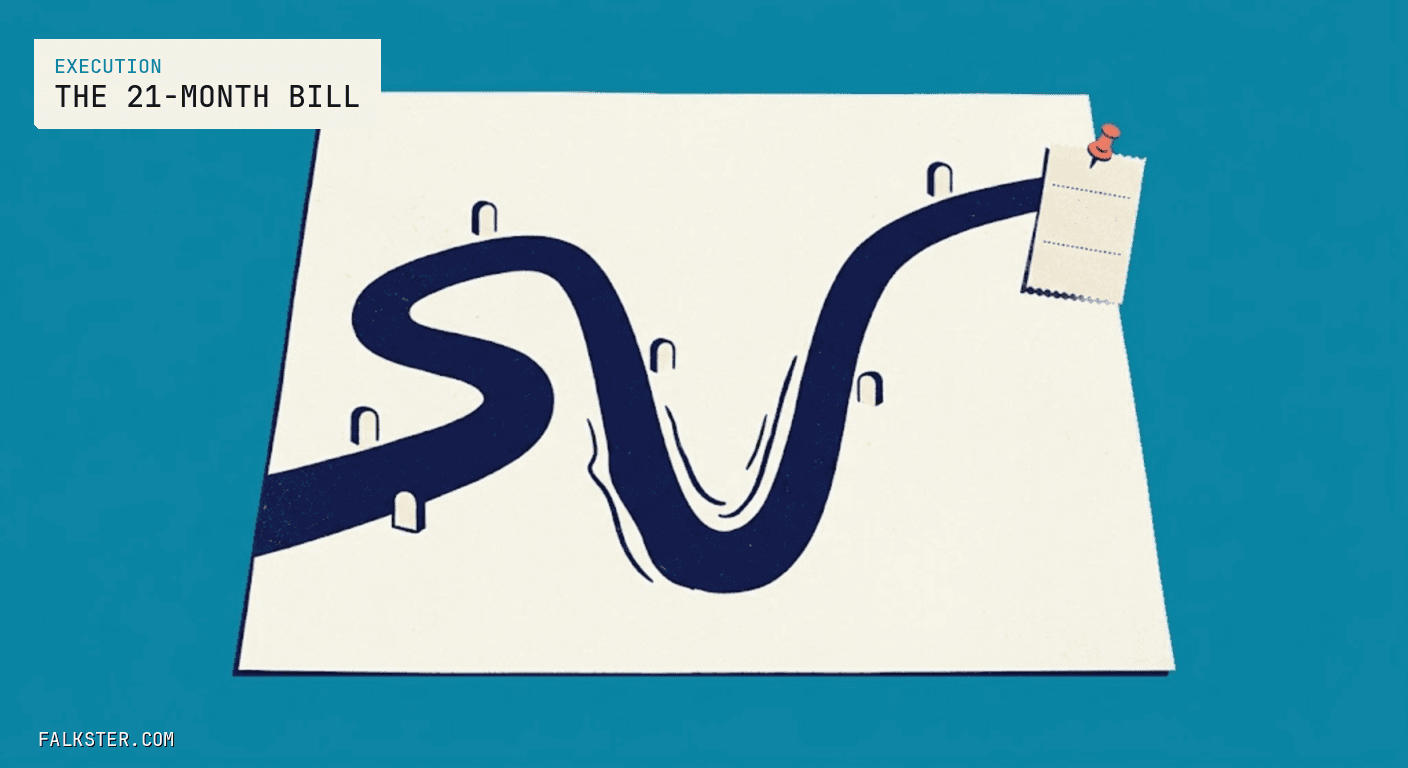
I ran that road once. The bill is public. It has months on it.
The short version
Elena Verna, who leads growth at Lovable, says AI pricing has a problem she cannot solve either: credits are arcade money, nobody knows the unit, and vendors cannot predict their own inference cost, so outcome pricing stays a theory because Lovable would not survive the road to it. I have the road's bill from a $40M ARR SaaS that moved from per-seat to hybrid outcome pricing. Twenty-one months from decision to sunset. A gross margin curve from 80% to a bottom in the high fifties and back to 71% by month 22, when outcome revenue reached 91%. On sunset day, 12 accounts were paying minimums and barely using the product, 14 of 35 edge-case mid-market accounts churned, the unit definition held for 98% of cases while the other 2% became 200 contested cases a week, and disputes ran at 600 a week against 50 planned. Nobody switches. Hybrid goes live for new customers in quarter two, the credit keeps selling the general-purpose work, and the one outcome you price is the one the customer counted before you existed. The dispute queue is not a reason to wait. It is the part of the road you cannot skip by staying on credits.
What Verna actually found
She went looking for the answer to a basic question. Pay $20 a month for an AI product, and what do you get? Grok sells "4x more usage" of a base it never states. Muse has no public pricing page and sells 500 million tokens a week inside the app, billed monthly. Lovable, her own company, sells 100 Pro credits for $25, and "no one knows what that means until you start building." ElevenLabs gives you far more credits, with a plan grid she says a human brain cannot hold. ChatGPT's plans are a column of "Limited," "More," "Expanded," and "Maximum." Anthropic's Pro plan is "More usage" with an asterisk that connects to nothing.
Her diagnosis has four parts, and she is fair to the industry on each. Credits are arcade money, the mental-accounting trick casinos use with chips, but they also solve a real problem: a product with many models and tools needs a common currency or the customer is managing a miniature AWS bill. Bigger numbers get mistaken for more value, and nobody wakes up wanting 500 million tokens. The unit of consumption is unclear for a product that can research, build, and run support in the same session. And vendors cannot predict their own cost, because two customers asking for the same outcome can trigger very different amounts of planning, retrying, and tool calls.
Then outcome pricing. She loves it in theory and gives three reasons it is not simple. The same outcome has wildly different delivery costs. Outcomes are hard to define. And "the customer and the AI company disagree about whether the job was successfully completed." She closes by naming the race: whoever makes AI pricing understandable, predictable, and within the customer's control first has the advantage.
All three reasons are true. I have invoices for each. What her post does not have, because nobody who has not finished the road can have it, is the duration and the trough. That is what I can add.
The road, by quarter
The playbook I wrote up as Pricing Migration: The 18-Month Quarterly Playbook runs in six quarters, and the curve is the part Verna is afraid of, so here it is without the softening.
| Quarter | What happens | Blended gross margin |
|---|---|---|
| Q1 | Four conversations (CFO on the trough, CRO on comp, board on the narrative, lead customer on the pilot) and the contract template | 80% |
| Q2 | Hybrid pricing live for new customers, comp plan rewritten, lead customer becomes a public reference | Starting to fall |
| Q3 | Top 20 strategic accounts migrated, 90 minutes each plus follow-up | 65 to 68% |
| Q4 | Trough at the bottom, sunset date announced 12 months out | 58 to 62% |
| Q5 | Outcome revenue past 60% of the total | Recovering toward 65% |
| Q6 | Outcome revenue past 75%, legacy sunset | 70% or better |
The actuals from the migration I ran are in Field Report: What Broke When We Killed Our Per-Seat Tier. Twenty-one months from the decision to the day the per-seat tier sunset. By month 22, outcome revenue was 91% of the total and blended gross margin was back at 71%.
Two things about that curve matter for a company in Verna's position.
The first is that nobody switches. The thing that would put Lovable out of business is turning off credits and turning on outcomes on the same day. The playbook never does that. Hybrid goes live for new customers in quarter two, and the credit keeps selling the general-purpose work the whole way through, because the general-purpose work is exactly the part where Verna is right that the unit is unknown. The outcome tier prices one thing.
The second is that the trough is sized before it happens. The CFO conversation in Q1 is about the shape of that curve, and the board sees three slides every quarter for 24 months: the change, the curve, the leading indicators. In the first 90 days of the transition, which I wrote up separately in Field Report: 90 Days Inside a SaaS-to-Agents Transition, the surprise was not the trough. It was that the lead customer's contract took eight weeks of legal review instead of four, because the unit definition triggered legal, security, and procurement questions in sequence. The definition is where the time goes.
What broke on sunset day
Verna's three objections map onto the five things that broke the day the legacy tier went away, and that mapping is the useful part.
Twelve accounts had migrated on paper. They were paying their committed minimums and their real usage sat below the minimum. Nobody escalated because the dashboard said fine. When the legacy tier sunset we lost two of them. That is her "we don't know what unit we charge for" objection from the customer's side: a customer who cannot see what the unit buys commits to a floor and never draws it.
Fourteen of 35 mid-market accounts with edge use cases churned. The migration template assumed the agent was strong on their use case and it was not. That is her delivery-cost objection, except the cost landed on the customer's side as a product that was weak for them at a price that assumed it was strong.
The unit definition held for 98% of cases. The other 2% became more than 200 contested cases a week, every one of them an argument about one word. Disputes ran at 600 a week against 50 projected, twelve times the plan, and the internal dispute team grew from 4 analysts to 9. That is her third objection, the one where the two sides disagree about whether the job was done.
Sales reps quietly negotiated three extensions nobody had authorized. That one is not in her list, and it should be in everyone's.
The dispute queue is not a reason to wait
Here is the one place I would push on her post.
The disagreement about whether the job was done is real. It is also a queue, with a volume, a cost per case, and a rule for who wins. Ours had a 48-hour definition: a ticket counted as resolved if the issue did not come back within 48 hours. The definition held for 98% of cases. The 2% was the queue. Six hundred a week is a bad number, but it is a number, and a number can be staffed, priced into the contract, and reduced with a tighter definition. The playbook now sizes it before the first invoice goes out, and Kill the Finish-Line Price is the argument that the definition belongs at every handoff rather than at the end.
What staying on credits does not do is avoid that queue. A credit has a burn rate, how many credits an action costs, and in the credit-based companies Verna lists that burn rate is set by the vendor, published in documentation, and changed in a release. When it changes, the customer finds out from the invoice. The GitHub and Cursor threads I traced in 41 Brands Price AI Five Ways. The Credit Is the New Seat. are the same argument as my dispute queue, moved from "was the job done" to "why did this cost 1,180 credits." The dispute is about the definition either way. Outcome pricing at least puts the definition in the contract where both sides can read it.
Tomasz Tunguz published a chart this week that makes the vendor-side objection smaller than it was. Five frontier models now sit within five points of each other in intelligence at a 3.8x spread in cost per task, with Google pricing lowest. A vendor that cannot predict its inference cost per outcome today has a cheaper model at the same quality available tomorrow, and the margin math I wrote up in the Jevons cliff runs in the vendor's favor if the price holds.
Which outcome to price first
The reason my definition held for 98% of cases is not that we were clever about it. It is that a resolved ticket was a thing help desks had counted for twenty years before an agent touched one. The customer already had the number. We priced their number.
That is the test for Lovable or anyone in Verna's seat. Not "what is the unit of consumption for a general-purpose agent," which has no answer, but "what was this customer counting before we existed." For support it is a resolution, and all four outcome sellers on the AI Momentum Partners chart price that. For a builder I do not know the customer's count, and I would not trust anyone who claims to without having asked. It might be a deployed app that is still running at 30 days. It might be something nobody at Lovable has thought of because nobody asked the customer what they count. The honest version of Verna's post ends with that question, and the work after it is a quarter, not a theory.
This is the SaaS to AI Business Models argument from the inside of a migration: the price has to move to the outcome, and the margin structure moves with it. Verna's post is the clearest statement yet of why that move is hard. The road has a bill. It is payable.
This week: if your company sells credits, write down the one thing your largest customer was counting before you existed, and the rule for when it counts. If you cannot write the rule in two sentences, you have found the dispute queue, and it is already running.
Related answer: How long does moving from credits to outcome pricing take?
Sources: Elena Verna, "What on earth is going on with AI pricing and packaging?," Elena's Growth Scoop, October 16, 2026, read in full. Tomasz Tunguz, "Price War in the Chip Aisle," October 13, 2026, read in full. Falk Gottlob, "Field Report: What Broke When We Killed Our Per-Seat Tier" and "Pricing Migration: The 18-Month Quarterly Playbook." The migration numbers are from an anonymized company and are representative, as both pieces state.
Also on Medium
Full archive →Frequently asked
What does Elena Verna say is wrong with AI pricing?+
In her October 16, 2026 post she walks through Grok, Muse, Lovable, ElevenLabs, ChatGPT, and Anthropic and finds four causes: credits and tokens act as arcade money, bigger allocations get mistaken for more value, nobody agrees on the unit of consumption for a general-purpose agent, and vendors cannot predict their own inference cost. She defends credits as a real packaging solution, says outcome pricing is right in theory, and admits that Lovable would not be in business by the time it got there.
How long does a migration from credits or seats to outcome pricing take?+
In my case, 21 months from the decision to the day the legacy per-seat tier sunset, at a $40M ARR SaaS, and 22 months until outcome revenue reached 91% of the total. The 18-month playbook runs it in six quarters: alignment and the contract template in Q1, hybrid pricing live for new customers in Q2, the top 20 accounts migrated in Q3, the trough and the sunset announcement in Q4, recovery in Q5 and Q6.
How far does gross margin fall during an outcome pricing migration?+
The playbook's curve starts at 80% blended gross margin, reaches 65 to 68% in Q3, bottoms at 58 to 62% in Q4, recovers toward 65% in Q5, and is back above 70% in Q6. The migration I ran recovered to 71% by month 22. The CFO conversation about that trough is the first thing on the schedule, not the last.
What breaks on the day a per-seat tier sunsets?+
Five things broke in mine: 12 accounts had migrated on paper, were paying committed minimums, and barely used the product, and we lost two of them; 14 of 35 mid-market accounts with edge use cases churned; the unit definition held for 98% of cases and the other 2% became more than 200 contested cases a week; disputes ran at 600 a week against 50 projected and the dispute team grew from 4 analysts to 9; and sales reps negotiated three extensions nobody had authorized.
Should an AI company wait on outcome pricing until it can define the outcome?+
No, and not because the definition problem is small. The disagreement about whether the job was done is a dispute queue, and it can be sized before the first invoice. Staying on credits does not avoid it, because a credit with an unpublished burn rate produces the same argument on a different line of the invoice. Price the one outcome the customer already counted before you existed, print the definition and the dispute rule next to the price, and keep the credit for the general-purpose work.
Which outcome should an AI company price first?+
The one the customer was already counting before the vendor existed. For a support agent that is a resolved ticket, and the four outcome sellers on the AI Momentum Partners chart (Fin, HubSpot, Sierra, and Zendesk) all price that. For a general-purpose builder the honest answer is that I do not know the customer's count, and neither does anyone who has not asked them. The definition held for 98% of my cases because it was a definition help desks had used for twenty years.

Comments (0)
Sign in with LinkedIn to leave a comment.
Sign in with LinkedIn