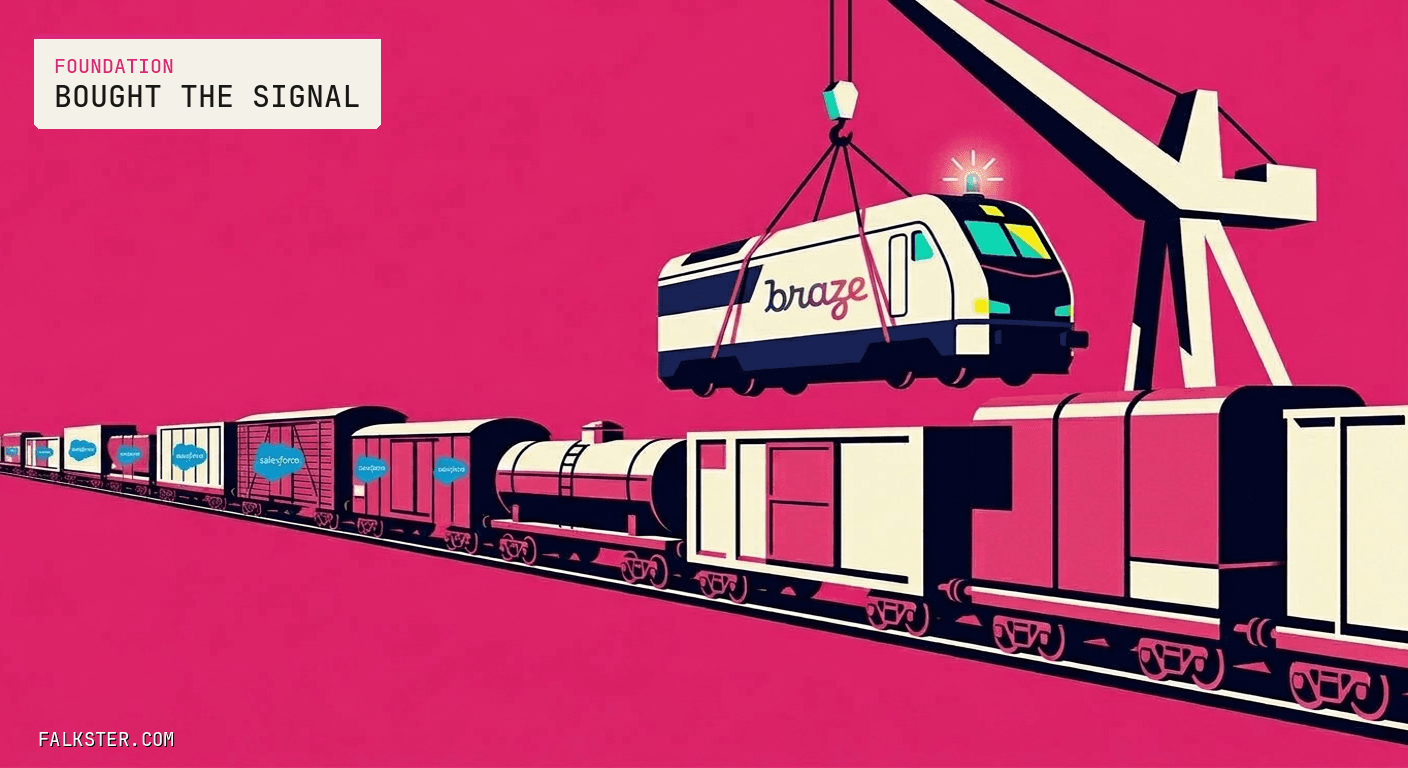
Salesforce announced today that it's buying Braze for about $5.66 billion in enterprise value, $47.50 a share in cash.
I read the press release twice. Once as someone who advises AI companies. And once as the former VP of Product who led the Marketing Cloud platform team. Marketing Cloud is the product Braze is now supposed to make better. All of Marketing Cloud's shared services sat in the platform, including the send engine and the data layer. So did the work of integrating Marketing Cloud with Salesforce CRM and with each new acquisition as it came in.
The second read is the one worth writing about.
The short version
Salesforce is buying Braze, a real-time customer engagement platform, to give Marketing Cloud the event-streaming, mobile-first layer it never built. Marketing Cloud was built on the send. Braze is built on the signal. The integration will be brutal, because Marketing Cloud is already a decade-long stitch of acquisitions from Radian6 to Evergage. But Braze is the missing piece: with Data 360 knowing who the customer is and Agentforce acting on it, Braze is the layer that knows what the customer is doing right now. If Salesforce makes it the real-time core instead of one more studio, $5.66 billion will look cheap. I wrote a short answer to why Salesforce is buying Braze too.
Marketing Cloud was built on a send
Salesforce bought ExactTarget in 2013 for about $2.5 billion, and it became the foundation of Marketing Cloud. Braze costs more than twice that. Sit with that ratio for a second.
ExactTarget's DNA was the send, and I know that engine from the inside. Audiences, segments, templates, a campaign scheduled for Tuesday morning. It was very good at that, and for a long time the send was the job. Email was the channel of record, and delivering at enterprise scale was a real moat.
Journey Builder pushed us toward orchestration. But the architecture's center of gravity stayed with the batch: define the audience, then push the message. Customer behavior showed up as data you imported, not as an event you reacted to.
Braze was built on a signal
Braze started from the other end. Its event-streaming architecture updates the customer profile continuously and adjusts the journey as behavior arrives. Mobile first. In-app messages, content feeds, live updates. The unit isn't the campaign, it's the moment.
Salesforce's own release describes Braze as optimized for high-volume, real-time B2C engagement. Read that as a polite way of naming what Marketing Cloud never became. The two have been rivals for years, and in mobile-first consumer apps the momentum went to Braze: roughly 2,770 customers, including Canva, Instacart, and Venmo.
So Salesforce isn't buying a messaging tool. It already has one. It's buying a different default.
Why now: agents run on the live record
Salesforce frames the deal around agentic marketing, systems that understand customers, make decisions, and act in real time. Fine. But an agent deciding the next best action is only as good as the context it has at the moment of decision.
I've argued before that written context is rented. Docs, playbooks, and prompts port anywhere. The earned observation record does not. Braze holds exactly that record for consumer brands: what a customer is doing in the app, right now, at a scale of trillions of messages and journey actions a year.
Data 360 knows who the customer is. Braze knows what they're doing this second. Agentforce needs both, and only one of them was in the building. (It's the same gap I wrote about when Salesforce named the harness: the layer that matters is the one you can't retrofit.)
That's the strategy. Fresher context for the agents, which is the whole argument I keep making about Enterprise AI Agents: they're only as good as what they know at the moment they act.
The integration is brutal. It's also the whole point
Here's what people outside forget. Marketing Cloud isn't one product. It's a portfolio of acquisitions wearing one name. Radian6 for social listening in 2011. Buddy Media for social publishing in 2012. ExactTarget in 2013, which brought Pardot with it. Krux for audience data in 2016. Datorama for analytics in 2018. Evergage for real-time personalization in 2020. Each came with its own data model, its own UI, and its own idea of who the customer is.
I led the platform team underneath that portfolio, the shared services and the plumbing that connected each acquisition to Salesforce CRM. So here's the honest version from the inside: stitching it together has been a decade-long project, and it still isn't done. Even Evergage, bought specifically for real-time, landed as another studio rather than the new core.
So Braze lands in a stack that's still digesting the last six. Its CEO says they'll keep building as Braze, which is the right call for the next 18 months, because you don't break a platform 2,770 customers depend on. But for a while that means two journey builders, two segmentation engines, and yet another place the customer profile lives. If Braze stays a parallel product, customers get a bigger portfolio, not a simpler one.
I still think it's the right deal.
Every piece Salesforce bought before was a destination: a channel, a dashboard, a data store. None of them was the nervous system, the layer that takes a live signal and turns it into a decision in milliseconds. Braze is that layer. It's the piece that can make the others behave like one product, because a real-time event stream is something every studio can subscribe to.
Put it together and the loop finally closes. Data 360 knows who the customer is. Braze senses what they're doing right now and decides. Agentforce acts across sales, service, and commerce. Marketing Cloud's enterprise email and governance sit on top. No point solution can match that loop. That's where the value is, for Salesforce and for every brand running on it.
The bold move is letting Braze's streaming architecture become the real-time core instead of one more studio. That's a hard internal conversation, and the installed base usually wins those. If Salesforce gets it right, $5.66 billion will look cheap.
The deal is expected to close in Salesforce's fiscal 2028. Watch what they say about architecture between now and then, not channels.
What I'd take from this as a product leader
Your architecture is your strategy. A batch-first core quietly caps what your product can become, and Salesforce is now paying $5.66 billion to change a default it bought in 2013.
And in the agent era, context has a timestamp. The question isn't whether your agent knows the customer. It's how old that knowledge is when the agent acts.
One thing to try this week: pick the most important decision your product makes on a customer's behalf. Write down how old the data is when that decision fires. Seconds, hours, a day? That number is the ceiling on how good your agents can get. Then go shrink it.
Sources: Salesforce press release (SEC filing) · CMSWire · Techzine
Frequently asked
Why is Salesforce buying Braze?+
To get the real-time, mobile-first engagement layer Marketing Cloud never built. Marketing Cloud grew out of ExactTarget, whose architecture centers on the send: define an audience, then push a message. Braze is built on event streaming, so it updates the customer profile and adjusts the journey as behavior arrives. Salesforce wants that live signal feeding Data 360 and Agentforce, so agents decide on what a customer is doing right now, not on yesterday's import.
How much is Salesforce paying for Braze?+
About $5.66 billion in enterprise value, or $47.50 per Braze share in cash, announced October 20, 2026. The deal is expected to close in Salesforce's fiscal 2028, pending Braze shareholder and regulatory approval. For scale, Salesforce paid about $2.5 billion for ExactTarget in 2013, the deal that created Marketing Cloud.
Why will integrating Braze into Marketing Cloud be hard?+
Because Marketing Cloud is already a portfolio of acquisitions: Radian6, Buddy Media, ExactTarget with Pardot, Krux, Datorama, and Evergage. Each came with its own data model, UI, and idea of who the customer is, and stitching them together is still unfinished. Braze adds a second journey builder, a second segmentation engine, and another place the customer profile lives. If it stays a parallel product, customers get a bigger portfolio, not a simpler one.
Why is Braze the missing piece for Salesforce?+
Every earlier Marketing Cloud acquisition was a destination: a channel, a dashboard, a data store. None was the layer that turns a live signal into a decision in milliseconds. Braze is that layer, and a real-time event stream is something every studio can subscribe to. With Data 360 knowing who the customer is, Braze sensing what they're doing now, and Agentforce acting across sales, service, and commerce, the loop finally closes.
What should product leaders take from the Braze deal?+
That architecture is strategy, and context has a timestamp. A batch-first core caps what a product can become, and Salesforce is paying $5.66 billion to change a default it bought in 2013. Pick the most important decision your product makes for a customer, write down how old the data is when it fires, and treat that number as the ceiling on how good your agents can get.

Comments (0)
Sign in with LinkedIn to leave a comment.
Sign in with LinkedIn