
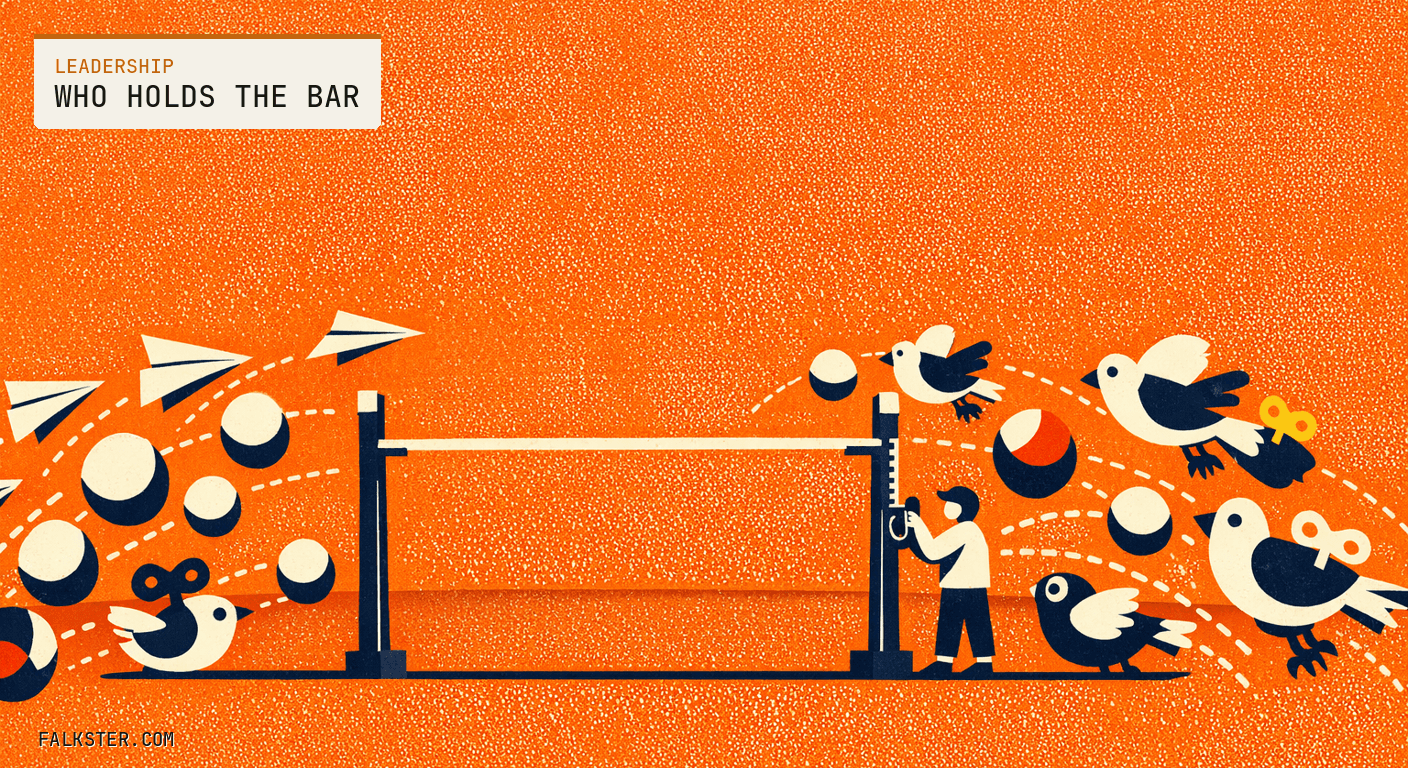
Dylan Field told investors two weeks ago that design is the differentiator. Six days later, Lenny Rachitsky counted the fewest open design jobs he has ever tracked.
On Figma's Q3 call on November 4, Field said "the easier it is to build software, the more it matters what you build and just as important, how well it's designed." Then, about design: "It is the differentiator." Figma had the quarter to back it, $391 million in revenue, up 43% from a year earlier.
On November 10, Lenny published his late-2026 job market report, built on TrueUp and Live Data Technologies data. "There are only about 1,900 open product design roles at tech companies globally right now," he wrote. "It's the lowest we've seen since we started tracking, and down 28% from a year ago." There are now 3.8 open PM roles for every open design role.
I think both are right. Demand for design is rising. Demand for a department that produces the design is falling. A CPO has to read those two together, because the gap between them is a decision, and it's yours this quarter: where does the quality bar live when the design work no longer lives in the design org?
This is part 10 of The CPO Transition, part of The Product OS. Part 9 put the story inside the product org. This part does the same for design, from the CPO's chair. The Design Transition covers the craft.
The short version
- Design matters more and the design department is getting smaller, and both follow from one change: the design work moved.
- PMs, engineers, and agents make the first draft now, so on Lenny Rachitsky's numbers there are 3.8 open PM roles per open design role and about 1,900 open design roles globally, while Figma's Dylan Field calls design the differentiator and cites research that 52% of product builders say fixing AI output is eating their day.
- A design standard held in a separate org only reaches the work routed through that org, and that share shrinks every quarter.
- So the bar has to be written, run in the release pipeline, and enforced by whoever owns the release. That's the CPO's org.
- The decision is to put the head of design on the CPO's staff, let design write the bar and let a failed bar block a release, and fund design against bar coverage and the repair rate, not against a headcount ratio.
The work moved out of the department
Listen to who Field says comes to Figma next. Asked about the top of the funnel, he started with "folks who are product managers and researchers and folks in marketing or non-developers." He also cited Figma's own research that "a majority of product builders, developers included, believe the design skills are becoming more important than coding skills."
So the people doing design work are multiplying. They just don't have designer in the title.
The hiring market says the same thing from the other side. Lenny reports that "Claude" became the second most mentioned skill in designer job descriptions this spring. Tom Scott, who writes Verified Insider on design hiring, noted on November 3 that one of the most common reasons design candidates get declined is not being technical enough. Everybody is moving toward the middle, where one person or one agent takes a problem to a working surface.
I wrote the day Lenny's report came out that the PM-to-designer ratio stopped measuring design, so I won't argue the number again. The CPO's question is different. If the first draft of most screens, flows, and agent answers comes from someone or something outside the design team, what happens to the standard the design team used to apply by hand?
A bar that covers only what designers touch isn't a bar
Here's what happens today in most companies. The design org has a real standard. It applies that standard to the work that comes through design. A PM's prototype that goes straight to a customer pilot skips it. So does the screen an agent generates at runtime, and the answer the support agent gives at 2am, and the assistant-facing agent from part 9.
At 3.8 to 1 and climbing, the routed share keeps shrinking. A separate design org can have the highest standard in the company and still watch it cover less of the product every quarter. Nobody decided that. It's arithmetic.
3.8
Field's 52% is what that looks like from the inside. He said product builders call fixing AI outputs "one of the most time-consuming parts of their day-to-day work." That's repair, done downstream, by whoever happens to notice. Part 5 of The Design Transition argues design should own that number. I agree, and owning it means being able to act on it before the release, not after.
That takes three things. The bar is written down, as a rubric with cases, so a PM or an agent can be checked against it without a designer in the room. The bar runs in the pipeline, next to the PM's eval, on every release. And someone with authority over the release backs it when it fails.
Only one org owns the release. This is design's piece of the one-function case. Design writes the bar. The pipeline runs it. The CPO backs the block. Take any one of those away and the standard goes back to covering whatever a designer had time to look at.
Three calls for this quarter
Start with the reporting line. The head of design sits on the CPO's staff, as a peer of the head of product. Not under a PM leader, because the bar has to be able to say no to the spec.
Then the authority. A failed bar blocks a release the way a failed test does. The head of design owns what the bar says. Waiving it takes the CPO, in writing, with a date to fix it. That sounds heavy. In practice a waiver you have to sign is the cheapest quality mechanism I know.
Last, the budget. Stop sizing design by ratio. Fund bar coverage: the share of what shipped last month that was checked against a written, current bar, whoever made the first draft. Put the repair rate beside it. Those are design's inputs to the one outcome number, and they tell you how many designers you need far better than a ratio does.
The CPO owes design something in return. Scott writes that for a head of design "the expectations have widened fast": manage, set direction, show hands-on work, and lead the AI change, all at once. He's also hearing from VPs who want to go back to principal roles. That's a job that grew without a mandate to match. Give it one. The bar, the repair rate, and the critique practice for the whole product org, with the authority above.
Some design leaders will worry that inside product, quality gets traded against the date. It gets traded now, quietly, every time something ships without going near design. Under one owner the trade is at least visible, and one person answers for it.
What I expect
These are my predictions, not facts.
My prediction: by the end of 2027, the head of design sits on the CPO's staff at most AI-native software companies, and the standalone design org stays mainly where the product is physical.
My prediction: by 2028, the written design bar runs as checks in the release pipeline at those companies, and a failed check blocks a release without a meeting.
My prediction: within two years, job descriptions for design leaders name the bar and the repair rate as the job, and "ships high-quality designs" disappears from them.
My prediction: design headcount keeps shrinking through 2027 while design's authority over what ships grows, and the designers who write the bar are paid like the people who own a release.
One thing to try this week
List the last 20 things your product org shipped to customers. Screens, flows, agent behaviors, generated emails, anything a customer saw. For each one, write who or what made the first draft. Then mark whether anything checked it against a written design bar before it went out.
The share with a mark is your bar coverage. If it's under half, you don't have a design capacity problem. You have a bar that lives in the wrong place, and moving it is your call.
Sources: Figma, Q3 2026 earnings call, Dylan Field, transcript via The Motley Fool, call held November 4, 2026, quotes as transcribed, research figures as Field cited them. Lenny Rachitsky, "State of the tech job market: late 2026," Lenny's Newsletter, November 10, 2026, with TrueUp and Live Data Technologies data as he reports it. Tom Scott, "Design Hiring Observations," Verified Insider, November 3, 2026.
Part of the running argument on Product Leadership: the product org chart was calibrated to a build cost that collapsed, and in the AI era the whole product outcome, from customer signal to adoption, belongs to one function under the CPO.
Related answer: Should design report to the CPO?
Frequently asked
Should design report to the CPO?+
Falk's answer is yes, with the head of design on the CPO's staff as a peer of the head of product. The reason is coverage. PMs, engineers, and agents now make most first drafts, so a design standard held in a separate org only reaches the work routed through that org. The bar has to cover everything a customer sees, which means it has to run in the release pipeline, and the CPO's org owns the release.
What did Dylan Field say about design on Figma's Q3 2026 call?+
On November 4, 2026, Field said "the easier it is to build software, the more it matters what you build and just as important, how well it's designed," that "the companies that win will invest in design," and of design, "It is the differentiator." Figma reported $391 million in revenue, up 43% year over year. He also cited Figma research that 52% of product builders say fixing AI outputs is becoming one of the most time-consuming parts of their work.
How many open design jobs are there?+
As Lenny Rachitsky reports it on November 10, 2026, from TrueUp data: about 1,900 open product design roles at tech companies globally, the lowest since he started tracking and down 28% from a year ago, and 3.8 open PM roles for every open design role, up from 1.9 in early 2023.
How can design matter more while design jobs fall?+
Because the design work moved out of the design department. The first draft of a screen, a flow, or an agent's answer now comes from a PM, an engineer, or a model. What's scarce is the judgment about whether it's good, and that judgment is worth more when written down as a bar that every draft is checked against than when it's applied by hand to the share of work a designer touches.
What is bar coverage?+
Falk's name for the share of what a product org shipped to customers that was checked against a written, current design bar before it went out, whoever or whatever made the first draft. It's the CPO's version of the surfaces-with-a-rubric count from the Design Transition series, measured on releases. He argues design should be funded against bar coverage and the repair rate, not against a PM-to-designer ratio.
What does Falk predict about design and the CPO?+
His predictions, labeled as such: by the end of 2027 the head of design sits on the CPO's staff at most AI-native software companies; by 2028 the written design bar runs as checks in the release pipeline and a failed check blocks a release at those companies; within two years design leadership job descriptions name the bar and the repair rate as the job; and design headcount keeps shrinking through 2027 while design's authority over what ships grows.
Sign in with LinkedIn to leave a comment.
Sign in with LinkedIn