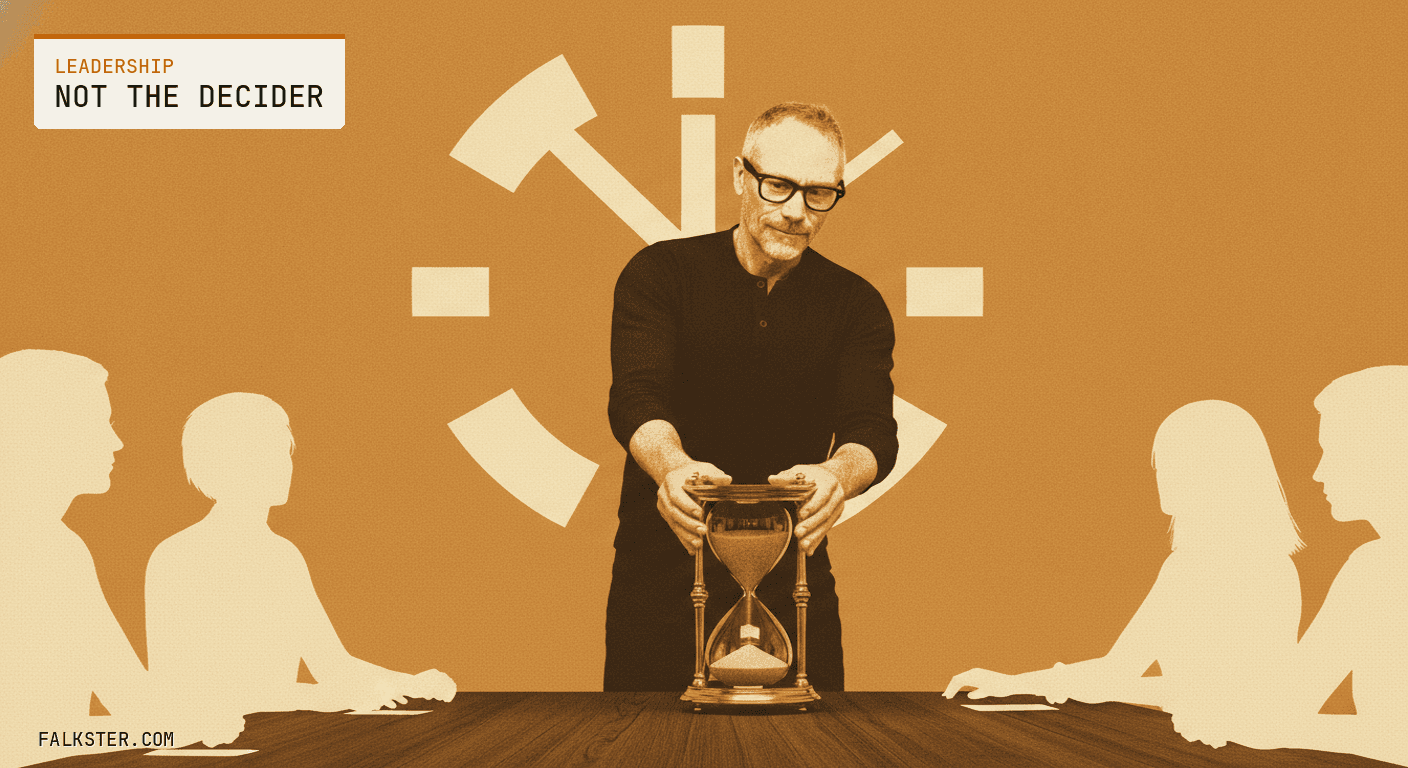
It is not the PM's job to make decisions. It is the PM's job to make sure decisions get made.
I have believed this for twenty years, and for most of them it was a subtlety I rarely had to defend. In the AI era it stopped being a subtlety. It became the entire job description, and the PMs who still think their value is the calls they personally make are about to become the most expensive bottleneck on their own teams.
The short version
The PM's job was never to make decisions, it was to make sure decisions get made, by the right owner, on real evidence, before the window closes. That was always true, and building being slow used to hide the cost of getting it wrong. In the AI era building collapses to a day, so every slow decision is now the critical path, and a PM who insists on personally making every call becomes the thing throttling the loop. The job in this era is to be the decision architect: design who decides, on what evidence, by when. Deciders get pushed to the lowest accountable level. Evidence comes from evals, so the team can decide without you in the room. Every decision gets a clock, because an unmade decision just lets agent output rot in review. This is not the same as letting the AI decide. That is abdication. The job is the narrow middle: make sure the right human decides, well, on time.
The principle, stated plainly
Your worth as a PM is not the decisions you made. It is the decisions that got made because you were in the room. Made by the right person, on evidence that was actually gathered, before the moment to decide had passed.
A PM who measures themselves by the calls they personally own has misread the role from day one. Deciding is a task. Plenty of people can do it. Ensuring an organization can decide, quickly and well and without dropping the decisions nobody obviously owns, is a different and much harder thing. That second thing is the job. It always was.
Building stopped being the constraint
Here is what changed, and why a quiet principle became a loud one.
In the old world the scarce resource was engineering capacity, and the bottleneck was building. Decisions could afford to be slow because building was slower. A PM could take three weeks to make a call because the build behind it took three months. The slow decision hid inside the slower build, and nobody could see the cost.
That slack is gone. In the outcome-to-prototype loop I build my company around, an agent turns a customer outcome into a working prototype in a day. When building collapses to a day, the three-week decision is no longer hiding inside anything. It is the critical path, in full view, and it is now the slowest thing on the team by a wide margin.
The bottleneck moved from the keyboard to the decision. That single shift is why the principle went from nice-to-hold to load-bearing.
The AI era makes the decider-PM dangerous
A PM who insisted on being the one who decides was always a mild drag. Now they are the drag.
Agents produce ten prototypes, twenty options, and a hundred eval results a week. A single human deciding all of it, serially, on their own calendar, cannot keep up, and the entire loop stalls behind them. The instinct to hold every call, which used to read as diligence, now reads as the thing starving the team of throughput. The output stacks up unshipped, waiting on one person to get to it. Most of it never ships at all, which is how you end up with a prototype graveyard: not a shortage of good work, a shortage of decisions about the good work.
The decider-PM did not get worse. The cost of them just went up by an order of magnitude, because everything around them got faster and they did not.
The job in the AI era: decision architect
So the move is to design the decision system, not to sit in the middle of it. Three parts.
Deciders
Push every decision to the lowest level that can carry it. Your job is to make sure it has a clear, accountable owner, not that the owner is you. Most of what an agent surfaces does not need the PM, it needs someone answerable and unblocked. You are the person who guarantees each decision has exactly that, and that no decision is quietly owned by nobody, drifting between people until it expires. Ownerless decisions are the ones that kill loops, and finding them before they rot is more valuable than making any single call yourself.
Evidence
A decision without an evidence bar is an opinion contest, and opinion contests default to the highest-paid person or the loudest one in the room. In the AI era the evidence bar is the eval. Evals are how a team decides without you present, because they swap "I think this is good" for "it passes the bar we agreed on." This is why I put evals at the center of the org and why I care so much about how the rubric actually gets built. Building the evidence layer is how you make yourself removable from a decision without making the decision worse. A PM who cannot be removed from a decision has not built a system, they have built a dependency on themselves.
The clock
Every decision needs a deadline, because an unmade decision is not neutral. In a world where agents keep producing whether or not anyone decides, choosing not to decide is choosing to let output pile up and go stale. So you put a clock on it. The dual-cadence model exists precisely because the fast loop cannot sit and wait on the slow one. Forcing the call before the window closes is the most literal version of making sure decisions get made, and it is the part most PMs are worst at, because it feels less safe than gathering more input. Gathering more input past the deadline is not rigor. It is the decision to miss the window, made quietly.
The trap: this is not letting the AI decide
There is a lazy reading where "make sure decisions get made" quietly becomes "let the model decide and move on." That is abdication wearing the principle's clothes, and it is the failure mode I worry about most as this gets easier.
The AI can generate the options. It can score them against the evals. It cannot own the outcome, and it cannot be accountable for the call, because accountability is the one thing you cannot delegate to something that does not bear the consequences. Ensuring a decision is made means ensuring a human owns it, on evidence, on the record. The decider-PM over-owns, holding calls that were never theirs to hold. The abdicating-PM under-owns, handing the call to a model to avoid the discomfort of judgment. The job is the narrow middle that neither of them will stand in: make sure the right human decides, well, and on time.
What this makes the PM
Not the smartest person in the room, deciding. The reason the room decided at all: fast, on evidence, with a clear owner and a clock.
In the old world that was a leadership style, one good way among several to run a team. In the AI era it is the function itself. The agents took the building. What is left for the PM is judgment, ownership, and tempo, and the PM who architects how those three meet is the one who makes the whole loop move. Everyone else is just standing in front of it.
If your team is drowning in agent output that never ships, the problem is almost never the agents. It is the decision system, and building that system is your job. Not deciding everything. Making sure the deciding happens.
Also on Medium
Full archive →The AI Revolution: Faster, Deeper, and More Disruptive
Why the current AI shift compounds faster than the Industrial Revolution did.
The Evolution of Product Management Over the Last 20 Years
From feature factories to outcome teams to Product Builders, three eras in one chart.
Frequently asked
Is it the PM's job to make decisions?+
No. It is the PM's job to make sure decisions get made, by the right person, on real evidence, before the window closes. Deciding is a task anyone accountable can do. Ensuring the organization can decide well and fast is the job, and it is a different job. A PM who measures their worth by the calls they personally make has misread the role.
Why does this principle matter more in the AI era?+
Because building stopped being the constraint. When an agent turns a customer outcome into a working prototype in a day, every slow decision becomes the critical path. The bottleneck moved from the keyboard to the decision. A PM who insists on personally making every call is now the thing throttling the loop, not the rigor protecting it.
What is a PM as decision architect?+
A PM who designs the decision system instead of sitting at the center of it. Three parts: deciders (every decision has a clear accountable owner, rarely the PM), evidence (an eval bar so the team can decide without you in the room), and a clock (every decision has a deadline, because an unmade decision lets agent output rot in review).
Does making sure decisions get made mean letting the AI decide?+
No, that is abdication wearing the principle's clothes. AI can generate the options and score them against evals, but it cannot own the outcome. Ensuring a decision is made means ensuring a human owns it, on evidence, on the record. The decider-PM over-owns. The abdicating-PM under-owns. The job is the harder middle.
How do evals connect to the PM's decision role?+
Evals are the evidence bar that lets a team decide without the PM in the room. They replace 'I think this is good' with 'it passes the bar we agreed on.' Building the evidence layer is how a PM makes themselves removable from a decision without making the decision worse, which is the whole point of the role.

Comments (0)
Sign in with LinkedIn to leave a comment.
Sign in with LinkedIn