
Buyers now ask an AI assistant what your product costs before they ask you. And the assistant usually answers from somewhere other than your pricing page.
Kyle Poyar, who writes the Growth Unhinged newsletter, published the data on November 18. He worked with Jennifer Zou, an economist at Profound, a company that tracks what people ask AI assistants. They looked at 27,374 prompts from people shopping for software.
Price was the biggest single theme, at 5.5% of the prompts. Feature fit came second at 4.4%.
For AI products the pull is stronger. One in ten early questions about coding agents and website builders was about cost.
So the price isn't a page anymore. It's an answer a model gives, built from whatever it can read. That makes the price part of the product. And it changes what a product marketing manager (PMM) does with it.
This is part 5 of The Product Marketing Transition. Part 4 gave messaging a test suite. This part gives the price the same treatment, and a home.
The short version
- People shopping for software now ask an AI assistant about price more than anything else.
- The assistant often takes its answer from other websites, not from the company that sells the product.
- At the same time, prices are moving from a flat fee per user to charges for usage. Usage is often counted in credits, and a credit is hard to explain.
- Buyers also worry more about surprise bills than about high prices. So a price now has three parts. There's the meter in the software that counts usage. There's the story that explains the unit in one sentence. And there's the profit left after the AI costs. Those three change together, so one team should own them.
- I think that team is product, led by the chief product officer (CPO). The product marketer owns the unit's name and its story, and tests what the assistants say the price is.
The assistant quotes your price before you do
Poyar ran an earlier test in September with Nikolas Laskaris, a researcher at Profound. They asked six AI engines pricing questions about the Cloud 100, a list of top private cloud companies. That produced about 7,600 answers.
The company's own pricing page was the first source in 12% of them. It showed up somewhere in the sources in 46%.
Who filled the gap? The outside sites the engines cited most were Vendr, Reddit, and G2. That's a price benchmark site, a forum, and a review site.
Some of this is plumbing. Of the 77 public pricing pages in the test, 57 were fully readable by the engines' crawlers. The rest hid part of the page, behind a script, a slider, or a blocked crawler.
And some of it is silence. One company in the test had no public price at all. The engines gave a range for it anyway, from about $100 to $2,400 per user per month.
That one is the lesson. If you don't state the price, the assistant states one for you.
5.5%
The unit keeps changing, and the unit is the hard part
A readable page fixes the easy problem. The harder one is that the thing on the page keeps changing shape.
FourWeekMBA, a business analysis site, counted five AI price changes on one day, November 9. Meta, Anthropic, Google, ClickUp, and Apple each set or changed a price. By the site's own count, all five charge by usage. Two stack the usage on top of a per-user plan.
Look at what a buyer has to work out. ClickUp, the project management tool, sells AI credits at $10 per 10,000, as the site reports it. Apple's Creator Studio adds a one-time $49.99 usage pack to a monthly plan. And the site notes that Apple doesn't say how much usage the pack buys.
A credit is a unit somebody invented. What does one buy? If your own sales team can't say it in a sentence, the assistant can't either.
More change is coming. OMR Reviews, the software review site of the German media company Online Marketing Rockstars (OMR), surveyed 153 software vendors with the firms hy and Appinio. Mariella Knospe, Sebastian Voigt, and Felix Rahlmeyer wrote it up in September. They found 80% plan or are weighing a pricing change in the next 12 months. Only 5% sell credits today.
And vendors already know what scares buyers. G2 Research, part of the review site G2, asked 110 software companies in a report dated September 23. More than four in ten said the buyer's top worry is unpredictable spend. About two in ten said it's a high price.
So the hard part of a usage price is whether a buyer can understand the unit and predict the bill. That's a comprehension problem. Product marketing is the seat that owns comprehension.
A price is three things, and they change together
Here's this seat's piece of the one-function case.
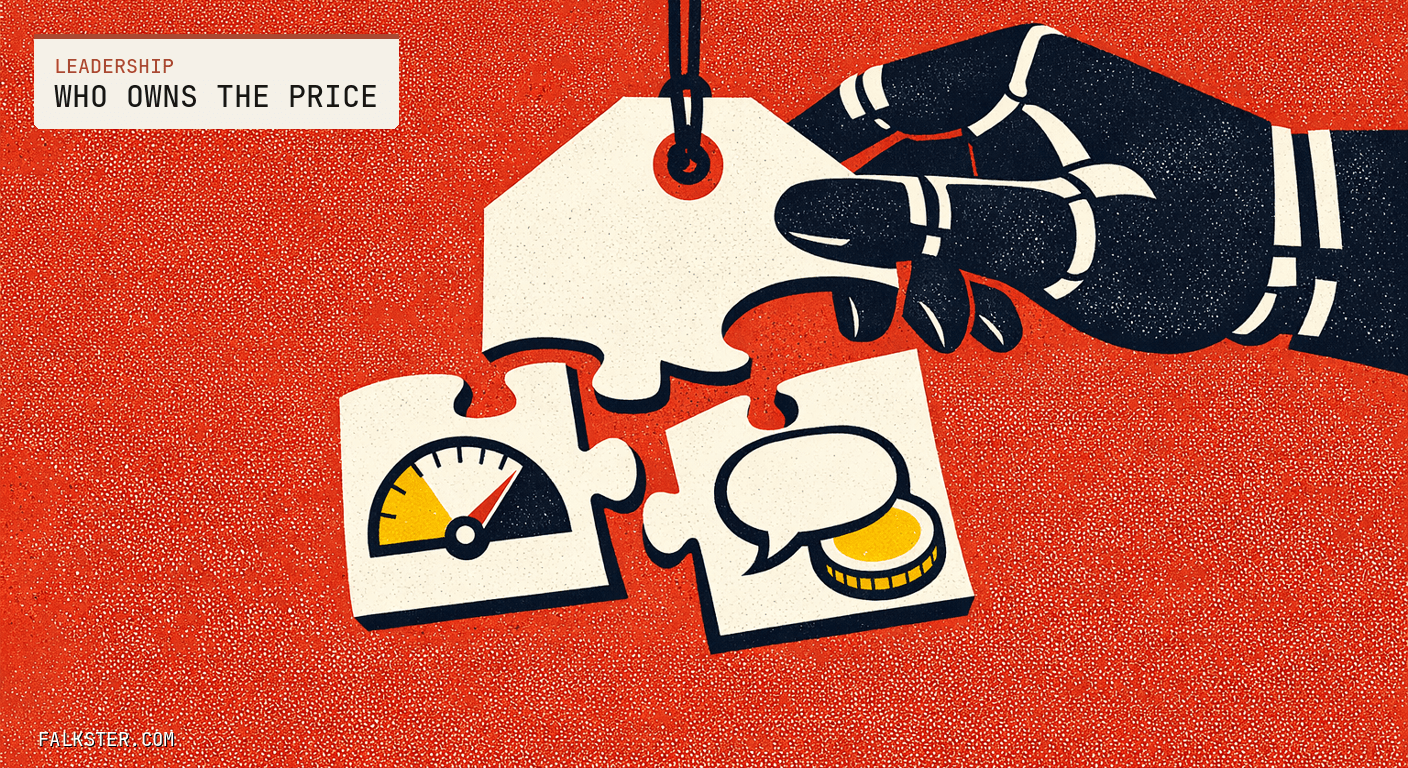
A usage price has three parts. The meter is code. It counts the credits, the tasks, or the resolved cases, and product and engineering build it. The story is the sentence that says what the unit buys and what a normal month costs. The margin is what's left after the bill from the AI model. The CPO series argued that margin is a product number now, and the handbook has a chapter on it.
Change one part and the other two move. A cheaper model cuts the cost of a task, so the margin moves, so the price can move. A new feature burns more credits per use, so the story about a normal month is wrong by Friday. I went through the mechanics in The Credit Is the New Seat. The question here is who holds all three.
Spread them across three departments and every change waits on a meeting. The product ships daily. The pricing page ends up describing a meter that's a month old, and the assistants repeat it to buyers.
Meenal Relekar made a related point in a piece for the Product Marketing Alliance in August 2025. It's older, so treat it as background. She wrote that the alliance's 2025 survey doesn't list pricing among core product marketing duties. Most product marketers, she said, get called in late to polish the pricing page.
That's the part that flips.
The split I'd make is simple. The product manager owns the meter. The product marketer owns the unit's name, the one-sentence story, and the evidence that buyers can predict a bill. The CPO owns the margin and makes the call. Finance reviews the math, the way security reviews a release.
In practice the price goes into the claim file, the versioned file every customer-facing agent loads. Price questions go into the message test suite from part 4. And any change to the meter, the unit, or the number needs the product marketer's review before it merges.
That only works when all three people sit in one org with one calendar. It's why The Product OS puts product marketing under the CPO, and why the CPO Transition keeps landing on one function that owns the whole outcome. Part 1 of this series made the reporting-line case. Pricing is where it gets tested first, because a wrong price shows up on an invoice.
The decision for a CPO this quarter: name one owner of pricing inside the product org. Make the product marketer a required reviewer on every change to the unit. Then check weekly what the assistants say you cost.
What I expect
These are my predictions, not facts.
By the end of 2027, at AI-native software companies, the pricing page and a machine-readable price file are generated from the same configuration the billing meter reads. A price change is a pull request, a proposed change that gets reviewed before it goes live.
By 2028, price drift is a number on the dashboard. That's the share of assistant answers that give the wrong price or the wrong unit. It gets reported monthly, next to message drift from part 4.
Within two years, by late 2028, most heads of product marketing at AI-native companies have the pricing unit and its story in their job description. OMR's 80% says the changes are coming either way. The companies that put one team on all three parts will make them faster.
One thing to try this week
Ask ChatGPT, Claude, Gemini, and Perplexity what your product costs for a 2,000-person company. Write down the number, the unit, and the first source each one cites. Then compare all four to a real quote.
After that, ask three colleagues outside the pricing team to explain your usage unit in one sentence. If the three sentences differ, start there. Fix the sentence before you fix the page.
Sources: Kyle Poyar, with analysis by Jennifer Zou, "The B2B buyer journey with AI," Growth Unhinged, November 18, 2026, Profound panel data, 27,374 prompts. Kyle Poyar and Nikolas Laskaris, "What AI agents really think about your pricing," Growth Unhinged, September 2, 2026, Profound data. FourWeekMBA, "Five AI Pricing Moves in a Day Point From Seats to Usage," unsigned, on the moves of November 9, 2026, the site's own count. Mariella Knospe, Sebastian Voigt, and Felix Rahlmeyer, "SaaS & AI Pricing 2027: Why Seat is falling behind and Discovery is becoming the bottleneck," OMR Reviews with hy and Appinio, September 10, 2026, survey of 153 software vendors. G2 Research, "AI Monetization in Transition," report dated September 23, 2026, 110 software organizations. Meenal Relekar, "Should product marketing own pricing?," Product Marketing Alliance, August 6, 2025, context only.
Part of the running argument on SaaS to AI Business Models: the price is moving from the seat to usage and outcomes. A price that changes with the product needs one owner inside the product org, and product marketing holds the unit and its story.
Related answer: Growth Unhinged found price is what buyers ask AI most. Who owns pricing now?
Frequently asked
Why is pricing a product decision now?+
Because a usage price has three parts that change together: the meter in the software that counts usage, the story that explains the unit, and the margin left after the AI bill. A new model or feature moves all three. One team has to hold them, and the meter already lives in the product. So pricing belongs in the product org under the chief product officer.
How often do buyers ask AI assistants about price?+
Kyle Poyar's November 18, 2026 analysis of 27,374 software shopping prompts, done with Jennifer Zou at Profound, found price was the largest single theme at 5.5% of the prompts. Feature fit came second at 4.4%. For AI coding agents and website builders, one in ten early questions was about cost.
Where do AI assistants get pricing answers?+
Mostly not from the vendor first. In a September 2026 test by Kyle Poyar and Nikolas Laskaris of about 7,600 AI answers, the company's own pricing page was the first source in 12% and appeared anywhere in the citations in 46%. The outside sources cited most were Vendr, Reddit, and G2.
What does the product marketer own in pricing?+
The unit's name, the one-sentence story that says what the unit buys and what a normal month costs, and the test of what AI assistants say the price is. The product manager owns the meter. The chief product officer owns the margin and the final call. Finance reviews the math.
What is price drift?+
The share of AI assistant answers that give the wrong price or the wrong unit for a product. Falk's prediction is that by 2028 it is reported monthly next to message drift, the share of answers that miss the current claim.
What are Falk's predictions on pricing and product marketing?+
Three, labeled as predictions. By the end of 2027, at AI-native software companies, the pricing page and a machine-readable price file are generated from the same configuration the billing meter reads. By 2028, price drift is reported monthly next to message drift. And by late 2028, most heads of product marketing at AI-native companies have the pricing unit and its story in their job description.
Sign in with LinkedIn to leave a comment.
Sign in with LinkedIn