
A lot of companies bought AI coding tools to ship faster. Many of them now see heavy use and flat delivery. The engineers aren't slacking. The time was never in the typing.
Atlassian, the company behind the work tracker Jira, published numbers on this. This is a field note on what they show, and who should act on them.
The short version
- Atlassian makes Jira, a tool teams use to track work.
- One of its product managers wrote about 6,000 engineers using AI agents. He cites outside data with a hard finding.
- Even when AI helps with nearly every code change, team output levels off about 10% better.
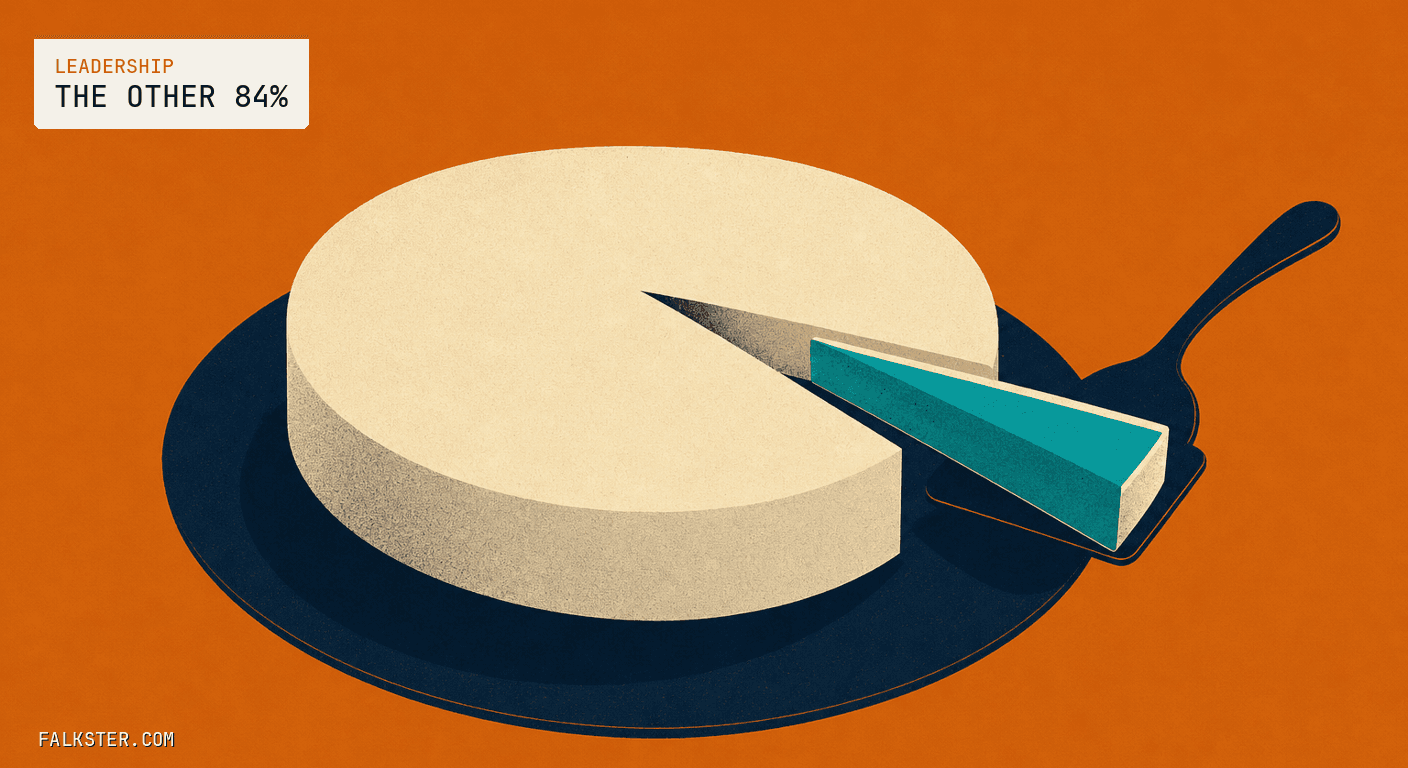
- The reason is that developers spend about 16% of their time writing code. The other 84% is planning, review, and handoffs. Atlassian's own gains came from that larger part.
- Work arrived better prepared, and safe jobs went straight to an agent. Those are product decisions. If you run product, the 84% is yours to fix.
What Atlassian reported
The post is by Matthew Canham, a Senior Group Product Manager for AI at Atlassian. It went out on November 23, 2026. I read it in full.
It opens with data from DX, a firm that measures how developers work. Team output gets about 10% better and then levels off. That holds even as the share of AI-assisted code changes nears 100%. The post gives the reason. Developers spend only about 16% of their time writing code.
Atlassian also quotes its own survey of teams. Only 48% of executives said AI had improved how people work together.
Then it lists its own results. The table has them. Watch the second row.
| What Atlassian measured | Result |
|---|---|
| Possible security problems resolved by coding agents | 51% |
| Time to finish a work item | from 11.5 days to 6.7 |
| Engineering time saved by agent work that got merged | about 50 days a week |
| Time from proposing a code change to merging it, with its review agent | down 45% |
These are a vendor's numbers about its own tools. Nobody outside has checked them. I didn't open the DX report or the survey. I'm using the post for the pattern, and the pattern is plain enough.
11.5 to 6.7 days
What changed was the work around the code
Read the post for what Atlassian did, and four changes stand out.
- Planning. Product, design, and engineering build the plan together with an agent. The agent can see the code and earlier work. It suggests which tasks suit a person and which suit an agent. The team decides.
- Requests. Many requests start in a chat thread. The thread now becomes the work item, with its reasons and odd cases attached.
- Routing. Low-risk changes go straight to an agent. Bigger ones are summed up and sent to a person first.
- Review. A review agent checks each change against shared standards. It also checks it against what was asked for.
Nothing on that list is typing faster. The post says so itself. Its line is that faster coding was never going to be enough.
Why I call that product work
Look at the questions under those four changes. What is this work? Why does it matter? Who should do it? What does done mean?
Those are product questions. When the answers are thin, the work bounces. An engineer or an agent starts, hits a gap, and waits for someone to fill it. That waiting is where the 84% goes.
The post is written for engineering leaders, which makes sense for Atlassian. I'd hand it to the head of product. I've argued that one person has to own how work moves across the whole team. That's in Somebody Has to Steer: The CPO Now Owns the Operating Model. A CPO is a chief product officer. These numbers are the best case I've seen for that argument this month.
It also fits a number I'd already retire. Counting the cost of each merged code change stops too early. I wrote that up in Kill Cost per Merged PR as the Coding Agent Number. The Count Stops at Merge.. Atlassian's better number is the time to finish the whole work item.
The same ceiling in my own setup
I run a small version of this, and I hit the same wall.
One of my agents drafts four posts each run. That step got fast. But I post one a day on LinkedIn. Today 80 posts are waiting for their turn.
So my writing speed went up, and my output per day didn't change. The slow step was never the writing.
Two counts to start
If you run product, you don't need Atlassian's tools to begin. Start with two counts.
- The wait before work starts. Take the date a request was written. Take the date someone began it. Count the days between.
- The returns. Count how often a piece of work came back because something was missing. A missing reason counts, and so does a missing design or decision.
Both sit outside the code, so no coding tool will move them. A better-prepared request will.
This week
Pick one feature your team finished last month. Add up the days it spent waiting. Compare that with the days someone was building it. Bring both numbers to your engineering partner. This sits in Product Leadership because the slow part of delivery now has product's name on it.
Related answer: Why does AI coding raise team output by only about 10%?
Sources: Matthew Canham, "6K engineers, 1M agent sessions: scaling the AI SDLC at Atlassian," Atlassian Blog, November 23, 2026, read in full. Every figure about Atlassian is the company's own. The 10% and 16% figures are DX data as that post cites them, and I did not open the DX report. The 84% is the remainder the post states. The count of 80 waiting posts is from this site's own files.
Frequently asked
Why does AI coding raise team output by only about 10%?+
Atlassian cites data from DX, a firm that measures developer work. It shows team output leveling off around 10% better, even as AI helps with nearly every code change. The reason given is that developers spend about 16% of their time writing code. The rest goes to planning, review, finding context, and handoffs.
What did Atlassian change to get past that?+
By its own account, it worked on the steps around the code. Teams plan with an agent that knows the code and past work. Requests are captured from chat with their reasons attached. Small, safe jobs go straight to an agent. Review checks each change against what was asked for.
What results does Atlassian report?+
The time to finish a work item fell from 11.5 days to 6.7. Coding agents resolve 51% of possible security problems. A review agent cut the time a code change takes to merge by 45%. These are the company's own numbers about its own products.
Why is the other 84% product's job?+
Because it's made of product decisions. What is the work? Why does it matter? Who does it, a person or an agent? What does done mean? When those answers are missing, the fastest coder in the world still waits.
What should a product leader measure first?+
Two counts. How long a request waits before anyone starts it. How often it comes back because context was missing. Both are cheap to collect and both sit outside the code.

Sign in with LinkedIn to leave a comment.
Sign in with LinkedIn