
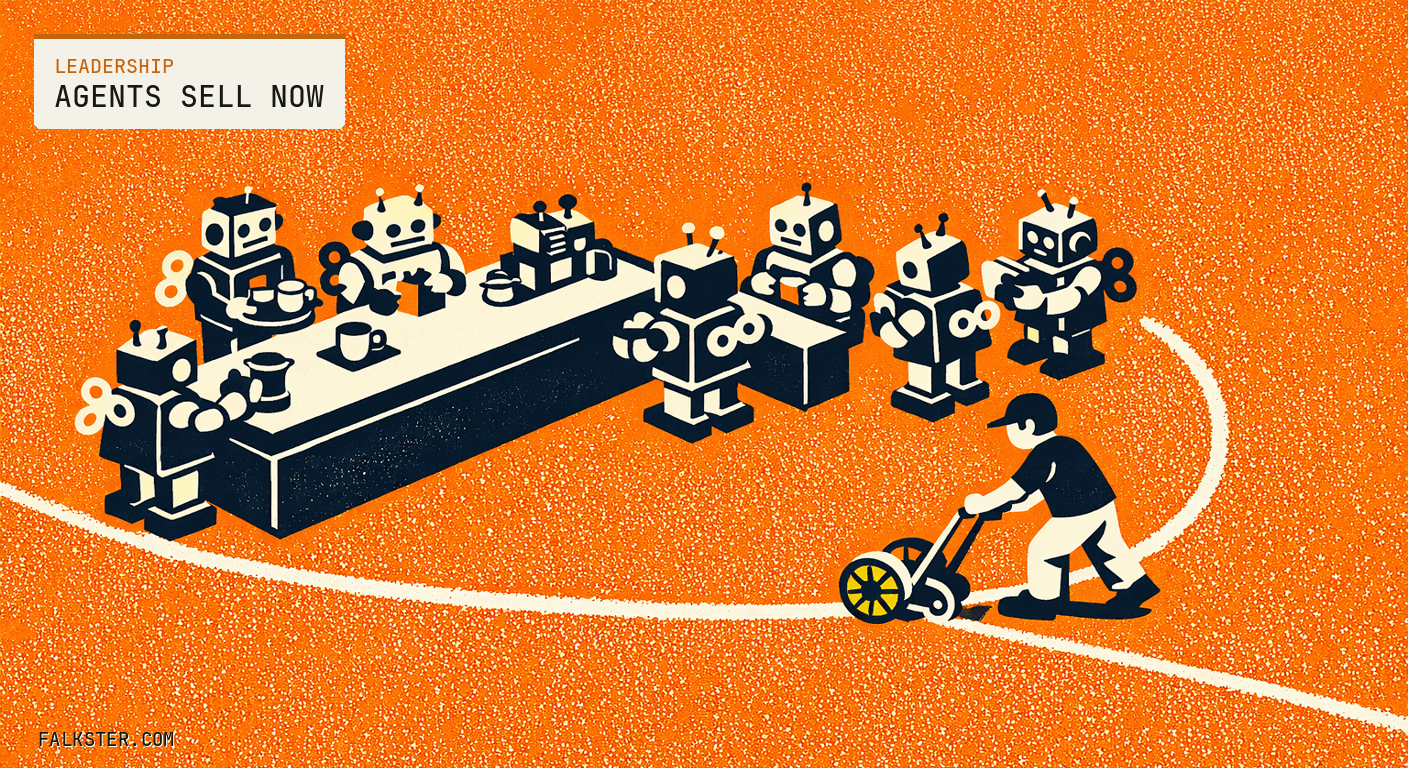
Software companies are starting to sell with agents, and their customers are starting to buy with agents. When both sides of a sale are software, somebody has to decide who builds and runs that software. Most companies haven't decided.
Jason Lemkin put real numbers on it yesterday. Lemkin founded SaaStr, a community and events business for software companies. He wrote: "We're on track to do about $20M at SaaStr this year with 3 humans and roughly 20 AI agents in production." And then: "Our sales team went from a full team to 1.5 people through attrition we never backfilled."
SaaStr is small, and it's one company's own account. Still, the shape is the useful part. Agents answer every inbound question. Agents send the outreach emails, roughly 3,200 a month by his count. Agents chase renewals and old leads nobody called.
The same week, Cristina Cordova described the buying side. She's the chief operating officer of Linear, which makes software for tracking engineering work. In an interview with Basil Chatha at Latent Space, the write-up says: "Agents created 3% of Linear's work a year ago. Now it's more than half."
So here's the decision for this quarter. When agents sell, support, and buy, where is the line between the chief product officer (CPO), the chief revenue officer (CRO), and the chief marketing officer (CMO)? The CRO is the executive who owns sales and the revenue target.
This is part 11 of The CPO Transition, part of The Product OS. Part 10 put the design bar in the release. Part 9 promised this one.
The short version
- Agents now do a lot of the selling at some companies. Agents also do some of the buying. A selling agent is software.
- It has instructions, data, and tests, and it must change when the product changes. A buying agent doesn't take a sales call. It reads the help pages, the prices, and the usage limits. Those are product pages. So I'd draw a new line. If an agent does it or reads it, the product team ships it. If a person decides it, sales or marketing owns it. The head of sales still owns the revenue number.
- The head of marketing still owns the brand and the human audience.
- The head of product owns every agent that speaks for the company, and keeps one list of them.
A selling agent is software
Look at what Lemkin's agents need in order to work.
They need to know what the product does today. They need the price. They need rules about what they can promise. He writes that his inbound agent checks seven signals before it reaches out. He caps spending on AI at $100 a day, and says an agent went past the cap once. He also describes a model that added a rule nobody asked for and skipped a signed deal.
Those are software problems, the kind a product team handles every day. There's a behavior you want, and a way it can go wrong. So you write a test that catches it before a customer does.
And the selling agent goes stale the same way a help page does. Ship a new plan on Tuesday and the agent quotes the old one on Wednesday, unless the two move together. Part 4 of The Product Marketing Transition argued that every customer-facing agent should load one file of approved claims. Part 5 did the same for price. A selling agent is one more reader of that file.
Only one org can update the product and the agent in the same motion. It's the org that ships the release.
There's a second reason. Lemkin passes on a rule from Kyle Norton, who runs revenue at Owner, a software company for restaurants. "Kyle Norton's rule at Owner is to never let reps run their own agents." And, in Lemkin's words about that rule: "Each agent has a person who owns it, and each number has a person who owns it."
I'd take that rule one step further. Every agent has an owner, and the owner sits where the release sits.
The buyer's agent reads product pages
Now the other side of the table. Lemkin again: "An agent evaluating your product reads your API docs, pricing page and rate limits, and it never books a demo."
An API is the way one piece of software talks to another. So the agent reads the docs for that, the prices, and the usage limits. Nothing on that list comes from the sales team. Every item is something the product org wrote, or should have.
He also writes that agents are now a top-5 source of traffic to SaaStr. And he describes his own agents acting as buyers. One dropped a vendor within 12 hours.
Linear shows where this goes. More than half of the work created there now comes from agents. The write-up carries a warning with it: "If agent usage climbs and app usage doesn't, you're becoming a commodity." In plain words, if agents use you and people stop opening your app, you're easy to swap out.
That's a product risk, and it shows up first in what looks like a sales channel. An agent that can't find your limits, or finds an old price, doesn't complain. It moves on. Nobody on the sales team ever hears about it.
So the first sales conversation with an agent buyer is a set of product pages. Part 9 called the company's profile on outside assistants a release target. The docs, the price page, and the limits belong on the same list.
What stays with the CRO and the CMO
A lot stays, and it matters more than before.
Lemkin is direct about the limits. "Reading a buying committee, handling a real objection and deciding on price still fall to a person." His agents have closed millions, he writes, all of it on standard packages. He also notes that fast-growing AI companies still build sales teams.
Linear agrees from a different angle. It passed $100 million in yearly revenue and, per the write-up, "has never hired a single SDR." That means a sales development rep (SDR), the entry-level person who does first outreach. But Linear has account executives, and solutions engineers who sell beside them. Cordova says in the interview that many companies won't buy without building trust with human beings. I wrote about Linear's choice to skip forward deployed engineers yesterday.
So the CRO's team gets smaller and more senior. Lemkin cites a survey of more than 560 companies by Emergence, a venture firm. As he reports it, 36% cut their outreach reps and 28% grew their account executive teams. The outreach work went to agents. The judgment went to people.
The CMO keeps brand, demand, and events. Those reach people, and people still sign the big contracts.
Here's the line I'd draw.
If an agent does it or reads it, product ships it. That covers the selling agent, the support agent, the company's agent on outside assistants, the docs, the price page, and the limits.
If a person decides it, the CRO or the CMO owns it. That covers the committee, the objection, the non-standard deal, the brand, and the room.
And the number stays where it is. The CRO owns revenue. The CRO is the selling agent's most important customer, and tells product what it has to do. Product builds it, tests it, and ships it. That's the same deal the CPO has with every other team that depends on the product.
One loop, so one owner for the agents
This is the CPO's piece of the one-function case. The loop runs customer, spec, build, story, adoption. An agent that sells is the story stage, running as software. An agent that supports is the adoption stage, running as software. Part 7 put the support agent and the field under product for that reason.
Split them and you get what part 9 warned about. Sales runs one agent and support runs another. Marketing runs a third. Each has its own version of the product. The buyer's agent talks to all three and trusts none.
Put them in one function and you get one file of claims, one set of tests, and one release. Product marketing writes the claims, which is why The Product Marketing Transition sits inside the product org. The field brings back what customers asked, which is the job of the forward deployed engineer (FDE). The FDE Transition covers that seat. And the result rolls up to the one outcome number.
I don't read this as product taking territory from sales. A CRO with 1.5 people and 20 agents needs those agents to be right more than anyone does.
1.5 people
What I expect
These are my predictions, not facts.
My prediction: by the end of 2027, at most AI-native software companies, the selling agent and the support agent ship through the product release process. Each one has a named owner in the product org.
My prediction: by 2028, the CRO's team at those companies is smaller and more senior. It's account executives and solutions engineers, with no entry-level outreach team.
My prediction: within two years, companies track the share of new customers whose first evaluation was done by an agent. Product owns that number, because product owns the pages the agent read.
My prediction: the handoff of a lead from marketing to sales mostly disappears by 2028. An agent answers in seconds, so there's nothing to hand off.
One thing to try this week
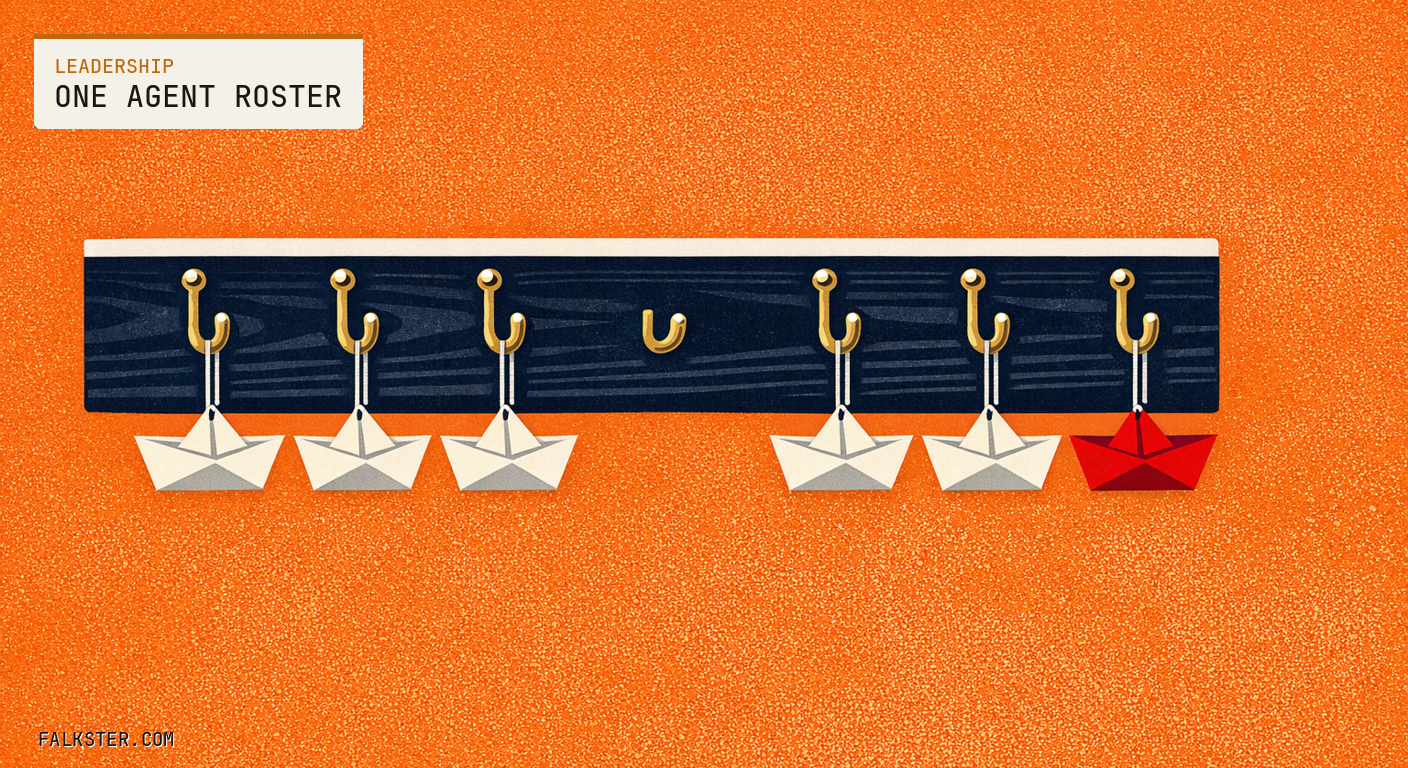
Make an agent roster. List every agent that talks to a customer or a buyer in your company's name. Include the chat on the website, the outreach emails, the support bot, and anything on an outside assistant.
Next to each one, write three things. Who owns it, by name. When it last changed. What test it has to pass before a change goes live.
Then count the rows with a blank. Bring the list to your CRO and your CMO, and agree on the line together. That's your decision for the quarter.
Sources: Jason Lemkin, "The Top 10 Things That Have Changed in Sales & GTM in the Age of AI. And 10 Things That Really Haven't," SaaStr, November 20, 2026, SaaStr's figures as he states them, the Emergence survey and Kyle Norton's rule at Owner as he reports them. Basil Chatha with Cristina Cordova, "Scaling Linear's GTM to $100M ARR," Latent Space, November 19, 2026, quotes from the written summary, Cordova's remark on trust from the automated transcript.
Part of the running argument on Product Leadership: the product org chart was calibrated to a build cost that collapsed. In the AI era the whole product outcome, from customer signal to adoption, belongs to one function under the CPO.
Related answer: SaaStr sells with 1.5 people and 20 agents. Who owns the sales agent?
Frequently asked
Who owns the AI sales agent, the CPO or the CRO?+
Falk's answer is that the CPO's org ships it and the CRO owns the number it serves. A selling agent has instructions, data, permissions, and tests, and it has to change the day the product changes. That makes it software, and it should go out through the same release process as the product. The CRO keeps the revenue target and the people who make judgment calls on deals.
What did Jason Lemkin say about SaaStr's sales team?+
On November 20, 2026, Lemkin wrote that SaaStr is on track to do about $20M this year with 3 humans and roughly 20 AI agents in production. He wrote that the sales team went from a full team to 1.5 people through attrition that was never backfilled. He also wrote that reading a buying committee, handling a real objection, and deciding on price still fall to a person.
What does it mean that agents are buying software?+
Lemkin writes that an agent evaluating your product reads your API docs, pricing page, and rate limits, and it never books a demo. So the first sales conversation with that buyer is a set of product pages. Falk argues those pages are release targets, and the product org has to keep them true as of today.
What stays with the CRO and the CMO?+
The CRO keeps the revenue number, the account executives and solutions engineers, non-standard deals, and price decisions on those deals. The CMO keeps brand, demand, events, and the human audience. What moves to the CPO is narrower: the agents that talk to customers and buyers, and the product pages that outside agents read.
What is the agent roster?+
Falk's name for one list of every agent that talks to a customer or a buyer in the company's name. Each row has a named owner, the date of the last change, and the test it has to pass before a change goes live. It borrows from Kyle Norton's rule at Owner, as Lemkin reports it: each agent has a person who owns it, and reps never run their own agents.
What does Falk predict about the CPO, CRO, and CMO?+
His predictions, labeled as such: by the end of 2027 the selling and support agents ship through the product release process at most AI-native software companies; by 2028 the CRO's team at those companies is smaller and more senior, with no entry-level outreach team; within two years companies track the share of new customers whose first evaluation was done by an agent; and the handoff of a lead from marketing to sales mostly disappears.
Sign in with LinkedIn to leave a comment.
Sign in with LinkedIn