
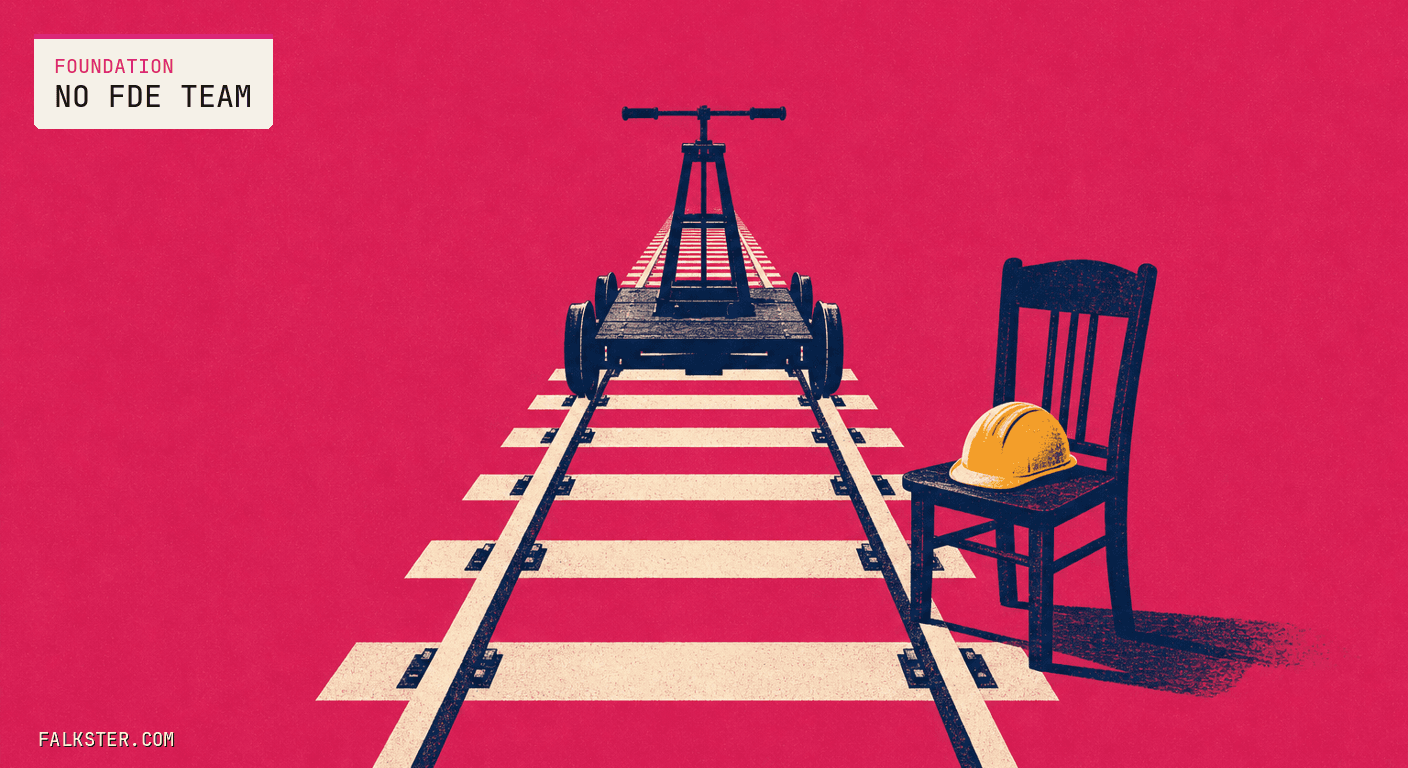
Many software companies now send their own engineers to work inside a customer's business. The job is called a forward deployed engineer (FDE). One of the fastest growing software companies says it has never done this. The reason is more useful than the headline. This is a Ship Story: one company's decision, the result, and my read of it.
The short version
- Linear makes software that engineering teams use to plan and track their work. This year it passed $100 million in yearly subscription revenue. It has more than 40,000 paying customers.
- Its chief operating officer, Cristina Cordova, told the Latent Space podcast that Linear has no forward deployed engineers.
- Those are engineers a software company sends to work inside a customer's own systems. Her reason is that Linear should be easy enough to set up without one.
- Last month I wrote five cases for when a company should skip this role. Linear fits two of them. The product has a fixed way of working.
- And the average customer pays too little to cover a visiting engineer. So don't copy the rule. Check those two things about your own product first.
What Cordova said
Latent Space is a podcast and newsletter about AI engineering, started by the writer known as swyx. It published the interview on November 19, 2026. I read the written summary in full and the part of the transcript about the sales team.
Cordova spent seven and a half years at Stripe, the payments company. She joined Linear in 2023, when it had about 40 people and one salesperson.
The numbers, as the episode gives them. Linear passed $100 million in yearly subscription revenue this year, with more than 40,000 paying customers. In August, employees sold $99 million of their stock at a price that valued the company at $2.5 billion. The company is about 170 people.
Then two things Linear does not do.
It has never hired a sales development rep. That is the person who calls a buyer first to ask about budget before a salesperson shows up. Cordova thinks that call wastes the buyer's time.
And it does not do forward deployed engineering. In the transcript she says her team is typically not going into a customer's systems to set Linear up. She calls it a belief the company holds: the product should be easy enough for a customer to connect on their own.
What Linear has in place of that is solutions engineers. They work next to the salespeople on the larger deals. They answer the deep technical questions, such as how to move 30,000 people off an older tool. Sometimes one builds a working demo overnight. Her example is a connection to ServiceNow, the software many big companies use to run their help desks.
She gives one more reason, and it is about AI agents. A year ago, agents created 3% of the work items in Linear. Now it is more than half. She says a tool with clear rules is easier for an agent to read. In looser tools, one team's "bug" label means something different from another team's.
Why it worked: two of my five cases
In When Not to Hire Forward Deployed Engineers: The Honest Cases I listed five cases where a company should not post the job. I wrote that four weeks before this interview. Linear fits the first two.
Case one: the product is opinionated and the work is setup. Opinionated means the product has one way of doing things and expects you to follow it. Cordova describes Linear that way herself. She contrasts it with tools you can bend any way you like. Those end up with staff whose whole job is running the tool.
Case two: the deal can't pay for the seat. Divide $100 million by 40,000 customers. You get about $2,500 a customer a year. That is my math, and it is rough, since both numbers are round.
about $2,500
In that earlier post I quoted Frank Bien, who ran the data company Looker. His customers paid $25,000 a year, and he had no room for a visiting engineer. Linear's average is about a tenth of his.
The opinion is doing the engineer's job
Here is how I read it. An engineer on site fits the product to how one customer works. Linear made that call once, inside the product, for everyone.
That has a cost. A buyer who wants the tool bent to their own process will not get it. Linear pays that cost on purpose.
It also pays off twice now. The same fixed structure that removes the setup work is what lets agents read the data. More than half of Linear's new work items come from agents, so that matters more each month.
Other large vendors went the other way. In Customers Are Not Paying for Your FDEs. Microsoft and ServiceNow Already Know. I wrote about big companies that now give forward deployed engineers (FDEs) away inside large deals. Linear spends nothing on the role and puts the effort into the product.
When this stops being true
Linear started a push into bigger companies in 2025. Bigger deals change case two. A customer paying six figures can carry an engineer, and will ask for one.
So I would watch the overnight demo. In my posts on this role, the seat has one job. Take in what one customer needs, then get the product to take it in, so the next customer needs less help.
A demo built overnight is the first half. The question is where it goes next. If it goes into the product for everyone, Linear stays Linear. If it gets installed and kept running for one customer, that is forward deployed work without the name. This is my read, not something Cordova said.
This week
Before you copy Linear's rule, or the opposite one, write two lines about your own product.
- How many ways can a customer set up the main thing your product tracks? One, or as many as they want?
- What does the average customer pay a year?
"One way" and "a few thousand dollars" points to Linear's answer. Hire solutions engineers and make setup easier. "Any way they like" and "six figures" points to the forward deployed role, and to the checks in the post linked above.
The whole series is at The FDE Transition. This sits in AI Product Management because both lines are product decisions.
Related answer: Do you need forward deployed engineers to sell AI software?
Sources: Latent Space, "Scaling Linear's GTM to $100M ARR, Cristina Cordova, COO," November 19, 2026. I read the written summary in full and the transcript from 40:30 to 46:30. I did not read the rest of the transcript or watch the video. The revenue, customer, stock sale, headcount, and agent figures are the episode's. The $2,500 average is my division. The Looker figure is from my earlier post, which cites First Round Review.
Frequently asked
Does Linear use forward deployed engineers?+
No. Cristina Cordova, Linear's chief operating officer, told the Latent Space podcast on November 19, 2026 that Linear does not do forward deployed engineering. It has solutions engineers who work beside the sales team on larger deals. Her reason is that Linear should be easy enough for a customer to set up on their own.
What is a forward deployed engineer?+
An engineer a software company sends to work inside one customer's business and systems. The engineer builds what that customer needs, and the good ones bring the lessons back so the product improves for everyone. The short name is FDE.
Why did skipping the role work for Linear?+
Two reasons, both from my list of five cases for when not to hire. Linear's product has a fixed way of working, so there is little to fit to each customer. And the average customer pays about $2,500 a year by my rough division, which cannot pay for a visiting engineer.
Where does the $2,500 figure come from?+
It is my own division. The episode says Linear passed $100 million in yearly subscription revenue with more than 40,000 paying customers. $100 million divided by 40,000 is $2,500. Both inputs are round, so treat it as a rough average and not a reported number.
When would Linear's rule stop working?+
When deals get large enough to carry a dedicated engineer and customers ask for work that only fits them. The thing to watch is the demo a solutions engineer builds overnight. If it gets installed and kept running for one customer, that is forward deployed work without the name.
Should my company copy Linear and skip forward deployed engineers?+
Check two facts first. How many ways can a customer set up your product, and what does the average customer pay a year? One way and a few thousand dollars points to Linear's answer. Any way they like and six figures points the other way.
Sign in with LinkedIn to leave a comment.
Sign in with LinkedIn